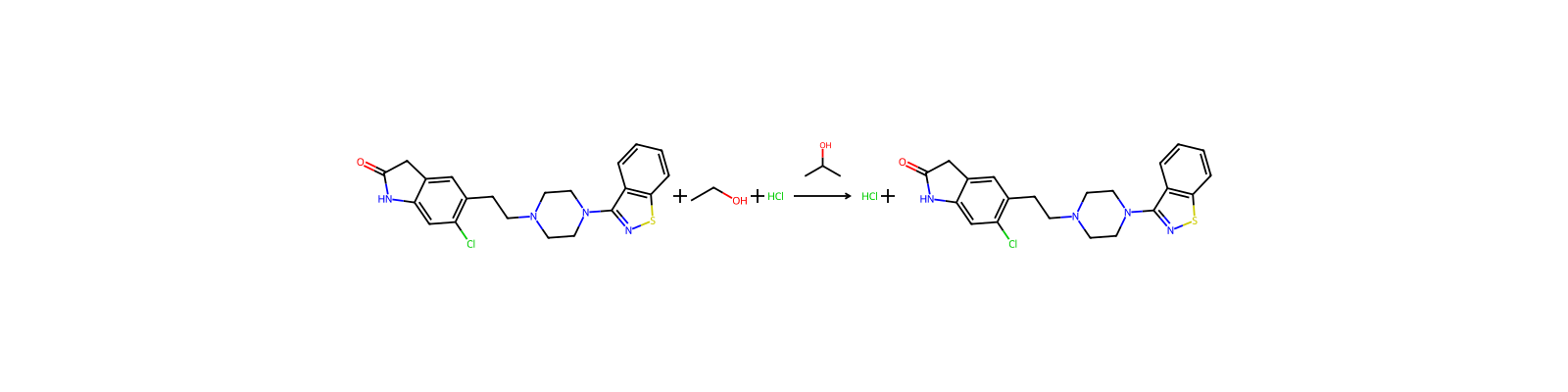
Ziprasidone Hydrochloride
Daten werden ergänzt – lade die Seite später neu, um den aktuellen Stand zu sehen

Grundinformationen
- CAS
122883-93-6- Standard-SMILES
Cl.O=C1Cc2cc(CCN3CCN(c4nsc5ccccc45)CC3)c(Cl)cc2N1- InChIKey
NZDBKBRIBJLNNT-UHFFFAOYSA-N- Summenformel
- C21H22Cl2N4OS
- Durchschnittliche Molmasse
- 449,4 g/mol
- Monoisotopische Masse
- 448,08913768
Überblick
Ziprasidone Hydrochloride is the hydrochloride salt form of ziprasidone, a benzothiazolylpiperazine derivative and an atypical antipsychotic agent with an antischizophrenic property. Ziprasidone hydrochloride functions as an antagonist at the dopamine D2 and serotonin 5-HT2A and 5-HT1D receptors, and as an agonist at the 5-HT1A receptor. Ziprasidone hydrochloride also inhibits synaptic reuptake of serotonin and norepinephrine. The mechanism of action by which ziprasidone hydrochloride exerts its antischizophrenic effect is unknown but is potentially mediated through a combination of dopamine D2 and serotonin 5-HT2 antagonism. This agent also has antagonistic activity against histamine H1 and alpha-1-adrenergic receptors.
Namen und Bezeichner
- Bevorzugter Name
- Ziprasidone Hydrochloride
- IUPAC
- 5-[2-[4-(1,2-benzothiazol-3-yl)piperazin-1-yl]ethyl]-6-chloro-1,3-dihydroindol-2-one;hydrochloride
- Englischer Name
- Ziprasidone Hydrochloride
- Summenformel
- C21H21ClN4OS
- Molmasse
- 412.943
Namen und Synonyme
Ziprasidone hydrochloride122883-93-6Ziprasidone HClZeldoxJAL53626GGDTXSID00153762ziprasidone hydrochloride, monohydrateCP-880591Geodon, CapsulesRefChem:56242DTXCID00762535-(2-(4-(1,2-Benzisothiazol-3-yl)-1-piperazinyl)ethyl)-6-chloro-1,3-dihydro-2H-Indol-2-one Monohydrochloride
Weitere Namen anzeigen
CP-88059 HClCP88059 hydrochlorideCP 88059 hydrochlorideCP-88059 hydrochlorideZiprasidone HCl (CP-88059)Ziprasidone hydrochloride, 10 mM in DMSOZiprasidone hydrochloride (CP-88059 hydrochloride2H-Indol-2-one,5-[2-[4-(1,2-benzisothiazol-3-yl)-1-piperazin...5-[2-[4-(1,2-benzothiazol-3-yl)piperazin-1-yl]ethyl]-6-chloro-oxindole hydrochloride
216X081ORUCP-88,059-1CP-88059-15-(2-(4-(Benzo[d]isothiazol-3-yl)piperazin-1-yl)ethyl)-6-chloroindolin-2-one hydrochlorideGeodonC21H22Cl2N4OS5-[2-[4-(1,2-Benzisothiazol-3-yl)-1-piperazinyl]ethyl]-6-chloro-1,3-dihydro-2H-indol-2-one hydrochlorideZiprasidone (hydrochloride)
Eigenschaften
Berechnete StruktureigenschaftenWird ergänzt
- Polarare Oberfläche (TPSA)
- 76,7 Ų
- H-Brücken-Donoren
- 2
- H-Brücken-Akzeptoren
- 5
- Frei drehbare Bindungen
- 4
- Schwere Atome
- 29
- Formalladung
- 0
- Komplexität
- 573
Experimentelle und physikochemische Eigenschaften
Human Drugs
Breast Feeding; Lactation; Milk, Human; Antipsychotic Agents
FDA approved drugs -> Active ingredient
FDA approved drugs -> Active ingredient
Physikochemische Eigenschaften
- Schmelzpunkt
- 300 °C · >300 °C
- storage temp.
- -20 °C · Store at -20°C
- Löslichkeit
- 10 mM · Soluble in DMSO > 10 mM
- Aggregatzustand
- Powder
- Stabilität
- Hygroscopic
- InChI
- 1S/C21H21ClN4OS.ClH.H2O/c22-17-13-18-15(12-20(27)23-18)11-14(17)5-6-25-7-9-26(10-8-25)21-16-3-1-2-4-19(16)28-24-21;;/h1-4,11,13H,5-10,12H2,(H,23,27);1H;1H2
- InChIKey
- ZCBZSCBNOOIHFP-UHFFFAOYSA-N
Sicherheit und Regulatorisches
Sicherheitsangaben dienen nur zur Orientierung und ersetzen weder das Sicherheitsdatenblatt (SDB) des Lieferanten noch geltende Vorschriften oder eine fachliche Bewertung.
GHS-Klassifizierung
GHS Classification
This chemical does not meet GHS hazard criteria for 33.3% (1 of 3) of reports.
Warning
H315 (33.3%): Causes skin irritation [Warning Skin corrosion/irritation]
P260, P261, P264, P264+P265, P271, P272, P280, P302+P352, P304+P340, P305+P351+P338, P319, P321, P332+P317, P333+P317, P337+P317, P362+P364, P403+P233, P405, and P501 (click each P-code to see the statement)
Aggregated GHS information provided per 3 reports by companies from 3 notifications to the ECHA C&L Inventory. Each notification may be associated with multiple companies.
Gefahrenhinweise
Hazard Classes and CategoriesSkin Irrit. 2 (33.3%)
Toxikologische Informationen
Drug Induced Liver Injury
Drug Induced Liver Injury Rank (DILIrank 2.0)
Ziprasidone hydrochloride
vLess-DILI-concern
3
Adverse reactions
DOI:10.1016/j.drudis.2016.02.015
Effects During Pregnancy and Lactation◉ Summary of Use during Lactation
Sicherheitsdaten
- wgk
- WGK 2
- Speicherklasse
- 3 - Flammable liquids
- Hazard Classifications
- Acute Tox. 3 DermalAcute Tox. 3 InhalationAcute Tox. 3 OralFlam. Liq. 2STOT SE 1
Chemie und Industrie
Pharmakologische Informationen
FDA Pharmacological Classification
ZIPRASIDONE HCL
Atypical Antipsychotic [EPC]
ZIPRASIDONE HYDROCHLORIDE
Atypical Antipsychotic [EPC]
MeSH Pharmacological Classification
Drugs that bind to but do not activate serotonin receptors, thereby blocking the actions of serotonin or SEROTONIN RECEPTOR AGONISTS.
Agents that control agitated psychotic behavior, alleviate acute psychotic states, reduce psychotic symptoms, and exert a quieting effect. They are used in SCHIZOPHRENIA; senile dementia; transient psychosis following surgery; or MYOCARDIAL INFARCTION; etc. These drugs are often referred to as neuroleptics alluding to the tendency to produce neurological side effects, but not all antipsychotics are likely to produce such effects. Many of these drugs may also be effective against nausea, emesis, and pruritus.
Drugs that bind to but do not activate DOPAMINE RECEPTORS, thereby blocking the actions of dopamine or exogenous agonists. Many drugs used in the treatment of psychotic disorders (ANTIPSYCHOTIC AGENTS) are dopamine antagonists, although their therapeutic effects may be due to long-term adjustments of the brain rather than to the acute effects of blocking dopamine receptors. Dopamine antagonists have been used for several other clinical purposes including as ANTIEMETICS, in the treatment of Tourette syndrome, and for hiccup. Dopamine receptor blockade is associated with NEUROLEPTIC MALIGNANT SYNDROME.
Anwendungen
BeschreibungBoth p.o. and i.m. formulations of ziprasidone were launched in Sweden for the treatment of schizophrenia and agitated psychoses. It is the sixth marketed atypical antipsychotic after clozapine, risperidone, olanzapine, sertindole and quetiapine. The synthesis of ziprasidone involves a novel one-step process for the preparation of 3-(1- piperazinyl)-1,2-benzisothiazole followed by coupling with a chlorooxindole fragment. Ziprasidone is a very potent 5-HT2A/D2 antagonist with a ratio of about 11 in favor of the serotonin receptor. It also shows very high 5-HT2c antagonistic activity, high 5-HT1A agonistic and 5-HT1D antagonistic activity, as well as moderate antagonism of α1 and H1 receptors and moderate norepinephrine and serotonin reuptake inhibition. Its complex binding profile for serotonin and dopamine receptors resulted during clinical trials in high antipsychotic efficacy with low extrapyramidal side effects and also in antidepressive action with low propensity for weight gain in opposition to other atypical and typical neuroleptics. An intramuscular formulation of ziprasidone was demonstrated to be superior to haloperidol, a conventional neuroleptic, for the short-term treatment of agitation in acutely psychotic patients. When administered orally in the fed state, this well-tolerated agent which strongly binds to plasma proteins shows a bioavailability of about 60% which is almost 2 fold greater than in the fasted state. It is transformed into 4 circulating major metabolites by different enzyme systems. The small QTc prolongation observed with ziprasidone was found to be comparable to other antipsychotic drugs and it is considered to be without significant risk.
Zugehörige Reaktionen
14



Notizen zur Verbindung
Wird geladen…