6,7-Dihydro-1,2,3,10-tetramethoxy-7-methylamino-benzo(a)heptalen-9(5H)-on
COLCEMID · COLCHAMINE · omaine · Colcemide · Tropisteron · (S)-1,2,3,10-Tetramethoxy-7-(methylamino)-6,7-dihydrobenzo[a]heptalen-9(5H)-one · omain · Osamin
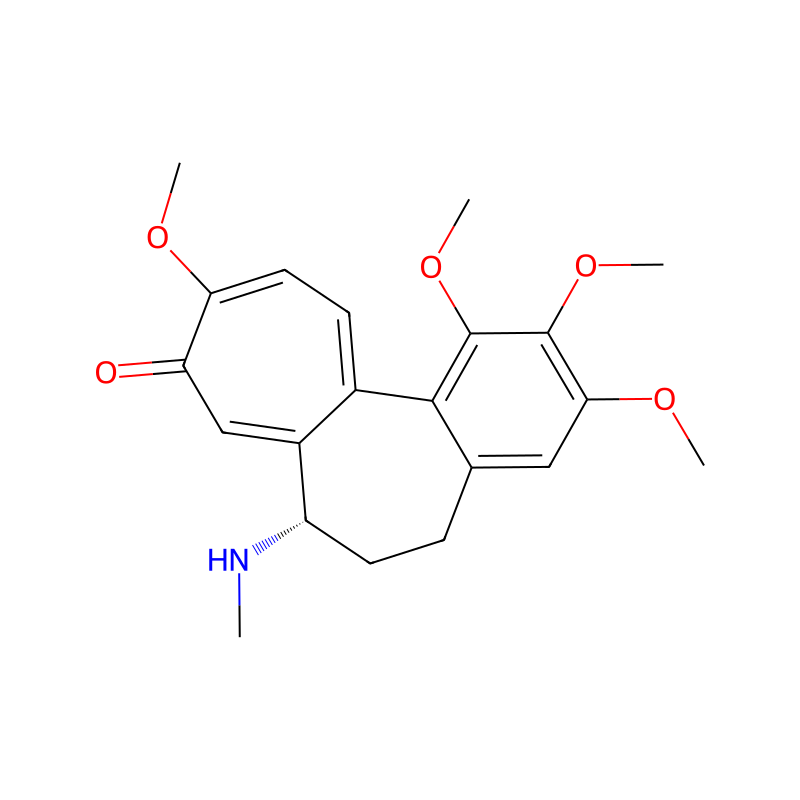
Identifikatoren & physikalische Daten
| CAS No. | 477-30-5 |
|---|---|
| Summenformel | C21H25NO5 |
| Durchschnittliche Molmasse | 371,4 g/mol |
| Monoisotopische Masse | 371,1732729 g/mol |
| SMILES | CN[C@H]1CCc2cc(OC)c(OC)c(OC)c2-c2ccc(OC)c(=O)cc21 |
| InChIKey | NNJPGOLRFBJNIW-HNNXBMFYSA-N |
| PubChem CID | 220401 |
| ChEMBL | CHEMBL312862 |
| ChEBI | CHEBI:4393 |
| EC No. | 207-514-6 |
| DTXSID | DTXSID7020342 |
| Lokaler Name | 6,7-Dihydro-1,2,3,10-tetramethoxy-7-methylamino-benzo(a)heptalen-9(5H)-on |
Chemische & physikalische Eigenschaften
| XLogP | 1,4 |
|---|---|
| Polarare Oberfläche (TPSA) | 66 |
| H-Brücken-Donoren | 1 |
| H-Brücken-Akzeptoren | 6 |
| Frei drehbare Bindungen | 5 |
| Schwere Atome | 27 |
| Formalladung | 0 |
| Komplexität | 653 |
| Stoffklassen | Other Uses -> Biochemical Research |
| Endocrine Disruptors | Potential endocrine disrupting compound |
| Physical Description | Pale yellow solid[Merck Index] Light yellow crystalline solid[Sigma-Aldrich MSDS] |
| Schmelzpunkt | 73-75°C |
| Siedepunkt | 501.11°C (rough estimate) |
| Dichte | 1.2350 (rough estimate) |
| Brechungsindex | 1.5614 (estimate) |
| Lagerbedingungen | 2-8°C |
| Löslichkeit | DMSO: 10 mg/mL |
| Aggregatzustand | powder |
| pKa (Säurekonstante) | 8.48±0.40(Predicted) |
| Farbe | White to off-white |
| BRN | 2822892 |
| Stabilität | Hygroscopic |
| InChI | 1S/C21H25NO5/c1-22-15-8-6-12-10-18(25-3)20(26-4)21(27-5)19(12)13-7-9-17(24-2)16(23)11-14(13)15/h7,9-11,15,22H,6,8H2,1-5H3 |
| InChIKey | NNJPGOLRFBJNIW-UHFFFAOYSA-N |
| SMILES | N(C1CCc2c(c(c(c(c2)OC)OC)OC)C3=CC=C(C(=O)C=C31)OC)C |
Sicherheit & Vorschriften
| GHS-Einstufung | DangerH300 (97.5%): Fatal if swallowed [Danger Acute toxicity, oral]P264, P270, P301+P316, P321, P330, P405, and P501 (click each P-code to see the statement)Aggregated GHS information provided per 40 reports by companies from 2 notifications to the ECHA C&L Inventory. |
|---|---|
| Regulatorische Informationen | N-Deacetyl-N-Methylcolchicine: Does not have an individual approval but may be used under an appropriate group standard |
| Gefahrenübersicht | Causes somnolence and diarrhea in intravenous lethal-dose studies of mice[RTECS] May cause irritationHighly toxic by ingestionTargets bone marrowTeratogenic and mutagenic effects observed in laboratory studies[Sigma-Aldrich MSDS] |
| Hazard Classes and Categories | Acute Tox. 2 (97.5%) |
| F | 8-10-23 |
| Wassergefährdungsklasse (WGK) | 3 |
| UN-Transportnummer | UN 2811 6.1/PG 2 |
| RTECS-Nr. | GH0800000 |
| R-Sätze (R) | 25-26/27/28 |
| Toxizität | LD50 oral in mouse: 25530ug/kg |
| Gefahrensymbole | T,T+ |
| Sicherheitshinweise (S) | 22-24/25-45-36/37/39 |
| Gefahrenklasse | 6.1(a) |
| Verpackungsgruppe | II |
Anwendungen & Verwendung
Beschreibung
Colcemid is a colchicine derivative that inhibits tubulin polymerization as potently as colchicine (IC50 = 2.1 and 2.4 μM, respectively) but is less toxic. At very low (nanomolar) concentrations, colcemid suppresses microtubule dynamicity and inhibits cell migration, while at micromolar levels it blocks microtubule assembly, arresting cells in metaphase. Mitotic block by colcemid is used to synchronize cells and for karyotyping in cytogenetic studies. Prolonged exposure to colcemid can activate p53, leading to apoptosis.
Verwenden
An antimitotic agent that disrupts microtubles by binding to tubulin and preventing its polymerization. Stimulates the intrinsic GTPase activity of tubulin. Induces apoptosis in several normal and tumor cell lines and activates the JNK/SAPK signaling pathway.