StartseiteMCPWorkbenchSkills
StartseiteWorkbenchBenachrichtigungenMein Bereich
llms.txt · MCP-AnleitungDatenschutz · Nutzungsbedingungen · Supportv1.8.0
  1. Startseite
  2. /Verbindung

Iodmonochlorid

Iodine chloride

HCID 24640
Neue NotizNeue ReaktionAnfrage stellen
Druckvorschau
GrundinformationenÜberblickNamen und BezeichnerEigenschaftenSicherheit und RegulatorischesChemie und IndustrieZugehörige ReaktionenNotizen zur Verbindung
TeilstruktursucheÄhnliche Strukturen suchen

Grundinformationen

CAS
7790-99-0
Standard-SMILES
ClI
InChIKey
QZRGKCOWNLSUDK-UHFFFAOYSA-N
Summenformel
ClI
Durchschnittliche Molmasse
162,36 g/mol
Monoisotopische Masse
161,87333

Überblick

Iodine monochloride appears as black crystals or a reddish brown oily liquid with a pungent odor. Melting point 27 °C (alpha form) or 14 °C (beta form). Corrosive to metals and tissue.

Namen und Bezeichner

Bevorzugter Name
Iodine chloride
Lokaler Name
Iodmonochlorid
Englischer Name
Iodine monochloride
Summenformel
ClI
Molmasse
162.36

Namen und Synonyme

IODINE MONOCHLORIDE7790-99-0Iodine chlorideIodochlorineWijs' chlorideIodine chloride (ICl)Chlorine iodide (ClI)Protochlorure D'iode0SMG5NLU45DTXSID1064879RefChem:148492DTXCID7048087
Weitere Namen anzeigen
IClWIJS REAGENTWIJS SOLUTIONIodine MonochloridIODOCHLORIDEiodochloraneCHLORINE IODIDE
232-236-7ChloroiodideiodomonochlorideProtochlorure d'iode [French]HSDB 601UNII-0SMG5NLU45EINECS 232-236-7MFCD00011354

Datenbank-Bezeichner

CAS
7790-99-0
PubChem CID
24640
DTXSID
DTXSID1064879
UNII
0SMG5NLU45
EC Number
232-236-7
Nikkaji
J95.175G

Eigenschaften

Berechnete Struktureigenschaften

XLogP
1,7
Polarare Oberfläche (TPSA)
0 Ų
H-Brücken-Donoren
0
H-Brücken-Akzeptoren
0
Frei drehbare Bindungen
0
Schwere Atome
2
Formalladung
0
Komplexität
2

Experimentelle und physikochemische Eigenschaften

Chemical Classes · 2 Einträge

Other Classes -> Halogenated Aliphatics, Saturated

Corrosives

Density3.10 @ 29 °C/4 °C
Color/FormBLACK CRYSTALS OR REDDISH-BROWN LIQ
Solubility · 2 Einträge

SOL IN WATER, ALC, ETHER, CARBON DISULFIDE, ACETIC ACID

SOL IN HYDROCHLORIC ACID

Boiling Point97 °C, DECOMP
DecompositionWhen heated to decomposition, it emits highly toxic fumes of /hydrogen chloride and hydrogen iodide/ and may explode.
Melting PointALPHA 27.2; BETA 13.9 °C
Food Contact SubstancesFCS -> FDA Inventory of Food Contact Substances Listed in 21 CFR
Physical Description · 2 Einträge

Iodine monochloride appears as black crystals or a reddish brown oily liquid with a pungent odor. Melting point 27 °C (alpha form) or 14 °C (beta form). Corrosive to metals and tissue.

Sicherheit und Regulatorisches

Sicherheitsangaben dienen nur zur Orientierung und ersetzen weder das Sicherheitsdatenblatt (SDB) des Lieferanten noch geltende Vorschriften oder eine fachliche Bewertung.

GHS-Klassifizierung

GHS Classification · 4 Einträge

Danger

H226 (17.8%): Flammable liquid and vapor [Warning Flammable liquids]

P210, P233, P240, P241, P242, P243, P260, P261, P262, P264, P264+P265, P270, P271, P280, P284, P301+P316, P301+P330+P331, P302+P352, P302+P361+P354, P303+P361+P353, P304+P340, P305+P354+P338, P316, P317, P319, P321, P330, P342+P316, P361+P364, P363, P370+P378, P403, P403+P233, P403+P235, P405, and P501 (click each P-code to see the statement)

Aggregated GHS information provided per 73 reports by companies from 13 notifications to the ECHA C&L Inventory. Each notification may be associated with multiple companies.

Gefahrenhinweise

Regulatory Information · 4 Einträge

Chemical: Iodine chloride (ICl)

REACH registered substance: Iodine monochloride (EC: 232-236-7)

Iodine monochloride: Does not have an individual approval but may be used under an appropriate group standard

The New Jersey Worker and Community Right to Know Act requires public and private employers to provide information about hazardous substances at their workplaces. (N.J.S.A. 34:5A-1 et. seq.)

DOT LabelCorrosive
Fire Hazards · 3 Einträge

Excerpt from ERG Guide 157 [Substances - Toxic and/or Corrosive (Non-Combustible / Water-Sensitive)]:

· Non-combustible, substance itself does not burn but may decompose upon heating to produce corrosive and/or toxic fumes.

· Non-combustible, substance itself does not burn but may decompose upon heating to produce corrosive and/or toxic fumes.

Fire PotentialALUMINUM FOIL, AFTER CONTINUED CONTACT WITH IODINE MONOCHLORIDE, IGNITES SPONTANEOUSLY & BURNS WITH BLUISH-WHITE FLAME.
Health Hazards

Chemie und Industrie

Pharmakologische Informationen

Absorption, Distribution and ExcretionIODINE MONOCHLORIDE HAS ABILITY TO PENETRATE BACTERIAL CELL & ACCUM IN CELL WALL & PROTOPLASTS.

Verwendung und Herstellung

Uses · 3 Einträge

Used in analytical chemistry and as a topical antimicrobial agent; [Merck Index] Used in organic synthesis; [Hawley]

IN WIJS' SOLN TO DETERMINE IODINE VALUES OF FATS & OILS; TOPICAL ANTI-INFECTIVE

ANTIBACTERIAL AGENT

Methods of ManufacturingFROM THE ELEMENTS: CORNOG, KARGES, INORG SYN 1, 165 (1939); BUCKLES, BADER, IBID 9, 130 (1967).
General Manufacturing Information · 5 Einträge

Iodine chloride (ICl): ACTIVE

VET: 1% SOLN OF IODINE MONOCHLORIDE KILLS CLOSTRIDIUM PERFRINGENS TYPES C & D SPORES WITHIN 20 MIN & 0.75% SOLN...USED AS DISINFECTANT FOR...UDDERS OF DAIRY CATTLE.

VET: IODINE MONOCHLORIDE HAS ABILITY TO PENETRATE BACTERIAL CELL & ACCUM IN CELL WALL & PROTOPLASTS. BACTERIAL DEATH PRESUMED...RESULT OF MALFUNCTIONING ENZYME SYSTEMS & PROTEIN COAGULATION.

IODINE CHLORIDE IN CONCN OF 0.5% OR 1% SHOWED STRONGER BACTERICIDAL ACTIVITY AGAINST MICROFLORA ISOLATED FROM HUMAN ORAL CAVITIES THAN DID IODINE CHLORIDE IN MORE DIL CONCN.

USED AS REAGENT IN DETERMINATION OF PYRETRINS.

Anwendungen · 1 Eintrag

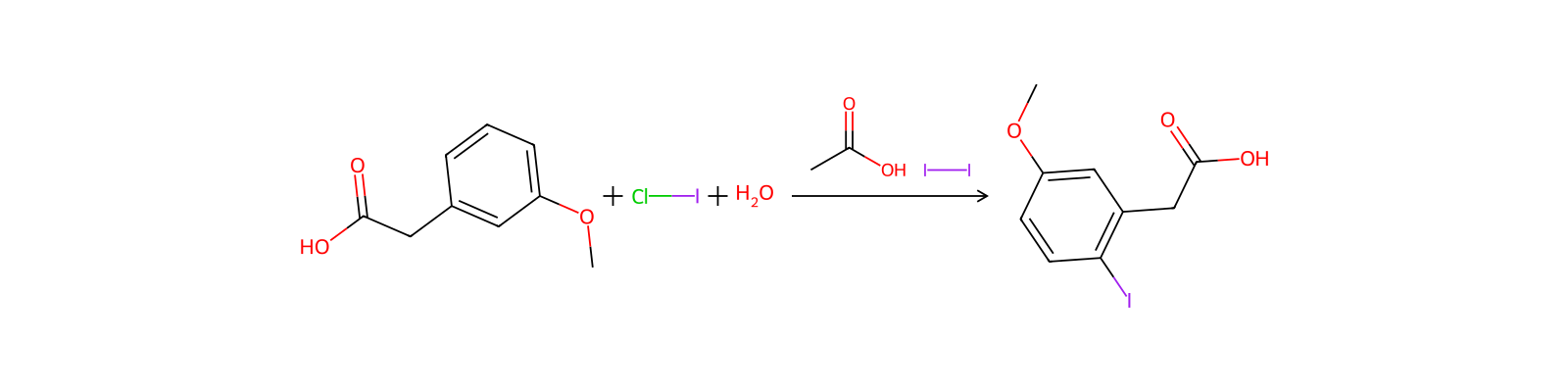
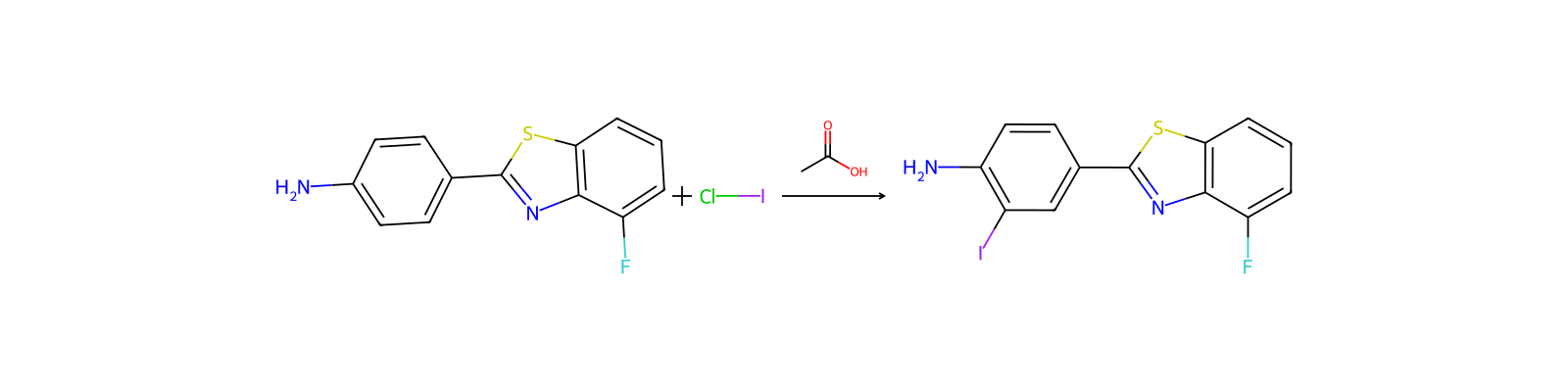
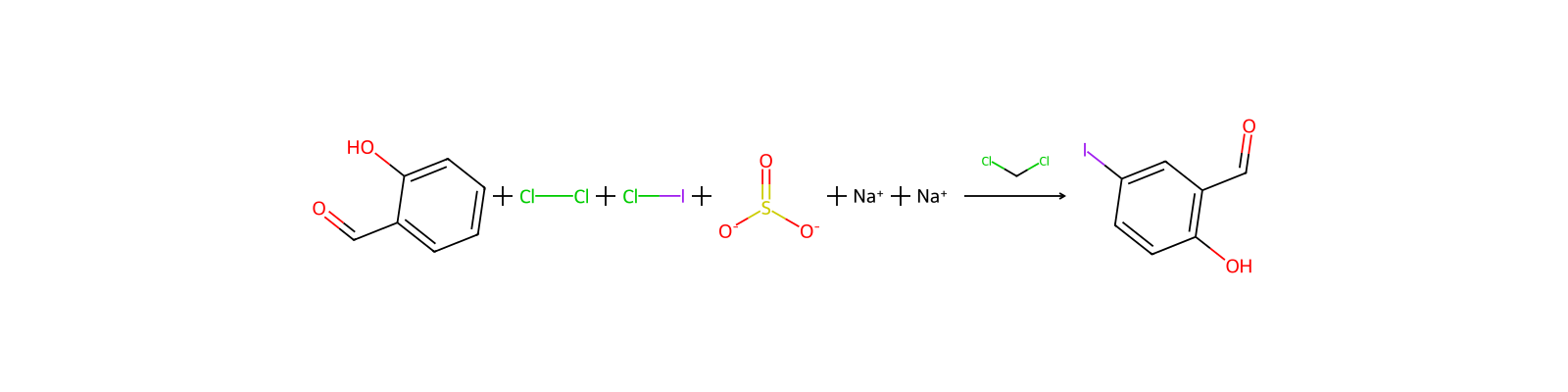
VerwendenIodine monochloride is used to estimate theiodine values of fats and oils and as a topicalanti-infective (Merck 1996). For determination of iodine absorption number of fats Iodine monochloride is used as a catalyst in organic synthesis. It is the source of electrophilic iodine in the synthesis of certain aromatic iodides.

Darstellung · 1 Eintrag

Zugehörige Reaktionen

789
Reaktionsaufzeichnung erstellen
Reaktionsgleichung von HRID 2756
HRID 2756als Eduktuspto-grants-1998_03
Reaktionsgleichung von HRID 4280
HRID 4280als Eduktuspto-grants-1988_02
Reaktionsgleichung von HRID 4888
HRID 4888als Eduktuspto-grants-1993_09
Reaktionsgleichung von HRID 8114
HRID 8114als Eduktuspto-grants-2006_08
Reaktionsgleichung von HRID 10753
HRID 10753als Eduktuspto-grants-2006_08
Reaktionsgleichung von HRID 14183
HRID 14183als Eduktuspto-grants-2010_06
Reaktionsgleichung von HRID 19836
HRID 19836als Eduktuspto-grants-2010_06
Reaktionsgleichung von HRID 25264
HRID 25264als Eduktuspto-grants-2005_02
Seite 1 von 99

Notizen zur Verbindung

Wird geladen…

Auf dieser SeiteGrundinformationenÜberblickNamen und BezeichnerEigenschaftenSicherheit und RegulatorischesChemie und IndustrieZugehörige ReaktionenNotizen zur Verbindung
Weitere Aktionen
Neue NotizNeue ReaktionAnfrage stellen

Black solid or reddish-brown liquid; Solid occurs as alpha (mp = 27.2 deg C) and beta (mp = 13.9 deg C) forms; Soluble in water; [Merck Index] Black crystalline solid with an acrid odor; Insoluble in water; [MSDSonline]

Other Experimental Properties · 3 Einträge

CRYSTALS OCCUR IN ALPHA (STABLE) & BETA (LABILE) FORMS

BLACK NEEDLES (RUBY RED BY TRANSMITTED LIGHT) /ALPHA FORM/; BLACK PLATELETS (BROWNISH RED BY TRANSMITTED LIGHT) /BETA FORM/

RHOMBIC 6-SIDED PLATES /BETA/; NEEDLES, CUBIC /ALPHA/

Physikochemische Eigenschaften

Schmelzpunkt
25 · 25-27°C
Siedepunkt
97.4 °C · 97.4 °C (lit.)
Dichte
3.24 g/mL · 3.24 g/mL at 25 °C (lit.)
Dampfdichte
5.5 · 5.5 (vs air)
Flammpunkt
96 · 96-98°C
storage temp.
2 · 2-8°C
Löslichkeit
acetic acid: soluble(lit.)
Aggregatzustand
Liquid
Farbe
Red-brown
PH
1 · <1 (H2O, 20°C)
Wasserlöslichkeit
decomposes
Spezifische Wärmekapazität
0.22 J/ · Cp(gas): 0.22 J/(g·K), at 25℃
Merck
14 · 14,5017
BRN
3902972 · 3902972
Henry's Law Constant
1.1 · 1.1×100 mol/(m3Pa) at 25℃, Wagman et al. (1982)
Stabilität
Stable. Incompatible with organic materials, strong bases, metals. Air, light and moisture sensitive.
InChI
1S/ClI/c1-2
InChIKey
QZRGKCOWNLSUDK-UHFFFAOYSA-N
SMILES
ClI
CAS Datenbank
7790 · 7790-99-0(CAS DataBase Reference)
NIST chemische Informationen
Iodine monochloride(7790-99-0)
EPA chemische Informationen
Iodine chloride (ICl) (7790-99-0)
· 3 Einträge

Excerpt from ERG Guide 157 [Substances - Toxic and/or Corrosive (Non-Combustible / Water-Sensitive)]:

· TOXIC and/or CORROSIVE; inhalation, ingestion or contact (skin, eyes) with vapors, dusts or substance may cause severe injury, burns or death.

· TOXIC and/or CORROSIVE; inhalation, ingestion or contact (skin, eyes) with vapors, dusts or substance may cause severe injury, burns or death.

Hazards Summary · 1 Eintrag

Reacts with air forming iodine pentoxide; Causes skin burns; [Merck Index] A strong skin and eye irritant; [Hawley] Reacts with water evolving heat and toxic and corrosive fumes; Exposure may cause severe injury, burns, or death; [CAMEO] Corrosive to skin and eyes; [eChemPortal: ERMA] A corrosive substance that can cause injury to the skin, eyes, and respiratory tract; Inhalation may cause chemical pneumonitis; [MSDSonline] See Iodine for the TLV of Iodides.

DOT ID and Guide · 2 Einträge

1792 157

3498 157

Reactive GroupOxidizing Agents, Strong
Reactivity AlertsStrong Oxidizing Agent
Reactivity Profile · 1 Eintrag

IODINE MONOCHLORIDE is moderately explosive when heated [Lewis]. Reacts with rubber and many organic materials. Enflames (after a period of delay) with aluminum foil [Mellor 2:119(1946-1947)]. Reacts dangerously with other active metals. Reacts vigorously with cadmium sulfide, lead sulfide, silver sulfide, and zinc sulfide [Mellor 2, Supp. 1:502(1956)]. Combines very exothermically with phosphorus trichloride [Mellor 2, Supp. 1:502(1956)]. Forms Iodine pentaoxide in air which reacts explosively when warmed with carbon, sulfur, sugar, resin, or powdered combustible elements [Mellor 8: 841(1946-1947)].

DOT Emergency Guidelines · 5 Einträge

/GUIDE 157: SUBSTANCES - TOXIC AND/OR CORROSIVE (NON-COMBUSTIBLE/WATER -SENSITIVE)/ Health: TOXIC; inhalation, ingestion or contact (skin, eyes) with vapors, dusts or substance may cause severe injury, burns, or death. Reaction with water or moist air will release toxic, corrosive or flammable gases. Reaction with water may generate much heat which will increase the concentration of fumes in the air. Fire will produce irritating, corrosive and/or toxic gases. Runoff from fire control or dilution water may be corrosive and/or toxic and cause pollution.

/GUIDE 157: SUBSTANCES - TOXIC AND/OR CORROSIVE (NON-COMBUSTIBLE/WATER -SENSITIVE)/ Fire or Explosion: Non-combustible, substance itself does not burn but may decompose upon heating to produce corrosive and/or toxic fumes. Vapors may accumulate in confined areas (basement, tanks, hopper/tank cars etc.). Substance will react with water (some violently), releasing corrosive and/or toxic gases. Contact with metals may evolve flammable hydrogen gas. Containers may explode when heated or contaminated with water.

/GUIDE 157: SUBSTANCES - TOXIC AND/OR CORROSIVE (NON-COMBUSTIBLE/WATER -SENSITIVE)/ Public Safety: CALL Emergency Response Telephone Number ... . As an immediate precautionary measure, isolate spill or leak area in all directions for at least 50 meters (150 feet) for liquids and at least 25 meters (75 feet) for solids. Keep unauthorized personnel away. Stay upwind. Keep out of low areas. Ventilate enclosed areas.

/GUIDE 157: SUBSTANCES - TOXIC AND/OR CORROSIVE (NON-COMBUSTIBLE/WATER -SENSITIVE)/ Protective Clothing: Wear positive pressure self-contained breathing apparatus (SCBA). Wear chemical protective clothing that is specifically recommended by the manufacturer. It may provide little or no thermal protection. Structural firefighters' protective clothing provides limited protection in fire situations ONLY; it is not effective in spill situations where direct contact with the substance is possible.

For more DOT Emergency Guidelines (Complete) data for IODINE MONOCHLORIDE (8 total), please visit the HSDB record page.

DOT Hazard Classification · 6 Einträge

Iodine monochloride, liquid

UN3498

Class 8 Corrosive material (49 eCFR § 173.136)

PG II: the degree of danger presented by the material is medium

Iodine monochloride, solid

UN1792

Sicherheit und Schutzausrüstung

Fire FightingExcerpt from ERG Guide 157 [Substances - Toxic and/or Corrosive (Non-Combustible / Water-Sensitive)]:
Accidental Release Measures · 4 Einträge

· CALL 911. Then call emergency response telephone number on shipping paper. If shipping paper not available or no answer, refer to appropriate telephone number listed on the inside back cover.

· ELIMINATE all ignition sources (no smoking, flares, sparks or flames) from immediate area.

· CALL 911. Then call emergency response telephone number on shipping paper. If shipping paper not available or no answer, refer to appropriate telephone number listed on the inside back cover.

· ELIMINATE all ignition sources (no smoking, flares, sparks or flames) from immediate area.

First Aid · 3 Einträge

Excerpt from ERG Guide 157 [Substances - Toxic and/or Corrosive (Non-Combustible / Water-Sensitive)]:

General First Aid:

General First Aid:

Exposure Control and Personal Protection · 2 Einträge

· Wear positive pressure self-contained breathing apparatus (SCBA).

· Wear positive pressure self-contained breathing apparatus (SCBA).

Storage Conditions · 2 Einträge

MAY BE STORED IN BROWN GLASS-STOPPERED BOTTLES.

IN GENERAL MATERIALS...TOXIC AS STORED OR WHICH CAN DECOMP INTO TOXIC COMPONENTS...SHOULD BE STORED IN COOL...VENTILATED PLACE, OUT OF... SUN, AWAY FROM...FIRE HAZARD...BE PERIODICALLY INSPECTED & MONITORED. INCOMPATIBLE MATERIALS SHOULD BE ISOLATED.

Nonfire Spill ResponseExcerpt from ERG Guide 157 [Substances - Toxic and/or Corrosive (Non-Combustible / Water-Sensitive)]:
Preventive MeasuresBASIC...METHODS ARE LOCAL EXHAUST...& DIL OR GENERAL VENTILATION.
Isolation and Evacuation · 3 Einträge

Excerpt from ERG Guide 157 [Substances - Toxic and/or Corrosive (Non-Combustible / Water-Sensitive)]:

Immediate precautionary measure

Immediate precautionary measure

Personal Protective Equipment (PPE)Excerpt from ERG Guide 157 [Substances - Toxic and/or Corrosive (Non-Combustible / Water-Sensitive)]:
Emergency Response Planning Guidelines · 2 Einträge

· Note: Some foams will react with the material and release corrosive/toxic gases.

· Note: Some foams will react with the material and release corrosive/toxic gases.

Toxikologische Informationen

Adverse EffectsDermatotoxin - Skin burns.
Human Toxicity ExcerptsCAUTION: ATTACKS SKIN, FORMING DARK, PAINFUL PATCHES...

Sicherheitsdaten

F
1-8-10
wgk
3
tsca
TSCA listed
ridadr
UN 3498 8/PG II (IODINE MONOCHLORIDE, LIQUID)
hs_code
3822 00 00
RTECS-Nr.
NN1650000
risk_code
34-42-35-10-40-67-37
hazard_code
C
safety_code
26-36/37/39-45-23
hazard_class
8
packing_group
II
Speicherklasse
8A - Combustible corrosive hazardous materials
Giftige Stoffe Daten
7790-99-0(Hazardous Substances Data)
Hazard Classifications
Eye Dam. 1Skin Corr. 1BSTOT SE 3

synthetischeIodine monochloride is prepared by the action of liquid or dry chlorine on astoichiometric quantity of solid iodine. Aqueous solutions of ICl are preparedby passing chlorine gas into a suspension of iodine in moderately stronghydrochloric acid: 5I2 + 4HCl + 3Cl2 → 10ICl + 2H2 Alternatively, iodine monochloride may be made by oxidation of iodine withiodic acid in strong hydrochloric acid solution: 2I2 + HIO3 + 2HCl → 2ICl + 3HIO

Vor- und nachgelagerte Produkte

Nachgelagerte Produkte

5-Iod-1H-indol-2,3-dion6,10,12-Trichlornaphth[2,3-c]acridin-5,8,14(13H)-trion3-Amino-2,4,6-triiod-5-[(methylamino)carbonyl]benzoesure5-Iodoanthranilsaeure3,5-Diiodsalicylsure2,6-Diiod-4-nitroanilinN-Acetyl-3,5-diiodo-L-tyrosine ethyl ester3-Amino-2,4,6-triiodbenzoesure4-Iodanisol3-(3-Amino-2,4,6-triiodophenyl)propionic acid2,4-Dichloro-5-iodopyrimidine3-Cyano-4-hydroxybenzoic acidSchwefelsureCyanogeniodidDiiodhydroxychinolin3-Bromo-5-iodophenylboronic acid