
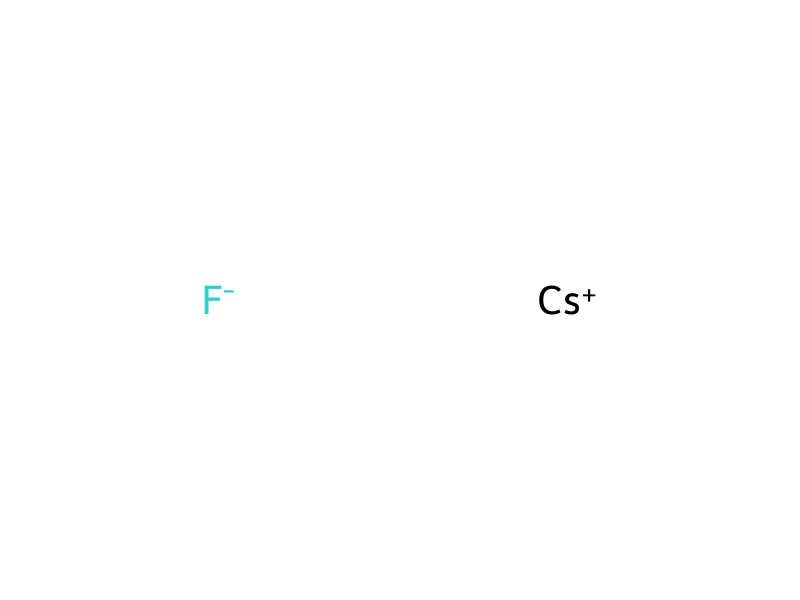
Grundinformationen
- CAS
13400-13-0- Standard-SMILES
[Cs+].[F-]- InChIKey
XJHCXCQVJFPJIK-UHFFFAOYSA-M- Summenformel
- CsF
- Durchschnittliche Molmasse
- 151,9039 g/mol
- Monoisotopische Masse
- 151,90385512
Namen und Bezeichner
- Bevorzugter Name
- Cesium fluoride
- IUPAC
- cesium fluoride
- Lokaler Name
- Caesiumfluorid
- Englischer Name
- Caesium fluoride
- Summenformel
- CsF
- Molmasse
- 151.9
Namen und Synonyme
CESIUM FLUORIDECaesium fluoride13400-13-0Cesium monofluorideCesium fluoride (CsF)T76A371HJRNSC-84270DTXSID30893927RefChem:124638DTXCID501323967236-487-3cesium;fluoride
Weitere Namen anzeigen
Cesium FlorideCsF, CesiuM fluorideB2TBM600LAMC2
Dicesium difluoridecaesium(1+) fluorideMFCD00010960CSFTricesium trifluorideCesium Monofluoride; NSC 84270EINECS 236-487-3NSC 84270
Datenbank-Bezeichner
- CAS
13400-13-0- PubChem CID
- 25953
- DTXSID
DTXSID30893927- UNII
- T76A371HJR
- EC Number
- 236-487-3
- Nikkaji
- J43.758A
Eigenschaften
Berechnete Struktureigenschaften
- Polarare Oberfläche (TPSA)
- 0 Ų
- H-Brücken-Donoren
- 0
- H-Brücken-Akzeptoren
- 1
- Frei drehbare Bindungen
- 0
- Schwere Atome
- 2
- Formalladung
- 0
- Komplexität
- 2
Experimentelle und physikochemische Eigenschaften
Density4.64 @25 °C
Boiling Point1251 °C @760 [mm Hg]
Melting Point703 °C
Physical DescriptionDeliquescent solid; [Hawley] White odorless crystalline solid; [MSDSonline]
Physikochemische Eigenschaften
- Schmelzpunkt
- 682 °C · 682 °C(lit.)
- Siedepunkt
- 1251 °C · 1251 °C
- Dichte
- 4.115 g/mL · 4.115 g/mL at 25 °C(lit.)
- Dampfdruck
- 0 Pa · 0Pa at 25℃
- Flammpunkt
- 1251 °C · 1251°C
- storage temp.
- 0 · 0-6°C
- Löslichkeit
- 2 O: · H2O: 3 M at 20 °C, clear, colorless
- Aggregatzustand
- Powder/Lump
- Farbe
- White
- Wichte
- 4.115 · 4.115
- PH
- 6.5 · 6.5-7.5 (25℃, 3M in H2O)
- Wasserlöslichkeit
- 369 g/100 · 369 g/100 mL (18 ºC)
- Spezifische Wärmekapazität
- 0.34 J/ · Cp(crystal): 0.34 J/(g·K), at 25℃
- Merck
- 14 · 14,2012
- Stabilität
- hygroscopic
- InChI
- 1S/Cs.FH/h;1H/q+1;/p-1
- InChIKey
- XJHCXCQVJFPJIK-UHFFFAOYSA-M
- SMILES
- [F-].[Cs+]
- LogP
- 0.23 at · 0.23 at 20℃
- CAS Datenbank
- 13400 · 13400-13-0(CAS DataBase Reference)
- NIST chemische Informationen
- Cesium fluoride(13400-13-0)
- EPA chemische Informationen
- Cesium fluoride (CsF) (13400-13-0)
Sicherheit und Regulatorisches
GHS-Klassifizierung
GHS Classification
Danger
H301+H311+H331 (44.4%): Toxic if swallowed, in contact with skin or if inhaled [Danger Acute toxicity, oral; acute toxicity, dermal; acute toxicity, inhalation];H301 (95.6%): Toxic if swallowed [Danger Acute toxicity, oral];H311 (95.6%): Toxic in contact with skin [Danger Acute toxicity, dermal];H314 (21.1%): Causes severe skin burns and eye damage [Danger Skin corrosion/irritation];H315 (76.7%): Causes skin irritation [Warning Skin corrosion/irritation];H318 (80%): Causes serious eye damage [Danger Serious eye damage/eye irritation];H331 (91.1%): Toxic if inhaled [Danger Acute toxicity, inhalation];H361 (46.7%): Suspected of damaging fertility or the unborn child [Warning Reproductive toxicity]
P203, P260, P261, P262, P264, P264+P265, P270, P271, P280, P301+P316, P301+P330+P331, P302+P352, P302+P361+P354, P304+P340, P305+P354+P338, P316, P317, P318, P321, P330, P332+P317, P361+P364, P362+P364, P363, P403+P233, P405, and P501 (click each P-code to see the statement)
Aggregated GHS information provided per 90 reports by companies from 10 notifications to the ECHA C&L Inventory. Each notification may be associated with multiple companies.;Information may vary between notifications depending on impurities, additives, and other factors. The percentage value in parenthesis indicates the notified classification ratio from companies that provide hazard codes. Only hazard codes with percentage values above 10% are shown. For more detailed information, please visit ECHA C&L website.
Gefahrenhinweise
Regulatory Information
Chemical: Cesium fluoride (CsF)
Status: Active Update: 23-01-2023 https://echa.europa.eu/registration-dossier/-/registered-dossier/26172
Cesium fluoride: Does not have an individual approval but may be used under an appropriate group standard
Other Safety InformationEvaluation - Cesium salts
Hazards SummaryPoisonous; [Hawley] Corrosive to skin and eyes; [eChemPortal: ERMA] An irritant; Can be absorbed through skin; [MSDSonline] See FLUORIDES.
Hazard Classes and CategoriesAcute Tox. 3 (95.6%);Acute Tox. 3 (95.6%);Skin Corr. 1C (21.1%);Skin Irrit. 2 (76.7%);Eye Dam. 1 (80%);Acute Tox. 3 (91.1%);Repr. 2 (46.7%)
Sicherheit und Schutzausrüstung
Exposure Control and Personal Protection
Biological Exposure Indices (BEI) [ACGIH] - Fluorides in urine = 2 mg/L prior to shift or 3 mg/L at end of shift; (Repeated measurements recommended.)
1.0 [mg/m3], inhalable fraction, as F[German Research Foundation (DFG)]
Threshold Limit Values (TLV)2.5 [mg/m3], as F
Permissible Exposure Limit (PEL)2.5 [mg/m3], as F
Protective Action Criteria (PAC)
1.5 [mg/m3]
17 [mg/m3]
99 [mg/m3]
Toxikologische Informationen
Adverse EffectsDermatotoxin - Skin burns.
Regulatorische Informationen
Regulatory Information
Chemical: Cesium fluoride (CsF)
Status: Active Update: 23-01-2023 https://echa.europa.eu/registration-dossier/-/registered-dossier/26172
Cesium fluoride: Does not have an individual approval but may be used under an appropriate group standard
Sicherheitsdaten
- F
- 3-10
- wgk
- 3
- tsca
- TSCA listed
- ridadr
- UN 2923 8/PG 2
- hs_code
- 28261990
- RTECS-Nr.
- FK9650000
- risk_code
- 23/24/25-34-62-41-38-32
- hazard_code
- T,C
- hazard_note
- Corrosive
- safety_code
- 26-36/37/39-45
- hazard_class
- 6.1
- packing_group
- III
- Speicherklasse
- 11 - Combustible Solids
- Hazard Classifications
- Acute Tox. 4 OralAquatic Chronic 3Eye Dam. 1Repr. 2STOT RE 2
Chemie und Industrie
Verwendung und Herstellung
Uses
Used to make optics and specialty glasses; [Hawley] Used as a catalyst, an inorganic scintillator, and a fluoride source in organic synthesis; [Merck Index]
Glass Manufacturing [Category: Industry]
Glassblowing [Category: Hobbies]
General Manufacturing InformationCesium fluoride (CsF): ACTIVE
Anwendungen
VerwendenUsed as a base in a Suzuki cross-coupling synthesis of ortho-substituted biaryls.5 Also employed as a reagent for nucleophilic fluorination of primary halides and sulfonates in protic media such as tert-butyl and tert-pentyl alcohols.6
VerwendenCesium fluoride is an inorganic compound with the chemical formula CsF, which is a hygmoscopic white salt. Cesium fluoride can be used as a source of fluoride anion for organic synthesis. Caesium has the highest electropositivity of all non-radioactive elements and fluorine has the highest electronegativity of all elements.
Vor- und nachgelagerte Produkte
Nachgelagerte Produkte
Anbieter100 Anbieter
国药集团化学试剂有限公司86-21-63210123 · [email protected]
北京华美互利生物化工010-56205725 · [email protected]
梯希爱(上海)化成工业发展有限公司021-67121386 · [email protected]
衢州润东化工有限公司0570-8789886 18892685668 · [email protected]
上海阿拉丁生化科技股份有限公司400-6206333 13167063860 · [email protected]
河北创海生物科技有限公司+86-86-13131129325 · [email protected]
爱斯特(成都)生物制药股份有限公司+86-28-85122536 85324413 · [email protected]
科瑞迪化学400-821-5857 021-64326257 · [email protected]
河北秒变生物科技有限公司17733850068
上海迈瑞尔生化科技有限公司4006356688 18621169109 · [email protected]
江苏普乐司生物科技有限公司0513-66017706 18551496367 · [email protected]
阿法埃莎(中国)化学有限公司400-6106006 · [email protected]
安耐吉化学&3A(安徽泽升科技股份有限公司)400-0056266 · [email protected]
Allfluoro Pharmaceutical Company Limited+86-400-0216110 +86-15958047586 · [email protected]
上海瀚鸿科技股份有限公司021-54306202 13764082696 · [email protected]
上海景颜化工科技有限公司13817811078 · [email protected]
嘉兴市艾森化工有限公司0573-85285100 18627885956 · [email protected]
上海隆盛化工有限公司58099637 13585536065 · [email protected]
山东西亚化学有限公司13355009207 13355009207 · [email protected]
玛雅试剂+86 (573) 82222445 (0)18006601000 452520369 · [email protected]
四川库利南科技有限公司400-1166-196 18981987031 · [email protected]
天津希恩思生化科技有限公司400 638 7771 · [email protected]
南京维奥化工有限公司Please Send Email 18652950785 · [email protected]
斯百全化学(上海)有限公司021-021-021-67601398-809-809-809 15221380277 · [email protected]
艾科试剂4008-755-333 18080918076 · [email protected]
上海思域化工科技有限公司86-21-34053660 · [email protected]
赛默飞世尔科技(中国)有限公司800-810-5118 · [email protected]
上海特伯化学科技有限公司+86-21-60341587 · [email protected]
TCI AMERICA800-4238616 · [email protected]
TOKYO CHEMICAL INDUSTRY CO., LTD.03-36680489 · [email protected]
TCI Europe320-37350700 · [email protected]
上海贤鼎生物科技有限公司4009209199 · [email protected]
上氟科技021-65170832 15601903708
深圳康特腾科技有限公司86-0755-86635001 · [email protected]
越林试剂021-62960152 · [email protected]
Clearsynth Labs Limited+91-22-26355700 · [email protected]
北京环宇世纪化学科技有限公司hysj_bj.com
上海将来实业股份有限公司021-61552785 · [email protected]
HBCChem, Inc.+1-510-219-6317 · [email protected]
成都零六生物科技有限公司400-1166-196 13458535857 · [email protected]
上海御略医药科技有限公司021-60345187 13671753212 · [email protected]
上海麦克林生化科技股份有限公司15221275939 15221275939 · [email protected]
杭州杰恒化工有限公司0571-87396432 · [email protected]
上海嵩爰化工科技有限公司010-1234567 18521000990 · [email protected]
上海有朋化工有限公司021-69005955 13701776567 · [email protected]
上海凯赛化工有限公司021-33516722 13701817765 · [email protected]
上海彤源化工有限公司021-021-69182866 13701855675 · [email protected]
凯试(上海)科技有限公司021-50135380 · [email protected]
上海蓝润化学有限公司021-69515658 ; 69515628 13701998368 · [email protected]
上海容立化学科技有限公司021-69992220 13701886816 · [email protected]
Zugehörige Reaktionen
4.586



Notizen zur Verbindung
Wird geladen…