
Grundinformationen
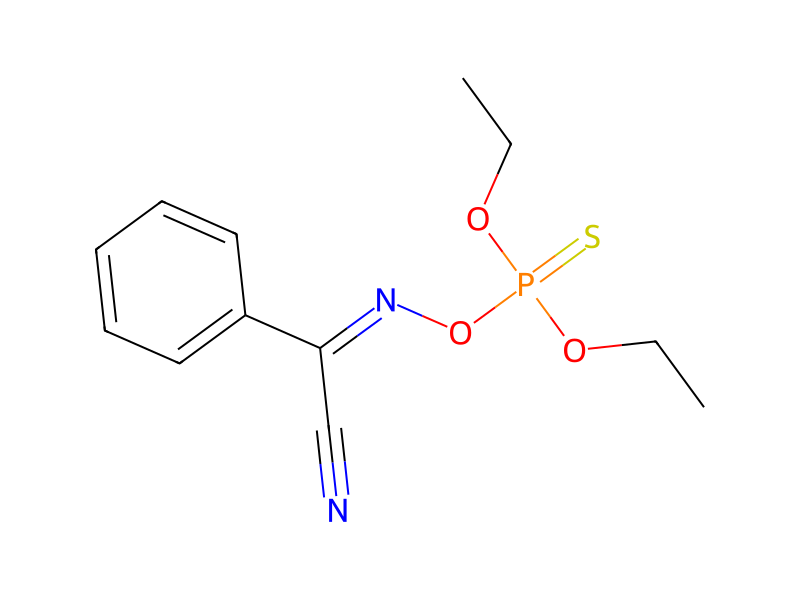
- Standard-SMILES
CCOP(=S)(OCC)ON=C(C#N)c1ccccc1- InChIKey
ATROHALUCMTWTB-UHFFFAOYSA-N- Summenformel
- C12H15N2O3PS
- Durchschnittliche Molmasse
- 298,3 g/mol
- Monoisotopische Masse
- 298,05410052
Namen und Bezeichner
- Bevorzugter Name
- Phoxim
- IUPAC
- N-diethoxyphosphinothioyloxybenzenecarboximidoyl cyanide
- Lokaler Name
- Phoxim (ISO)
- Englischer Name
- Phoxim
- Summenformel
- C12H15N2O3PS
- Molmasse
- 298.3
Namen und Synonyme
PHOXIM14816-18-3BaythionPhoximeSebacil (insecticide)6F5V775VPOBAYER-9053Bay-77488BAY 77488PhoxinDTXSID8034324Phenylglyoxylnitrile oxime O,O-diethyl phosphorothioate
Weitere Namen anzeigen
Foximb77488VOLATONoms1170Sebacilsra7502Valexon
O,O-Diethyl-alpha-cyanobenzylidineaminooxyphosphonothiateCHEBI:38812Sebacil Pour-onRefChem:863020DTXCID20810007phenylglyoxylonitrile oxime O,O-diethylphosphorothioate238-887-3alpha-(((Diethoxyphosphinothioyl)oxy)imino)benzeneacetonitrile
Datenbank-Bezeichner
- CAS
14816-18-3- PubChem CID
- 26927
- DTXSID
DTXSID8034324- ChEMBL
CHEMBL1906626- UNII
- 6F5V775VPO
- EC Number
- 238-887-3
Eigenschaften
Berechnete Struktureigenschaften
- XLogP
- 4,4
- Polarare Oberfläche (TPSA)
- 95,9 Ų
- H-Brücken-Donoren
- 0
- H-Brücken-Akzeptoren
- 6
- Frei drehbare Bindungen
- 7
- Schwere Atome
- 19
- Formalladung
- 0
- Komplexität
- 389
Experimentelle und physikochemische Eigenschaften
Collision Cross Section165.7 Ų [M-H]- [CCS Type: DT; Buffer gas: N2; Ionization: ESI-; Dataset: TOXCAST; Source Identifier: DTXSID8034324]
Physikochemische Eigenschaften
- Schmelzpunkt
- 5.55 °C · 5.55°C
- Siedepunkt
- 0.01 · bp0.01 102°
- Dichte
- 420 · d420 1.176
- Dampfdruck
- 2.1 · 2.1×10-3 Pa (20 °C)
- Brechungsindex
- 20 · nD20 1.5405
- storage temp.
- 0 · 0-6°C
- Löslichkeit
- Acetonitrile (Slightly), Chloroform (Slightly), Methanol (Slightly)
- Wasserlöslichkeit
- 1.5 mg · 1.5 mg l-1 (20 °C)
- Aggregatzustand
- liquid
- Farbe
- Colorless to light yellow
- Henry's Law Constant
- 5 · 5.0×101 mol/(m3Pa) at 25℃, Ebert et al. (2023)
- Stabilität
- Hygroscopic, Moisture Sensitive
- InChIKey
- ATROHALUCMTWTB-WYMLVPIESA-N
- CAS Datenbank
- 14816 · 14816-18-3(CAS DataBase Reference)
- NIST chemische Informationen
- Phoxim(14816-18-3)
- EPA chemische Informationen
- Phoxim (14816-18-3)
Sicherheit und Regulatorisches
GHS-Klassifizierung
GHS Classification
Warning
H302: Harmful if swallowed [Warning Acute toxicity, oral];H317: May cause an allergic skin reaction [Warning Sensitization, Skin];H361f ***: Suspected of damaging fertility [Warning Reproductive toxicity];H400: Very toxic to aquatic life [Warning Hazardous to the aquatic environment, acute hazard];H410: Very toxic to aquatic life with long lasting effects [Warning Hazardous to the aquatic environment, long-term hazard]
P203, P261, P264, P270, P272, P273, P280, P301+P317, P302+P352, P318, P321, P330, P333+P317, P362+P364, P391, P405, and P501 (click each P-code to see the statement)
Danger
Gefahrenhinweise
Other Safety Information
IMAP assessments - 3,5-Dioxa-6-aza-4-phosphaoct-6-ene-8-nitrile, 4-ethoxy-7-phenyl-, 4-sulfide: Human health tier I assessment;IMAP assessments - 3,5-Dioxa-6-aza-4-phosphaoct-6-ene-8-nitrile, 4-ethoxy-7-phenyl-, 4-sulfide: Environment tier I assessment
Hazard Classes and Categories
Acute Tox. 3 (33.6%);Acute Tox. 4 (66.4%);Acute Tox. 3 (67.3%);Skin Sens. 1 (97.3%);Acute Tox. 2 (34.5%);Repr. 2 (96.5%);Aquatic Acute 1 (100%);Aquatic Chronic 1 (100%)
Reproductive toxicity - category 2;Acute toxicity - category 4;Skin sensitisation - category 1;Hazardous to the aquatic environment (acute) - category 1;Hazardous to the aquatic environment (chronic) - category 1
Repr. 2;Acute Tox. 4 *;Skin Sens. 1;Aquatic Acute 1;Aquatic Chronic 1
Toxikologische Informationen
Acute Toxicity LinkChemical: PHOXIM
Sicherheitsdaten
- wgk
- 3
- ridadr
- UN 2810
- hs_code
- 29269090
- RTECS-Nr.
- MD4740000
- risk_code
- 22-50/53-62-43
- Toxizität
- LD50 orally in mice: >2000 mg/kg (Vinopal, Fukuto)
- hazard_code
- Xn;N,N,Xn
- safety_code
- 36-60-61-46-36/37
- hazard_class
- 6.1(b)
- packing_group
- III
Chemie und Industrie
Pharmakologische Informationen
ATC CodeQP - Antiparasitic products, insecticides and repellents;QP53 - Ectoparasiticides, insecticides and repellents;QP53A - Ectoparasiticides for topical use, incl. insecticides;QP53AF - Organophosphorous compounds;QP53AF01 - Phoxime
MeSH Pharmacological Classification
Drugs that inhibit cholinesterases. The neurotransmitter ACETYLCHOLINE is rapidly hydrolyzed, and thereby inactivated, by cholinesterases. When cholinesterases are inhibited, the action of endogenously released acetylcholine at cholinergic synapses is potentiated. Cholinesterase inhibitors are widely used clinically for their potentiation of cholinergic inputs to the gastrointestinal tract and urinary bladder, the eye, and skeletal muscles; they are also used for their effects on the heart and the central nervous system.
Pesticides designed to control insects that are harmful to man. The insects may be directly harmful, as those acting as disease vectors, or indirectly harmful, as destroyers of crops, food products, or textile fabrics.
Verwendung und Herstellung
Use Classification
Veterinary Drug -> INSECTICIDE -> JECFA Functional Classes
Veterinary Drug -> INSECTICIDE -> JECFA Functional Classes
Veterinary Drug -> INSECTICIDE -> JECFA Functional Classes
INSECTICIDES
Anwendungen
BeschreibungPhoxim is a light yellow liquid, Solubility in water is 1.5 mg/L (20 C). It is readily soluble in most organic solvents and slightly in aliphatic hydrocarbons. Log Kow = 3.38. It is relatively slowly hydrolyzed in aqueous media; DT50 (22 C) at pH 4, 7, and 9 is 26.7, 7.2, and 3.1 d, respectively.
VerwendenPhoxim is used to control stored product insect pests in silos and barns. It is also used to control household insects such as ants and other public health pests. Agricultural targets include caterpillars and soil insects in maize, vegetables, cotton and potatoes.
Vor- und nachgelagerte Produkte
Vorgelagerte Rohstoffe
Nachgelagerte Produkte
Anbieter50 Anbieter
国药集团化学试剂有限公司86-21-63210123 · [email protected]
上海阿拉丁生化科技股份有限公司400-6206333 13167063860 · [email protected]
湖北万得化工有限公司15377098680 15377098680 · [email protected]
湖北威德利化学试剂有限公司181-6332-1995 18062128043 · [email protected]
盐城通铭生物科技有限公司15195160625 · [email protected]
上海麦克林生化科技股份有限公司021-50706066 15221275939 · [email protected]
湖北常奥药业有限公司027-87058617 13419515565
湖北海克斯生化有限公司17362916295; 17362916295 · [email protected]
陕西缔都新材料有限公司029-63373950 17392216152 · [email protected]
武汉灵灵九生物科技有限公司15623309010
江苏星科元信息科技有限公司400-605-7200 15335295587
湖北威德利化学试剂有限公司17771473825 13385289472 · [email protected]
上海晶抗生物工程有限公司021-54721350 13524668266 · [email protected]
安耐吉化学&3A(安徽泽升科技有限公司)021-58432009 400-005-6266 · [email protected]
梯希爱(上海)化工贸易有限公司021-61109150 · [email protected]
湖北魏氏化学试剂股份有限公司027-59102966 18717199209 · [email protected]
山东沃德森生物科技有限公司0531-88723173 18596073690 · [email protected]
湖北广奥生物科技有限公司027-02702759223056 18162699093 · [email protected]
医恩医疗系统研发(上海)有限公司021-58958002 18930822973 · [email protected]
武汉丰泰威远科技有限公司+86-27-8746-5837 +86-18627785180 · [email protected]
武汉丰泰威远科技有限公司027-87465837 19945049750 · [email protected]
河北茹麒科技有限公司176-03256889 17603256889 · [email protected]
湖北成海化工有限公司027-59220433 18327245847 · [email protected]
上海毕楷科技有限公司18516304666
四川库利南科技有限公司400-1166-196 18981987031 · [email protected]
艾科试剂4008-755-333 18080918076 · [email protected]
上海遐瑞医药科技有限公司+86 21 61551611
成都思天德生物科技有限公司028-83243028 19136088901 · [email protected]
南京生利德生物科技有限公司025-57798810 18652991625 · [email protected]
上海将来实业股份有限公司400-0066400 13621662912 · [email protected]
天津阿尔塔科技有限公司022-65378550-8551 · [email protected]
天津普西唐生物医药科技有限公司010-60605840 · [email protected]
杭州杰恒化工有限公司0571-87396432 · [email protected]
武汉弘德悦欣医药科技有限公司027-83855396 15271852016
湖北巨胜科技有限公司027-59599241 18871490274 · [email protected]
桦特昇生物科技(武汉)有限公司027-59207879 1972026995 18140587686 · [email protected]
九鼎化学(上海)科技有限公司4009209199 · [email protected]
湖北威德利化学试剂有限公司18327179646 · [email protected]
湖北玖丰隆化工有限公司13277936479 · [email protected]
武汉峰耀同辉化学制品有限公司027-87466205 15377579727 · [email protected]
厦门志信化学有限公司+86-5922680277 +86-13806087780 · [email protected]
上海玻尔化学试剂有限公司19102157732 · [email protected]
泰安市江舟生物科技有限公司1385-13854830759 13854830759 · [email protected]
湖北魏氏化学试剂股份有限公司13125137732 18686406941
湖北辰心化工有限公司17362916295
湖北万业众诚化学试剂有限责任公司18671296875 · [email protected]
台州市瑞欣化工有限公司0576-89085261 15867635987 · [email protected]
北京华威锐科化工科技有限公司89508211 18501085097 · [email protected]
湖北猫尔沃生物医药有限公司[email protected]
湖南瑞威尔生物科技有限公司18502762003
Zugehörige Reaktionen
1
Verknüpfte Notizen
Wird geladen…