
Grundinformationen
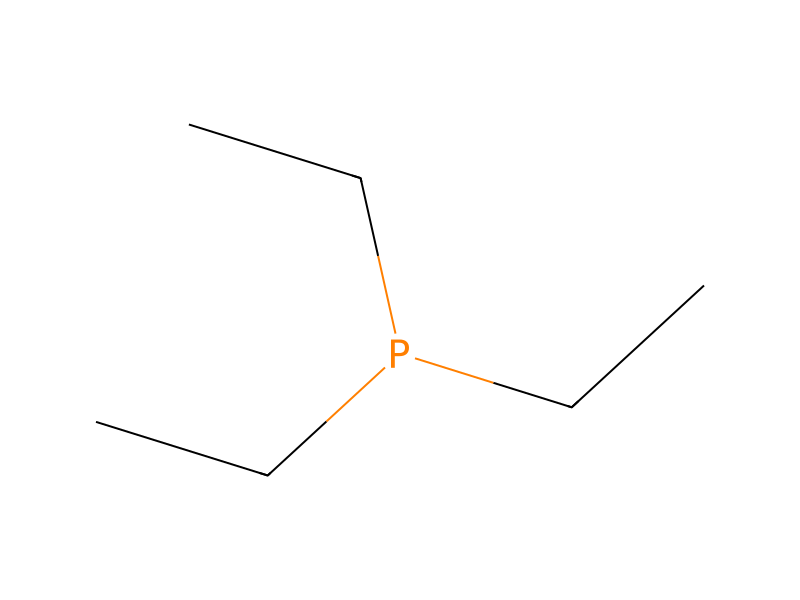
- Standard-SMILES
CCP(CC)CC- InChIKey
RXJKFRMDXUJTEX-UHFFFAOYSA-N- Summenformel
- C6H15P
- Durchschnittliche Molmasse
- 118,16 g/mol
- Monoisotopische Masse
- 118,09113748
Namen und Bezeichner
- Bevorzugter Name
- Triethylphosphine
- IUPAC
- triethylphosphane
- Lokaler Name
- Triethylphosphin
- Englischer Name
- Triethylphosphine
- Summenformel
- C6H15P
- Molmasse
- 118.16
Namen und Synonyme
TriethylphosphineTRIETHYLPHOSPHANEPhosphine, triethyl-Triethyl phosphineEINECS 209-068-8UNII-5W435D16PMBRN 09691705W435D16PMPhosphorus triethyl4-16-00-01699 (Beilstein Handbook Reference)TRIETHYLPHOSPHINE [MI]DTXSID3060293
Weitere Namen anzeigen
PEt3Triethylphosphine,99%Et3Ptl409Cytop? 320CYTOP(R) 320AURORA KA-1111HISHICOLIN P-2
CHEBI:39971(C2H5)3Pphosphine, triethylRefChem:191547DTXCID7041885UN2845209-068-8InChI=1/C6H15P/c1-4-7(5-2)6-3/h4-6H2,1-3H
Datenbank-Bezeichner
- CAS
554-70-1- PubChem CID
- 27365
- DTXSID
DTXSID3060293- ChEBI
CHEBI:39971- UNII
- 5W435D16PM
- EC Number
- 209-068-8
- Nikkaji
- J44.119H
Eigenschaften
Berechnete Struktureigenschaften
- XLogP
- 1
- Polarare Oberfläche (TPSA)
- 0 Ų
- H-Brücken-Donoren
- 0
- H-Brücken-Akzeptoren
- 0
- Frei drehbare Bindungen
- 3
- Schwere Atome
- 7
- Formalladung
- 0
- Komplexität
- 25
Experimentelle und physikochemische Eigenschaften
Physical DescriptionColorless liquid with an odor of hyacinths; [Merck Index] Pungent odor; [Alfa Aesar MSDS]
Physikochemische Eigenschaften
- Schmelzpunkt
- -88 °C · -88°C
- Siedepunkt
- 127 · 127-128 °C(lit.)
- Dichte
- 0.88 g/mL · 0.88 g/mL at 20 °C
- Brechungsindex
- 20 · n20/D 1.456(lit.)
- Flammpunkt
- 1 °F · 1 °F
- Aggregatzustand
- liquid
- Farbe
- colorless
- Geruch (Odor)
- vile, nauseating odor.stench
- Wasserlöslichkeit
- Insoluble in water.
- Merck
- 14 · 14,9675
- BRN
- 969170 · 969170
- InChI
- 1S/C6H15P/c1-4-7(5-2)6-3/h4-6H2,1-3H3
- InChIKey
- RXJKFRMDXUJTEX-UHFFFAOYSA-N
- SMILES
- CCP(CC)CC
- CAS Datenbank
- 554 · 554-70-1(CAS DataBase Reference)
- NIST chemische Informationen
- Phosphine, triethyl-(554-70-1)
- EPA chemische Informationen
- Phosphine, triethyl- (554-70-1)
Sicherheit und Regulatorisches
GHS-Klassifizierung
GHS Classification
Danger
H224 (17.5%): Extremely flammable liquid and vapor [Danger Flammable liquids];H225 (81.2%): Highly Flammable liquid and vapor [Danger Flammable liquids];H250 (100%): Catches fire spontaneously if exposed to air [Danger Pyrophoric liquids];H302 (17.5%): Harmful if swallowed [Warning Acute toxicity, oral];H314 (95%): Causes severe skin burns and eye damage [Danger Skin corrosion/irritation];H318 (17.5%): Causes serious eye damage [Danger Serious eye damage/eye irritation]
P210, P222, P231, P233, P240, P241, P242, P243, P260, P264, P264+P265, P270, P280, P301+P317, P301+P330+P331, P302+P335+P334, P302+P361+P354, P303+P361+P353, P304+P340, P305+P354+P338, P316, P317, P321, P330, P363, P370+P378, P403+P235, P405, and P501 (click each P-code to see the statement)
Aggregated GHS information provided per 80 reports by companies from 4 notifications to the ECHA C&L Inventory. Each notification may be associated with multiple companies.;Information may vary between notifications depending on impurities, additives, and other factors. The percentage value in parenthesis indicates the notified classification ratio from companies that provide hazard codes. Only hazard codes with percentage values above 10% are shown. For more detailed information, please visit ECHA C&L website.
Gefahrenhinweise
Hazards SummaryPyrophoric; Self-heating in large quantities and may catch fire; An irritant; Harmful by inhalation; [Alfa Aesar MSDS] See Tributylphosphine and tert-Butylphosphine.
Hazard Classes and CategoriesFlam. Liq. 1 (17.5%);Flam. Liq. 2 (81.2%);Pyr. Liq. 1 (100%);Acute Tox. 4 (17.5%);Skin Corr. 1B (95%);Eye Dam. 1 (17.5%)
Toxikologische Informationen
Toxicity DataLC (mouse) > 1,000 mg/m3/10min
Sicherheitsdaten
- F
- 10-13-23
- wgk
- 3
- tsca
- TSCA listed
- ridadr
- UN 2924 3/PG 2
- RTECS-Nr.
- SZ3400000
- risk_code
- 11-34-67-17-40-37-19
- hazard_code
- F,C
- safety_code
- 26-36/37/39-45-7/9-33-16
- hazard_class
- 4.2
- packing_group
- I
- Speicherklasse
- 4.2 - Pyrophoric and self-heating hazardous materials
- Hazard Classifications
- Acute Tox. 4 OralEye Dam. 1Flam. Liq. 2Pyr. Liq. 1Skin Corr. 1B
Chemie und Industrie
Verwendung und Herstellung
UsesUsed in organic syntheses; [Merck Index]
General Manufacturing InformationPhosphine, triethyl-: ACTIVE
Anwendungen
VerwendenTriethylphosphine is used as a ligand for arylation. It is used in organic synthesis.
Vor- und nachgelagerte Produkte
Nachgelagerte Produkte
Anbieter50 Anbieter
上海阿拉丁生化科技股份有限公司400-6206333 13167063860 · [email protected]
武汉欣扬瑞和化学科技有限公司13720274133 · [email protected]
武汉欣扬瑞和化学科技有限公司153-07155313 15307155313 · [email protected]
上海遐瑞医药科技有限公司+86-021-61551413 · [email protected]
Dayang Chem (Hangzhou) Co.,Ltd.+86-0571-88938639 17705817739 · [email protected]
Hebei Yanxi Chemical Co., Ltd.+86-17531190177 · [email protected]
科瑞迪化学400-821-5857 021-64326257 · [email protected]
上海迈瑞尔生化科技有限公司4006356688 18621169109 · [email protected]
北京华威锐科化工有限公司0757-86329057 18934348241 · [email protected]
宁波亿诺化学品有限公司86-574-27787657 · [email protected]
阿法埃莎(中国)化学有限公司400-6106006 · [email protected]
上海德默医药科技有限公司400-021-7337 2355568890 · [email protected]
安耐吉化学&3A(安徽泽升科技股份有限公司)400-0056266 · [email protected]
上海瀚鸿科技股份有限公司021-54306202 13764082696 · [email protected]
常州卡伏勒环保材料有限公司13839301681 · [email protected]
上海景颜化工科技有限公司13817811078 · [email protected]
嘉兴市艾森化工有限公司0573-85285100 18627885956 · [email protected]
维赛诺化学技术(北京)有限公司13811761079 · [email protected]
上海隆盛化工有限公司58099637 13585536065 · [email protected]
郑州研德生物科技有限公司0371-63682289 15538176268 · [email protected]
山东西亚化学有限公司13355009207 13355009207 · [email protected]
四川库利南科技有限公司400-1166-196 18981987031 · [email protected]
南京辛西亚生物科技有限公司0550-5618439 15951861180 · [email protected]
河南多贝化工有限公司0370-2785118 17550508557 · [email protected]
武汉泰宇凯尚科技有限公司027-027-87680032 18963957250 · [email protected]
艾科试剂4008-755-333 18080918076 · [email protected]
武汉欣扬瑞和化学科技有限公司027-83855316 18171155316
苏州思变化学技术有限公司0512-65617459 18915409046 · [email protected]
天津尚德药缘科技有限公司13132578992 · [email protected]
上海遐瑞医药科技有限公司+86 21 61551611
上海健超生物科技有限公司150-2103-5486 18017383231 · [email protected]
深圳康特腾科技有限公司86-0755-86635001 · [email protected]
越林试剂021-62960152 · [email protected]
上海泽信化工科技有限公司021-60136491 15901897992
上海倍卓生物科技有限公司021-61119791,13386096464 · [email protected]
上海将来实业股份有限公司021-61552785 · [email protected]
安徽科迪达化工有限公司0554-2106669 · [email protected]
成都零六生物科技有限公司400-1166-196 13458535857 · [email protected]
上海御略医药科技有限公司021-60345187 13671753212 · [email protected]
上海嵩爰化工科技有限公司010-1234567 18521000990 · [email protected]
上海孚一生物科技有限公司+86 (21) 61124340
池州凯隆进出口贸易有限公司[email protected]
Sigma-Aldrich西格玛奥德里奇(上海)贸易有限公司021-61415566 800-8193336 · [email protected]
郑州科豫隆化工产品有限公司17319789407 17319789407 · [email protected]
九鼎化学(上海)科技有限公司4009209199 · [email protected]
北京禾兴源科技有限公司18511709189 · [email protected]
Henan Alfa Chemical Co., Ltd+8618339805032 · [email protected]
厦门志信化学有限公司+86-5922680277 +86-13806087780 · [email protected]
广东翁江化学试剂有限公司0751-2886766 13927870850 · [email protected]
上海博景化工有限公司021-37199966 13681836088 · [email protected]
Zugehörige Reaktionen
68


Verknüpfte Notizen
Wird geladen…