
HRID 35993als Edukt
Cephalexin

15686-71-2CC1=C(C(=O)O)N2C(=O)[C@@H](NC(=O)[C@H](N)c3ccccc3)[C@H]2SC1ZAIPMKNFIOOWCQ-UEKVPHQBSA-NCephalexin is a semisynthetic first-generation cephalosporin antibiotic having methyl and beta-(2R)-2-amino-2-phenylacetamido groups at the 3- and 7- of the cephem skeleton, respectively. It is effective against both Gram-negative and Gram-positive organisms, and is used for treatment of infections of the skin, respiratory tract and urinary tract. It has a role as an antibacterial drug. It is a cephalosporin, a semisynthetic derivative and a beta-lactam antibiotic allergen. It is a conjugate acid of a cephalexin(1-).
15686-71-2、23325-78-2DTXSID9022780CHEMBL1200544、CHEMBL1727CHEBI:3534Pharmaceuticals -> Listed in ZINC15
Pharmaceuticals -> Antibiotics (Cefalosporins)
Pharmaceuticals -> Antibiotics
CRYSTALS
WHITE TO OFF-WHITE, CRYSTALLINE POWDER
10mg/mL
SLIGHTLY SOL IN WATER; PRACTICALLY INSOL IN ALC, CHLOROFORM, ETHER
2.97e-01 g/L
Breast Feeding; Lactation; Milk, Human; Anti-Infective Agents; Antibacterial Agents; Cephalosporins
FDA approved drugs -> Active ingredient
FDA approved drugs -> Active ingredient
Access group antibiotics
EMA approved medicines: Veterinary medicine
FDA approved animal drugs -> Active ingredient
Pharmaceuticals -> UK Veterinary Medicines Directorate List
Pharmaceuticals -> Animal Drugs -> Approved in Taiwan
Sicherheitsangaben dienen nur zur Orientierung und ersetzen weder das Sicherheitsdatenblatt (SDB) des Lieferanten noch geltende Vorschriften oder eine fachliche Bewertung.
Danger
H317 (100%): May cause an allergic skin reaction [Warning Sensitization, Skin]
P233, P260, P261, P271, P272, P280, P284, P302+P352, P304+P340, P321, P333+P317, P342+P316, P362+P364, P403, and P501 (click each P-code to see the statement)
Aggregated GHS information provided per 75 reports by companies from 5 notifications to the ECHA C&L Inventory. Each notification may be associated with multiple companies.
5-Thia-1-azabicyclo4.2.0oct-2-ene-2-carboxylic acid, 7-(2R)-aminophenylacetylamino-3-methyl-8-oxo-, (6R,7R)-: Does not have an individual approval but may be used as a component in a product covered by a group standard. It is not approved for use as a chemical in its own right.
Cephalexin: Does not have an individual approval but may be used under an appropriate group standard
Manufacturers, packers, and distributors of drug and drug products for human use are responsible for complying with the labeling, certification, and usage requirements as prescribed by the Federal Food, Drug, and Cosmetic Act, as amended (secs 201-902, 52 Stat. 1040 et seq., as amended; 21 U.S.C. 321-392).
J01DB01
J - Antiinfectives for systemic use
QJ - Antiinfectives for systemic use
QJ - Antiinfectives for systemic use
J01DB01
Cephalexin (also called Cefalexin) is a first generation cephalosporin antibiotic. It is one of the most widely prescribed antibiotics, often used for the treatment of superficial infections that result as complications of minor wounds or lacerations. It is effective against most gram-positive bacteria through its inihibition of the cross linking reaction between N-acetyl muramicacid and N-acetylglucosamine in the cell wall, leading to cell lysis.
Cephalexin is a first generation cephalosporin antibiotic. Cephalosporins contain a beta lactam and dihydrothiazide. Unlike penicillins, cephalosprins are more resistant to the action of beta lactamase. Cephalexin inhibits bacterial cell wall synthesis, leading breakdown and eventualy cell death.
CEPHALOTHIN & ITS CONGENERS INHIBIT BACTERIAL CELL-WALL SYNTHESIS IN MANNER SIMILAR TO THAT OF PENICILLIN. /CEPHALOSPORINS/
The penicillins and their metabolites are potent immunogens because of their ability to combine with proteins and act as haptens for acute antibody-mediated reactions. The most frequent (about 95 percent) or "major" determinant of penicillin allergy is the penicilloyl determinant produced by opening the beta-lactam ring of the penicillin. This allows linkage of the penicillin to protein at the amide group. "Minor" determinants (less frequent) are the other metabolites formed, including native penicillin and penicilloic acids. /Penicillins/
Bactericidal; action depends on ability to reach and bind penicillin-binding proteins located in bacterial cytoplasmic membranes; cephalosporins inhibit bacterial septum and cell wall synthesis, probably by acylation of membrane-bound transpeptidase enzymes. This prevents cross-linkage of peptidoglycan chains, which is necessary for bacterial cell wall strength and rigidity. Also, cell division and growth are inhibited, and lysis and elongation of susceptible bacteria frequently occur. Rapidly dividing bacteria are those most susceptible to the action of cephalosporins. /Cephalosporins/




2.53
7.14
PKA: 5.2, 7.3
178.5 Ų [M+H]+ [CCS Type: TW; Method: calibrated with polyalanine and drug standards]
163.36 Ų [M+H-H2O]+ [CCS Type: TW; Method: calibrated with polyalanine and drug standards]
183.1 Ų [M+Na]+ [CCS Type: TW; Method: calibrated with Waters Major Mix]
179.56 Ų [M-H]-
Cephalexin capsules, tablets, and powder for oral suspension should be stored in tight containers at a temperature less than 40 °C, preferably between 15-30 °C. After reconstitution, cephalexin oral suspensions should be stored at 2-8 °C and discarded if not used within 2 wk.
SRP: At the time of review, criteria for land treatment or burial (sanitary landfill) disposal practices are subject to significant revision. Prior to implementing land disposal of waste residue (including waste sludge), consult with environmental regulatory agencies for guidance on acceptable disposal practices.
PROBENECID IS EFFECTIVE IN SLOWING URINARY CLEARANCE & ENHANCING DURATION OF SYSTEMIC ANTIMICROBIAL ACTIVITY /OF CEPHALEXIN/.
...CEPHALOSPORINS...MAY BE AFFECTED BY CONCURRENT USE OF...SULFINPYRAZONE. DIMINISHED TUBULAR SECRETION...RESULT IN HIGHER & MORE SUSTAINED SERUM LEVELS & HENCE, INTENSIFICATION OF DRUG ACTIVITY. /CEPHALOSPORINS/
FUROSEMIDE MAY ENHANCE NEPHROTOXICITY OF CEPHALOSPORINS. /CEPHALOSPORINS/
Hypoprothrombinemia induced by large doses of salicylates and/or cephalosporins, and the gastrointestinal ulcerative or hemorrhagic potential of nonsteroidal anti-inflammatory drugs (NSAIDs), salicylates, or sulfinpyrazone may increase the risk of hemorrhage. /Cephalosporins/
For more Interactions (Complete) data for CEPHALEXIN (6 total), please visit the HSDB record page.
The adverse effects reported by drug manufacturers associated with cephalexin include abdominal pain, diarrhea, dyspepsia, gastritis, nausea, vomiting, erythema multiforme, genital pruritus, vaginitis, vaginal discharge, candidiasis, thrombocytopenia, neutropenia, eosinophilia, arthralgia, arthropathy, and arthritis.
Cephalexin is associated with a relatively low incidence of adverse effects in patients when the drug is administered correctly and safely. However, in cases of toxicity or overdose, adverse effects may include soreness of the oral cavity, pruritus of pregnancy, and gastrointestinal symptoms such as nausea, vomiting, epigastric distress, diarrhea, and hematuria. Furthermore, there have been only a few sporadic documented cases of cephalexin leading to fatal episodes of Stevens-Johnson syndrome and toxic epidermal necrolysis.
NEUROTOXICITY, SUCH AS HEADACHE, TINNITUS, ATAXIA, & DIPLOPIA, SOMETIMES DEVELOP; THESE EFFECTS ARE REVERSIBLE. CHANGES IN INTESTINAL & VAGINAL FLORA MAY OCCUR; MONILIASIS IS OCCASIONAL, & OVER GROWTH BY PS AERUGINOSA HAS BEEN REPORTED.
ABOUT 5% OF PATIENTS RECEIVING...SEMISYNTHETIC CEPHALOSPORINS DEVELOP HYPERSENSITIVITY REACTIONS, INCL FEVER, EOSINOPHILIA, SERUM SICKNESS, URTICARIAL OR MORBILLIFORM RASHES, OR ANAPHYLAXIS. TRANSIENT NEUTROPENIA HAS BEEN OBSERVED... /CEPHALOSPORINS/
...CEPHALEXIN, ORALLY ADMIN CEPHALOSPORINS, OCCASIONALLY PRODUCE NAUSEA, VOMITING, & DIARRHEA.
DIRECT POSITIVE COOMBS REACTION IS FREQUENTLY (40%) NOTED WHEN LARGE DOSES OF...CEPHALOSPORINS ARE ADMIN OR WHEN CONVENTIONAL DOSES ARE GIVEN IN PRESENCE OF RENAL DYSFUNCTION. /CEPHALOSPORINS/
For more Human Toxicity Excerpts (Complete) data for CEPHALEXIN (35 total), please visit the HSDB record page.
Drug Induced Liver Injury Rank (DILIrank 2.0)
Cephalexin
vLess-DILI-concern
4
Adverse reactions
DOI:10.1016/j.drudis.2016.02.015
◉ Summary of Use during Lactation
◈ What is cephalexin?
LD50 MOUSE ORAL 1.6-4.5 G/KG /MONOHYDRATE/
LD50 MOUSE INTRAPERITONEAL 0.4-1.3 G/KG /MONOHYDRATE/
LD50 RAT ORAL GREATER THAN 5.0 G/KG /MONOHYDRATE/
LD50 RAT INTRAPERITONEAL GREATER THAN 3.7 G/KG /MONOHYDRATE/
Cephalexin
23.3
98.6
The usual adult dose is 250 mg every 6 hours. For some infections, a dosage of 500 mg may be administered every 12 hours.
Data used to generate the benchmarks include the following: Lowest Daily Dose (LDD): 1000 mg/day, Lowest Therapeutic Dose (LTD): 12.5 mg/kg-day, and Screening Dose: 0.004 mg/kg-day.
29-Aug-11
Manufacturers, packers, and distributors of drug and drug products for human use are responsible for complying with the labeling, certification, and usage requirements as prescribed by the Federal Food, Drug, and Cosmetic Act, as amended (secs 201-902, 52 Stat. 1040 et seq., as amended; 21 U.S.C. 321-392).
CEPHALOSPORIN C IS VERY RESISTANT TO ACTION OF PENICILLINASE, FOR WHICH IT IS BOTH COMPETITIVE & NONCOMPETITIVE INHIBITOR, DEPENDING ON SUBSTRATE TESTED... /CEPHALOSPORINS/
The half life of cephalexin is 49.5 minutes in a fasted state and 76.5 minutes with food though these times were not significantly different in the study.
LESS THAN 10 TO 15%...IS BOUND TO PLASMA PROTEIN, & PLASMA DRUG CONCN FALL RAPIDLY, T/2 OF CEPHALEXIN NORMALLY BEING ABOUT 40 MIN.
/IN RATS/ RATIOS OF BONE TO SERUM CONCN AVG...1:9 FOR CEPHALEXIN DURING 0.25-4 HR AFTER /ORAL/ DOSING. DESPITE DIFFERENCES IN CONCN; T/2 IN BONE & SERUM WERE SIMILAR.
PEAK TIME, T/2 OF ELIMINATION, T/2 OF ABSORPTION, & VOL OF DISTRIBUTION WERE ALL SIMILAR FOLOWING ADMIN OF EITHER 1 OR 2 G OF CEPHALEXIN.
The serum half-life of cephalexin is 0.5-1.2 hr in adults with normal renal function. The serum half-life of the drug is reported to be about 5 hr in neonates and 2.5 hr in children 3-12 mo of age. In one study, the serum half-life was 7.7 hr in adults with creatinine clearances of 9.2 ml/min and 13.9 hr in adults with creatinine clearances of 4 ml/min.
5SFF1W6677
CEPHALEXIN ANHYDROUS
Established Pharmacologic Class [EPC] - Cephalosporin Antibacterial
Chemical Structure [CS] - Cephalosporins
Cephalexin anhydrous is a Cephalosporin Antibacterial.
CEPHALEXIN
Well absorbed from the upper gastrointestinal tract with nearly 100% oral bioavailability. Cephalexin is not absorbed in the stomach but is absorbed in the upper intestine. Patients taking 250mg of cephalexin reach a maximum plasma concentration of 7.7mcg/mL and patients taking 500mg reach 12.3mcg/mL.
Cephalexin is over 90% excreted in the urine after 6 hours by glomerular filtration and tubular secretion with a mean urinary recovery of 99.3%. Cephalexin is unchanged in the urine.
5.2-5.8L.
Clearance from one subject was 376mL/min.
LESS THAN 10 TO 15%...IS BOUND TO PLASMA PROTEIN, & PLASMA DRUG CONCN FALL RAPIDLY... MORE THAN 90%...IS EXCRETED UNALTERED IN URINE WITHIN 6 HR, PRIMARILY BY RENAL TUBULAR SECRETION. ...THERAPEUTICALLY EFFECTIVE CONCN ARE STILL ACHIEVED IN URINE OF PT WITH DECR RENAL FUNCTION.
CEPHALEXIN...IS WELL ABSORBED FROM GI TRACT. PEAK PLASMA CONCN, REACHED @ ABOUT 1 HR AFTER INGESTION OF DRUG, ARE APPROX 9 & 18 UG/ML AFTER ORAL DOSES OF 250 & 500 MG, RESPECTIVELY. INGESTION OF FOOD MAY DELAY ABSORPTION.
ANTIBIOTIC FOR INFECTIONS OF THE RESPIRATORY & GENITOURINARY TRACTS & OF THE SKIN, EYE, & BONE; ANTIBIOTIC FOR VETERINARY USE
MEDICATION
MEDICATION (VET):
Use (kg; approx.) in Germany (2009): >1000
(1977) PROBABLY GREATER THAN 4.54X10+5 GRAMS
(1979) PROBABLY GREATER THAN 4.54X10+5 GRAMS
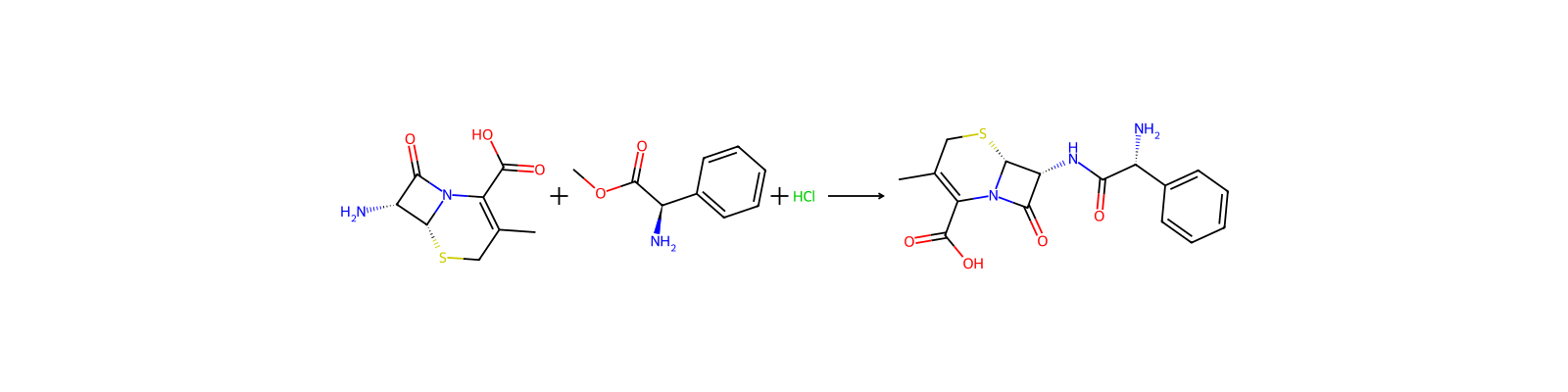
ACYLATION OF 7-AMINO-3-METHYL-8-OXO-5-THIA-1-AZABICYCLO[4.2.0]OCT-2-ENE-2-CARBOXYLIC ACID (PREPARED FROM CEPHALOSPORIN C) WITH 2-PHENYLGLYCINE IN AN APPROPRIATE DEHYDRATING ENVIRONMENT
7-AMINO-3-METHYL-8-OXO-5-THIA-1-AZABICYCLO[4.2.0]OCT-2-ENE-2-CARBOXYLIC ACID, WHICH MAY BE PREPD FROM NATURAL ANTIBIOTIC CEPHALOSPORIN C, IS ACYLATED WITH 2-PHENYLGLYCINE IN APPROPRIATE DEHYDRATING ENVIRONMENT.
RYAN, ET AL, J MED CHEM 12, 310 (1969); MORIN, JACKSON, US PATENT 3,275,626 (1966 TO LILLY)
.../CEPHALEXIN/ SEMISYNTHETIC DERIVATIVE OF CEPHALOSPORIN C.
BeschreibungUse of the ampicillin-type side chain conveys oral activity to cephalexin. Whereas it no longer has an activating side chain at C-3 and, as a consequence, is somewhat less potent, it does not undergo metabolic deactivation and, thus, maintains potency. It is rapidly and completely absorbed from the GI tract and has become quite popular. Somewhat puzzling is the fact that the use of the ampicillin side chain in the cephalosporins does not result in a comparable shift in antimicrobial spectrum. Cephalexin, like the other first-generation cephalosporins is active against many Gram-positive aerobic cocci but is limited against Gram-negative bacteria. It is a widely used drug, particularly against Gram-negative bacteria causing urinary tract infections, Gram-positive infections (Staphyl ococcus aureus, Streptococcus pneumoni ae and Streptococcus pyogenes) of soft tissues, pharyngitis, and minor wounds.
VerwendenAntibacterial.
DefinitionChEBI: A semisynthetic first-generation cephalosporin antibiotic having methyl and beta-(2R)-2-amino-2-phenylacetamido groups at the 3- and 7- of the cephem skeleton, respectively. It is effective against both Gram-negative and G am-positive organisms, and is used for treatment of infections of the skin, respiratory tract and urinary tract.