
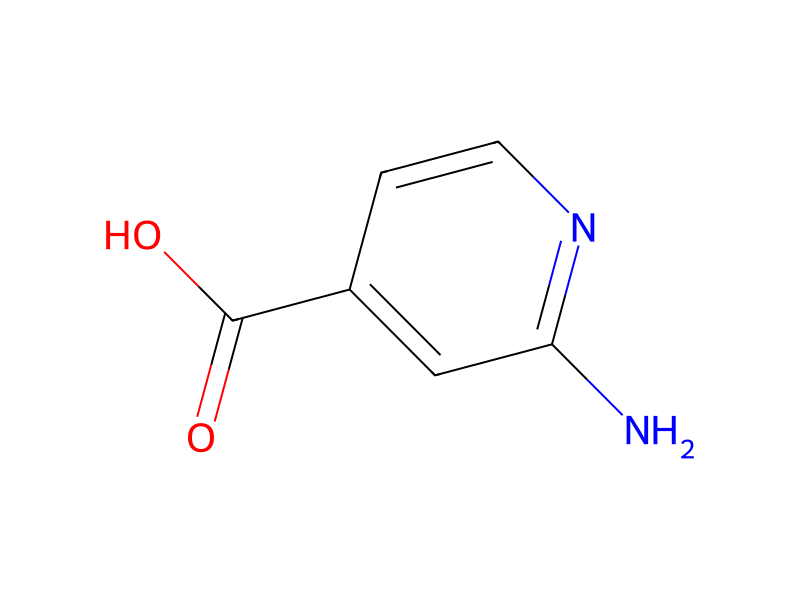
Grundinformationen
- Standard-SMILES
Nc1cc(C(=O)O)ccn1- InChIKey
QMKZZQPPJRWDED-UHFFFAOYSA-N- Summenformel
- C6H6N2O2
- Durchschnittliche Molmasse
- 138,12 g/mol
- Monoisotopische Masse
- 138,04292744
Namen und Bezeichner
- Bevorzugter Name
- 2-Aminopyridine-4-carboxylic acid
- IUPAC
- 2-aminopyridine-4-carboxylic acid
- Englischer Name
- 2-Aminoisonicotinic acid
- Summenformel
- C6H6N2O2
- Molmasse
- 138.12
Namen und Synonyme
2-aminopyridine-4-carboxylic acidRefChem:465205681-100-72-aminoisonicotinic acid13362-28-22-Amino-4-Pyridinecarboxylic Acid2-Amino-isonicotinic acidMFCD00233714CHEMBL33228662-Amino isonicotinic acid2-Aminoisonicotinicacid4-PYRIDINECARBOXYLIC ACID, 2-AMINO-
Weitere Namen anzeigen
RARECHEM AL BO 2405CHEMBRDG-BB 40151212-Aminoisonicotinicaci2-amino-4-carboxypyridine2-AMinopyridine-4-carboxylic2-Aminoisonicotinic Acid >2-AMINOPYRIDINE-4-CARBOXYLATE2-AMinoisonicotinic Acid, 95+%
NSC127962SCHEMBL220538pyridine, 2-amino-4-carboxy-SCHEMBL6698056SCHEMBL11546896SCHEMBL307057412-Amino-4-PyridinecarboxylicAcidDTXSID40299072
Datenbank-Bezeichner
- CAS
13362-28-2- PubChem CID
- 278396
- DTXSID
DTXSID40299072- ChEMBL
CHEMBL3322866- EC Number
- 681-100-7
- Nikkaji
- J81.605A
Eigenschaften
Berechnete Struktureigenschaften
- XLogP
- 0
- Polarare Oberfläche (TPSA)
- 76,2 Ų
- H-Brücken-Donoren
- 2
- H-Brücken-Akzeptoren
- 4
- Frei drehbare Bindungen
- 1
- Schwere Atome
- 10
- Formalladung
- 0
- Komplexität
- 138
Physikochemische Eigenschaften
- Schmelzpunkt
- 300 · 300-302°C
- Siedepunkt
- 498.5 · 498.5±30.0 °C(Predicted)
- Dichte
- 1.417 · 1.417±0.06 g/cm3(Predicted)
- storage temp.
- Inert atmosphere,Room Temperature
- Aggregatzustand
- Powder
- pka
- 2.11 · 2.11±0.10(Predicted)
- Farbe
- Off-white to brown
- BRN
- 3156 · 3156
- InChI
- InChI=1S/C6H6N2O2/c7-5-3-4(6(9)10)1-2-8-5/h1-3H,(H2,7,8)(H,9,10)
- InChIKey
- QMKZZQPPJRWDED-UHFFFAOYSA-N
- SMILES
- C1(N)=NC=CC(C(O)=O)=C1
- CAS Datenbank
- 13362 · 13362-28-2(CAS DataBase Reference)
Sicherheit und Regulatorisches
GHS-Klassifizierung
GHS Classification
Warning
H302 (84.8%): Harmful if swallowed [Warning Acute toxicity, oral];H315 (100%): Causes skin irritation [Warning Skin corrosion/irritation];H319 (100%): Causes serious eye irritation [Warning Serious eye damage/eye irritation];H335 (97.8%): May cause respiratory irritation [Warning Specific target organ toxicity, single exposure; Respiratory tract irritation]
P261, P264, P264+P265, P270, P271, P280, P301+P317, P302+P352, P304+P340, P305+P351+P338, P319, P321, P330, P332+P317, P337+P317, P362+P364, P403+P233, P405, and P501 (click each P-code to see the statement)
Aggregated GHS information provided per 46 reports by companies from 5 notifications to the ECHA C&L Inventory. Each notification may be associated with multiple companies.;Information may vary between notifications depending on impurities, additives, and other factors. The percentage value in parenthesis indicates the notified classification ratio from companies that provide hazard codes. Only hazard codes with percentage values above 10% are shown. For more detailed information, please visit ECHA C&L website.
Gefahrenhinweise
Hazard Classes and CategoriesAcute Tox. 4 (84.8%);Skin Irrit. 2 (100%);Eye Irrit. 2A (100%);STOT SE 3 (97.8%)
Sicherheitsdaten
- wgk
- 3
- hs_code
- 29339900
- risk_code
- 36/37/38-23/24/25-22
- hazard_code
- Xi,T,Xn
- hazard_note
- Irritant/Keep Cold
- safety_code
- 26-36-45-36/37/39
- hazard_class
- IRRITANT
- Speicherklasse
- 11 - Combustible Solids
- Hazard Classifications
- Acute Tox. 4 OralEye Irrit. 2Skin Irrit. 2STOT SE 3
Chemie und Industrie
Anwendungen
BeschreibungAs an organic acid, 2-Aminoisonicotinic acid (AN) can be grafted onto chitosan chains through amidation, thereby introducing 2-aminopyridine residues with good hydration capacity. Due to its specific chemical structure possessing push-pull effects and suitable length, 2-aminoisonicotinic acid is a promising ligand for the design of functional metal-organic frameworks. In addition, some studies demonstrated that the compounds bearing 2-aminopyridine residues showed good antibacterial activities. Given its functional characteristics, the grafting of 2-amino isonicotinic acid onto chitosan is expected to exhibit good water solubility and antibacterial activity and serve as an effective ligand to form stable chitosaniodine complexes with iodine for antibacterial applications[1].
Vor- und nachgelagerte Produkte
Vorgelagerte Rohstoffe
Nachgelagerte Produkte
Anbieter50 Anbieter
国药集团化学试剂有限公司86-21-63210123 · [email protected]
梯希爱(上海)化成工业发展有限公司021-67121386 · [email protected]
上海阿拉丁生化科技股份有限公司400-6206333 13167063860 · [email protected]
INTATRADE GmbH+49 3493/605464 · [email protected]
爱斯特(成都)生物制药股份有限公司+86-28-85122536 85324413 · [email protected]
北京安司莫森技术有限公司010-82954736 13391601435 · [email protected]
上海将来实业股份有限公司400-0066400 13621662912 · [email protected]
上海迈瑞尔生化科技有限公司4006356688 18621169109 · [email protected]
北京华威锐科化工有限公司0757-86329057 18934348241 · [email protected]
阿法埃莎(中国)化学有限公司400-6106006 · [email protected]
安耐吉化学&3A(安徽泽升科技股份有限公司)400-0056266 · [email protected]
石家庄斯迪亚诺精细化工有限公司0311-89250318 13582355795 · [email protected]
武汉凯威斯科技有限公司86-027-67849912 · [email protected]
常州安轩化工有限公司13912302692 · [email protected]
上海瀚鸿科技股份有限公司021-54306202 13764082696 · [email protected]
上海景颜化工科技有限公司13817811078 · [email protected]
嘉兴市艾森化工有限公司0573-85285100 18627885956 · [email protected]
Pure Chemistry Scientific Inc.001-857-928-2050 or 1-888-588-9418 · [email protected]
上海隆盛化工有限公司58099637 13585536065 · [email protected]
云南西力生物技术股份有限公司0871-65217109 · [email protected]
石家庄可辰化工有限公司18633820607 18633820607 · [email protected]
唐山默内德贸易有限公司0315-8309571 15633399667 · [email protected]
四川库利南科技有限公司400-1166-196 18981987031 · [email protected]
南京斯贝源医药科技有限公司+86-25-68710855, +86-25-68710897 · [email protected]
南京维奥化工有限公司Please Send Email 18652950785 · [email protected]
艾科试剂4008-755-333 18080918076 · [email protected]
上海思域化工科技有限公司86-21-34053660 · [email protected]
赛默飞世尔科技(中国)有限公司800-810-5118 · [email protected]
上海拓莱化学科技有限公司021-31137757-00; 18121466954;18121466954 · [email protected]
北京清露源科技有限公司+86 (10) 6333-0989 · [email protected]
TCI AMERICA800-4238616 · [email protected]
TOKYO CHEMICAL INDUSTRY CO., LTD.03-36680489 · [email protected]
TCI Europe320-37350700 · [email protected]
上海贤鼎生物科技有限公司4009209199 · [email protected]
深圳康特腾科技有限公司86-0755-86635001 · [email protected]
Shanghai Witofly Chemical Co.,Ltd[email protected]
越林试剂021-62960152 · [email protected]
上海睿升化工科技有限公司+86-021-50935922
Clearsynth Labs Limited+91-22-26355700 · [email protected]
苏州爱玛特生物科技有限公司0512-56316828 4008675858 · [email protected]
北京环宇世纪化学科技有限公司hysj_bj.com
上海湄水化工科技有限公司021-60549325 18616193163
上海将来实业股份有限公司400-0066400 13621662912 · [email protected]
上海将来实业股份有限公司021-61552785 · [email protected]
HBCChem, Inc.+1-510-219-6317 · [email protected]
上海毕得医药科技股份有限公司400-164-7117 18317119277 · [email protected]
上海石洋化工有限公司021-56795766 · [email protected]
杭州泛凯科技有限公司86-0571-87649320 · [email protected]
凯方医药科技(上海)有限公司021-67220633 021-54824098 · [email protected]
上海御略医药科技有限公司021-60345187 13671753212 · [email protected]
Zugehörige Reaktionen
18


Verknüpfte Notizen
Wird geladen…