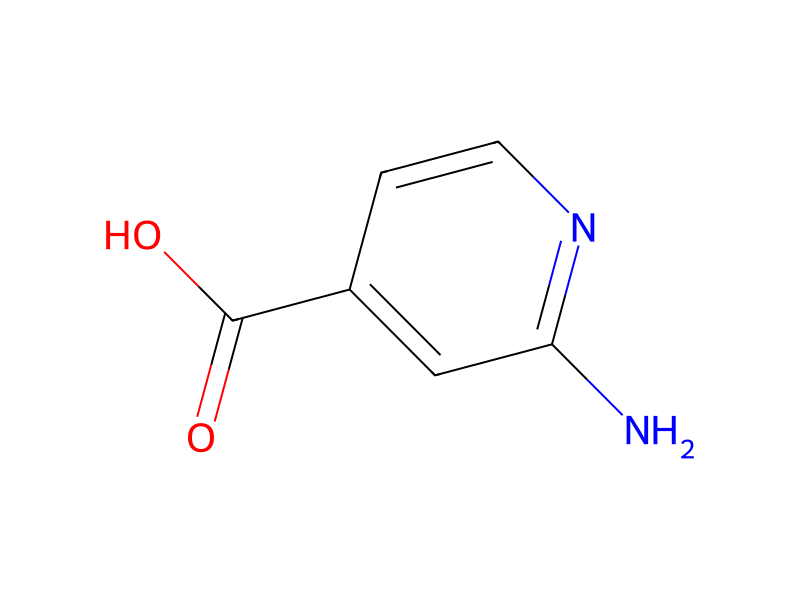
To a solution of 2-aminoisonicotinic acid (2.76 g, 20.0 mmol) in N,N-dimethylformamide (60 mL) was added 1-(3-dimethylaminopropyl)-3-ethylcarbodiimide hydrochloride (5.00 g, 26.0 mmol) and N,N-diisopropylethylamine (10 mL, 57.7 mmol). The resulting solution was stirred for 30 minutes at ambient temperature followed by the addition of 1-hydroxybenzotriazole (3.24 g, 24.0 mmol) and benzylamine (3.2 mL, 29.3 mmol). The reaction mixture was stirred for 72 hours at ambient temperature, diluted with water (30 mL) and extracted with ethyl acetate (200 mL×4). The combined organic layers were washed with brine (30 mL), dried over anhydrous sulphate, filtered and concentrated in vacuo. The residue was triturated with ethyl acetate and hexanes (in a 1:10 ratio), filtered and dried in vacuo to give 2-amino-N-benzylisonicotinamide as a colorless solid (1.97 g, 43%): NMR (300 MHz, CDCl3) δ 8.11-8.09 (m, 1H), 7.37-7.27 (m, 5H), 6.88-6.82 (m, 2H), 6.42 (br s, 1H), 4.60 (d, J=5.7 Hz, 2H); MS (ES+) m/z 228.5 (M+1).