
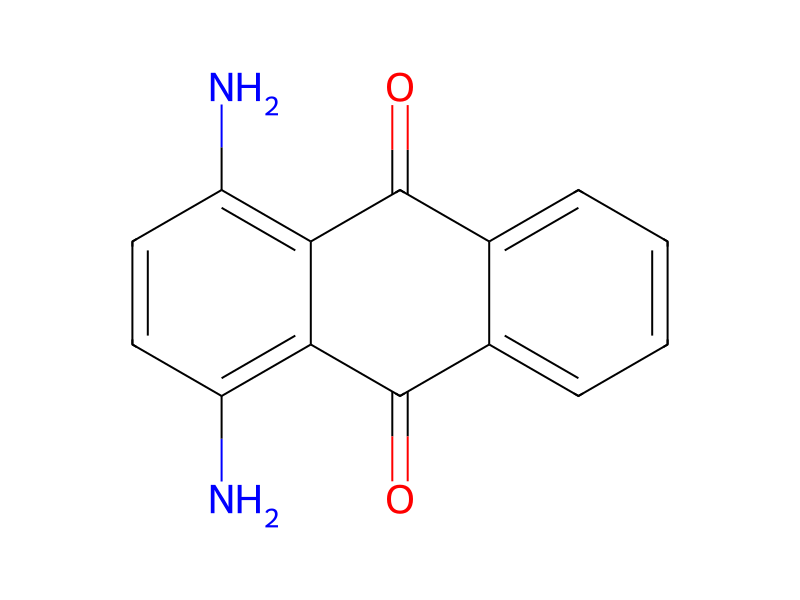
1,4-Diaminoanthrachinon
Disperse Violet 1
Grundinformationen
- CAS
128-95-0- Standard-SMILES
Nc1ccc(N)c2c1C(=O)c1ccccc1C2=O- InChIKey
FBMQNRKSAWNXBT-UHFFFAOYSA-N- Summenformel
- C14H10N2O2
- Durchschnittliche Molmasse
- 238,24 g/mol
- Monoisotopische Masse
- 238,07422757
Namen und Bezeichner
- Bevorzugter Name
- Disperse Violet 1
- IUPAC
- 1,4-diaminoanthracene-9,10-dione
- Lokaler Name
- 1,4-Diaminoanthrachinon
- Englischer Name
- 1,4-Diamino anthraquinone
- Summenformel
- C14H10N2O2
- Molmasse
- 238.24
Namen und Synonyme
1,4-Diaminoanthraquinone128-95-0Disperse violet 1KrisolamineAcetate Red Violet ROracet Violet 2RCibacet Violet 2R9,10-Anthracenedione, 1,4-diamino-Grasol Violet RSeacyl Violet RSetacyl Violet RDisperse Violet K
Weitere Namen anzeigen
1,4-diaminoanthracene-9,10-dioneCI 611001,4-diamino-9,10-anthracenedioneNSC 7833NSC 63807oilvioletrViolet ER
C.I. Disperse Violet 1Gracet Violet 2RResiren Violet TRSetile Violet 3RAmacel heliotrope RDuranol Violet 2RNacelan Violet 4RDispersive Violet K
Datenbank-Bezeichner
- CAS
128-95-0、71775-54-7- PubChem CID
- 31420
- DTXSID
DTXSID2041252- ChEMBL
CHEMBL86771- UNII
- N21HDQ0TKN
- EC Number
- 204-922-6、615-398-7
- Nikkaji
- J3.264F、J710.752H
Eigenschaften
Berechnete Struktureigenschaften
- XLogP
- 2,6
- Polarare Oberfläche (TPSA)
- 86,2 Ų
- H-Brücken-Donoren
- 2
- H-Brücken-Akzeptoren
- 4
- Frei drehbare Bindungen
- 0
- Schwere Atome
- 18
- Formalladung
- 0
- Komplexität
- 346
Experimentelle und physikochemische Eigenschaften
Chemical Classes
Dyes -> Anthraquinone Dyes
Dye
Cosmetics
Cosmetic ingredients (Disperse Violet 1) -> CIR (Cosmetic Ingredient Review)
Hair dyeing
SpringerMaterials PropertiesBoiling point
LogP3.0
Physical DescriptionDark violet solid; [EC: SCCS (Scientific Committee on Consumer Safety), Opinion on Disperse Violet 1, 22 June 2010] Black powder; [Alfa Aesar MSDS]
Collision Cross Section147.5 Ų [M]+ [CCS Type: DT; Buffer gas: N2; Ionization: APCI+; Dataset: TOXCAST; Source Identifier: DTXSID2041252]
Physikochemische Eigenschaften
- Schmelzpunkt
- 265 · 265-269 °C(lit.)
- Siedepunkt
- 380.84 °C · 380.84°C (rough estimate)
- Dichte
- 1.44 g/cm3 · 1.44 g/cm3 (20℃)
Sicherheit und Regulatorisches
Sicherheitsangaben dienen nur zur Orientierung und ersetzen weder das Sicherheitsdatenblatt (SDB) des Lieferanten noch geltende Vorschriften oder eine fachliche Bewertung.
GHS-Klassifizierung
GHS Classification
This chemical does not meet GHS hazard criteria for 21.4% (31 of 145) of reports.
Danger
H301 (62.8%): Toxic if swallowed [Danger Acute toxicity, oral]
P260, P261, P264, P270, P272, P280, P301+P316, P302+P352, P319, P321, P330, P333+P317, P362+P364, P405, and P501 (click each P-code to see the statement)
Aggregated GHS information provided per 145 reports by companies from 15 notifications to the ECHA C&L Inventory. Each notification may be associated with multiple companies.
Not Classified
Gefahrenhinweise
Regulatory Information
Chemical: 9,10-Anthracenedione, 1,4-diamino-
9,10-Anthracenedione, 1,4-diamino-: Does not have an individual approval but may be used as a component in a product covered by a group standard. It is not approved for use as a chemical in its own right.
Hazards Summary
In a patch test study of 104 human female volunteers, 1 to 3 subjects exhibited skin sensitization; Another study of 98 human female volunteers produced 1 subject with a possible sensitization reaction; Causes mild eye irritation in experimental animals at a concentration of 1% in water; A skin sensitizer in a local lymph node assay of mice; No evidence of photo-allergy in a study of guinea pigs; No adverse effects observed in 13-week feeding study of rats at 500 ppm in the diet; Diffuse midzonal/centrilobular liver hypertrophy and increased cholesterol levels observed in males at 20 mg/kg/day in 90-day oral study of rats; [EC: Scientific Committee on Consumer Safety, Opinion on Disperse Violet 1, 22 June 2010] An eye irritant; Risk of irreversible adverse health effects; [Alfa Aesar MSDS]
Hazard Classes and CategoriesAcute Tox. 3 (62.8%)
Toxikologische Informationen
Chemie und Industrie
Verwendung und Herstellung
Uses
CIR ingredient: Disperse Violet 1
Used as a hair dye; [EC: Scientific Committee on Consumer Safety, Opinion on Disperse Violet 1, 22 June 2010]
Dressing Hair [Category: Other]
Household ProductsInformation on 8 consumer products that contain C.I. Disperse violet 1 in the following categories is provided:
Use ClassificationCosmetics -> Hair dyeing
General Manufacturing Information9,10-Anthracenedione, 1,4-diamino-: ACTIVE
Anwendungen
VerwendenAs an anthraquinone derivative, 1,4-Diamino anthraquinone is a potent and selective protein kinase CK1 delta inhibitor. Studies suggest that it has potential solar cell applications. 1,4-Diamino anthraquinone can be used in studies as a potential competitive non-peptidic inhibitor of HIV-1 proteinase.
Vor- und nachgelagerte Produkte
Vorgelagerte Rohstoffe
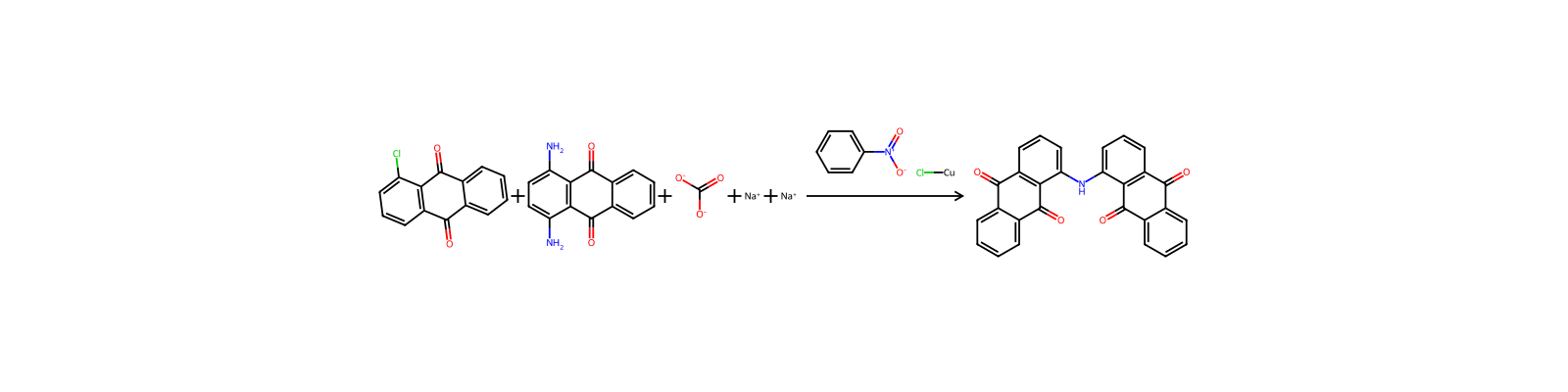
Zugehörige Reaktionen
18



Notizen zur Verbindung
Wird geladen…