StartseiteMCPWorkbenchSkills
StartseiteWorkbenchBenachrichtigungenMein Bereich
llms.txt · MCP-AnleitungDatenschutz · Nutzungsbedingungen · Supportv1.8.3
  1. Startseite
  2. /Verbindung

Phosphonsure

Phosphonic acid

HCID 407
Neue Reaktion
Drucken
GrundinformationenNamen und BezeichnerEigenschaftenSicherheit und RegulatorischesChemie und IndustrieZugehörige ReaktionenNotizen zur Verbindung
TeilstruktursucheÄhnliche Strukturen suchen

Grundinformationen

CAS
13598-36-2
Standard-SMILES
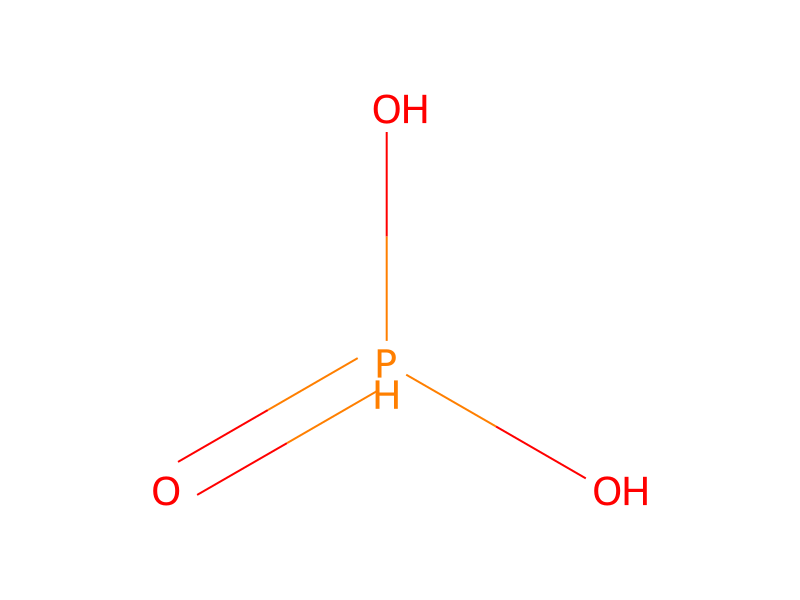
O=[PH](O)O
InChIKey
ABLZXFCXXLZCGV-UHFFFAOYSA-N
Summenformel
H3O3P
Durchschnittliche Molmasse
81,996 g/mol
Monoisotopische Masse
81,98198095

Namen und Bezeichner

Bevorzugter Name
Phosphonic acid
IUPAC
phosphonic acid
Lokaler Name
Phosphonsure
Englischer Name
Phosphorous acid
Summenformel
H3O3P
Molmasse
82

Namen und Synonyme

RefChem:6132DTXCID6029674237-066-713598-36-2CHEBI:44976DTXSID2049715Phosphonic acidPhosphorus trihydroxidePhosphorous acidPHOSPHORUS ACIDPhosphorous acid 99%Phosphonsure
Weitere Namen anzeigen
Phospohorous acidPhosphorous Acid CrystalPhosphorous acid, extra pure, 98%Phosphorous acid, 98%, extra pureH3PO3

Datenbank-Bezeichner

CAS
13598-36-2
PubChem CID
407
DTXSID
DTXSID2049715
ChEMBL
CHEMBL1235291
EC Number
237-066-7

Eigenschaften

Berechnete Struktureigenschaften

XLogP
-1,6
Polarare Oberfläche (TPSA)
57,5 Ų
H-Brücken-Donoren
2
H-Brücken-Akzeptoren
3
Frei drehbare Bindungen
0
Schwere Atome
4
Formalladung
0
Komplexität
26,3

Experimentelle und physikochemische Eigenschaften

Chemical ClassesCorrosives
Physical DescriptionDry Powder; Liquid; Liquid; Large Crystals; CBI; Dry Powder

Physikochemische Eigenschaften

Schmelzpunkt
73 °C · 73 °C
Siedepunkt
200 °C · 200 °C
Dichte
1.651 g/mL · 1.651 g/mL at 25 °C(lit.)
Dampfdruck
0.001 Pa · 0.001Pa at 20℃
Flammpunkt
200 °C · 200°C
storage temp.
0 · 0-6°C
Löslichkeit
DMSO (Slightly), Methanol (Slightly), Water (Sparingly)
Aggregatzustand
Crystals
pka
1 · pK1 1.29; pK2 6.74(at 25℃)
Wichte
1.651 · 1.651
Farbe
White
PH
1 · pKa1= 1.10, pKa2 = 6.33(25℃)
Wasserlöslichkeit
SOLUBLE
Merck
14 · 14,7346
Stabilität
Stable. Incompatible with strong bases. Hygroscopic.
InChI
1S/H3O3P/c1-4(2)3/h4H,(H2,1,2,3)
InChIKey
ABLZXFCXXLZCGV-UHFFFAOYSA-N
SMILES
[H]P(O)(O)=O
CAS Datenbank
13598 · 13598-36-2(CAS DataBase Reference)
NIST chemische Informationen
2 HPO · (HO)2HPO(13598-36-2)
EPA chemische Informationen
Phosphonic acid (13598-36-2)

Sicherheit und Regulatorisches

Sicherheitsangaben dienen nur zur Orientierung und ersetzen weder das Sicherheitsdatenblatt (SDB) des Lieferanten noch geltende Vorschriften oder eine fachliche Bewertung.

GHS-Klassifizierung

GHS Classification · 6 Einträge

Danger

H302: Harmful if swallowed [Warning Acute toxicity, oral]

P260, P264, P270, P280, P301+P317, P301+P330+P331, P302+P361+P354, P304+P340, P305+P354+P338, P316, P321, P330, P363, P405, and P501 (click each P-code to see the statement)

This chemical does not meet GHS hazard criteria for 0.1% (2 of 1718) of reports.

Danger

H290 (22.3%): May be corrosive to metals [Warning Corrosive to Metals]

Gefahrenhinweise

Regulatory Information · 6 Einträge

Chemical: Phosphonic acid

Commission Regulation No 844/2012

Phosphonic acid is listed on the EPA's Chemical Data Reporting (CDR) system. Manufacturers and importers of Phosphonic acid are required to report information about their production and use of this chemical to the EPA under the Toxic Substances Control Act (TSCA). (40 eCFR Part 711)

REACH registered substance: Phosphonic acid (EC: 237-066-7)

Ortho phosphorous acid: Does not have an individual approval but may be used under an appropriate group standard

The New Jersey Worker and Community Right to Know Act requires public and private employers to provide information about hazardous substances at their workplaces. (N.J.S.A. 34:5A-1 et. seq.)

Other Safety InformationIMAP assessments - Phosphonic acid: Human health tier II assessment
EPA Safer ChemicalChemical: Phosphonic acid
Hazard Classes and Categories · 5 Einträge

Met. Corr. 1 (22.3%)

Acute toxicity - category 4

Self-reactive substances and mixtures - Type G

Corrosives

Acute Tox. 4 *

Sicherheit und Schutzausrüstung

Protective Action Criteria (PAC) · 3 Einträge

5.7 [mg/m3]

63 [mg/m3]

380 [mg/m3]

Sicherheitsdaten

F
3
wgk
1
tsca
TSCA listed
ridadr
UN 2834
hs_code
28092019
RTECS-Nr.
SZ6400000
risk_code
22-35
hazard_code
C
safety_code
26-36/37/39-45
hazard_class
8
packing_group
III
Speicherklasse
8A - Combustible corrosive hazardous materials
Hazard Classifications
Acute Tox. 4 OralEye Dam. 1Met. Corr. 1Skin Corr. 1A

Chemie und Industrie

Verwendung und Herstellung

U.S. Production2023: 10,000,000 - <25,000,000 lb
Consumer UsesNot Known or Reasonably Ascertainable
Industry UsesCBI
Household ProductsInformation on 6 consumer products that contain Phosphorus acid in the following categories is provided:
Use Classification · 2 Einträge

EPA Safer Chemical Functional Use Classes -> Oxidants and Oxidant Stabilizers

Safer Chemical Classes -> Yellow triangle - The chemical has met Safer Choice Criteria for its functional ingredient-class, but has some hazard profile issues

General Manufacturing Information · 2 Einträge

All Other Basic Organic Chemical Manufacturing

Phosphonic acid: ACTIVE

Anwendungen · 2 Einträge

BeschreibungPhosphorous acid, H3PO3, is diprotic (readily ionizes two protons), not triprotic as might be suggested by this formula. Phosphorous acid is as an intermediate in the preparation of other phosphorous compounds. Because preparation and uses of “phosphorous acid” actually pertain more to the major tautomer, phosphonic acid, it is more often referred to as “phosphorous acid”. Phosphorous acid has the chemical formula H3PO3, which is best expressed as HPO(OH)2 to show its diprotic character. P(OH)3 (IUPAC: phosphorous acid) has CAS number 10294-56-1. It has been shown to be a stable tautomer.

VerwendenPhosphorous acid is used to produce the fertilizer phosphate salt like potassium phosphite, ammonium phosphite and calcium phosphite. It is actively involved in the preparation of phosphites like aminotris(methylenephosphonic acid) (ATMP), 1-hydroxyethane 1,1-diphosphonic acid (HEDP) and 2-phosphonobutane-1,2,4-tricarboxylic Acid (PBTC), which find application in water treatment as a scale or corrosive inhibitor. It is also used in chemical reactions as a reducing agent. Its salt, lead phosphite is used as PVC stabilizer. It is also used as a precursor in the preparation of phosphine and as an intermediate in the preparation of other phosphorus compounds.

Darstellung · 1 Eintrag

synthetischePhosphorus acid can be prepared by the reaction of phosphorus trichloride with water: PCl3 + 3H2O → H3PO4 + 3HClThe reaction is violent. Addition of PCl3 should be extremely cautious and slow. The addition can be carried out safely in the presence of concentrated HCl. Alternatively, a stream of air containing PCl3 vapor is passed into icecold water and solid crystals of H3PO4 form. Alternatively, phosphorus acid can be prepared by adding phosphorus trichloride to anhydrous oxalic acid: PCl3 + 3(COOH)2 → H3PO3 + 3CO + 3CO2 + 3HCl In this reaction, all products except H3PO3 escape as gases leaving the liquid acid. Dissolution of phosphorus sesquioxide in water also forms phosphorus acid. When shaken with ice water, phosphorus acid is the only product . P4O6 + 6H2O → 4H3PO3 However, in hot water part of the phosphorus acid disproportionates to phosphoric acid and phosphorus or phosphine.

Vor- und nachgelagerte Produkte

Vorgelagerte Rohstoffe

PhosphitePhosphorige Säure-trichloridHydrogenchlorid

Nachgelagerte Produkte

Tribleidioxidphosphonat[[(Phosphonomethyl)imino]bis[ethan-2,1-diylnitrilobis(methylen)]]tetrakisphosphonsureHydroxyphosphonoessigsäureGlyphosatPhosphorwasserstoffDCUPHOSPHATE STANDARD

Ergänzende Hinweise

DefinitionChEBI: Phosphorous acid is a phosphorus oxoacid. It is a conjugate acid of a dihydrogenphosphite. It is a tautomer of a phosphonic acid.

Zugehörige Reaktionen

45
Reaktionsaufzeichnung erstellen
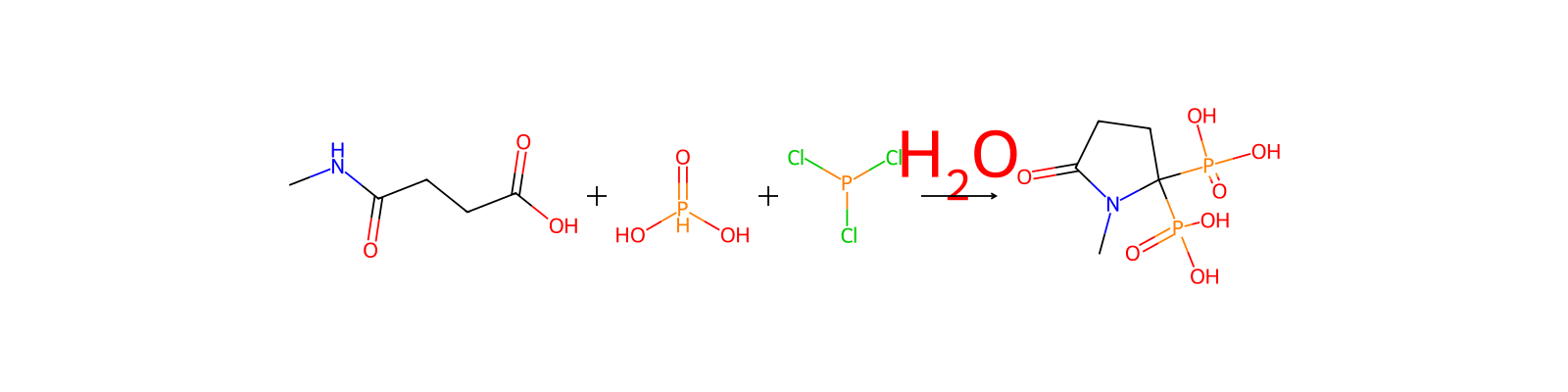
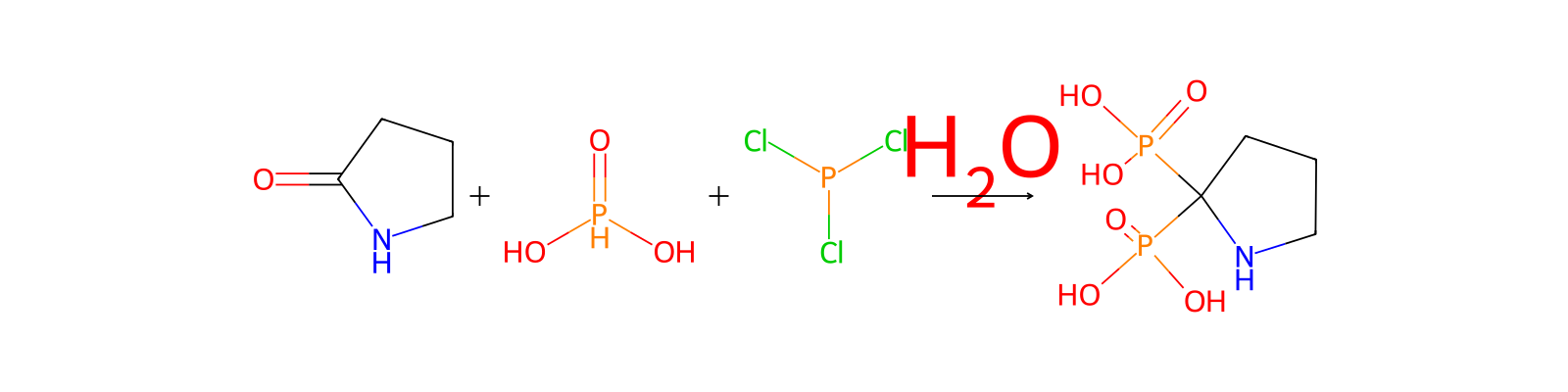
Reaktionsgleichung von HRID 114127
HRID 114127als Edukt
Reaktionsgleichung von HRID 118002
HRID 118002als Edukt
Reaktionsgleichung von HRID 158136
HRID 158136als Edukt
Reaktionsgleichung von HRID 177227
HRID 177227als Edukt
Reaktionsgleichung von HRID 198162
HRID 198162als Produktals Edukt
Reaktionsgleichung von HRID 225101
HRID 225101als Edukt
Reaktionsgleichung von HRID 258657
HRID 258657als Edukt
Reaktionsgleichung von HRID 267185
HRID 267185als Edukt
ZurückSeite 1 von 6

Notizen zur Verbindung

Auf dieser SeiteGrundinformationenNamen und BezeichnerEigenschaftenSicherheit und RegulatorischesChemie und IndustrieZugehörige ReaktionenNotizen zur Verbindung