
Tetrakis[μ-(acetato-O:O')]dirhodium
Acetic acid, rhodium salt (4:2)
Daten werden ergänzt – lade die Seite später neu, um den aktuellen Stand zu sehen

Grundinformationen
- CAS
15956-28-2- Standard-SMILES
CC(=O)O.CC(=O)O.CC(=O)O.CC(=O)O.[Rh].[Rh]- InChIKey
DRGVLUZIGUIMLB-UHFFFAOYSA-N- Summenformel
- C8H16O8Rh2
- Durchschnittliche Molmasse
- 446,02 g/mol
Namen und Bezeichner
- Bevorzugter Name
- Acetic acid, rhodium salt (4:2)
- IUPAC
- acetic acid;bis(rhodium)
- Lokaler Name
- Tetrakis[μ-(acetato-O:O')]dirhodium
- Englischer Name
- Rhodium(II) acetate dimer
- Summenformel
- C8H12O8Rh2
- Molmasse
- 441.99
Namen und Synonyme
Acetic acid, rhodium salt (4:2)NSC156310Rh2(OAc)4RHODIUM ACETATE DIMERDIRHODIUM(II) TETRAACETATEdirhodiumtetraacetatetetrakis(acetato)dirhodiumtetraacRh2(CH3CO2)4Dimer acid rhodiumRHODIUM(11) ACETATErhodiumdiacetatedimer
Datenbank-Bezeichner
- CAS
15956-28-2- PubChem CID
- 423677
Eigenschaften
Berechnete StruktureigenschaftenWird ergänzt
- Polarare Oberfläche (TPSA)
- 149 Ų
- H-Brücken-Donoren
- 4
- H-Brücken-Akzeptoren
- 8
- Frei drehbare Bindungen
- 0
- Schwere Atome
- 18
- Formalladung
- 0
- Komplexität
- 181
Physikochemische Eigenschaften
- Schmelzpunkt
- 205 °C · 205 °C
- storage temp.
- Inert atmosphere,Room Temperature
- Löslichkeit
- Methanol + Water (Slightly)
- Aggregatzustand
- powder
- Farbe
- Green to dark green
- Wasserlöslichkeit
- Soluble in aqueous solution like water. Slightly soluble in ethanol
- Stabilität
- Hygroscopic
- InChI
- InChI=1S/4C2H4O2.2Rh/c4*1-2(3)4;;/h4*1H3,(H,3,4);;/q;;;;2*+2/p-4
- InChIKey
- ANSVJOOIUURYRN-UHFFFAOYSA-N
- SMILES
- CC1=O[Rh+2]234O=C(C)[O-][Rh+2]2(O=C(C)[O-]3)(O=C(C)[O-]4)[O-]1
Sicherheit und Regulatorisches
Sicherheitsangaben dienen nur zur Orientierung und ersetzen weder das Sicherheitsdatenblatt (SDB) des Lieferanten noch geltende Vorschriften oder eine fachliche Bewertung.
Sicherheitsdaten
- wgk
- 3
- tsca
- No
- hs_code
- 28439000
- RTECS-Nr.
- VI9361000
- risk_code
- 36/38
- hazard_code
- Xi
- safety_code
- 37/39-26-15
- Speicherklasse
- 11 - Combustible Solids
- Hazard Classifications
- Eye Irrit. 2Skin Irrit. 2
Chemie und Industrie
Anwendungen
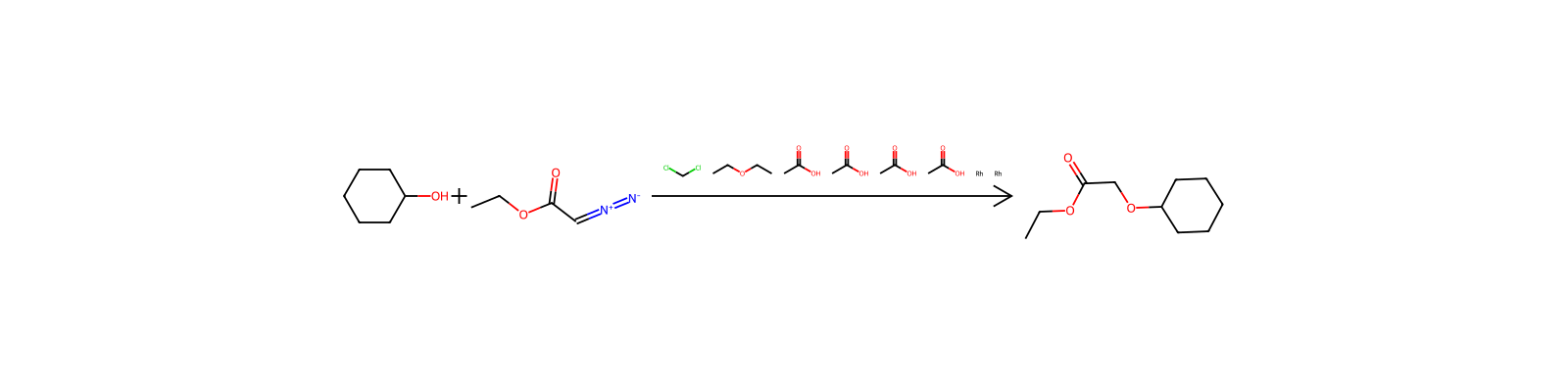
VerwendenRhodium (II) Acetate Dimer is a effective catalyst for ylide formation and it is also catalyst for cyclopropanation of alkenes, oxidation of alcohols, cyclization reactions involving -diazo carbonyl groups, insertion into C-H and X-H bonds (X-H is NH or SH or OH). More reactive and useful in differentiating ribonucleosides and deoxynucleosides. It is also used in functionalizing fullerenes into polymers. Efficient catalyst for hydrogen transfer from 2-propanol to cyclohexanone and other unsaturated compounds.
Darstellung
synthetischeRhodium(II) acetate dimer synthesis: A suspension of 10.0g. of Rh(OH)3.H20 in 400 ml. of glacial acetic acid dissolved upon refluxing for 18 hr. to give a deep emerald-green solution. Most of the acetic acid was evaporated on a steam bath; remaining traces mere removed by heating the residue at 120° for 1hr. The residue was then extracted with boiling acetone until the extract was colorless rather than bluish green. The extract was quickly passed through a fritted glass filter, concentrated on a steam bath to 1/3 its original volume, and placed in the freezing compartment of a refrigerator for 18hr. The resulting large dark green crystals were collected on a filter, washed with small portions of ice-cold acetone, and dried at 110°. When first collected, the product is the weak adduct [Rh(OOCCH3)2(CH3)2C0]2; however, acetone is lost fairly readily at room temperature and immediately in the drying oven; yield, 6.2g. (48%).
Vor- und nachgelagerte Produkte
Nachgelagerte Produkte
Zugehörige Reaktionen
102



Notizen zur Verbindung
Wird geladen…