(+-)-Weinsure
L-Tartaric acid
Daten werden ergänzt – lade die Seite später neu, um den aktuellen Stand zu sehen
Grundinformationen
- CAS
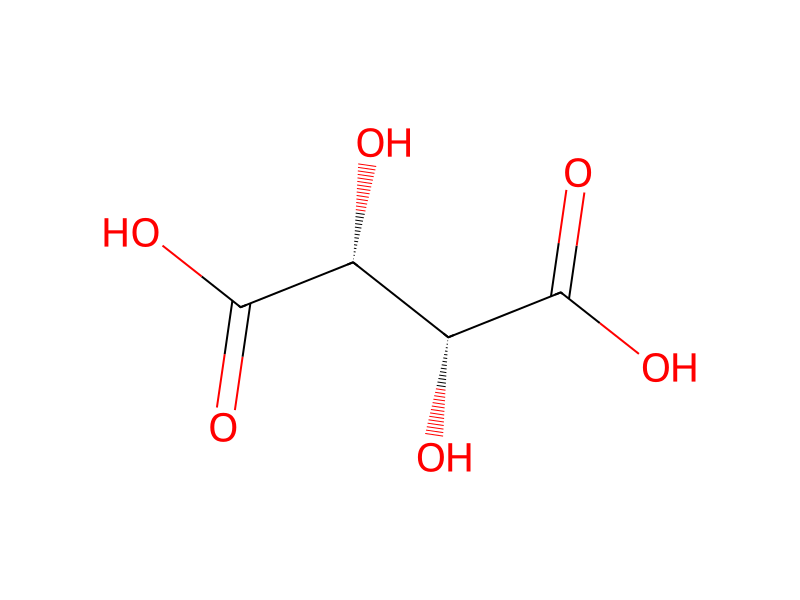
133-37-9- Standard-SMILES
O=C(O)[C@H](O)[C@@H](O)C(=O)O- InChIKey
FEWJPZIEWOKRBE-JCYAYHJZSA-N- Summenformel
- C4H6O6
- Durchschnittliche Molmasse
- 150,09 g/mol
- Monoisotopische Masse
- 150,01643791
Namen und Bezeichner
- Bevorzugter Name
- L-Tartaric acid
- IUPAC
- (2R,3R)-2,3-dihydroxybutanedioic acid
- Lokaler Name
- (+-)-Weinsure
- Englischer Name
- DL-Tartaric acid
- Summenformel
- C4H6O6
- Molmasse
- 150.09
Namen und Synonyme
L-tartaric acid87-69-4L-(+)-Tartaric acidtartaric acid(2R,3R)-2,3-dihydroxysuccinic acid(2R,3R)-2,3-dihydroxybutanedioic acid(+)-Tartaric acid(+)-L-Tartaric acid(R,R)-Tartaric acidThrearic acidDextrotartaric acidL-threaric acid
Weitere Namen anzeigen
RACEMIC ACIDdl-Tartaric acid anhydrousDL-TARTRATEDL-TartaricClopidogrel Impurity 45DL-Tartaric acid concentrateButanedioic acid, 2,3-dihydroxy-, (2R,3R)-rel-DL-Tartaric acid 133-37-9 pure 99% food additives Paratartaric acid kf-wang(at)kf-chem.comUvic acid
Natural tartaric acidAcidum tartaricum(+)-(R,R)-Tartaric acid(2R,3R)-Tartaric acidRechtsweinsaeureKyselina vinna(R,R)-(+)-Tartaric acidWeinsaeure
Datenbank-Bezeichner
- CAS
133-37-9、868-14-4、87-69-4- PubChem CID
- 444305
- DTXSID
DTXSID8023632- ChEMBL
CHEMBL1236315- ChEBI
CHEBI:15671- UNII
- 4J4Z8788N8、W4888I119H
- EC Number
- 201-766-0、205-105-7
- Nikkaji
- J31.839F
Eigenschaften
Berechnete StruktureigenschaftenWird ergänzt
- XLogP
- -1,9
- Polarare Oberfläche (TPSA)
- 115 Ų
- H-Brücken-Donoren
- 4
- H-Brücken-Akzeptoren
- 6
- Frei drehbare Bindungen
- 3
- Schwere Atome
- 10
- Formalladung
- 0
- Komplexität
- 134
Physikochemische Eigenschaften
- Schmelzpunkt
- 210 · 210-212 °C(lit.)
- Siedepunkt
- 191.59 °C · 191.59°C (rough estimate)
- Dichte
- 1.788 · 1.788
- Dampfdruck
- 0.1 hPa · <0.1 hPa (20 °C)
- FEMA
- 3044 · 3044 | TARTARIC ACID (D-, L-, DL-, MESO-)
- Brechungsindex
- 1.586 · 1.5860 (estimate)
- Flammpunkt
- 210 °C · 210 °C
- storage temp.
- 30 °C · Store below +30°C.
- Löslichkeit
- 2 O: · H2O: 0.1 g/mL, clear
- Aggregatzustand
- Liquid
- pka
- 3.03 · 3.03, 4.37(at 25℃)
- Farbe
- White
- PH
- 3.19 · 3.19(1 mM solution);2.58(10 mM solution);2.03(100 mM solution);
- Geruch (Odor)
- 100 % · at 100.00 %. very mild caramellic
- Geruchsart
- odorless
Sicherheit und Regulatorisches
Sicherheitsangaben dienen nur zur Orientierung und ersetzen weder das Sicherheitsdatenblatt (SDB) des Lieferanten noch geltende Vorschriften oder eine fachliche Bewertung.
Sicherheitsdaten
- wgk
- 3
- tsca
- TSCA listed
- hs_code
- 29181200
- risk_code
- 36/37/38-41
- hazard_code
- Xi
- safety_code
- 26-37/39-36
- Speicherklasse
- 11 - Combustible Solids
- Hazard Classifications
- Eye Dam. 1
- Selbstentzündungstemperatur
- 425 °C
Chemie und Industrie
Anwendungen
Occurrenced-Tartaric acid occurs in many fruits or other parts of the plant, free or combined with potassium, calcium or magnesium. It is also reported found in raw, lean fish, white wine, red wine and port wine.
VerwendenDL-Tartaric acid is used as a synergist for antioxidants, emulsifier, sequestrant and flavoring agent. It is also added with citric acid to prepare effervescent salts, thereby enhancing the taste of oral medications. It is also utilized in pigments, processing aids, ink, toner and colorant products. It acts as a chelating agent in metal and farming industries. Further, it is used as lubricant and grease. It is mixed with sodium bicarbonate and used as a leavening agent in food preparation. In the pharmaceutical industry, it is utilized in the preparation of tartar emetic, which is used in cough syrup as an expectorant.
Darstellung
synthetischeThe tartrates used in commerce are obtained as a by-product of wine manufacture and have the L(+) configuration. Produced from argols or wine lees, which are formed in the manufacture of wine by extracting the potassium acid tartrate, transforming this into the calcium salt and then acidifying with dilute sulfuric acid; also by oxidation of d-glucose with nitric acid. The dl-tartaric acid is obtained by boiling the d-tartaric acid with an aqueous solution of NaOH or by oxidation of fumaric acid. The l- and the meso-tartaric acid are also known, but are less important.
Vor- und nachgelagerte Produkte
Vorgelagerte Rohstoffe
Zugehörige Reaktionen
305




Notizen zur Verbindung
Wird geladen…