
(1S,2R)-(+)-Norephedrine

Grundinformationen
- CAS
14838-15-4- Standard-SMILES
CC(N)C(O)c1ccccc1- InChIKey
DLNKOYKMWOXYQA-UHFFFAOYSA-N- Summenformel
- C9H13NO
- Durchschnittliche Molmasse
- 151,21 g/mol
- Monoisotopische Masse
- 151,09971404
Überblick
Phenylpropanolamine is a sympathomimetic agent that acts as a nonselective adrenergic receptor agonist and norepinephrine reuptake inhibitor. It has been used as a decongestant and appetite suppressant. Currently, it is withdrawn from the market in Canada and the United States due to the risk for hemorrahgic strokes.
Namen und Bezeichner
- Bevorzugter Name
- (1S,2R)-(+)-Norephedrine
- IUPAC
- 2-amino-1-phenylpropan-1-ol
- Englischer Name
- Benzenemethanol, -alpha--(1-aminoethyl)-
- Summenformel
- C9H13NO
- Molmasse
- 151.21
Namen und Synonyme
2-Amino-1-phenyl-1-propanol(1S,2R)-(+)-NorephedrineDTXSID70859305RefChem:393928DTXCID00196755628-077-148115-38-4alpha-(1-aminoethyl)benzyl alcoholNSC-120735UNII-683H0R96592-Amino-2-methyl-1-phenylethanol2-Amino-1-hydroxy-1-phenylpropane
Weitere Namen anzeigen
α-(1-Aminoethyl)benzenemethanolBenzenemethanol, α-(1-aminoethyl)-Benzenemethanol, -alpha--(1-aminoethyl)-
beta-Hydroxy-alpha-methylphenethylamineBenzenemethanol, alpha-(1-aminoethyl)-Benzenemethanol, .alpha.-(1-aminoethyl)-683H0R965937577-28-9Dexatrim(-)-Pseudo NorephedrineNorpseudoephedrine, (+)-
Datenbank-Bezeichner
- CAS
14838-15-4、37577-28-9、48115-38-4- PubChem CID
- 4786
- DTXSID
DTXSID70859305- ChEMBL
CHEMBL61006- EC Number
- 628-077-1
- Nikkaji
- J136.573H
Eigenschaften
Berechnete Struktureigenschaften
- XLogP
- 0,8
- Polarare Oberfläche (TPSA)
- 46,3 Ų
- H-Brücken-Donoren
- 2
- H-Brücken-Akzeptoren
- 2
- Frei drehbare Bindungen
- 2
- Schwere Atome
- 11
- Formalladung
- 0
- Komplexität
- 110
Experimentelle und physikochemische Eigenschaften
Drugs
DEA NFLIS-Drug Category -> Phenethylamines (Amphetamines) (S)
Pharmaceuticals
SolubilityFreely soluble
Melting Point190-194 °C
Dissociation Constants9.44 (at 20 °C)
Physikochemische Eigenschaften
- Schmelzpunkt
- 103 °C · 103 °C
- Siedepunkt
- 122 °C · 122 °C(Press: 4-5 Torr)
- Dichte
- 1.071 · 1.071±0.06 g/cm3(Predicted)
- pka
- 12.07 · 12.07±0.45(Predicted)
Sicherheit und Regulatorisches
Sicherheitsangaben dienen nur zur Orientierung und ersetzen weder das Sicherheitsdatenblatt (SDB) des Lieferanten noch geltende Vorschriften oder eine fachliche Bewertung.
GHS-Klassifizierung
GHS Classification
Warning
H302 (100%): Harmful if swallowed [Warning Acute toxicity, oral]
P261, P264, P264+P265, P270, P271, P280, P301+P317, P302+P352, P304+P340, P305+P351+P338, P319, P321, P330, P332+P317, P337+P317, P362+P364, P403+P233, P405, and P501 (click each P-code to see the statement)
Aggregated GHS information provided per 40 reports by companies from 3 notifications to the ECHA C&L Inventory. Each notification may be associated with multiple companies.
Gefahrenhinweise
Hazard Classes and CategoriesAcute Tox. 4 (100%)
Chemie und Industrie
Pharmakologische Informationen
Pharmacodynamics
Phenylpropanolamine (PPA), a sympathomimetic agent structurally similar to pseudoephedrine, is used to treat nasal congestion. Phenylpropanolamine is found in appetite suppressant formulations and with guaifenesinin in cough-cold formulations. In 2000, the FDA requested that all drug companies discontinue marketing products containing phenylpropanolamine, due to an increased risk of hemorrhagic stroke in women who used phenylpropanolamine.
Mechanism of Action
Phenylpropanolamine acts directly on alpha- and, to a lesser degree, beta-adrenergic receptors in the mucosa of the respiratory tract. Stimulation of alpha-adrenergic receptors produces vasoconstriction, reduces tissue hyperemia, edema, and nasal congestion, and increases nasal airway patency. PPA indirectly stimulates beta-receptors, producing tachycardia and a positive inotropic effect.
Biological Half-Life2.1 to 3.4 hours.
Metabolism/MetabolitesHepatic
Absorption, Distribution and ExcretionReduced bioavailability (about 38%) from gastrointestinal tract because of first pass metabolism by monoamine oxidase in the stomach and liver.
Verwendung und Herstellung
UsesUse (kg; approx.) in Germany (2009): >100
Vor- und nachgelagerte Produkte
Nachgelagerte Produkte
Zugehörige Reaktionen
17


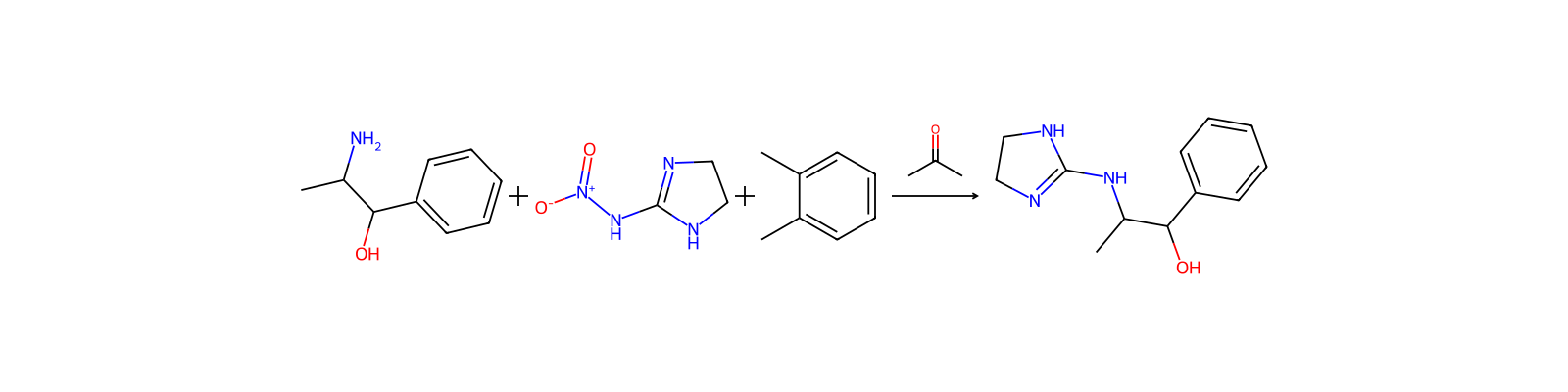

Notizen zur Verbindung
Wird geladen…