
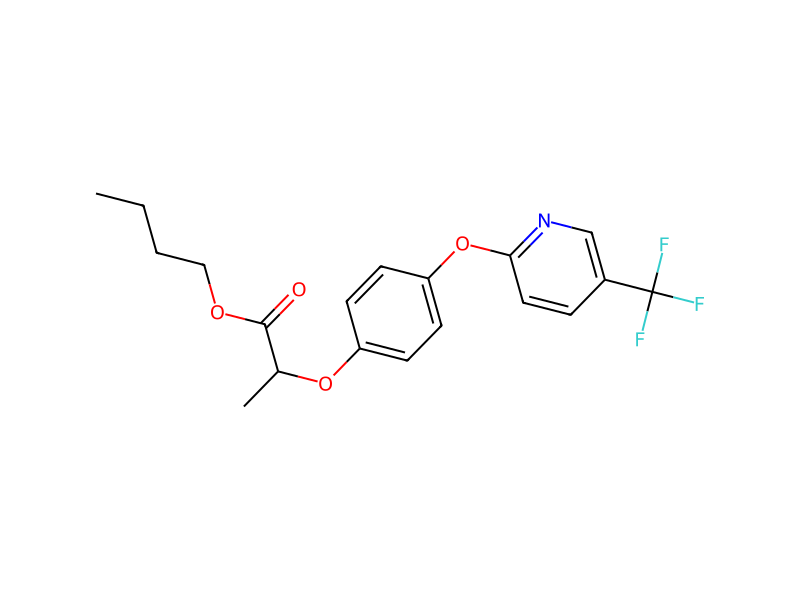
Grundinformationen
- Standard-SMILES
CCCCOC(=O)C(C)Oc1ccc(Oc2ccc(C(F)(F)F)cn2)cc1- InChIKey
VAIZTNZGPYBOGF-UHFFFAOYSA-N- Summenformel
- C19H20F3NO4
- Durchschnittliche Molmasse
- 383,4 g/mol
- Monoisotopische Masse
- 383,13444278
Überblick
Fluazifop Butyl can cause developmental toxicity according to The Environmental Protection Agency (EPA).
Namen und Bezeichner
- Bevorzugter Name
- Fluazifop-butyl
- IUPAC
- butyl 2-[4-[[5-(trifluoromethyl)-2-pyridinyl]oxy]phenoxy]propanoate
- Lokaler Name
- Fluazifop-butyl
- Englischer Name
- Fluazifop-butyl
- Summenformel
- C19H20F3NO4
- Molmasse
- 383.36
Namen und Synonyme
FLUAZIFOP-BUTYL69806-50-4FusiladeFluazifop butylOnecideHalokonHache uno superOnecide ECFusilade 4EIH 773BPP 009DTXSID3034612
Weitere Namen anzeigen
pp009ih773btf1169ts-7236
TF 1169SL-23612O1Z35LQAPP-009TF-1169DTXCID10146122-(4-((5-(Trifluoromethyl)-2-pyridinyl)oxy)phenoxy)propanoic acid butyl esterButyl 2-[4-(5-trifluoromethyl-2-pyridyloxy)phenoxy]propionate
Datenbank-Bezeichner
- CAS
69806-50-4、86334-14-7- PubChem CID
- 50897
- DTXSID
DTXSID3034612- ChEMBL
CHEMBL449397- ChEBI
CHEBI:132963- UNII
- 12O1Z35LQA
- EC Number
- 274-125-6
- Nikkaji
- J18.830A
Eigenschaften
Berechnete Struktureigenschaften
- XLogP
- 4,5
- Polarare Oberfläche (TPSA)
- 57,7 Ų
- H-Brücken-Donoren
- 0
- H-Brücken-Akzeptoren
- 8
- Frei drehbare Bindungen
- 9
- Schwere Atome
- 27
- Formalladung
- 0
- Komplexität
- 453
Experimentelle und physikochemische Eigenschaften
Pesticides
Pesticides -> Herbicides, Other
Herbicides
Pesticide (Fluazifop butyl) -> USDA PDB
LogPLog Kow = 4.5
OdorOdorless
Density1.21 g/cu cm at 20 °C
Color/FormPale straw-colored liquid.
Solubility
In water, 1 mg/l at pH 6.5
Miscible with acetone, cyclohexanone, hexane, methanol, dichloromethane, and xylene. In propylene glycol 24 g/l at 20 °C.
In water, 2 ppm at ambient temperature.
Boiling Point165 °C at 0.02 mm Hg
DecompositionWhen heated to decomposition it emits toxic fumes of F- and NOx.
Melting Point13 °C
Vapor Pressure
0.00000041 [mmHg]
0.055 mPa at 20 °C
Physical Description
Fluazifop butyl appears as a pale straw colored liquid. Selective herbicide.
Light yellow odorless liquid; mp = 13 deg C; [Hawley] Pale yellow odorless liquid; mp = 5 deg C; [MSDSonline]
Stability/Shelf Life
Stable for 3 yr at 25 °C and for 6 months at 37 °C. Reasonably stable in acidic and neutral conditions, but rapidly hydrolyzed in alkaline media (pH 9).
Tested stable in storages 40-120 °F (5-50 °C).
Physikochemische Eigenschaften
- Schmelzpunkt
- 13 °C · 13°C
- Siedepunkt
- 0.05 · bp0.05 167°
- Dichte
- 1.21 · 1.2100
- Flammpunkt
- 2 °C · 2 °C
- storage temp.
- 0 · 0-6°C
- pka
- 0.78 · 0.78±0.22(Predicted)
- Wasserlöslichkeit
- 536.6 ug/L · 536.6ug/L(temperature not stated)
- Merck
- 13 · 13,4142
- Henry's Law Constant
- 4.7 · 4.7×101 mol/(m3Pa) at 25℃, HSDB (2015)
- Major Application
- agriculturecleaning productscosmeticsenvironmentalfood and beveragespersonal care
- InChI
- 1S/C19H20F3NO4/c1-3-4-11-25-18(24)13(2)26-15-6-8-16(9-7-15)27-17-10-5-14(12-23-17)19(20,21)22/h5-10,12-13H,3-4,11H2,1-2H3
- InChIKey
- VAIZTNZGPYBOGF-UHFFFAOYSA-N
- SMILES
- CCCCOC(=O)C(C)Oc1ccc(Oc2ccc(cn2)C(F)(F)F)cc1
- EPA chemische Informationen
- Fluazifop-butyl (69806-50-4)
Sicherheit und Regulatorisches
GHS-Klassifizierung
GHS Classification
Danger
H360D ***: May damage the unborn child [Danger Reproductive toxicity]
P203, P273, P280, P318, P391, P405, and P501 (click each P-code to see the statement)
Danger
H360 (59.2%): May damage fertility or the unborn child [Danger Reproductive toxicity]
P203, P273, P280, P318, P391, P405, and P501 (click each P-code to see the statement)
Gefahrenhinweise
Regulatory Information
Hazard Traits - Developmental Toxicity; Reproductive Toxicity
Commission Regulation (EC) No 33/2008
The New Jersey Worker and Community Right to Know Act requires public and private employers to provide information about hazardous substances at their workplaces. (N.J.S.A. 34:5A-1 et. seq.)
Other Safety InformationIMAP assessments - Propanoic acid, 2-[4-[[5-(trifluoromethyl)-2-pyridinyl]oxy]phenoxy]-, butyl ester: Human health tier I assessment
DOT LabelClass 9
Fire HazardsExcerpt from ERG Guide 171 [Substances (Low to Moderate Hazard)]:
Health HazardsExcerpt from ERG Guide 171 [Substances (Low to Moderate Hazard)]:
Hazards SummaryVirtually non-toxic by ingestion; May be formulated with xylene up to 38%; No chronic toxicity in animal studies at doses up to 10 mg/kg/day; Elevation of liver enzymes in high-dose animals; Mild irritant; [HSDB]
Reactive GroupAmines, Phosphines, and Pyridines
FIFRA Requirements
Tolerances are established for residues for the herbicide fluazifop-butyl(+ or -)-2-(4-(5-(trifluoromethyl)-2-pyridinyl)oxy)phenoxy propanoic acid (fluazifop), both free and conjugated and of (+ or -)-2-(4-(-(trifluoromethyl)-2-pyridinyl)oxy)phenoxy propanoate (fluazifop-butyl), all expressed as fluazifop, in or on the following raw agricultural commodities: cattle, fat; cattle, meat; cattle, mbyp; cottonseed; eggs; goats, fat; goats, meat; goats, mbyp; hogs, fat; hogs, meat; hogs, mbyp; horses, fat; horses, meat; horses mbyp; milk; poultry, fat; poultry, meat; poultry, mbyp; sheep, fat; sheep, meat; sheep, mbyp; and soybeans.
Tolerances with regional registration are established for residues fluazifop-butyl(+ or -)-2-(4-(5-(trifluoromethyl)-2-pyridinyl)oxy)phenoxy propanoic acid (fluazifop), both free and conjugated and of (+ or -)butyl-2-(4-(5-(trifluoromethyl)-2-pyridinyl)oxy)phenoxy propanoate (fluazifop-butyl), all expressed as fluazifop, in or on the following raw agricultural commodities: peppers, tabasco.
Tolerances are established for residues of the resolved isomer of fluazifop, (R)-2-(4-((5-(trifluoromethyl)-2-pyridinyl)oxy)phenoxy)propanoic acid both free and conjugated and of fluazifop-P-butyl, butyl(R)-2-(4-((5-(triflluoromethyl)-2-pyridinyl)phenoxy)propanoate, all expressed as fluazifop, in or on the raw agricultural commodity: carrots ; endive; macadamia nuts; onions (bulb); pecans; spinach; stone fruits; and sweet potatoes.
Tolerances with regional registration ... are established for residues of the resolved isomer of the herbicide fluazifop, (R)-2-(4-((5-trifluoromethyl)-2-pyridinyl)-oxy)phenoxy)propanoic acid, both free and conjugated and of fluazifop-P-butyl, butyl(R)-2-(4-((5-(trifluoromethyl)-2-pyridinyl)oxy)phenoxy)propanoate, all expressed as fluazifop, in or on the raw agricultural commodities: asparagus; coffee; and rhubarb.
As the federal pesticide law FIFRA directs, EPA is conducting a comprehensive review of older pesticides to consider their health and environmental effects and make decisions about their future use. Under this pesticide reregistration program, EPA examines health and safety data for pesticide active ingredients initially registered before November 1, 1984, and determines whether they are eligible for reregistration. In addition, all pesticides must meet the new safety standard of the Food Quality Protection Act of 1996. Pesticides for which EPA had not issued Registration Standards prior to the effective date of FIFRA, as amended in 1988, were divided into three lists based upon their potential for human exposure and other factors, with List B containing pesticides of greater concern and List D pesticides of less concern. Butyl (RS)-2-(4-((5-(trifluoromethyl)-2-pyridinyl)oxy)phenoxy)propanoate is found on List B. Case No: 2285; Pesticide type: herbicide; Case Status: No products containing the pesticide are actively registered ... The case /is characterized/ as "cancelled." Under FIFRA, pesticide producers may voluntarily cancel their registered products. EPA also may cancel pesticide registrations if registrants fail to pay required fees or make/meet certain reregistration commitments, or if EPA reaches findings of unreasonable adverse effects.; Active ingredient (AI): Butyl (RS)-2-(4-((5-(trifluoromethyl)-2-pyridinyl)oxy)phenoxy)propanoate; Data Call-in (DCI) Date(s): 06/12/91; AI Status: The active ingredient is no longer contained in any registered pesticide products ... "cancelled.".
Reactivity Profile
FLUAZIFOP BUTYL is a trimethyl phenoxy pyridine ester. May react with acids to liberate heat. Strong oxidizing acids may cause a vigorous reaction that is sufficiently exothermic to ignite the reaction products. May generate heat with caustic solutions. Genreates flammable hydrogen with alkali metals and hydrides.
Air and Water ReactionsSlightly soluble in water.
Hazard Classes and Categories
Repr. 1B (59.2%)
Reproductive toxicity - category 1B
Repr. 1B
Sicherheit und Schutzausrüstung
Fire FightingExcerpt from ERG Guide 171 [Substances (Low to Moderate Hazard)]:
First AidExcerpt from ERG Guide 171 [Substances (Low to Moderate Hazard)]:
Nonfire Spill ResponseExcerpt from ERG Guide 171 [Substances (Low to Moderate Hazard)]:
Disposal Methods
SRP: At the time of review, criteria for land treatment or burial (sanitary landfill) disposal practices are subject to significant revision. Prior to implementing land disposal of waste residue (including waste sludge), consult with environmental regulatory agencies for guidance on acceptable disposal practices.
Isolation and EvacuationExcerpt from ERG Guide 171 [Substances (Low to Moderate Hazard)]:
Allowable Tolerances
Tolerances are established for residues for the herbicide fluazifop-butyl(+ or -)-2-(4-(5-(trifluoromethyl)-2-pyridinyl)oxy)phenoxy propanoic acid (fluazifop), both free and conjugated and of (+ or -)-2-(4-(-(trifluoromethyl)-2-pyridinyl)oxy)phenoxy propanoate (fluazifop-butyl), all expressed as fluazifop, in or on the following raw agricultural commodities: cattle, fat 0.05 ppm; cattle, meat 0.05 ppm; cattle, mbyp 0.05 ppm; cottonseed 0.1 ppm; eggs 0.05 ppm; goats, fat 0.05 ppm; goats, meat 0.05 ppm; goats, mbyp 0.05 ppm; hogs, fat 0.05 ppm; hogs, meat 0.05 ppm; hogs, mbyp 0.05 ppm; horses, fat 0.05 ppm; horses, meat 0.05 ppm; horses mbyp 0.05 ppm; milk 0.05 ppm; poultry, fat 0.05 ppm; poultry, meat 0.05 ppm; poultry, mbyp 0.05 ppm; sheep, fat 0.05 ppm; sheep, meat 0.05 ppm; sheep, mbyp 0.05 ppm; and soybeans 1.0 ppm.
Tolerances with regional registration are established for residues fluazifop-butyl(+ or -)-2-(4-(5-(trifluoromethyl)-2-pyridinyl)oxy)phenoxy propanoic acid (fluazifop), both free and conjugated and of (+ or -)butyl-2-(4-(5-(trifluoromethyl)-2-pyridinyl)oxy)phenoxy propanoate (fluazifop-butyl), all expressed as fluazifop, in or on the following raw agricultural commodities: peppers, tabasco 1.0 ppm.
Tolerances are established for residues of the resolved isomer of fluazifop, (R)-2-(4-((5-(trifluoromethyl)-2-pyridinyl)oxy)phenoxy)propanoic acid both free and conjugated and of fluazifop-P-butyl, butyl(R)-2-(4-((5-(triflluoromethyl)-2-pyridinyl)phenoxy)propanoate, all expressed as fluazifop, in or on the raw agricultural commodity: carrots 2.0 ppm; endive 6.0 ppm; macadamia nuts 0.1 ppm; onions (bulb) 0.5 ppm; pecans 0.05 ppm; spinach 6.0 ppm; stone fruits 0.05 ppm; and sweet potatoes 0.5 ppm.
Tolerances with regional registration ... are established for residues of the resolved isomer of the herbicide fluazifop, (R)-2-(4-((5-trifluoromethyl)-2-pyridinyl)-oxy)phenoxy)propanoic acid, both free and conjugated and of fluazifop-P-butyl, butyl(R)-2-(4-((5-(trifluoromethyl)-2-pyridinyl)oxy)phenoxy)propanoate, all expressed as fluazifop, in or on the raw agricultural commodities: asparagus 3.0 ppm; coffee 0.1 ppm; and rhubarb 0.5 ppm.
Personal Protective Equipment (PPE)
Excerpt from ERG Guide 171 [Substances (Low to Moderate Hazard)]:
Protective clothing, PVC gloves when spraying Fusilade 4E. Also, apron and full face shield when handling or mixing concentrate. Refer to labels.
Toxikologische Informationen
Ecotoxicity Values
LD50 Mallard duck oral >17,000 mg/kg
LC50 Mallard duck >25,000 mg/kg diet/5-Day dietary/
LC50 Ring-necked pheasants >18,500 mg/kg diet /5-Day dietary/
LC50 Rainbow trout 1.37 mg/L/96 hr /conditions of bioassay not specified/
For more Ecotoxicity Values (Complete) data for FLUAZIFOP-BUTYL (6 total), please visit the HSDB record page.
Environmental Fate
TERRESTRIAL FATE: Based on a recommended classification scheme(1), an estimated Koc value of 6700(SRC), determined from a measured log Kow of 4.5(2) and a recommended regression-derived equation(3), indicates that fluazifop-butyl is expected to be immobile in soil(SRC). Volatilization of fluazifop-butyl from moist and dry soil surfaces is not expected to be important(SRC) given an estimated Henry's Law constant of 2.1X10⁻⁷ atm-cu m/mole(SRC), from its experimental values for vapor pressure, 4.1X10⁻⁷ mm Hg(2), and water solubility, 1 mg/l(2), and this compound's vapor pressure(2), respectively. Biodegradation of fluazifop-butyl in soil is expected to be important(SRC); fluazifop-butyl is rapidly biodegraded in moist soils, with a half-life of less than 1 week; the major degradation product being fluazifop(4).
AQUATIC FATE: Based on a recommended classification scheme(1), an estimated Koc value of 6700(SRC), determined from a measured log Kow of 4.5(2) and a recommended regression-derived equation(3), indicates that fluazifop-butyl is expected to adsorb to suspended solids and sediment in water(SRC). Volatilization from water surfaces is not expected to be an important process(3,SRC) based on an estimated Henry's Law constant of 2.1X10⁻⁷ atm-cu m/mole(SRC) from its experimental values for vapor pressure, 4.1X10⁻⁷ mm Hg(2), and water solubility, 1 mg/l(2). According to a classification scheme(5), an estimated BCF of 1500(3,SRC), from a measured log Kow(2), suggests that bioconcentration in aquatic organisms is very high(SRC). Biodegradation of fluazifop-butyl in aquatic systems may be important(SRC), given its microbial degradation in moist soils(6). Hydrolysis half-lives of 2.2 years and 79 days have been estimated for fluazifop-butyl at pHs 7 and 8, respectively(7).
ATMOSPHERIC FATE: According to a model of gas/particle partitioning of semivolatile organic compounds in the atmosphere(1), fluazifop-butyl, which has a measured vapor pressure of 4.1X10⁻⁷ mm Hg at 20 °C(2), will exist in both the vapor and particulate phases in the ambient atmosphere. Vapor-phase fluazifop-butyl is degraded in the atmosphere by reaction with photochemically-produced hydroxyl radicals(SRC); the half-life for this reaction in air is estimated to be about 13 hours(3,SRC). Particulate-phase fluazifop-butyl may be physically removed from the air by wet and dry deposition(SRC).
Adverse EffectsOccupational hepatotoxin - Secondary hepatotoxins: the potential for toxic effect in the occupational setting is based on cases of poisoning by human ingestion or animal experimentation.
Plant ConcentrationsResidues in potatoes and soybeans treated with fluazifop-butyl (Fusilade) were below 0.05 ug/g when harvested 90 days after herbicide application(1).
Soil Adsorption/Mobility
The Koc of fluazifop-butyl is estimated as approximately 6700(SRC), using a measured log Kow of 4.5(1) and a regression-derived equation(2,SRC). According to a recommended classification scheme(3), this estimated Koc value suggests that fluazifop-butyl is expected to be immobile in soil(SRC). Fluazifop-butyl is of low mobility in soil(4). Fluazifop-butyl has been found to bind strongly with homoionic clays(5).
TSCA Test Submissions
Fluazifop-butyl (CAS # 69806-50-4) was evaluated for subchronic oral toxicity in beagle dogs (4/sex/group) administered doses of 0 (vehicle control, corn oil), 5, 25 and 250 mg/kg/day in gelatin capsules for 13 weeks. Severe corneal ulceration, requiring humane sacrifice of 2 males and 1 female of a 250 mg/kg/day dosage during Week 4, prompted adjustment of this regimen to 125 mg/kg/day for the remainder of study. Prior to sacrifice, these dogs also exhibited progressive conjunctivitis and photophobia, and all lost weight. Hematology revealed reduced platelet counts, neutrophilia and immature white cells. Bilirubin, and alanine amine-transferase and alkaline phosphatase activity were elevated, and plasma protein concentrations were slightly depressed. The urine contained bile pigments and appeared bright yellow. Distended gall bladders, large friable livers and congested caecum and colon from engorgement of the blood vessels were noted upon necropsy. Histopathological evaluation confirmed treatment-related lesions of the eyes, liver, testes and gastrointestinal tract. Conversely, all dogs surviving 13-week treatment showed no clinical signs of toxicity, and no treatment-related changes on physical and ophthalmic examinations at Weeks 4, 8 and 12. All observed abnormalities were noted solely in the high-dose treatment group, including reduced food intake and bodyweight gains were most pronounced from Weeks 4-8 and reduced platelet counts, as seen in the early sacrificed animals, were resolved upon reduction of the dosage. Alkaline phosphatase, alanine amino-transferase and aspartate amino-transferase activities were increased in 250 mg/kg/day males just prior to the adjustment to a 125 mg/kg/day dosage, while both high-dose females and males exhibited alanine amino-transferase activity throughout 13-week treatment. High-dose dogs also had increased bromosulphonphthalein retention at the end of treatment, while glucose and cholesterol were slightly reduced throughout study. Upon terminal necropsy, organ weights and gross pathology of dogs surviving 13-week study were unremarkable and histopathological analysis identified a solitary incidence of arrested maturation in the testicular germinal epithelium of one high-dose male.
Fluazifop-butyl (CAS # 69806-50-4) was evaluated for subchronic dietary toxicity in Wistar rats (20/sex/group) receiving 0, 10, 100 and 2000 ppm by dietary inclusion for 13 weeks. Mean achieved dosages during 13-week treatment were 0, 0.7, 7.1 and 144.5 mg/kg/day in males of the respective treatment groups and 0, 0.8, 8.0 and 161.9 mg/kg/day in females. No mortality or pharmacotoxic signs were documented throughout treatment at any exposure level. In males of a 2000 ppm dietary exposure, treatment was associated with depressed food intake and bodyweight gains. Less efficient food utilization was noted in the high-dose males relative to controls. High-dose males also exhibited abnormalities in hematological values (Weeks 5 and 11), including slightly depressed packed cell volume, hemoglobin concentration and red blood cell count. The serum chemistry in this group was characterized by elevated alkaline phosphatase values, and higher alanine amino-transferase and aspartate amino-transferase activities. Also, cholesterol and total protein concentrations were low as compared to controls. The plasma of 2000 ppm females was found at Week 11 with depressed total protein and albumin contents relative to controls. Again at Week 11, isolated instances of elevated urinary protein levels were identified among high-dose males and females. Upon terminal necropsy, only high-dose males had evidence of hepatic enlargement or swelling (7/20), although higher absolute and relative liver weights were significant (p < 0.01, Student's t-test) in both males and females of the 2000 ppm group. Also, relative kidney weights were also significantly elevated in the high-dose males. Histopathology confirmed a specific liver toxicity in male rats, marked by significant dose-related hepatocytic hypertrophy with isolated instances of vesicular nuclei and or periacinal hepatocytic necrosis. Renal tubular degeneration, 70% and 20% in 2000 and 100 ppm males respectively, correlated with elevated kidney weights in these groups.
Fluazifop-butyl (CAS # 69806-50-4) was evaluated for subacute oral toxicity in Wistar albino rats (10/sex/group) administered 10 ml/kg doses in corn oil of 0, 4, 20, 100 and 500 mg/kg/day by oral gavage, 5 days/week for 2 weeks. Five-day weekly treatment periods were each followed by 2-day recovery. High-dose males only displayed overt toxicity and comprised the 2 study lethalities. These two 500 mg/kg/day males were sacrificed in extremis on Days 11 and 14 with severe pharmacotoxic signs including piloerection, reduced motor activity, retinal pallor, and a prone or hunched posture. One rat was bleeding from the penis. High-dose males consumed less food than control rats and their growth rate was depressed from Day 10, although mean bodyweights by the end of study were not significantly lower than controls. Hematology and serum chemistries suggested a primary toxicity of the liver, mostly in high-dose males. Males of the 500 mg/kg/day dosage group were found with statistically significant deficiencies in group mean hemoglobin concentration, packed cell volume, mean cell volume and erythrocyte count. Also, neutrophil counts were elevated and activated thromboplastin times were also increased in a dose-related manner. Blood chemistry indicated a dose-related elevation of alkaline phosphatase activity in 100 and 500 mg/kg/day males, elevated aspartate amino-transferase activity in 500 mg/kg/day males, and elevated cholesterol concentrations in 500 mg/kg/day males and females. Conversely, enzyme activity was depressed in rats of lower dosages. Blood samples from 1 rat killed in extremis showed still greater stimulation of enzyme activity, with reduced plasma proteins and electrolyte imbalance. Bone marrow cytology was negative for any treatment-related changes. Upon gross necropsy, no gross lesions related to treatment were identified. The decedent animals were found with abnormal upper gastrointestinal contents, and one rat exhibited congestion of mesenteric lymph nodes with pallor of kidneys, liver and spleen. Male rats of 100 and 500 mg/kg/day dosages had higher absolute and relative liver weights that was not seen in their female counterparts. Microscopic examination confirmed a particular liver pathology of treated males, characterized by dosage-related hepatocytic hypertrophy and necrosis (study lethalities), and dosage-related slight to moderate periacinal hepatocytic hypertrophy. Females of the 2 highest dosage groups only demonstrated dosage-related, slight increases in periacinal hypertrophy. Micropathological changes also included decreased periacinal hepatocytic anoxic vacuolation in all males but those of the highest dosage group and a universal treatment-related extramedullary hemopoiesis.
Fluazifop butyl (CAS # 69806-50-4) was evaluated for developmental toxicity in the progeny of Sprague-Dawley CD rats administered oral doses of 0 (corn oil vehicle control), 10, 50 and 200 mg/kg/day by gavage on gestation days 6-20. The general condition of treated rats was comparable to controls. Treatment did not alter food consumption and usage efficiency, although terminal mean bodyweights were significantly (p < 0.05; multiple t-test) depressed in the high-dose (200 mg/kg/day) group. Gravid uterus weights were also significantly (p < 0.01) elevated in association with the high dosage. Relative liver weights were also significantly (p < 0.05) greater in high-dose dams. Upon necropsy, no in-utero fetal mortality was attributable to treatment. Delayed fetal ossification and reduced fetal weight were dose-related and evident at all treatment levels, although fetal weights in association with dosages of 10 and 50 mg/kg/day were within the threshold of historical controls. Observed low incidence diaphragmatic hernia in fetuses of treated animals was also presumed a toxic response, although an unequivocal dose-response relationship was not established.
For more TSCA Test Submissions (Complete) data for FLUAZIFOP-BUTYL (6 total), please visit the HSDB record page.
Artificial Pollution SourcesFluazifop-butyl's former use as a highly selective post-emergence grass killer(1) will have resulted in its release to the environment(SRC).
Environmental Biodegradation
Fluazifop-butyl is rapidly biodegraded in moist soils, with a half-life of less than 1 week, the major degradation product being fluazifop(1). Conditions that promote microbial activity in soil, such as high moisture levels have been found to favor the degradation of fluazifop-butyl in soil(2). Fluazifop-butyl was rapidly hydrolyzed by a mixed culture enriched from a landfill leachate to fluazifop(3).
Carcinogen Classification
No indication of carcinogenicity to humans (not listed by IARC).
No indication of carcinogenicity to humans (not listed by IARC).
Environmental Bioconcentration
An estimated BCF of 1500 was calculated for fluazifop-butyl(SRC), using a measured log Kow of 4.5(1) and a recommended regression-derived equation(2). According to a classification scheme(3), this BCF suggests that bioconcentration in aquatic organisms is very high(SRC).
Volatilization from Water/Soil
The Henry's Law constant for fluazifop-butyl is estimated as 2.1X10⁻⁷ atm-cu m/mole(SRC) from its experimental values for vapor pressure, 4.1X10⁻⁷ mm Hg(1), and water solubility, 1 mg/l(1). This value indicates that volatilization of fluazifop-butyl from water surfaces is not expected to be an important fate process(2,SRC). Fluazifop-butyl's estimated Henry's Law constant(1,SRC) and measured vapor pressure of 4.1X10⁻⁷ mm Hg(1) indicate that volatilization from moist and dry soil surfaces, respectively, is not expected to be an important fate process(SRC).
Non-Human Toxicity Excerpts
Very low toxicity to bees, both orally and by contact.
Low toxicity to aquatic invertebrates.
Mild skin and eye irritant; practically non-irritating to eyes (rabbits). Not a skin sensitizer (guinea pigs).
Regulatorische Informationen
FIFRA Requirements
Tolerances are established for residues for the herbicide fluazifop-butyl(+ or -)-2-(4-(5-(trifluoromethyl)-2-pyridinyl)oxy)phenoxy propanoic acid (fluazifop), both free and conjugated and of (+ or -)-2-(4-(-(trifluoromethyl)-2-pyridinyl)oxy)phenoxy propanoate (fluazifop-butyl), all expressed as fluazifop, in or on the following raw agricultural commodities: cattle, fat; cattle, meat; cattle, mbyp; cottonseed; eggs; goats, fat; goats, meat; goats, mbyp; hogs, fat; hogs, meat; hogs, mbyp; horses, fat; horses, meat; horses mbyp; milk; poultry, fat; poultry, meat; poultry, mbyp; sheep, fat; sheep, meat; sheep, mbyp; and soybeans.
Tolerances with regional registration are established for residues fluazifop-butyl(+ or -)-2-(4-(5-(trifluoromethyl)-2-pyridinyl)oxy)phenoxy propanoic acid (fluazifop), both free and conjugated and of (+ or -)butyl-2-(4-(5-(trifluoromethyl)-2-pyridinyl)oxy)phenoxy propanoate (fluazifop-butyl), all expressed as fluazifop, in or on the following raw agricultural commodities: peppers, tabasco.
Tolerances are established for residues of the resolved isomer of fluazifop, (R)-2-(4-((5-(trifluoromethyl)-2-pyridinyl)oxy)phenoxy)propanoic acid both free and conjugated and of fluazifop-P-butyl, butyl(R)-2-(4-((5-(triflluoromethyl)-2-pyridinyl)phenoxy)propanoate, all expressed as fluazifop, in or on the raw agricultural commodity: carrots ; endive; macadamia nuts; onions (bulb); pecans; spinach; stone fruits; and sweet potatoes.
Tolerances with regional registration ... are established for residues of the resolved isomer of the herbicide fluazifop, (R)-2-(4-((5-trifluoromethyl)-2-pyridinyl)-oxy)phenoxy)propanoic acid, both free and conjugated and of fluazifop-P-butyl, butyl(R)-2-(4-((5-(trifluoromethyl)-2-pyridinyl)oxy)phenoxy)propanoate, all expressed as fluazifop, in or on the raw agricultural commodities: asparagus; coffee; and rhubarb.
As the federal pesticide law FIFRA directs, EPA is conducting a comprehensive review of older pesticides to consider their health and environmental effects and make decisions about their future use. Under this pesticide reregistration program, EPA examines health and safety data for pesticide active ingredients initially registered before November 1, 1984, and determines whether they are eligible for reregistration. In addition, all pesticides must meet the new safety standard of the Food Quality Protection Act of 1996. Pesticides for which EPA had not issued Registration Standards prior to the effective date of FIFRA, as amended in 1988, were divided into three lists based upon their potential for human exposure and other factors, with List B containing pesticides of greater concern and List D pesticides of less concern. Butyl (RS)-2-(4-((5-(trifluoromethyl)-2-pyridinyl)oxy)phenoxy)propanoate is found on List B. Case No: 2285; Pesticide type: herbicide; Case Status: No products containing the pesticide are actively registered ... The case /is characterized/ as "cancelled." Under FIFRA, pesticide producers may voluntarily cancel their registered products. EPA also may cancel pesticide registrations if registrants fail to pay required fees or make/meet certain reregistration commitments, or if EPA reaches findings of unreasonable adverse effects.; Active ingredient (AI): Butyl (RS)-2-(4-((5-(trifluoromethyl)-2-pyridinyl)oxy)phenoxy)propanoate; Data Call-in (DCI) Date(s): 06/12/91; AI Status: The active ingredient is no longer contained in any registered pesticide products ... "cancelled.".
Sicherheitsdaten
- wgk
- 3
- ridadr
- UN3082 9/PG 3
- hs_code
- 29333990
- RTECS-Nr.
- UA3000000
- risk_code
- 61-50/53-36-20/21/22-11
- hazard_code
- T,N,Xn,F
- safety_code
- 53-45-60-61-36-26-16
- Speicherklasse
- 6.1C - Combustible acute toxic Cat.3toxic compounds or compounds which causing chronic effects
- Giftige Stoffe Daten
- 69806-50-4(Hazardous Substances Data)
- Hazard Classifications
- Aquatic Acute 1Aquatic Chronic 1Repr. 1B
Chemie und Industrie
Pharmakologische Informationen
Mechanism of ActionActs by interfering with ATP production.
Metabolism/MetabolitesIn plants, fluazifop-butyl is rapidly hydrolyzed to fluazifop.
MeSH Pharmacological ClassificationPesticides used to destroy unwanted vegetation, especially various types of weeds, grasses (POACEAE), and woody plants. Some plants develop HERBICIDE RESISTANCE.
Verwendung und Herstellung
Uses
Used as food additive, herbicide, and agricultural chemical; [Hawley] Used as selective post-emergence herbicide for control of annual and perennial grasses; [HSDB]
Cancelled--no longer registered as a pesticide for use in the US; [HSDB]
Farming (Pesticides) [Category: Industry]
The active ingredient is no longer contained in any registered pesticide products ... "cancelled."
Selective post-emergence herbicide.
Highly selective post-emergence grass killer. It will control both annual and perennial grasses.
Methods of Manufacturingn-Butanol + 2-(4-chlorophenoxy)propionic acid + 2-hydroxy-5-(trifluoromethyl)pyridine (esterification/ether formation)
Formulations/PreparationsEmulsifiable concentrate, wettable powder.
Use ClassificationHerbicides
General Manufacturing InformationNot registered for use in the U.S.
Anwendungen
VerwendenFluazifop-butyl-d9 is the labeled version of Fluazifop-butyl (F407433), which is often found in herbicidal and fungicidal mixture compositions.
Vor- und nachgelagerte Produkte
Vorgelagerte Rohstoffe
Anbieter20 Anbieter
梯希爱(上海)化工贸易有限公司021-61109150 · [email protected]
上海艾梯西生物科技有限公司18721763493
上海毕楷科技有限公司18516304666
南京生利德生物科技有限公司025-57798810 18652991625 · [email protected]
天津普西唐生物医药科技有限公司010-60605840 · [email protected]
Sigma-Aldrich西格玛奥德里奇(上海)贸易有限公司021-61415566 800-8193336 · [email protected]
HANGZHOU LEAP CHEM CO., LTD.+86-571-87711850 +86-15355479329 · [email protected]
南通市苏北化工原料有限公司0513-85290972 18762756250 · [email protected]
南京罗迈美生物科技有限公司[email protected]
杭州洁汉化工有限公司+86-571-86217390; +8618058761490 · [email protected]
深圳聚合生化科技有限公司+86-400-002-6226 · [email protected]
爆牛贸易重庆有限公司+86-023-6139-8061 +86-86-13650506873 · [email protected]
SHANGHAI KEAN TECHNOLOGY CO., LTD.+8613817748580 · [email protected]
SUZHOU SENFEIDA CHEMICAL CO.,LTD+86-0512-83500002 +86-15195660023 · [email protected]
上海安谱实验科技股份有限公司18502138905 · [email protected]
上海杰股生物科技有限公司021-51698675 · [email protected]
南京世洲生物科技有限公司18351873721 · [email protected]
陕西缔都化学有限公司17691182729 17392216275 · [email protected]
Henan Fengda Chemical Co., Ltd+86-371-86557731 +86-13613820652 · [email protected]
南通众合化工新材料有限公司0513-85666561 15950816326 · [email protected]
Zugehörige Reaktionen
6


Verknüpfte Notizen
Wird geladen…