Reaktionsgleichung

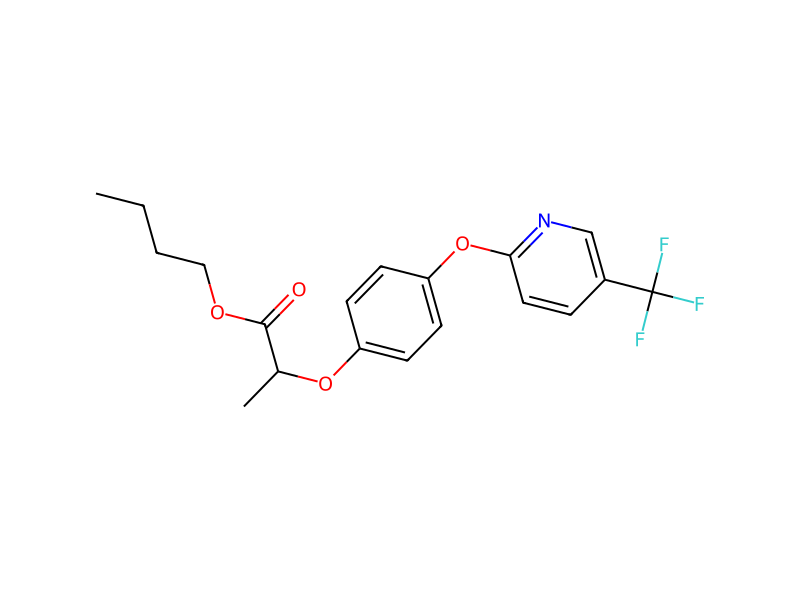
[F:1][C:2]([F:27])([F:26])[C:3]1[CH:4]=[CH:5][C:6]([O:9][C:10]2[CH:25]=[CH:24][C:13]([O:14][C:15](=[CH2:23])[C:16]([O:18][CH2:19][CH2:20][CH2:21][CH3:22])=[O:17])=[CH:12][CH:11]=2)=[N:7][CH:8]=1.[H][H].C([O-])(=O)CC>C(O)CCC.[Pd]>[F:26][C:2]([F:1])([F:27])[C:3]1[CH:4]=[CH:5][C:6]([O:9][C:10]2[CH:25]=[CH:24][C:13]([O:14][CH:15]([CH3:23])[C:16]([O:18][CH2:19][CH2:20][CH2:21][CH3:22])=[O:17])=[CH:12][CH:11]=2)=[N:7][CH:8]=1Komponenten
6
Edukt 3



Produkt 1
Reagenzien, Katalysatoren, Lösungsmittel 2


Versuchsvorschrift
The product (15 g) from Step 3 in n-butanol (300 ml) was hydrogenated at room temperature and atmospheric pressure using a 10% palladium on carbon catalyst. When the uptake of hydrogen ceased, the catalyst was filtered off and the filtrate evaporated under reduced pressure. The residue was purified by short-path distillation (at 140°-150°/0.2 mmHg) to afford a main fraction (11.6 g) containing 57% w/w of the desired propionate which was recrystallised from cold hexane to give n-butyl 2-[4-(5-trifluoromethylpyrid-2-yloxy)-phenoxy]propionate. The propionate may then be obtained substantially pure by recrystallisation from cold hexane.
Aufarbeitung
- customwas hydrogenated at room temperature
- filtrationthe catalyst was filtered off
- customthe filtrate evaporated under reduced pressure
- distillationThe residue was purified by short-path distillation (at 140°-150°/0.2 mmHg)
- customto afford a main fraction (11.6 g)
- customwas recrystallised from cold hexane
Quellen und Nachweise
- ORD-Eintrag
- ord-e4248a7e14cb4d4ca79cf0131ba920b0
- Quelldatensatz
- uspto-grants-1983_11
- Patentnummer
- US04414391
Verknüpfte Notizen
Wird geladen…