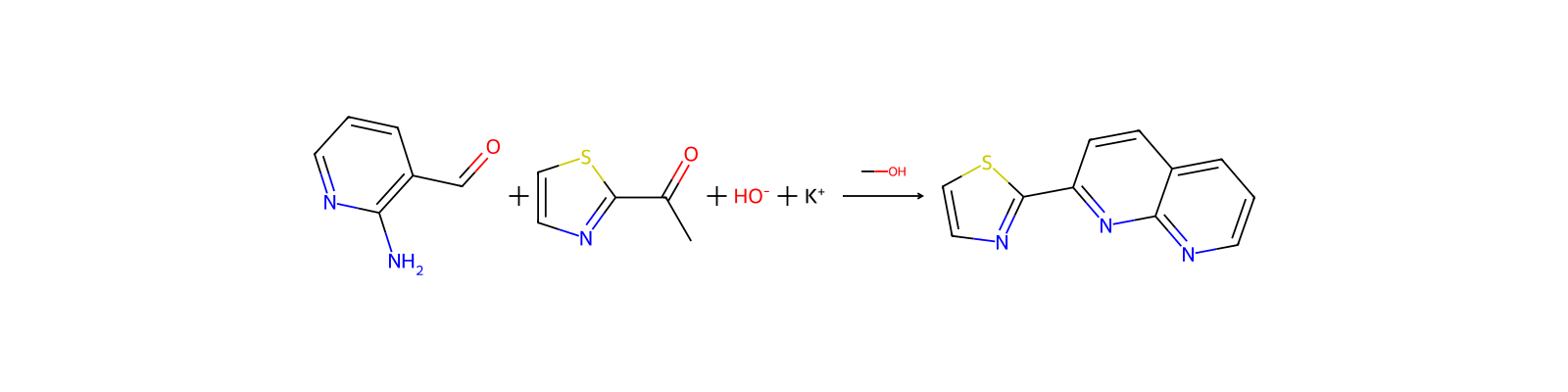
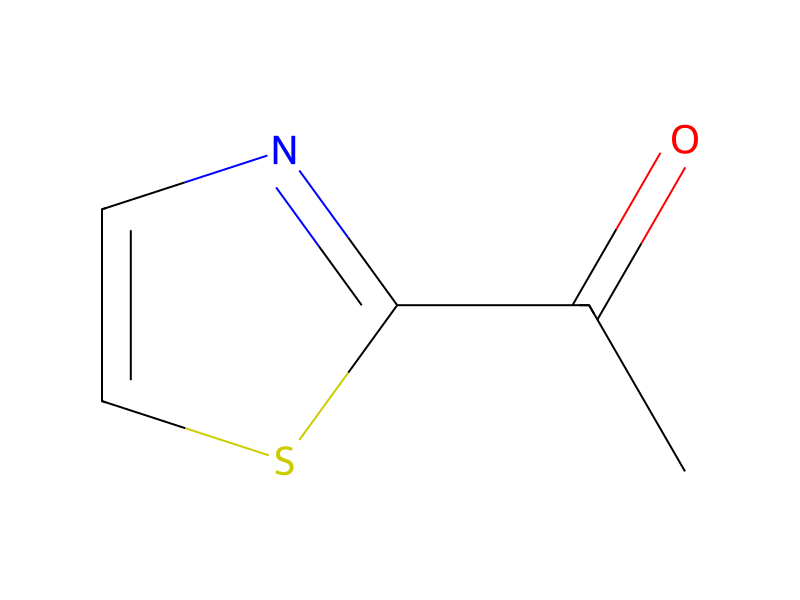
Grundinformationen
- Standard-SMILES
CC(=O)c1nccs1- InChIKey
MOMFXATYAINJML-UHFFFAOYSA-N- Summenformel
- C5H5NOS
- Durchschnittliche Molmasse
- 127,17 g/mol
- Monoisotopische Masse
- 127,00918496
Namen und Bezeichner
- Bevorzugter Name
- 2-Acetylthiazole
- IUPAC
- 1-(1,3-thiazol-2-yl)ethanone
- Lokaler Name
- 1-(Thiazol-2-yl)ethan-1-on
- Englischer Name
- 2-Acetylthiazole
- Summenformel
- C5H5NOS
- Molmasse
- 127.16
Namen und Synonyme
2-Acetylthiazole24295-03-21-(1,3-Thiazol-2-yl)ethan-1-one1-(1,3-Thiazol-2-yl)ethanoneEthanone, 1-(2-thiazolyl)-1-(Thiazol-2-yl)ethan-1-oneMethyl 2-thiazolyl ketoneKetone, methyl 2-thiazolyl2-Thiazolyl methyl ketoneFEMA No. 3328DTXSID003016216IGS5268I
Weitere Namen anzeigen
FEMA 3328AcetylthiazoleFEMA NUMBER 33282-acetylthiazoneTHIAZOLE-2-ACETYL2-Acetylo thiazole
DTXCID8010162RefChem:85013246-134-51-thiazol-2-yl-ethanone2-ACETYL THIAZOLEMFCD00005324Thiazole, 2-acetyl2-acetylthiazol
Datenbank-Bezeichner
- CAS
24295-03-2- PubChem CID
- 520108
- DTXSID
DTXSID0030162- ChEMBL
CHEMBL1589555- ChEBI
CHEBI:173474- UNII
- 16IGS5268I
- EC Number
- 246-134-5
- Nikkaji
- J45.590C
Eigenschaften
Berechnete Struktureigenschaften
- XLogP
- 1
- Polarare Oberfläche (TPSA)
- 58,2 Ų
- H-Brücken-Donoren
- 0
- H-Brücken-Akzeptoren
- 3
- Frei drehbare Bindungen
- 1
- Schwere Atome
- 8
- Formalladung
- 0
- Komplexität
- 105
Experimentelle und physikochemische Eigenschaften
Density1.225-1.229
Solubility
Insoluble in water; Soluble in fats, oils, most organic solvents
Miscible at room temperature (in ethanol)
Boiling Point
89.00 to 91.00 °C. @ 12.00 mm Hg
89-91 °C (12 mm Hg)
Melting Point64.5 - 65.5 °C
Refractive Index1.543-1.550
Physical Description
Solid
Clear, colourless to pale yellow, oily liquid; cocoa, hazelnut, popcorn, bread-like odour
Kovats Retention Index
981;986;1059;1038;989;989;989;979;980;979;981;986;995;976;973;1038;979;992;995;993
1064;1035;1042;1025;1064;1019;1008;1046;1018;1014;1036;1025;1027;1027;1040;1035;1038;1020;1020;1020
1661;1652;1637;1674;1644;1652;1635;1654;1654;1660;1596;1634;1667;1660;1662;1655;1610;1615;1620;1646
Physikochemische Eigenschaften
- Schmelzpunkt
- 65.5 °C · 65.5°C
- Siedepunkt
- 89 · 89-91 °C/12 mmHg (lit.)
- Dichte
- 1.227 g/mL · 1.227 g/mL at 25 °C (lit.)
- Brechungsindex
- 20 · n20/D 1.548(lit.)
- FEMA
- 3328 · 3328 | 2-ACETYLTHIAZOLE
- Flammpunkt
- 173 °F · 173 °F
- storage temp.
- Inert atmosphere,Room Temperature
- Aggregatzustand
- Powder or Crystals
- pka
- 0.05 · 0.05±0.10(Predicted)
- Wichte
- 1.23 · 1.23
- Farbe
- White to slightly yellow
- Geruch (Odor)
- 0.1 % · at 0.10 % in dipropylene glycol. nutty popcorn roasted peanuts hazelnut
- Geruchsart
- popcorn
- Biologische Quelle
- synthetic
- JECFA Number
- 1041 · 1041
- BRN
- 109803 · 109803
- Major Application
- flavors and fragrances
- Kosmetik-Inhaltsstoffe Funktionen
- PERFUMING
- InChI
- 1S/C5H5NOS/c1-4(7)5-6-2-3-8-5/h2-3H,1H3
- InChIKey
- MOMFXATYAINJML-UHFFFAOYSA-N
- SMILES
- CC(=O)c1nccs1
- LogP
- 0.37 · 0.37
- CAS Datenbank
- 24295 · 24295-03-2(CAS DataBase Reference)
- NIST chemische Informationen
- 2 · 2-Acetylthiazole(24295-03-2)
- EPA chemische Informationen
- 1 · Ethanone, 1-(2-thiazolyl)- (24295-03-2)
Sicherheit und Regulatorisches
GHS-Klassifizierung
GHS Classification
This chemical does not meet GHS hazard criteria for 9.7% (153 of 1570) of reports.
Warning
H302 (90.1%): Harmful if swallowed [Warning Acute toxicity, oral]
P264, P270, P301+P317, P330, and P501 (click each P-code to see the statement)
Aggregated GHS information provided per 1570 reports by companies from 13 notifications to the ECHA C&L Inventory.;Reported as not meeting GHS hazard criteria per 153 of 1570 reports by companies.;There are 12 notifications provided by 1417 of 1570 reports by companies with hazard statement code(s).;Information may vary between notifications depending on impurities, additives, and other factors. The percentage value in parenthesis indicates the notified classification ratio from companies that provide hazard codes. Only hazard codes with percentage values above 10% are shown. For more detailed information, please visit ECHA C&L website.
Gefahrenhinweise
Regulatory Information
Chemical: Ethanone, 1-(2-thiazolyl)-
Regulation (EC) No 1831/2003 (amended)
Ethanone, 1-(2-thiazolyl)-: Does not have an individual approval but may be used under an appropriate group standard
Other Safety InformationIMAP assessments - Ethanone, 1-(2-thiazolyl)-: Environment tier I assessment
Hazard Classes and CategoriesAcute Tox. 4 (90.1%)
Regulatorische Informationen
Regulatory Information
Chemical: Ethanone, 1-(2-thiazolyl)-
Regulation (EC) No 1831/2003 (amended)
Ethanone, 1-(2-thiazolyl)-: Does not have an individual approval but may be used under an appropriate group standard
Sicherheitsdaten
- F
- 13
- wgk
- 3
- tsca
- TSCA listed
- ridadr
- 3334
- hs_code
- 29341000
- risk_code
- 22-36-43-36/37/38
- hazard_code
- Xn,Xi
- hazard_note
- Irritant/Stench
- safety_code
- 26-36/37-24/25-36
- hazard_class
- STENCH
- Speicherklasse
- 10 - Combustible liquids
Chemie und Industrie
Pharmakologische Informationen
Cellular LocationsCytoplasm;Extracellular
Verwendung und Herstellung
Use Classification
Fragrance Ingredients
Flavouring Agent -> FLAVOURING_AGENT -> JECFA Functional Classes
Flavoring Agents -> JECFA Flavorings Index
Flavouring Agent -> FLAVOURING_AGENT -> JECFA Functional Classes
Flavouring Agent -> FLAVOURING_AGENT -> JECFA Functional Classes
Flavouring Agent -> FLAVOURING_AGENT -> JECFA Functional Classes
General Manufacturing InformationEthanone, 1-(2-thiazolyl)-: ACTIVE
Anwendungen
Occurrence2-Acetylthiazole is naturally found in raw asparagus, cooked asparagus, kohlrabi, cooked or boiled potatoes, turkey (roasted), raw chicken, boiled and cooked beef, grilled and roasted beef, pork liver, beer, Finnish whiskey, heated beans, other varieties of mushroom, rice bran, maize, and other natural sources.
Verwenden2-Acetylthiazole can be used as a flavoring agent in food industries. It may be used as a food additive in the preparation of ′fragrant′ rice. It also was used in the preparation of triazolothiazoles, chiral alcohols and in aldol condensation reactions.
Darstellung
synthetische2-Acetylthiazole is formed by oxidation of the corresponding carbinol using dichromate.
Vor- und nachgelagerte Produkte
Vorgelagerte Rohstoffe
Nachgelagerte Produkte
Anbieter50 Anbieter
国药集团化学试剂有限公司86-21-63210123 · [email protected]
梯希爱(上海)化成工业发展有限公司021-67121386 · [email protected]
上海阿拉丁生化科技股份有限公司400-6206333 13167063860 · [email protected]
枣庄九星生物科技有限公司0632-3759569 13589608009
宁夏信达昌科技有限公司13832371507
爱斯特(成都)生物制药股份有限公司+86-28-85122536 85324413 · [email protected]
韶远科技(上海)有限公司021-50795510 4000665055 · [email protected]
科瑞迪化学400-821-5857 021-64326257 · [email protected]
上海将来实业股份有限公司400-0066400 13621662912 · [email protected]
上海迈瑞尔生化科技有限公司4006356688 18621169109 · [email protected]
阿法埃莎(中国)化学有限公司400-6106006 · [email protected]
安耐吉化学&3A(安徽泽升科技股份有限公司)400-0056266 · [email protected]
武汉凯威斯科技有限公司86-027-67849912 · [email protected]
上海恩诺生物科技有限公司+86 (21) 6435-5022
上海瀚鸿科技股份有限公司021-54306202 13764082696 · [email protected]
石家庄利达化学品有限公司+86 (311) 8573-7996 · [email protected]
上海相辉医药科技有限公司13761987713 · [email protected]
吉良化学21-62165282 · [email protected]
上海景颜化工科技有限公司13817811078 · [email protected]
Pure Chemistry Scientific Inc.001-857-928-2050 or 1-888-588-9418 · [email protected]
上海长根化学科技有限公司021-69106814 13917161715
山东西亚化学有限公司13355009207 13355009207 · [email protected]
玛雅试剂+86 (573) 82222445 (0)18006601000 452520369 · [email protected]
四川库利南科技有限公司400-1166-196 18981987031 · [email protected]
南京维奥化工有限公司Please Send Email 18652950785 · [email protected]
河南多贝化工有限公司0370-2785118 17550508557 · [email protected]
艾科试剂4008-755-333 18080918076 · [email protected]
青岛保税区鲁联国际贸易有限公司0532-83893697 18561902820 · [email protected]
上海思域化工科技有限公司86-21-34053660 · [email protected]
赛默飞世尔科技(中国)有限公司800-810-5118 · [email protected]
上海特伯化学科技有限公司+86-21-60341587 · [email protected]
上海遐瑞医药科技有限公司+86 21 61551611
TCI AMERICA800-4238616 · [email protected]
TOKYO CHEMICAL INDUSTRY CO., LTD.03-36680489 · [email protected]
TCI Europe320-37350700 · [email protected]
卡迪亚医药科技有限公司0371-86615086 18203638366 0371-86159066 13526786601
上海贤鼎生物科技有限公司4009209199 · [email protected]
深圳康特腾科技有限公司86-0755-86635001 · [email protected]
越林试剂021-62960152 · [email protected]
上海睿升化工科技有限公司+86-021-50935922
Clearsynth Labs Limited+91-22-26355700 · [email protected]
上海将来实业股份有限公司400-0066400 13621662912 · [email protected]
上海将来实业股份有限公司021-61552785 · [email protected]
HBCChem, Inc.+1-510-219-6317 · [email protected]
成都零六生物科技有限公司400-1166-196 13458535857 · [email protected]
雷丁试剂0510-85629785 18013409632 · [email protected]
上海御略医药科技有限公司021-60345187 13671753212 · [email protected]
杭州杰恒化工有限公司0571-87396432 · [email protected]
上海洽凡生化科技有限公司+86-021-61654350 · [email protected]
湖北巨胜科技有限公司027-59599241 18871490274 · [email protected]
Zugehörige Reaktionen
25


Verknüpfte Notizen
Wird geladen…