Grundinformationen
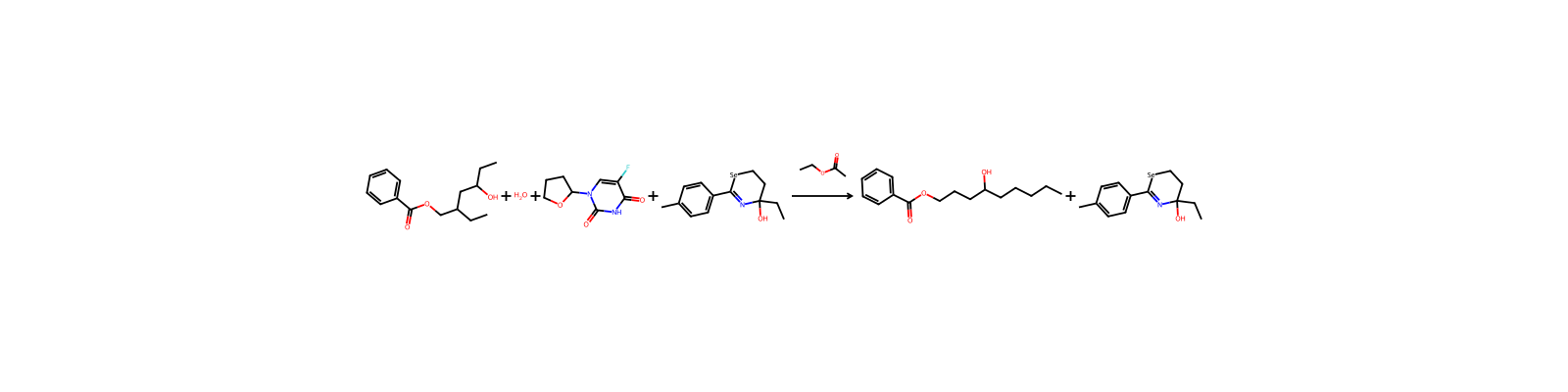
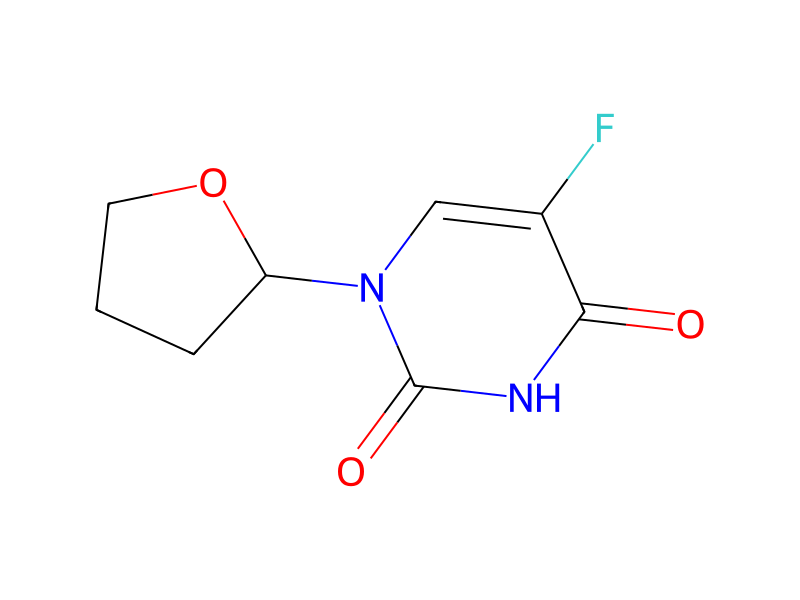
- Standard-SMILES
O=c1[nH]c(=O)n(C2CCCO2)cc1F- InChIKey
WFWLQNSHRPWKFK-UHFFFAOYSA-N- Summenformel
- C8H9FN2O3
- Durchschnittliche Molmasse
- 200,17 g/mol
- Monoisotopische Masse
- 200,05972037
Überblick
Tegafur is an organohalogen compound and a member of pyrimidines.
Namen und Bezeichner
- Bevorzugter Name
- Tegafur
- IUPAC
- 5-fluoro-1-(oxolan-2-yl)pyrimidine-2,4-dione
- Lokaler Name
- 5-Fluor-1-(tetrahydro-2-furyl)uracil
- Englischer Name
- Tegafur
- Summenformel
- C8H9FN2O3
- Molmasse
- 200.17
Namen und Synonyme
tegafur17902-23-7FtorafurFutrafulSinoflurolFentalNeberkCitofurLamarLifrilCoparoginFurafluor
Weitere Namen anzeigen
1-(Tetrahydro-2-furanyl)-5-fluorouracilafurFluaid
FurofutranNitobanilExonalFulfeelTefsiel CRiolFlorafurFT-207
Datenbank-Bezeichner
- CAS
17902-23-7、37076-68-9、82294-77-7- PubChem CID
- 5386
- DTXSID
DTXSID001009966- ChEMBL
CHEMBL20883- ChEBI
CHEBI:32188- UNII
- 1548R74NSZ
- EC Number
- 241-846-2
- Nikkaji
- J4.543H
Eigenschaften
Berechnete Struktureigenschaften
- XLogP
- -0,3
- Polarare Oberfläche (TPSA)
- 58,6 Ų
- H-Brücken-Donoren
- 1
- H-Brücken-Akzeptoren
- 4
- Frei drehbare Bindungen
- 1
- Schwere Atome
- 14
- Formalladung
- 0
- Komplexität
- 316
Experimentelle und physikochemische Eigenschaften
DrugsPharmaceuticals -> Antineoplastic and immunomodulating agents -> Antineoplastic agents
LogP-0.27
Solubility
Partly miscible
29.9 [ug/mL] (The mean of the results at pH 7.4)
Melting Point339.8-343.4
Physikochemische Eigenschaften
- Schmelzpunkt
- 171 · 171-173 °C(lit.)
- Dichte
- 1.3222 · 1.3222 (estimate)
- storage temp.
- room temp
- Löslichkeit
- 50 mg/mL · DMSO: >50mg/mL
- Aggregatzustand
- Very Fine Crystalline Powder
- pka
- 7.63 · 7.63±0.10(Predicted)
- Farbe
- white to off-white
- Merck
- 14 · 14,9112
- InChI
- 1S/C8H9FN2O3/c9-5-4-11(6-2-1-3-14-6)8(13)10-7(5)12/h4,6H,1-3H2,(H,10,12,13)
- InChIKey
- WFWLQNSHRPWKFK-UHFFFAOYSA-N
- SMILES
- FC1=CN(C2CCCO2)C(=O)NC1=O
- CAS Datenbank
- 17902 · 17902-23-7(CAS DataBase Reference)
- EPA chemische Informationen
- 2 · 2,4(1H,3H)-Pyrimidinedione, 5-fluoro-1-(tetrahydro-2-furanyl)- (17902-23-7)
Sicherheit und Regulatorisches
GHS-Klassifizierung
GHS Classification
Danger
H301 (95.1%): Toxic if swallowed [Danger Acute toxicity, oral]
P261, P262, P264, P270, P271, P280, P301+P316, P302+P352, P304+P340, P316, P321, P330, P361+P364, P403+P233, P405, and P501 (click each P-code to see the statement)
Aggregated GHS information provided per 41 reports by companies from 4 notifications to the ECHA C&L Inventory. Each notification may be associated with multiple companies.
Gefahrenhinweise
Other Safety InformationIMAP assessments - 2,4(1H,3H)-Pyrimidinedione, 5-fluoro-1-(tetrahydro-2-furanyl)-: Environment tier I assessment
Hazard Classes and CategoriesAcute Tox. 3 (95.1%)
Sicherheitsdaten
- wgk
- 3
- tsca
- TSCA listed
- ridadr
- UN 2811 6.1/PG 2
- hs_code
- 29349990
- RTECS-Nr.
- YR0450000
- risk_code
- 23/24/25
- Toxizität
- LD50 in mice (mg/kg): 900 orally (3 days) (Yasumoto); 750 i.p. (FR 1574684), also reported as 1150 i.p. (Smart)
- hazard_code
- T
- safety_code
- 22-36/37/39-45
- hazard_class
- 6.1
- packing_group
- II
- Speicherklasse
- 6.1C - Combustible acute toxic Cat.3toxic compounds or compounds which causing chronic effects
- Hazard Classifications
- Acute Tox. 3 DermalAcute Tox. 3 InhalationAcute Tox. 3 Oral
Chemie und Industrie
Pharmakologische Informationen
ATC Code
L01BC53
L - Antineoplastic and immunomodulating agents
QL - Antineoplastic and immunomodulating agents
Protein BindingTegafur is 52.3% bound to serum proteins and 5-FU is 18.4% protein bound.
Pharmacodynamics
Tegafur is an antineoplastic agent that belongs in the class of pyrimidine analogues. It interferes with the 2'-deoxythymidylate (DTMP) synthesis in the pyrimidine pathway, resulting in inhibition of DNA synthesis. In a phase III trial investigating the clinical efficacy of S-1 (tegafur/gimeracil/oteracil) in patients with advanced or recurrent gastric cancer, treatment resulted in a high response rate and was associated with a longer overall survival and longer progression-free survival rate when used in combination with cisplatin. In a meta analysis, triple combination therapy consisting of tegafur, gimeracil and oteracil showed longer survival times and well tolerance in patients with advanced gastric cancer. Tegafur and its active metabolites are potent myleosuppressive agents.
Mechanism of Action
The transformation of 2'-deoxyurindylate (dUMP) to 2'-deoxythymidylate (dTMP) is essential in driving the synthesis of DNA and purines in cells. Thymidylate synthase catalyzes the conversion of dUMP to dTMP, which is a precursor of thymidine triphosphate (TTP), one of the four deoxyribonucleotides required for DNA synthesis. After administration into the body, tegafur is converted into the active antineoplastic metabolite, fluorouracil (5-FU). In tumour cells, 5-FU undergoes phosphorylation to form the active anabolites, including 5-fluorodeoxyuridine monophosphate (FdUMP). FdUMP and reduced folate are bound to thymidylate synthase leading to formation of a ternary complex which inhibits DNA synthesis. In addition, 5-fluorouridine-triphosphate (FUTP) is incorporated into RNA causing disruption of RNA functions.
Biological Half-LifeThe elimination half life of tegafur is approximately 11 hours.
Metabolism/Metabolites
Hepatic CYP2A6 is the predominant enzyme that mediates 5-hydroxylation of tegafur to generate 5'-hydroxytegafur. This metabolite is unstable and undergoes spontaneous degradation to form 5-FU, which is an active antineoplastic agent that exerts a pharmacological action on tumours. 5-FU is rapidly metabolised by the liver enzyme dihydropyrimidine dehydrogenase (DPD).
Tegafur has known human metabolites that include 5-Fluorouracil.
MeSH Pharmacological ClassificationAntimetabolites that are useful in cancer chemotherapy.
Absorption, Distribution and Excretion
Tegafur displays a dose-proportional pharmacokinetic properties. Tegafur is rapidly and well absorbed into the systemic circulation, reaching the peak plasma concentration within 1 to 2 hours of administration.
Following oral administration, about less 20% of total tegafur is excreted unchanged in the urine.
The volume of distribution based on apparent volume of distribution and urinary excretion data of tegafur is 16 L/m^2.
No pharmacokinetic data available.
Verwendung und Herstellung
General Manufacturing Information2,4(1H,3H)-Pyrimidinedione, 5-fluoro-1-(tetrahydro-2-furanyl)-: INACTIVE
Anwendungen
BeschreibungTegafur is an orally bioavailable prodrug form of 5-fluorouracil (5-FU; ). It is converted to 5-FU in vivo enzymatically or by cytochrome P450 oxidation. Tegafur inhibits proliferation of HT-29, BxPC-3, and Panc02 cells (IC50s = 201, 172, and 179 μM, respectively). It also reduces tumor growth in an HT-27 colon carcinoma mouse xenograft model when administered at a dose of 50 mg/kg and in a 4-1ST gastric carcinoma mouse xenograft model when used in combination with uracil. Formulations containing tegafur, in combination with uracil, have been used in the treatment of cancer.
VerwendenIsotope labelled Tegafur (T013900), used as an antineoplastic.
Vor- und nachgelagerte Produkte
Vorgelagerte Rohstoffe
Anbieter50 Anbieter
北京华美互利生物化工010-56205725 · [email protected]
梯希爱(上海)化成工业发展有限公司021-67121386 · [email protected]
上海阿拉丁生化科技股份有限公司400-6206333 13167063860 · [email protected]
LGM Pharma1-(800)-881-8210 · [email protected]
上海迈瑞尔生化科技有限公司4006356688 18621169109 · [email protected]
大连美仑生物技术有限公司0411-62910999 13889544652 · [email protected]
安耐吉化学&3A(安徽泽升科技股份有限公司)400-0056266 · [email protected]
上海瀚鸿科技股份有限公司021-54306202 13764082696 · [email protected]
嘉兴市艾森化工有限公司0573-85285100 18627885956 · [email protected]
上海泰坦科技股份有限公司400-6009262 15618770481 · [email protected]
MedChemexpress LLC021-58955995 · [email protected]
Zhejiang J&C Biological Technology Co.,Limited+1-2135480471 · [email protected]
孝感深远化工有限公司15527621225; 15527621225 · [email protected]
云南西力生物技术股份有限公司0871-65217109 · [email protected]
四川库利南科技有限公司400-1166-196 18981987031 · [email protected]
天津希恩思生化科技有限公司400 638 7771 · [email protected]
上海源叶生物科技有限公司13636370518 · [email protected]
赛默飞世尔科技(中国)有限公司800-810-5118 · [email protected]
北京伊诺凯科技有限公司400-810-7969 010-59572699 · [email protected]
AdooQ BioScience, LLC+1 (866) 930-6790 · [email protected]
Wuhan NCE Biomedical Co.,Ltd.4000-027-021 |24 +86-13986109188 | +86-15623472865 | +81-08033611988
江苏艾康生物医药研发有限公司025-66113011 13913916777 · [email protected]
TCI AMERICA800-4238616 · [email protected]
TOKYO CHEMICAL INDUSTRY CO., LTD.03-36680489 · [email protected]
TCI Europe320-37350700 · [email protected]
深圳振强药物研发有限公司0755-66853366 13670046396 · [email protected]
上海诺宝化工有限公司+86(0)21 60484900
Clearsynth Labs Limited+91-22-26355700 · [email protected]
广州爱纯医药科技有限公司020-39119399 18927568969 · [email protected]
南京生利德生物科技有限公司025-57798810 18652991625 · [email protected]
湖北威德利化学试剂有限公司186-02735115 18602735115 · [email protected]
湖北鑫源顺医药化工有限公司13971561712, 13995564702, 027-50664929 · [email protected]
上海将来实业股份有限公司400-0066400 13621662912 · [email protected]
上海将来实业股份有限公司021-61552785 · [email protected]
安徽科迪达化工有限公司0554-2106669 · [email protected]
HBCChem, Inc.+1-510-219-6317 · [email protected]
上海笛柏生物科技有限公司400-008-9730,021-54359730 400-008-9730 · [email protected]
四川省维克奇生物科技有限公司028-81700200 18116577057 · [email protected]
成都零六生物科技有限公司400-1166-196 13458535857 · [email protected]
南京百鑫德诺生物科技有限公司025-58849295 · [email protected]
广州市慈铭生物科技有限公司020-38082199,29065168,38082986,29878298,29866629,4000192398
上海孚一生物科技有限公司+86 (21) 61124340
凯试(上海)科技有限公司021-50135380 · [email protected]
湖北巨胜科技有限公司027-59599241 18871490274 · [email protected]
池州凯隆进出口贸易有限公司[email protected]
Sigma-Aldrich西格玛奥德里奇(上海)贸易有限公司021-61415566 800-8193336 · [email protected]
AN PharmaTech Co Ltd86(21)68097365 · [email protected]
南京伶亚生物医药科技有限公司18068075658 · [email protected]
上海蓓琅生物科技有限公司17764003753 · [email protected]
TargetMol中国(陶术生物)021-021-33632979 15002134094 · [email protected]
Zugehörige Reaktionen
50



Verknüpfte Notizen
Wird geladen…