
Grundinformationen
- Standard-SMILES
O=C(O)[C@@H]1C[C@@H](O)CN1- InChIKey
PMMYEEVYMWASQN-DMTCNVIQSA-N- Summenformel
- C5H9NO3
- Durchschnittliche Molmasse
- 131,13 g/mol
- Monoisotopische Masse
- 131,05824315
Überblick
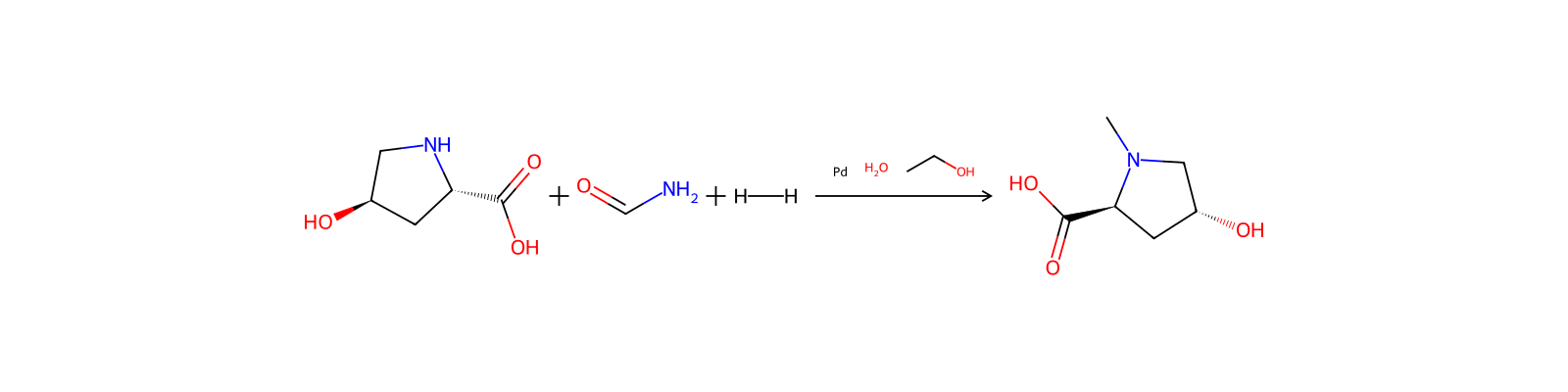
Trans-4-hydroxy-L-proline is an optically active form of 4-hydroxyproline having L-trans-configuration. It has a role as a mouse metabolite, a plant metabolite and a human metabolite. It is a tautomer of a trans-4-hydroxy-L-proline zwitterion.
Namen und Bezeichner
- Bevorzugter Name
- L-Hydroxyproline
- IUPAC
- (2S,4R)-4-hydroxypyrrolidine-2-carboxylic acid
- Lokaler Name
- L-4-Hydroxyprolin
- Englischer Name
- L-Hydroxyproline
- Summenformel
- C5H9NO3
- Molmasse
- 131.13
Namen und Synonyme
L-Hydroxyproline51-35-4trans-4-Hydroxy-L-prolinehydroxyprolineHyprohydroxy-L-proline(4R)-4-hydroxy-L-prolinetrans-L-HydroxyprolineL-Proline, 4-hydroxy-, (4R)-trans-Hydroxyproline4-Hydroxy-2-pyrrolidinecarboxylic aciddelta-Hydroxyproline
Weitere Namen anzeigen
Hyp(2S,4R)-4-HYDROXYPYRROLIDINE-2-CARBOXYLIC ACID4-HYDROXY-L-PROLINE4-HydroxyprolineH-HYP-OH4R-4-hydroxyproline4-HYDROXYPYRROLIDINE-2-CARBOXYLIC ACID5kg
L-Proline, 4-hydroxy-, trans-(2S,4R)-4-hydroxyprolineRMB44WO89XLUMISTORL-threo-4-hydroxyprolineNSC-46704(2S,4R)-4-hydroxy-2-pyrrolidinecarboxylic acidCHEBI:18095
Datenbank-Bezeichner
- CAS
51-35-4、618-28-0- PubChem CID
- 5810
- DTXSID
DTXSID10883225- ChEMBL
CHEMBL352418- ChEBI
CHEBI:18095- UNII
- RMB44WO89X
- EC Number
- 200-091-9
- Nikkaji
- J148.015D
Eigenschaften
Berechnete Struktureigenschaften
- XLogP
- -3,3
- Polarare Oberfläche (TPSA)
- 69,6 Ų
- H-Brücken-Donoren
- 3
- H-Brücken-Akzeptoren
- 4
- Frei drehbare Bindungen
- 1
- Schwere Atome
- 9
- Formalladung
- 0
- Komplexität
- 125
Experimentelle und physikochemische Eigenschaften
Chemical ClassesBiological Agents -> Amino Acids and Derivatives
DrugsPharmaceuticals -> Listed in ZINC15
CosmeticsSkin conditioning; Surfactant; Antistatic; Hair conditioning
LogP-3.17
Food AdditivesUse unspecified -> FDA Substance added to food
Solubility
Soluble in water at 0, 25, 50, and 60 °C
361 mg/mL at 25 °C
Boiling PointDecomposes
Melting Point
274°C
274 - 275 °C
Physical Description
Solid; [Merck Index] White crystalline powder; [Alfa Aesar MSDS]
Solid
Dissociation ConstantspK1′ 1.82 and pK2′ 9.65
Collision Cross Section
130.23 Ų [M+H]+ [CCS Type: DT; Method: stepped-field]
139.3 Ų [M+Na]+ [CCS Type: DT; Method: single field calibrated with ESI Low Concentration Tuning Mix (Agilent)]
122 Ų [M+H]+ [CCS Type: TW; Method: calibrated with polyalanine]
128.1 Ų [M+H]+ [CCS Type: DT; Method: single field calibrated with Agilent tune mix (Agilent)]
127.9 Ų [M+H]+
Physikochemische Eigenschaften
- Schmelzpunkt
- 273 °C · 273 °C (dec.)(lit.)
- Siedepunkt
- 242.42 °C · 242.42°C (rough estimate)
- Dichte
- 1.3121 · 1.3121 (rough estimate)
- Dampfdichte
- 4.5 · 4.5 (vs air)
- Brechungsindex
- -75.5 ° · -75.5 ° (C=4, H2O)
- storage temp.
- 30 °C · Store below +30°C.
- Löslichkeit
- 2 O: · H2O: 50 mg/mL
- Aggregatzustand
- Crystals or Crystalline Powder
- pka
- 1.82 · 1.82, 9.66(at 25℃)
- Farbe
- White
- Geruch (Odor)
- Odorless
- PH
- 5.5 · 5.5-6.5 (50g/l, H2O, 20℃)
- Wasserlöslichkeit
- 357.8 g/L · 357.8 g/L (20 º C)
- Merck
- 14 · 14,4840
- BRN
- 471933 · 471933
- Kosmetik-Inhaltsstoffe Funktionen
- HAIR CONDITIONINGANTISTATICSURFACTANT - CLEANSINGSKIN CONDITIONING
- InChI
- 1S/C5H9NO3/c7-3-1-4(5(8)9)6-2-3/h3-4,6-7H,1-2H2,(H,8,9)/t3-,4+/m1/s1
- InChIKey
- PMMYEEVYMWASQN-DMTCNVIQSA-N
- SMILES
- O[C@H]1CN[C@@H](C1)C(O)=O
- LogP
- -0.35 · -0.350 (est)
- CAS Datenbank
- 51 · 51-35-4(CAS DataBase Reference)
- NIST chemische Informationen
- Hydroxyproline(51-35-4)
- EPA chemische Informationen
- -4 · trans-4-Hydroxy-L-proline (51-35-4)
Sicherheit und Regulatorisches
GHS-Klassifizierung
GHS Classification
This chemical does not meet GHS hazard criteria for 89.3% (25 of 28) of all reports.
Warning
H315 (10.7%): Causes skin irritation [Warning Skin corrosion/irritation]
P261, P264, P264+P265, P271, P280, P302+P352, P304+P340, P305+P351+P338, P319, P321, P332+P317, P337+P317, P362+P364, P403+P233, P405, and P501 (click each P-code to see the statement)
Aggregated GHS information provided per 28 reports by companies from 4 notifications to the ECHA C&L Inventory. Each notification may be associated with multiple companies.
Gefahrenhinweise
Regulatory Information
Chemical: L-Proline, 4-hydroxy-, (4R)-
Status: Active Update: 27-04-2022 https://echa.europa.eu/registration-dossier/-/registered-dossier/21207
L-Proline, 4-hydroxy-, (4R)-: Does not have an individual approval but may be used under an appropriate group standard
Other Safety InformationIMAP assessments - L-Proline, 4-hydroxy-, trans-: Environment tier I assessment
Hazards SummaryMay cause irritation; [Alfa Aesar MSDS] See L-Proline.
Hazard Classes and CategoriesSkin Irrit. 2 (10.7%)
Toxikologische Informationen
Carcinogen ClassificationNo indication of carcinogenicity to humans (not listed by IARC).
Sicherheitsdaten
- wgk
- 3
- tsca
- TSCA listed
- hs_code
- 29339990
- RTECS-Nr.
- TW3586500
- risk_code
- 36/37/38-22
- hazard_code
- Xi,Xn
- safety_code
- 24/25-36/37/39-27-26
- hazard_class
- IRRITANT
- Speicherklasse
- 11 - Combustible Solids
Chemie und Industrie
Pharmakologische Informationen
Pharmacodynamics
Hydroxyproline as well as proline and glycine are the major components of collagen. Collagen is on one of the main building blocks of connective tissue such as skin, bone, and cartilage. Thus when these tissues are damaged, hydroxyproline is necessary for repair of the damaged area.
Tissue LocationsEpidermis
Cellular LocationsEndoplasmic reticulum
Metabolite PathwaysArginine: Glycine Amidinotransferase Deficiency (AGAT Deficiency)
Verwendung und Herstellung
Uses
An analog of proline and an non-essential amino acid found in collagen; [Merck Index]
This is an endogenously produced metabolite found in the human body. It is used in metabolic reactions, catabolic reactions or waste generation.
Use ClassificationCosmetics -> Skin conditioning; Surfactant; Antistatic; Hair conditioning
General Manufacturing InformationL-Proline, 4-hydroxy-, (4R)-: ACTIVE
Anwendungen
BeschreibungA non-essential amino acid. Can be isolated from gelatin. Hydroxyproline has not been reported as added to food in any of the NAS surveys.
VerwendenA natural constituent of animal structural proteins such as collagen and elastin. Several microorganisms producing proline trans-4- and cis-3-hydroxylase were discovered and these enzymes were applied to the industrial production of trans-4- and cis-3-hydroxy-L-proline.
Vor- und nachgelagerte Produkte
Vorgelagerte Rohstoffe
Nachgelagerte Produkte
Anbieter50 Anbieter
国药集团化学试剂有限公司86-21-63210123 · [email protected]
北京华美互利生物化工010-56205725 · [email protected]
梯希爱(上海)化成工业发展有限公司021-67121386 · [email protected]
上海阿拉丁生化科技股份有限公司400-6206333 13167063860 · [email protected]
苏州华赛生物工程技术有限公司0512-89581819; 18915732708 · [email protected]
河北九星化工产品有限公司13503103636 · [email protected]
INTATRADE GmbH+49 3493/605464 · [email protected]
T&W GROUP021-61551611 13296011611 · [email protected]
爱斯特(成都)生物制药股份有限公司+86-28-85122536 85324413 · [email protected]
上海如吉生物科技发展有限公司+86-21-65211385-8001 36031160 · [email protected]
韶远科技(上海)有限公司021-50795510 4000665055 · [email protected]
秦化(上海)生物科技有限公司18817338302 18817338302 · [email protected]
科瑞迪化学400-821-5857 021-64326257 · [email protected]
Syntechem Co.,Ltd[email protected]
上海迈瑞尔生化科技有限公司4006356688 18621169109 · [email protected]
武汉易泰科技有限公司上海分公司18930552037 · [email protected]
宁波亿诺化学品有限公司86-574-27787657 · [email protected]
大连美仑生物技术有限公司0411-62910999 13889544652 · [email protected]
阿法埃莎(中国)化学有限公司400-6106006 · [email protected]
太原市瑞和丰科贸有限公司+86 351 7031519 · [email protected]
安耐吉化学&3A(安徽泽升科技股份有限公司)400-0056266 · [email protected]
武汉凯威斯科技有限公司86-027-67849912 · [email protected]
上海瀚鸿科技股份有限公司021-54306202 13764082696 · [email protected]
天津万象恒远科技有限公司15722085254 · [email protected]
上海景颜化工科技有限公司13817811078 · [email protected]
嘉兴市艾森化工有限公司0573-85285100 18627885956 · [email protected]
Pure Chemistry Scientific Inc.001-857-928-2050 or 1-888-588-9418 · [email protected]
上海泰坦科技股份有限公司400-6009262 15618770481 · [email protected]
上海隆盛化工有限公司58099637 13585536065 · [email protected]
张家港市思普生化有限公司512-0512-58992291,58992287 18606280718 · [email protected]
武汉丰泰威远科技有限公司027-87465837 19945049750 · [email protected]
ChemPep, Inc.+1 (888) 615-9178 / (561) 791-8787 · [email protected]
孝感深远化工有限公司15527621225; 15527621225 · [email protected]
山东西亚化学有限公司13355009207 13355009207 · [email protected]
大赛璐药物手性技术(上海)有限公司021-50460086-9 15921403865 · [email protected]
玛雅试剂+86 (573) 82222445 (0)18006601000 452520369 · [email protected]
四川库利南科技有限公司400-1166-196 18981987031 · [email protected]
天津希恩思生化科技有限公司400 638 7771 · [email protected]
南京斯贝源医药科技有限公司+86-25-68710855, +86-25-68710897 · [email protected]
湖南汇百侍生物科技有限公司0731-85526065 13308475853 · [email protected]
南京维奥化工有限公司Please Send Email 18652950785 · [email protected]
河南多贝化工有限公司0370-2785118 17550508557 · [email protected]
斯百全化学(上海)有限公司021-021-021-67601398-809-809-809 15221380277 · [email protected]
上海源叶生物科技有限公司13636370518 · [email protected]
艾科试剂4008-755-333 18080918076 · [email protected]
上海思域化工科技有限公司86-21-34053660 · [email protected]
赛默飞世尔科技(中国)有限公司800-810-5118 · [email protected]
北京伊诺凯科技有限公司400-810-7969 010-59572699 · [email protected]
上海健超生物科技有限公司150-2103-5486 18017383231 · [email protected]
TCI AMERICA800-4238616 · [email protected]
Ergänzende Hinweise
DefinitionChEBI: An optically active form of 4-hydroxyproline having L-trans-configuration.
Zugehörige Reaktionen
448


Verknüpfte Notizen
Wird geladen…