
Grundinformationen
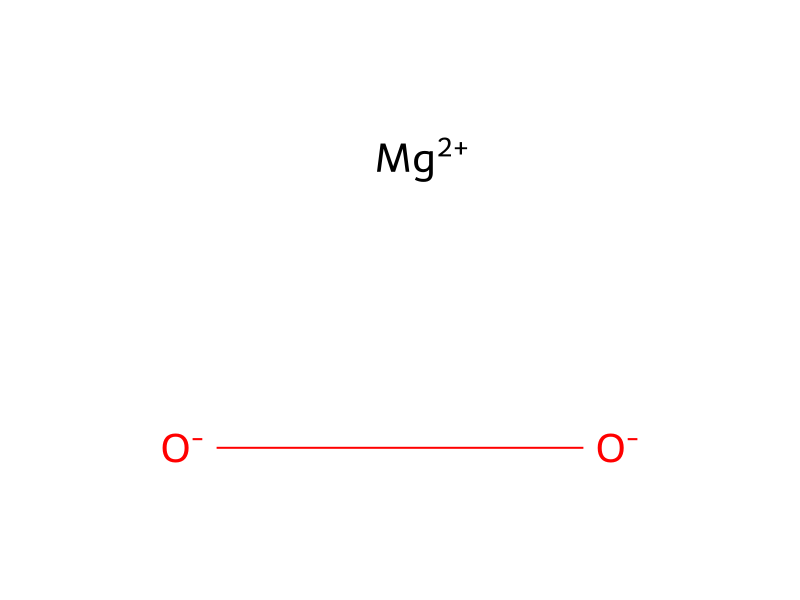
- Standard-SMILES
[Mg+2].[O-][O-]- InChIKey
SPAGIJMPHSUYSE-UHFFFAOYSA-N- Summenformel
- MgO2
- Durchschnittliche Molmasse
- 56,304 g/mol
- Monoisotopische Masse
- 55,97487094
Überblick
Magnesium peroxide appears as a white powder. Noncombustible but accelerates the burning of combustible material, if the combustible material is finely divided the mixture may be explosive. Mixtures of combustible material and the peroxide can be ignited by friction or contact with moisture. Used in medicine, and as a bleaching agent.
Namen und Bezeichner
- Bevorzugter Name
- Magnesium peroxide (Mg(O2))
- IUPAC
- magnesium peroxide
- Lokaler Name
- Magnesiumdioxid
- Englischer Name
- Magnesium dioxide
- Summenformel
- MgO2
- Molmasse
- 56.3
Namen und Synonyme
Magnesium peroxide14452-57-4PeromagMagnesium perhydrolMagnesium peroxide (Mg(O2))Drillox MMagnesium superoxolX8YVJ0TN96DTXSID9049667EktomorRefChem:58182DTXCID6029626
Weitere Namen anzeigen
24-28%asMgO2MagnesiumdioxidMAGNESII PEROXIDUMMagnesium peroxidumforanalyticalpurposeMagnesium superoxideMAGNESIUM PEROXIDE LIGHTmagnesiumperoxide(mg(o2))Magnesium peroxide light, Ph Eur
DTXSID201014606215-627-7238-438-1Magnesium dioxidemagnesium;peroxide1335-26-8MagnesiumperoxydUNII-X8YVJ0TN96
Datenbank-Bezeichner
- CAS
1335-26-8、14452-57-4- PubChem CID
- 61745
- DTXSID
DTXSID9049667- ChEMBL
CHEMBL3707298- EC Number
- 215-627-7、238-438-1
Eigenschaften
Berechnete Struktureigenschaften
- Polarare Oberfläche (TPSA)
- 46,1 Ų
- H-Brücken-Donoren
- 0
- H-Brücken-Akzeptoren
- 2
- Frei drehbare Bindungen
- 0
- Schwere Atome
- 3
- Formalladung
- 0
- Komplexität
- 2,8
Experimentelle und physikochemische Eigenschaften
OdorOdorless
TasteTasteless
DensityApproximately 3.0 g/cu cm
Color/Form
White cubic crystals
White powder
Solubility
Soluble in dilute acid solutions with formation of hydrogen peroxide
Insoluble in water and gradually decomposed by it with liberation of oxygen
Melting Point100 °C (decomposes)
Physical Description
Magnesium peroxide appears as a white powder. Noncombustible but accelerates the burning of combustible material, if the combustible material is finely divided the mixture may be explosive. Mixtures of combustible material and the peroxide can be ignited by friction or contact with moisture. Used in medicine, and as a bleaching agent.
Other Experimental Properties
A powerful oxidizing material
Dangerous fire risk, reacts with acidic materials and moisture
When strongly heated loses all the peroxide oxygen
Physikochemische Eigenschaften
- Löslichkeit
- Practically insoluble in water and in ethanol (96 per cent). It dissolves in dilute mineral acids.
- Merck
- 13 · 13,5704
- Kosmetik-Inhaltsstoffe Funktionen
- OXIDISING
- LogP
- -0.425 · -0.425 (est)
- CAS Datenbank
- 14452 · 14452-57-4
- EPA chemische Informationen
- Magnesium peroxide (Mg(O2)) (14452-57-4)
Sicherheit und Regulatorisches
GHS-Klassifizierung
GHS Classification
Danger
H271 (48.8%): May cause fire or explosion; strong Oxidizer [Danger Oxidizing liquids; Oxidizing solids]
P210, P220, P260, P264, P280, P283, P301+P330+P331, P302+P361+P354, P304+P340, P305+P354+P338, P306+P360, P316, P321, P363, P370+P378, P371+P380+P375, P405, P420, and P501 (click each P-code to see the statement)
Aggregated GHS information provided per 121 reports by companies from 4 notifications to the ECHA C&L Inventory. Each notification may be associated with multiple companies.
Danger
H272 (100%): May intensify fire; oxidizer [Danger Oxidizing liquids; Oxidizing solids]
Gefahrenhinweise
Regulatory Information
Chemical: Magnesium peroxide (Mg(O2))
Magnesium peroxide: Does not have an individual approval but may be used as a component in a product covered by a group standard. It is not approved for use as a chemical in its own right.
Other Safety InformationIMAP assessments - Peroxides of divalent cations: Human health tier II assessment
DOT LabelOxidizer
Fire Hazards
Excerpt from ERG Guide 140 [Oxidizers]:
CAUTION: Ammonium nitrate products may explode if involved in fire or contaminated with hydrocarbons (fuels), organic matter, other contaminants or when hot molten and contained. Treat as an explosive (GUIDE 112).
Fire PotentialFlammable by chemical reaction with acidic materials and moisture ... .
Health Hazards
Excerpt from ERG Guide 140 [Oxidizers]:
· Inhalation, ingestion or contact (skin, eyes) with vapors or substance may cause severe injury, burns or death.
DOT ID and Guide1476 140
Reactive GroupSalts, Basic
Reactivity AlertsStrong Oxidizing Agent
Reactivity Profile
Mixtures of combustible material and the peroxide can be ignited with friction or moisture. Water gradually decomposes it liberating oxygen, with dilute acids it forms hydrogen peroxide, when strongly heated it losses all peroxide oxygen [Merck 11th ed. 1989].
DOT Emergency Guidelines
/GUIDE 140: OXIDIZERS/ Fire or Explosion: These substances will accelerate burning when involved in a fire. Some may decompose explosively when heated or involved in a fire. May explode from heat or contamination. Some will react explosively with hydrocarbons (fuels). May ignite combustibles (wood, paper, oil, clothing, etc.). Containers may explode when heated. Runoff may create fire or explosion hazard.
/GUIDE 140: OXIDIZERS/ Health: Inhalation, ingestion or contact (skin, eyes) with vapors or substance may cause severe injury, burns or death. Fire may produce irritating, corrosive and/or toxic gases. Runoff from fire control or dilution water may cause pollution.
/GUIDE 140: OXIDIZERS/ Public Safety: CALL Emergency Response Telephone Number ... As an immediate precautionary measure, isolate spill or leak area in all directions for at least 50 meters (150 feet) for liquids and at least 25 meters (75 feet) for solids. Keep unauthorized personnel away. Stay upwind. Keep out of low areas. Ventilate closed spaces before entering.
/GUIDE 140: OXIDIZERS/ Protective Clothing: Wear positive pressure self-contained breathing apparatus (SCBA). Wear chemical protective clothing that is specifically recommended by the manufacturer. It may provide little or no thermal protection. Structural firefighters' protective clothing will only provide limited protection.
For more DOT Emergency Guidelines (Complete) data for Magnesium peroxide (8 total), please visit the HSDB record page.
DOT Hazard Classification
Magnesium peroxide
UN1476
Div 5.1 Oxidizer (49 eCFR § 173.127)
PG II: the degree of danger presented by the material is medium
Sicherheit und Schutzausrüstung
Fire FightingExcerpt from ERG Guide 140 [Oxidizers]:
Accidental Release Measures
· CALL 911. Then call emergency response telephone number on shipping paper. If shipping paper not available or no answer, refer to appropriate telephone number listed on the inside back cover.
· Keep combustibles (wood, paper, oil, etc.) away from spilled material.
First Aid
Excerpt from ERG Guide 140 [Oxidizers]:
General First Aid:
Firefighting HazardsWill decompose violently in or near a fire.
Exposure Control and Personal Protection· Wear positive pressure self-contained breathing apparatus (SCBA).
Fire Fighting Procedures
Personnel protection: ... Wear positive pressure self-contained breathing apparatus when fighting fires involving this material.
If material on fire or involved in fire: Flood with water. Cool all affected containers with flooding quantities of water. Apply water from as far a distance as possible.
Evacuation: If fire becomes uncontrollable -- consider evacuation of one-half (1/2) mile radius.
Nonfire Spill ResponseExcerpt from ERG Guide 140 [Oxidizers]:
Disposal Methods
SRP: The most favorable course of action is to use an alternative chemical product with less inherent propensity for occupational harm/injury/toxicity or environmental contamination. Recycle any unused portion of the material for its approved use or return it to the manufacturer or supplier. Ultimate disposal of the chemical must consider: the material's impact on air quality; potential migration in soil or water; effects on animal and plant life; and conformance with environmental and public health regulations.
Preventive Measures
SRP: The scientific literature for the use of contact lenses by industrial workers is inconsistent. The benefits or detrimental effects of wearing contact lenses depend not only upon the substance, but also on factors including the form of the substance, characteristics and duration of the exposure, the uses of other eye protection equipment, and the hygiene of the lenses. However, there may be individual substances whose irritating or corrosive properties are such that the wearing of contact lenses would be harmful to the eye. In those specific cases, contact lenses should not be worn. In any event, the usual eye protection equipment should be worn even when contact lenses are in place.
Personnel protection: Avoid breathing dusts. ... Do not handle broken packages unless wearing appropriate personal protective equipment. Wash away any material which may have contacted the body with copious amounts of water or soap and water. ...
If material not on fire and not involved in fire: Keep sparks, flames, and other sources of ignition away. Keep material out of water sources and sewers.
Isolation and Evacuation
Excerpt from ERG Guide 140 [Oxidizers]:
Immediate precautionary measure
Personal Protective Equipment (PPE)
Excerpt from ERG Guide 140 [Oxidizers]:
Personnel protection: ... Wear appropriate chemical protective gloves, boots and goggles.
Emergency Response Planning GuidelinesSmall Fire
Toxikologische Informationen
Ecotoxicity Excerpts
/OTHER TOXICITY INFORMATION/ Microporous filters containing MgO2 were shown to be effective in the removal and inactivation of bacteria and viruses from tap water. Pseudomonas aeruginosa, P. cepacia and Escherichia coli collected by the filters were found to rapidly decrease in numbers to undetectable levels within 24 hours. In contrast, the same bacteria collected on identical filters not containing MgO2, either rapidly increased in numbers or their numbers remained unchanged. Poliovirus type 1, Echovirus type 1, Reovirus type 3 and Rotavirus SA-11 were found to readily adsorb to the filters. The numbers of viruses which could be recovered from the MgO2 containing filters decreased rapidly with time as compared to control filters. No significant inactivation of bacteria or viruses occurred in tap water passed through the filters, strongly suggesting that the microorganisms were being inactivated while adsorbed to the filters and not by substances released by the filters into the water. The filters remained effective even after the passage of large volumes of tap water through small diameter filters and in the presence of raw sewage contaminated tap water. Such filters could potentially be useful for disinfection of water supplies for small community and individual water systems.
/OTHER TOXICITY INFORMATION/ Sulfate-reducing bacteria (SRB), which cause microbiologically influenced material corrosion under anoxic conditions, form one of the major groups of microorganisms responsible for the generation of hydrogen sulfide. In this study, which is aimed at reducing the presence of SRB, a novel alternative approach involving the addition of magnesium peroxide (MgO2) compounds involving the use of reagent-grade MgO2 and a commercial product (ORC) was evaluated as a means of inhibiting SRB in laboratory batch columns. Different concentrations of MgO2 were added in the columns when black sulfide sediment had appeared in the columns. The experimental results showed that MgO2 is able to inhibit biogenic sulfide. The number of SRB, the sulfide concentration and the sulfate reducing rate (SRR) were decreased. ORC trade mark as an additive was able to decrease more effectively the concentration of sulfide in water and the SRB-control effect was maintained over a longer time period when ORCtrade mark was used. The level of oxidation-reduction potential (ORP), which has a linear relationship to the sulfide/sulfate ratio, is a good indicator of SRB activity. As determined by fluorescence in-situ hybridization (FISH), most SRB growth was inhibited under increasing amounts of added MgO2. The concentration of sulfide reflected the abundance of the SRB. Utilization of organic matter greater than the theoretical SRB utilization rate indicated that facultative heterotrophs became dominant after MgO2 was added. The results of this study could supply the useful information for further study on evaluating the solution to biocorrosion problems in practical situations.
Probable Routes of Human ExposureNIOSH (NOES Survey 1981-1983) has statistically estimated that 1,426 workers (12 of these are female) are potentially exposed to manganese peroxide in the US(1).
Antidote and Emergency Treatment
Immediate first aid: Ensure that adequate decontamination has been carried out. If patient is not breathing, start artificial respiration, preferably with a demand-valve resuscitator, bag-valve-mask device, or pocket mask, as trained. Perform CPR as necessary. Immediately flush contaminated eyes with gently flowing water. Do not induce vomiting. If vomiting occurs, lean patient forward or place on left side (head-down position, if possible) to maintain an open airway and prevent aspiration. Keep patient quiet and maintain normal body temperature. Obtain medical attention. /Magnesium and Related Compounds/
Basic treatment: Establish a patent airway (oropharyngeal or nasopharyngeal airway, if needed). Suction if necessary. Watch for signs of respiratory insufficiency and assist ventilations if necessary. Administer oxygen by nonrebreather mask at 10 to 15 L/min. Monitor for pulmonary edema and treat if necessary ... . Monitor for shock and treat if necessary ... . For eye contamination, flush eyes immediately with water. Irrigate each eye continuously with 0.9% saline (NS) during transport ... . Do not use emetics. For ingestion, rinse mouth and administer 5 ml/kg up to 200 ml of water for dilution if the patient can swallow, has a strong gag reflex, and does not drool ... . /Magnesium and Related Compounds/
Advanced treatment: Consider orotracheal or nasotracheal intubation for airway control in the patient who is unconscious, has severe pulmonary edema, or is in severe respiratory distress. Positive-pressure ventilation techniques with a bag valve mask device may be beneficial. Consider drug therapy for pulmonary edema ... . Monitor cardiac rhythm and treat arrhythmias if necessary ... . Start IV administration of D5W /SRP: "To keep open", minimal flow rate/. Use 0.9% saline (NS) or lactated Ringer's (LR) if signs of hypovolemia are present. For hypotension with signs of hypovolemia, administer fluid cautiously. Consider vasopressors if patient is hypotensive with a normal fluid volume. Watch for signs of fluid overload ... . Use proparacaine hydrochloride to assist eye irrigation ... . /Magnesium and Related Compounds/
Sicherheitsdaten
- wgk
- 3
- tsca
- TSCA listed
- ridadr
- UN 1476
- risk_code
- 8-34
- hazard_code
- O,C
- safety_code
- 17-36-45-36/37/39-27-26
- hazard_class
- 5.1
- packing_group
- II
- Giftige Stoffe Daten
- 14452-57-4(Hazardous Substances Data)
Chemie und Industrie
Pharmakologische Informationen
ATC Code
A - Alimentary tract and metabolism
A - Alimentary tract and metabolism
QA - Alimentary tract and metabolism
QA - Alimentary tract and metabolism
Verwendung und Herstellung
Uses
Both oil base and water base fracturing fluids are being used in the fracturing industry. Water base, which includes alcohol-water mixtures and low strength acids, make up the majority of treating fluids. The common chemicals added to these fluids are polymers for viscosity development, crosslinkers for viscosity enhancement, pH control chemicals, gel breakers for polymer degradation following the treatment, surfactants, clay stabilizers, alcohol, bactericides, fluid loss additives and friction reducer. /Hydraulic fracturing/
Hydraulic fracturing uses a specially blended liquid which is pumped into a well under extreme pressure causing cracks in rock formations underground. These cracks in the rock then allow oil and natural gas to flow, increasing resource production. ... Chemical Name: Magnesium peroxide; Chemical Purpose: Allows a delayed break down of the gel; Product Function: Breaker.
Used in bioremediation as an oxygen source
Bleaching and oxidizing agent
Methods of Manufacturing
Commercial magnesium peroxide is made by mixing a light grade of magnesium oxide with hydrogen peroxide and drying the slurry. The product is a white powder containing about 25% MgO2 and 7% active oxygen. The remaining constituents are magnesium oxide, magnesium hydroxide, and magnesium carbonate.
Industrial production of magnesium peroxide ... involves the reaction of magnesium oxide and hydrogen peroxide. A product containing not more than 50% MgO2 is obtained. Another process using magnesium hydroxide yields a product containing up to 60% magnesium peroxide.
Household ProductsInformation on 4 consumer products that contain Magnesium peroxide in the following categories is provided:
General Manufacturing Information
Magnesium peroxide: ACTIVE
Magnesium peroxide (Mg(O2)): ACTIVE
Anwendungen
VerwendenBleaching and oxidizing agent, medicine (antacid).
Zugehörige Reaktionen
12


Verknüpfte Notizen
Wird geladen…