StartseiteMCPWorkbenchSkills
StartseiteWorkbenchBenachrichtigungenMein Bereich
llms.txt · MCP-AnleitungDatenschutz · Nutzungsbedingungen · Supportv1.8.0
  1. Startseite
  2. /Verbindung

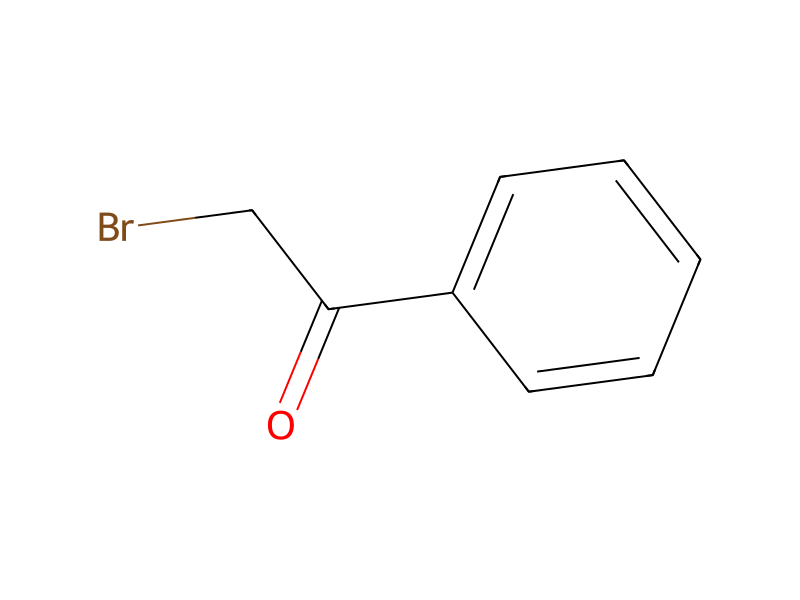
2-Bromacetophenon

Phenacyl bromide
HCID 6259
Neue NotizNeue ReaktionAnfrage stellen
Druckvorschau
GrundinformationenÜberblickNamen und BezeichnerEigenschaftenSicherheit und RegulatorischesChemie und IndustrieZugehörige ReaktionenNotizen zur Verbindung
TeilstruktursucheÄhnliche Strukturen suchen

Grundinformationen

CAS
70-11-1
Standard-SMILES
O=C(CBr)c1ccccc1
InChIKey
LIGACIXOYTUXAW-UHFFFAOYSA-N
Summenformel
C8H7BrO
Durchschnittliche Molmasse
199,04 g/mol
Monoisotopische Masse
197,96802694

Überblick

Phenacyl bromide appears as a crystalline solid or a liquid with a sharp odor. Toxic by inhalation, ingestion and skin absorption. A severe eye irritant (a lachrymator). Used to make other chemicals.

Namen und Bezeichner

Bevorzugter Name
Phenacyl bromide
IUPAC
2-bromo-1-phenylethanone
Lokaler Name
2-Bromacetophenon
Englischer Name
2-Bromoacetophenone
Summenformel
C8H7BrO
Molmasse
199.04

Namen und Synonyme

2-BromoacetophenonePhenacyl bromide70-11-12-Bromo-1-phenylethanoneBromoacetophenone2-Bromo-1-Phenylethan-1-OneBromomethyl phenyl ketoneEthanone, 2-bromo-1-phenyl-omega-BromoacetophenoneALPHA-BROMOACETOPHENONEAcetophenone, 2-bromo-Stauffer 4644
Weitere Namen anzeigen
α-BromoacetophenoneA-BROMOACETOPHENONE1-Phenyl-2-broMoethanone2-Bromoacetophenone ,99%NSC 9807AKOS BBS-00004003Bromoacetylbenzene-Bromoacetophenone
phenacylbromideBenzoylmethyl bromideomega-BromacetophenoneDTXSID2049426UN2645STAUFFER-4644phenyl bromomethyl ketoneNSC-9807

Datenbank-Bezeichner

CAS
70-11-1
PubChem CID
6259
DTXSID
DTXSID2049426

Eigenschaften

Berechnete Struktureigenschaften

XLogP
2,5
Polarare Oberfläche (TPSA)
17,1 Ų
H-Brücken-Donoren
0
H-Brücken-Akzeptoren
1
Frei drehbare Bindungen
2
Schwere Atome
10
Formalladung
0
Komplexität
116

Experimentelle und physikochemische Eigenschaften

Chemical ClassesOther Classes -> Aromatic Ketones, Halogenated
SpringerMaterials PropertiesChemical shift
LogP2.19
Vapor Pressure0.01 [mmHg]
Physical Description · 2 Einträge

Phenacyl bromide appears as a crystalline solid or a liquid with a sharp odor. Toxic by inhalation, ingestion and skin absorption. A severe eye irritant (a lachrymator). Used to make other chemicals.

Solid; [Merck Index] Beige crystalline solid; [Aldrich MSDS]

Physikochemische Eigenschaften

Schmelzpunkt
48 · 48-51 °C (lit.)
Siedepunkt
135 °C/18 · 135 °C/18 mmHg (lit.)
Dichte
1.476 · 1.476
Brechungsindex
1.57 · 1.5700 (estimate)
Flammpunkt
230 °F · >230 °F

Sicherheit und Regulatorisches

Sicherheitsangaben dienen nur zur Orientierung und ersetzen weder das Sicherheitsdatenblatt (SDB) des Lieferanten noch geltende Vorschriften oder eine fachliche Bewertung.

GHS-Klassifizierung

GHS Classification · 4 Einträge

Danger

H301 (20.6%): Toxic if swallowed [Danger Acute toxicity, oral]

P260, P261, P262, P264, P264+P265, P270, P271, P280, P284, P301+P316, P301+P330+P331, P302+P352, P302+P361+P354, P304+P340, P305+P351+P338, P305+P354+P338, P316, P319, P320, P321, P330, P332+P317, P337+P317, P361+P364, P362+P364, P363, P403+P233, P405, and P501 (click each P-code to see the statement)

Aggregated GHS information provided per 63 reports by companies from 8 notifications to the ECHA C&L Inventory. Each notification may be associated with multiple companies.

Gefahrenhinweise

Regulatory Information · 2 Einträge

Chemical: Ethanone, 2-bromo-1-phenyl-

2-Bromoacetophenone: Does not have an individual approval but may be used under an appropriate group standard

DOT LabelPoison
Fire Hazards · 2 Einträge

Excerpt from ERG Guide 153 [Substances - Toxic and/or Corrosive (Combustible)]:

· Combustible material: may burn but does not ignite readily.

Health Hazards · 2 Einträge

Excerpt from ERG Guide 153 [Substances - Toxic and/or Corrosive (Combustible)]:

· TOXIC and/or CORROSIVE; inhalation, ingestion or skin contact with material may cause severe injury or death.

Hazards Summary · 1 Eintrag

A lachrymator; A severe skin, eye, and mucous membrane irritant; [Merck Index] Slowly reacts with moisture producing hydrogen bromide; A lachrymator; Toxic by ingestion, inhalation, and skin absorption; [CAMEO] Causes burns and lachrymation; Inhalation may cause corrosive injuries to upper respiratory tract and lungs; [Aldrich MSDS] See alpha-Chloroacetophenone.

Chemie und Industrie

Pharmakologische Informationen

Metabolism/Metabolites · 1 Eintrag

Bromine is mainly absorbed via inhalation, but may also enter the body through dermal contact. Bromine salts can be ingested. Due to its reactivity, bromine quickly forms bromide and may be deposited in the tissues, displacing other halogens. (L626)

Verwendung und Herstellung

Uses · 2 Einträge

Used to make other chemicals; [CAMEO]

Phenacyl bromide is an industrial and laboratory chemical.

General Manufacturing InformationEthanone, 2-bromo-1-phenyl-: ACTIVE
Anwendungen · 1 Eintrag

Verwenden2-Bromoacetophenone is a brominated acteophenone derivative. 2-Bromoacetophenone has been shown to completely and irreversibly inactivate human liver aldehyde dehydrogenase (EC 1.2.1.3) isoenzymes E1 and E2. 2-Bromoacetophenone and its derivatives display some inhibitory activity on neutral protein tyrosine.inhibitors

Vor- und nachgelagerte Produkte

Vorgelagerte Rohstoffe

AcetonBrombenzolBrom

Nachgelagerte Produkte

α-Bromo-4-nitroacetophenone hexamine1-[2-(4-Chlorophenyl)-1-(1-hydroxy-1-phenylethyl)ethyl]-1,2,4-triazole

Zugehörige Reaktionen

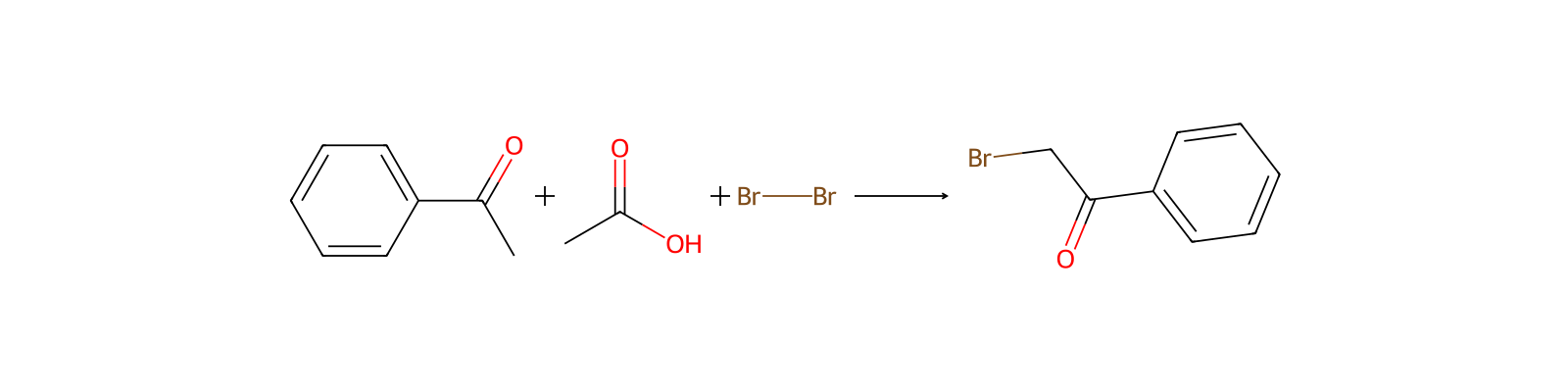
1.060
Reaktionsaufzeichnung erstellen
Reaktionsgleichung von HRID 1067
HRID 1067als Eduktuspto-grants-1998_03
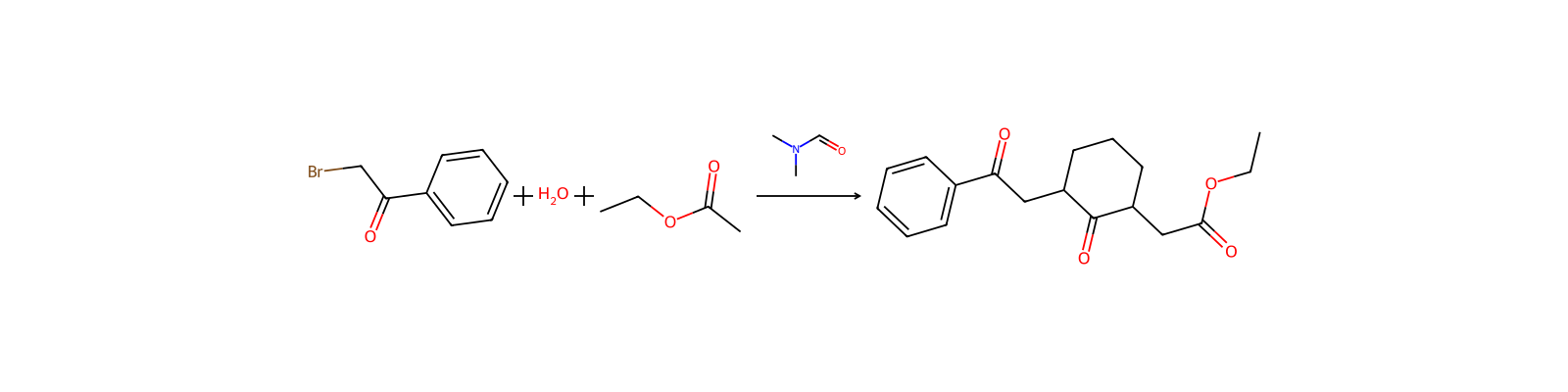
Reaktionsgleichung von HRID 1173
HRID 1173als Eduktuspto-grants-1998_03
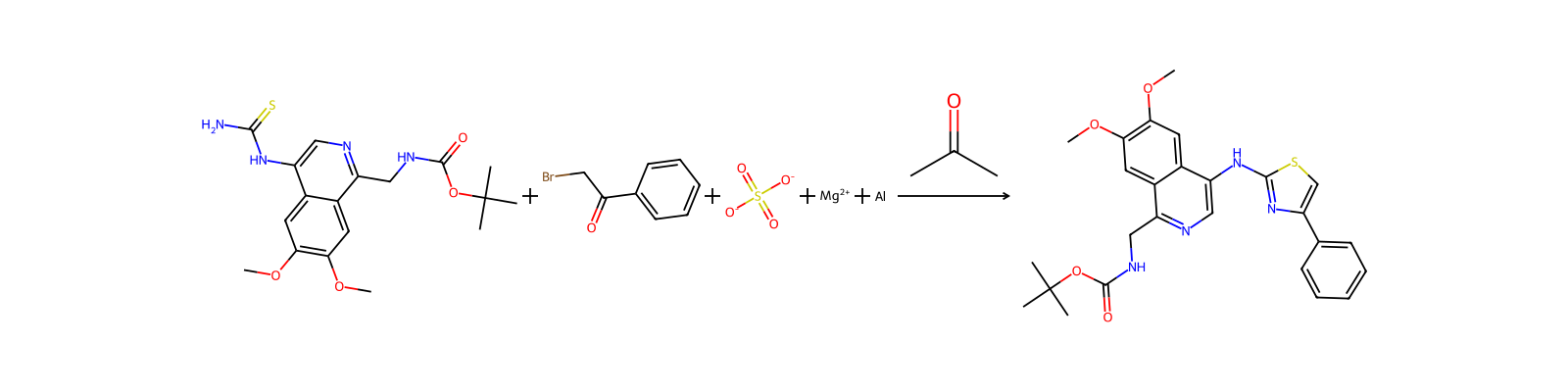
Reaktionsgleichung von HRID 7096
HRID 7096als Produktuspto-grants-2006_08
Reaktionsgleichung von HRID 10168
HRID 10168als Eduktuspto-grants-2006_08
Reaktionsgleichung von HRID 12608
HRID 12608als Eduktuspto-grants-2010_06
Reaktionsgleichung von HRID 14667
HRID 14667als Eduktuspto-grants-2010_06
Reaktionsgleichung von HRID 17656
HRID 17656als Eduktuspto-grants-2010_06
Reaktionsgleichung von HRID 18200
HRID 18200als Produktuspto-grants-2010_06
Seite 1 von 133

Notizen zur Verbindung

Wird geladen…

Auf dieser SeiteGrundinformationenÜberblickNamen und BezeichnerEigenschaftenSicherheit und RegulatorischesChemie und IndustrieZugehörige ReaktionenNotizen zur Verbindung
Weitere Aktionen
Neue NotizNeue ReaktionAnfrage stellen
ChEMBL
CHEMBL102953
ChEBI
CHEBI:51846
UNII
754Y0U325I
EC Number
200-724-9
Nikkaji
J4.874G
storage temp.
2 · 2-8°C
Löslichkeit
Chloroform (Slightly), DMSO (Slightly), Methanol (Slightly)
Aggregatzustand
Crystals or Powder
Farbe
White to dark green-brown
Wasserlöslichkeit
PRACTICALLY INSOLUBLE
Merck
14 · 14,1402
BRN
606474 · 606474
Stabilität
Stable. Incompatible with strong bases, strong oxidizing agents. Combustible.
InChI
1S/C8H7BrO/c9-6-8(10)7-4-2-1-3-5-7/h1-5H,6H2
InChIKey
LIGACIXOYTUXAW-UHFFFAOYSA-N
SMILES
BrCC(=O)c1ccccc1
CAS Datenbank
70 · 70-11-1(CAS DataBase Reference)
NIST chemische Informationen
2 · Ethanone, 2-bromo-1-phenyl-(70-11-1)
EPA chemische Informationen
2 · Ethanone, 2-bromo-1-phenyl- (70-11-1)
DOT ID and Guide2645 153
Reactive GroupHalogenated Organic Compounds
Reactivity ProfilePHENACYL BROMIDE reacts slowly with metals causing mild corrosion.
DOT Hazard Classification · 4 Einträge

Phenacyl bromide

UN2645

Div 6.1 Poisonous materials (49 eCFR § 173.132)

PG II: the degree of danger presented by the material is medium

Air and Water ReactionsReacts slowly with moisture in air to form hydrogen bromide.
Hazard Classes and CategoriesAcute Tox. 3 (20.6%)

Sicherheit und Schutzausrüstung

Fire FightingExcerpt from ERG Guide 153 [Substances - Toxic and/or Corrosive (Combustible)]:
Accidental Release Measures · 2 Einträge

· CALL 911. Then call emergency response telephone number on shipping paper. If shipping paper not available or no answer, refer to appropriate telephone number listed on the inside back cover.

· ELIMINATE all ignition sources (no smoking, flares, sparks or flames) from immediate area.

First Aid · 2 Einträge

Excerpt from ERG Guide 153 [Substances - Toxic and/or Corrosive (Combustible)]:

General First Aid:

Exposure Control and Personal Protection· Wear positive pressure self-contained breathing apparatus (SCBA).
Nonfire Spill ResponseExcerpt from ERG Guide 153 [Substances - Toxic and/or Corrosive (Combustible)]:
Isolation and Evacuation · 2 Einträge

Excerpt from ERG Guide 153 [Substances - Toxic and/or Corrosive (Combustible)]:

Immediate precautionary measure

Personal Protective Equipment (PPE)Excerpt from ERG Guide 153 [Substances - Toxic and/or Corrosive (Combustible)]:
Emergency Response Planning GuidelinesSmall Fire

Toxikologische Informationen

Treatment · 1 Eintrag

EYES: irrigate opened eyes for several minutes under running water. INGESTION: do not induce vomiting. Rinse mouth with water (never give anything by mouth to an unconscious person). Seek immediate medical advice. SKIN: should be treated immediately by rinsing the affected parts in cold running water for at least 15 minutes, followed by thorough washing with soap and water. If necessary, the person should shower and change contaminated clothing and shoes, and then must seek medical attention. INHALATION: supply fresh air. If required provide artificial respiration.

Health EffectsA strong lachrymator. Inhalation, ingestion or skin contact with material may cause severe injury or death. Potentially hepatotoxic. It is not carcinogenic or mutagenic.
Adverse EffectsDermatotoxin - Skin burns.
Exposure RoutesOral (L626) ; inhalation (L626) ; dermal (L626)
Toxicity Summary · 1 Eintrag

Organobromide compounds such as phenacyl bromide are strong alkylating agents. Consequently they can readily modify free thiols (cysteines) and methionine residues of the surfaces of proteins leading to the disruption of enzyme, transporter or membrane functions. One of the most probable protein targets is the TRPA1 ion channel that is expressed in sensory nerves (trigeminal nerve) of the eyes, nose, mouth and lungs. Human liver aldehyde dehydrogenase isozymes E1 and E2 are both completely and irreversibly inactivated by phenacyl bromide. This kind targeted modification may lead to liver toxicity.

Signs and Symptoms · 1 Eintrag

Phenacyl bromide is a strong lachrymator. Eye exposure produces irritation, characterized by a burning sensation, redness, tearing, inflammation, and possible corneal injury. Causes skin irritation and possible burns. May cause gastrointestinal irritation with nausea, vomiting and diarrhea. Causes respiratory tract irritation.

Carcinogen ClassificationNo indication of carcinogenicity (not listed by IARC). (L135)

Sicherheitsdaten

F
8-19
wgk
3
tsca
TSCA listed
ridadr
UN 2645
hs_code
29143990
risk_code
34-20/21/22
hazard_code
C
hazard_note
Corrosive
safety_code
26-36/37/39-45
hazard_class
6.1
packing_group
II
Speicherklasse
6.1A - Combustible acute toxic Cat. 1 and 2very toxic hazardous materials
Hazard Classifications
Skin Corr. 1B
3-(-Hydroxyphenethyl)-2-imino thiazolidine
4-Phenyl-1,2,3-thiadiazol-5-amine
Diethoxymethan
1-(2-Oxo-2-phenylethyl)pyridiniumbromid
5-Amino-3-phenylisoxazole
4-Amino-alpha-tert-butylamine-3,5-dichloroacetophenone
2-(2-Iminothiazolidin-3-yl)-1-phenylethan-1-onmonohydrobromid
4-Acetyloxy-3-acetyloxymethyl-(N-benzyl-N-tertbutylamino)acetophenone hydrochloride
1-Propanone, 3-hydroxy-1,3-diphenyl-
2-Phenylindol
N-[1-(Hydroxymethyl)-2-(4-nitrophenyl)-2-oxoethyl]acetamid
Levophenacylmorphan
(R)-(Epoxyethyl)benzol
Benzoic acid, 2-ethenyl- (9CI)
Aminomethylphenylketonhydrochlorid
4,6-Diphenyl-2-pyrone
R-4-Boc-2-phenylpiperazine

Ergänzende Hinweise

DefinitionChEBI: An alpha-bromoketone that is acetophenone substituted by a bromo group at position 2.