
Grundinformationen
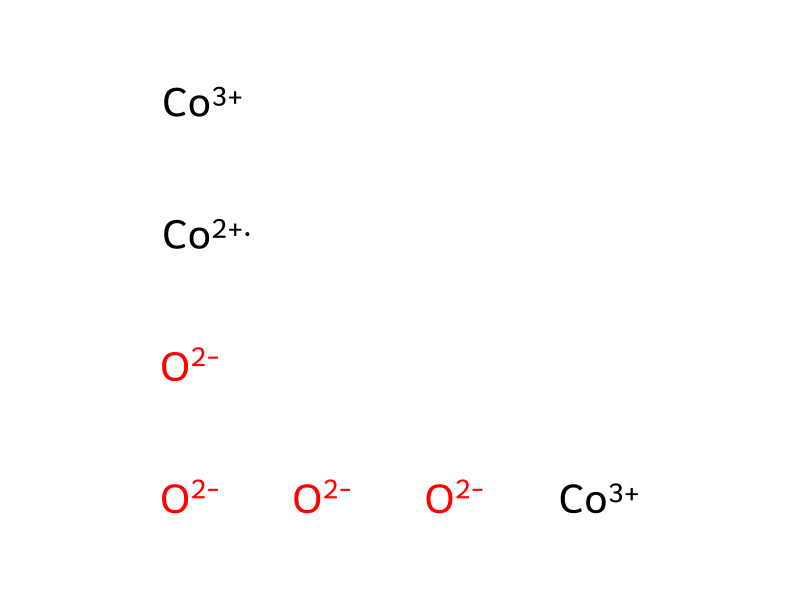
- Standard-SMILES
[Co+2].[Co+3].[Co+3].[O-2].[O-2].[O-2].[O-2]- InChIKey
UBEWDCMIDFGDOO-UHFFFAOYSA-N- Summenformel
- Co3O4
- Durchschnittliche Molmasse
- 240,797 g/mol
- Monoisotopische Masse
- 240,77924
Namen und Bezeichner
- Bevorzugter Name
- Cobalt oxide
- IUPAC
- cobalt(2+);bis(cobalt(3+));tetrakis(oxygen(2-))
- Lokaler Name
- Cobaltoxid
- Englischer Name
- Cobalt oxide
- Summenformel
- CoO
- Molmasse
- 0
Namen und Synonyme
Cobalt tetraoxideUSK772NS5611104-61-3234-334-5Co(3)O(4)Cobalt oxideCobaltum OxydatumDTXSID801014561RefChem:58007Tricobalt tetraoxideCobaltic-cobaltous oxidecobalt(2+);cobalt(3+);oxygen(2-)
Weitere Namen anzeigen
cobalt(2+),oxygen(2-)cobalt(2+),oxygen(2 oxygen(2-)
Cobalt oxide blackCOBALT (II,III) OXIDEoxocobalt; oxo(oxocobaltiooxy)cobaltEINECS 215-157-2Cobalt (II, III) oxideUNII-USK772NS56COBALT OXIDE [MART.]SCHEMBL5054762
Datenbank-Bezeichner
- CAS
11104-61-3、1308-06-1- PubChem CID
- 6432046
- UNII
- USK772NS56
- EC Number
- 215-157-2、234-334-5
Eigenschaften
Berechnete Struktureigenschaften
- Polarare Oberfläche (TPSA)
- 4 Ų
- H-Brücken-Donoren
- 0
- H-Brücken-Akzeptoren
- 4
- Frei drehbare Bindungen
- 0
- Schwere Atome
- 7
- Formalladung
- 0
- Komplexität
- 0
Experimentelle und physikochemische Eigenschaften
Physical Description
Large Crystals; Dry Powder
Black or grey solid; [Merck Index] Black powder, insoluble in water; [MSDSonline]
Physikochemische Eigenschaften
- EPA chemische Informationen
- Cobalt oxide (11104-61-3)
Sicherheit und Regulatorisches
GHS-Klassifizierung
GHS Classification
This chemical does not meet GHS hazard criteria for 100% (7 of 7) of all reports.
Not Classified;Reported as not meeting GHS hazard criteria by 7 of 7 companies. For more detailed information, please visit ECHA C&L website.
Aggregated GHS information provided per 7 reports by companies from 1 notifications to the ECHA C&L Inventory.;Reported as not meeting GHS hazard criteria per 7 of 7 reports by companies.;There are 0 notifications provided by 0 of 7 reports by companies with hazard statement code(s).;Information may vary between notifications depending on impurities, additives, and other factors. The percentage value in parenthesis indicates the notified classification ratio from companies that provide hazard codes. Only hazard codes with percentage values above 10% are shown. For more detailed information, please visit ECHA C&L website.
Danger
H317: May cause an allergic skin reaction [Warning Sensitization, Skin];H334: May cause allergy or asthma symptoms or breathing difficulties if inhaled [Danger Sensitization, respiratory];H372: Causes damage to organs through prolonged or repeated exposure [Danger Specific target organ toxicity, repeated exposure]
Gefahrenhinweise
Regulatory Information
Chemical: Cobalt oxide
Cobalt oxide is listed on the EPA's Chemical Data Reporting (CDR) system. Manufacturers and importers of Cobalt oxide are required to report information about their production and use of this chemical to the EPA under the Toxic Substances Control Act (TSCA). (40 eCFR Part 711)
Status: Active Update: 21-04-2023 https://echa.europa.eu/registration-dossier/-/registered-dossier/15110
Cobalt oxide: Does not have an individual approval but may be used under an appropriate group standard
Other Safety InformationIMAP assessments - Cobalt oxide: Human health tier II assessment
Hazards SummaryHarmful if swallowed; May cause skin sensitization; [MSDSonline] See Cobalt.
Hazard Classes and Categories
Not Classified
Specific target organ toxicity (repeated exposure) - category 1;Reproductive toxicity - category 1B;Respiratory sensitisation - category 1;Skin sensitisation - category 1;Acute toxicity (ingestion) - category 3;Acute toxicity (inhalation) - category 2
Respiratory sensitization - Category 1A;Skin sensitization - Category 1A;Specific target organ toxicity - Repeated exposure - Category 1 (respiratory organs)
Sicherheit und Schutzausrüstung
Exposure Control and Personal ProtectionBiological Exposure Indices (BEI) [ACGIH] - Cobalt in urine = 15 ug/L; sample at end of shift at end of workweek;
Minimum Risk LevelChronic Inhalation: 0.0001 mg/m3 (L134)
Intermediate Oral: 0.01 mg/kg/day (L134)
Threshold Limit Values (TLV)0.02 [mg/m3], as Co
Protective Action Criteria (PAC)
0.082 [mg/m3]
6.7 [mg/m3]
40 [mg/m3]
Toxikologische Informationen
TreatmentTreatment of cobalt poisoning is symptomatic. (L29)
Health EffectsExposure to high amount of cobalt can cause heart, lung, kidney, and liver damage. Skin contact is known to result in contact dermatitis. Cobalt may also have mutagenic and carcinogenic effects. (L29, L30)
Adverse EffectsSkin Sensitizer - An agent that can induce an allergic reaction in the skin.;Fibrogenic - Inducing tissue injury and fibrosis (scarring).
Exposure RoutesInhalation (L29) ; oral (L29) ; dermal (L29)
Toxicity Summary
Cobalt is believed to exhibit its toxicity through a oxidant-based and free radical-based processes. It produces oxygen radicals and may be oxidized to ionic cobalt, causing increased lipid peroxidation, DNA damage, and inducing certain enzymes that lead to cell apoptosis. Cobalt has also been shown to block inorganic calcium channels, possibly impairing neurotransmission. Cobalt can also chelate lipoic acids, impairing oxidation of pyruvate or fatty acids. In addition, cobalt may inhibit DNA repair by interacting with zinc finger DNA repair proteins, and has also been shown to inhibit heme synthesis and glucose metabolism. Cobalt may activate specific helper T-lymphocyte cells and interact directly with immunologic proteins, such as antibodies (IgA and IgE) or Fc receptors, resulting in immunosensitization. (L29)
Signs and SymptomsCobalt inhalation can cause asthma-like breathing problems. Skin contact is known to result in contact dermatitis, which is characterized by irritation and rashes. Ingesting large amounts of cobalt may cause nausea and vomiting. (L2090)
Carcinogen Classification2B, possibly carcinogenic to humans. (L135)
Toxicity DataLD50: >5 g/kg (Oral, Rat) (L494)
Regulatorische Informationen
Regulatory Information
Chemical: Cobalt oxide
Cobalt oxide is listed on the EPA's Chemical Data Reporting (CDR) system. Manufacturers and importers of Cobalt oxide are required to report information about their production and use of this chemical to the EPA under the Toxic Substances Control Act (TSCA). (40 eCFR Part 711)
Status: Active Update: 21-04-2023 https://echa.europa.eu/registration-dossier/-/registered-dossier/15110
Cobalt oxide: Does not have an individual approval but may be used under an appropriate group standard
Sicherheitsdaten
- tsca
- TSCA listed
Chemie und Industrie
Pharmakologische Informationen
Metabolism/Metabolites
Cobalt is absorbed though the lungs, gastrointestinal tract, and skin. Since it is a component of the vitamin B12 (cyanocobalamin), it is distributed to most tissues of the body. It is transported in the blood, often bound to albumin, with the highest levels being found in the liver and kidney. Cobalt is excreted mainly in the urine and faeces. (L29)
Verwendung und Herstellung
Uses
Used in enamels, semiconductors, and grinding wheels; [Merck Index] When cobalt (II) oxide is heated at 400-500 deg C in an atmosphere of oxygen, the cobalt (II,III) oxide is formed. [Ullmann]
Semiconductor Manufacturing [Category: Industry]
Enameling [Category: Hobbies]
No data.
U.S. Production2023: 468,662 lb;2022: 296,710 lb;2021: 359,860 lb;2020: 366,399 lb
Consumer UsesOther
Industry UsesOther
General Manufacturing Information
Petroleum Refineries;Primary Metal Manufacturing
Cobalt oxide: ACTIVE
Zugehörige Reaktionen
6





Verknüpfte Notizen
Wird geladen…