StartseiteMCPWorkbenchSkills
StartseiteWorkbenchBenachrichtigungenMein Bereich
llms.txt · MCP-AnleitungDatenschutz · Nutzungsbedingungen · Supportv1.8.3
  1. Startseite
  2. /Verbindung

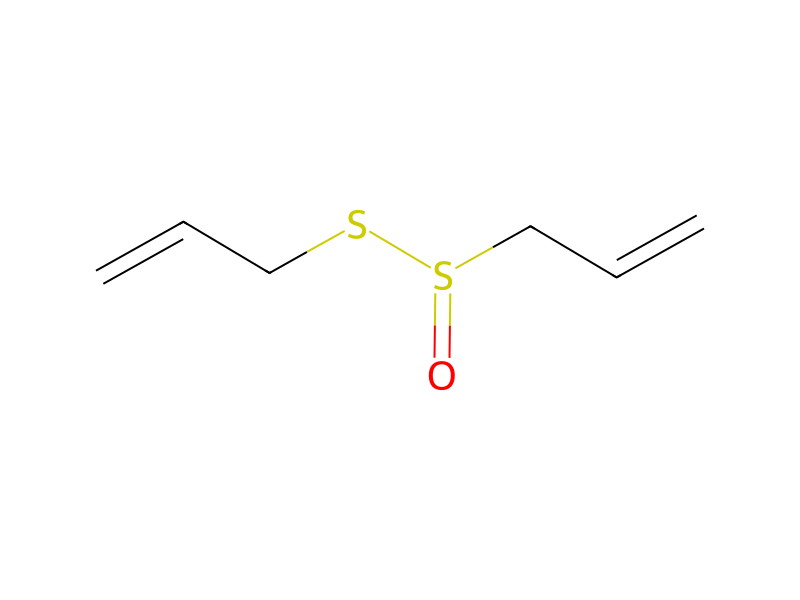
S-Allylacrylo-1-sulfinothioat

Allicin

HCID 65036
Neue Reaktion
Drucken
GrundinformationenÜberblickNamen und BezeichnerEigenschaftenSicherheit und RegulatorischesChemie und IndustrieZugehörige ReaktionenNotizen zur Verbindung
TeilstruktursucheÄhnliche Strukturen suchen

Grundinformationen

CAS
539-86-6
Standard-SMILES
C=CCSS(=O)CC=C
InChIKey
JDLKFOPOAOFWQN-UHFFFAOYSA-N
Summenformel
C6H10OS2
Durchschnittliche Molmasse
162,3 g/mol
Monoisotopische Masse
162,01730729

Überblick

Allicin is a sulfoxide and a botanical anti-fungal agent. It has a role as an antibacterial agent.

Namen und Bezeichner

Bevorzugter Name
Allicin
IUPAC
3-prop-2-enylsulfinylsulfanylprop-1-ene
Lokaler Name
S-Allylacrylo-1-sulfinothioat
Englischer Name
Allicin
Summenformel
C6H10OS2
Molmasse
162.27

Namen und Synonyme

Allicin539-86-6Diallyl thiosulfinateThio-2-propene-1-sulfinic acid S-allyl esterAllylthiosulphinic acid allyl ester3-prop-2-enylsulfinylsulfanylprop-1-ene2-Propene-1-sulfinothioic acid S-2-propenyl esterDTXSID60437073C39BY17Y63-[(prop-2-ene-1-sulfinyl)sulfanyl]prop-1-eneCHEBI:284113-((prop-2-ene-1-sulfinyl)sulfanyl)prop-1-ene
Weitere Namen anzeigen
Allitridgarlic mealAlliMedalliosanC6H10S2OAllisatinARICINE(P)ALLICIN(SH)Allicin 10%
RefChem:5523DTXCID4023707208-727-7S-allyl prop-2-ene-1-sulfinothioateDiallyldisulfid-S-oxid2-Propene-1-sulfinothioic acid, S-2-propenyl esterC6H10OS2DADSO

Datenbank-Bezeichner

CAS
539-86-6
PubChem CID
65036
DTXSID
DTXSID6043707
ChEMBL
CHEMBL359965
ChEBI
CHEBI:28411
UNII
3C39BY17Y6
EC Number
208-727-7
Nikkaji
J71.032F、J816.011B

Eigenschaften

Berechnete Struktureigenschaften

XLogP
1,3
Polarare Oberfläche (TPSA)
61,6 Ų
H-Brücken-Donoren
0
H-Brücken-Akzeptoren
3
Frei drehbare Bindungen
5
Schwere Atome
9
Formalladung
0
Komplexität
120

Experimentelle und physikochemische Eigenschaften

Solubility24 mg/mL at 10 °C
Melting Point25 °C
Physical DescriptionSolid

Physikochemische Eigenschaften

Schmelzpunkt
25 °C · < 25 °C (77 °F; 298 K)
Siedepunkt
decomposes
Dichte
1.112 g · 1.112 g cm−3
Brechungsindex
20 · nD20 1.561
storage temp.
4 °C, · 4°C, away from moisture and light
Löslichkeit
5 mg/mL · DMSO : 5 mg/mL (30.81 mM; Need ultrasonic)H2O : < 0.1 mg/mL (insoluble)
Aggregatzustand
liquid
Farbe
Colourless
Wasserlöslichkeit
24 g/L · 24g/L(10 ºC)
InChI
InChI=1S/C6H10OS2/c1-3-5-8-9(7)6-4-2/h3-4H,1-2,5-6H2
InChIKey
JDLKFOPOAOFWQN-UHFFFAOYSA-N
SMILES
C(S(SCC=C)=O)C=C
LogP
1.133 · 1.133 (est)

Sicherheit und Regulatorisches

Sicherheitsangaben dienen nur zur Orientierung und ersetzen weder das Sicherheitsdatenblatt (SDB) des Lieferanten noch geltende Vorschriften oder eine fachliche Bewertung.

GHS-Klassifizierung

GHS Classification · 4 Einträge

Warning

H315 (100%): Causes skin irritation [Warning Skin corrosion/irritation]

P261, P264, P264+P265, P271, P280, P302+P352, P304+P340, P305+P351+P338, P319, P321, P332+P317, P337+P317, P362+P364, P403+P233, P405, and P501 (click each P-code to see the statement)

Aggregated GHS information provided per 39 reports by companies from 2 notifications to the ECHA C&L Inventory. Each notification may be associated with multiple companies.

Gefahrenhinweise

Hazard Classes and CategoriesSkin Irrit. 2 (100%)

Sicherheitsdaten

hs_code
2932999099
Toxizität
LD50 in mice (mg/kg): 60 i.v.; 120 s.c. (Cavallito, Bailey)

Chemie und Industrie

Pharmakologische Informationen

Metabolism/MetabolitesDADSO is a known human metabolite of diallyl disulfide.
MeSH Pharmacological Classification · 5 Einträge

Substances that prevent infectious agents or organisms from spreading or kill infectious agents in order to prevent the spread of infection.

Substances that lower the levels of certain LIPIDS in the BLOOD. They are used to treat HYPERLIPIDEMIAS.

Naturally occurring or synthetic substances that inhibit or retard oxidation reactions. They counteract the damaging effects of oxidation in animal tissues.

Substances which lower blood glucose levels.

Substances that eliminate free radicals. Among other effects, they protect PANCREATIC ISLETS against damage by CYTOKINES and prevent myocardial and pulmonary REPERFUSION INJURY.

Cellular LocationsCytoplasm
Anwendungen · 3 Einträge

BeschreibungAllicin is one of the major allergens in garlic (Allium sativum L.). It is responsible of the characteristical fiavour of the bulbs.

HistoryAs the main active substance of garlic, garlic was separated by Cavallito and Bailey in 1944 from crushed garlic. Cavallito firstly clarified the physical properties and chemical structure of the scent of garlic.Fresh garlic does not contain free allicin but only its precursor material alliin. When the garlic undergoes physical mechanical crushing, garlic alliinase is activated and catalyzes the breakdown of alliin into allicin.The reported preparation methods of allicin contain extraction, biosynthesis, and chemical synthesis. Chemical synthesis starts from raw material of diallyldisulfides, m-chloroperoxy benzoic acid to get crude allicin. According to the United States patent report, biosynthesis preparation of allicin comes from natural sources or synthetic, after it is made into a certain concentration of aqueous solution, it is converted into allicin by reaction with alliinase. Extraction of allicin with low boiling nonpolar solvent can acquire pure allicin, but it must be stored at 70°C to prevent from decomposing.

VerwendenAllicin is naturally formed by the action of the enzyme allicinase on alliin when the tissue of the garlic bulb is disrupted. Allicin shows antibacterial activity.

Vor- und nachgelagerte Produkte

Vorgelagerte Rohstoffe

Garlic P.ENatriumthiosulfatSodium thiosulfate pentahydrate

Nachgelagerte Produkte

Prop-2-en-1-thiol

Ergänzende Hinweise

DefinitionAn antibacterial substance extracted from garlic (allium).

Zugehörige Reaktionen

5
Reaktionsaufzeichnung erstellen
Reaktionsgleichung von HRID 349158
HRID 349158als Produkt
Reaktionsgleichung von HRID 349159
HRID 349159als Produkt
Reaktionsgleichung von HRID 349160
HRID 349160als Edukt
Reaktionsgleichung von HRID 468086
HRID 468086als Produkt
Reaktionsgleichung von HRID 1514802
HRID 1514802als Produkt

Notizen zur Verbindung

Auf dieser SeiteGrundinformationenÜberblickNamen und BezeichnerEigenschaftenSicherheit und RegulatorischesChemie und IndustrieZugehörige ReaktionenNotizen zur Verbindung