78-85-3C=C(C)C=OSTNJBCKSHOAVAJ-UHFFFAOYSA-NMethacrylaldehyde appears as a colorless liquid. Less dense than water. May be toxic by ingestion, inhalation and skin absorption. Severely irritating to skin and eyes. Used to make plastics.
78-85-3DTXSID0052540CHEMBL4063095CHEBI:88384Other Classes -> Aldehydes
Flammable agents - 3rd degree
0.849 @ 25 °C/4 °C
Relative density (water = 1): 0.8
0.830 @ 20°C
0.49 mPa.s @ 20 °C
0.59 mm²/s at 20 °C
MISCIBLE WITH WATER, ETHANOL, ETHER
Water solubility = 5.9% (59,000 mg/L) at 20 °C
Solubility in water, g/100ml at 20 °C: 6 (soluble)
35 °F (NFPA, 2010)
35 °F (2 °C) (OPEN CUP)
-15 °C
68.4 °C
68 °C
Sicherheitsangaben dienen nur zur Orientierung und ersetzen weder das Sicherheitsdatenblatt (SDB) des Lieferanten noch geltende Vorschriften oder eine fachliche Bewertung.
Danger
H225 (93.5%): Highly Flammable liquid and vapor [Danger Flammable liquids]
P203, P210, P233, P240, P241, P242, P243, P260, P262, P264, P264+P265, P270, P271, P273, P280, P284, P301+P316, P301+P330+P331, P302+P352, P302+P361+P354, P303+P361+P353, P304+P340, P305+P354+P338, P316, P317, P318, P320, P321, P330, P361+P364, P363, P370+P378, P391, P403+P233, P403+P235, P405, and P501 (click each P-code to see the statement)
Aggregated GHS information provided per 170 reports by companies from 11 notifications to the ECHA C&L Inventory. Each notification may be associated with multiple companies.
Danger
H225: Highly Flammable liquid and vapor [Danger Flammable liquids]
Chemical: 2-Propenal, 2-methyl-
REACH registered substance: Methacrylaldehyde (EC: 201-150-1)
The New Jersey Worker and Community Right to Know Act requires public and private employers to provide information about hazardous substances at their workplaces. (N.J.S.A. 34:5A-1 et. seq.)
Excerpt from ERG Guide 131 [Flammable Liquids - Toxic; polymerization hazard]:
· HIGHLY FLAMMABLE: Will be easily ignited by heat, sparks or flames.
Highly flammable. Vapour/air mixtures are explosive.
Excerpt from ERG Guide 131 [Flammable Liquids - Toxic; polymerization hazard]:
Aldehydes are readily oxidized to organic acids, which, in turn, can serve as substrates for fatty acid oxidation pathways and the Krebs cycle. ... Oxidation of aldehydes is catalyzed by aldehyde dehydrogenase, which has been found in the brain, erythrocytes, liver, kidney, heart, and placenta. /Aldehydes/
... The detoxification of aldehydes can be seen to proceed basically via two routes: (1) an oxidation to yield readily metabolized acids; (2) inactivation by reaction with sulfhydryl groups, particularly glutathione. Under conditions that either deplete glutathione levels, or that result in an inhibition of aldehyde dehydrogenase (for example, Antabuse treatment), the acute and chronic effects of aldehyde toxicity might be more fully expressed. /Aldehydes/
Used as a chemical intermediate and a monomer to produce resins; [HSDB]
CHEMICAL INTERMEDIATE; COMONOMER IN RESIN PRODN
Copolymers, resins.
As an intermediate in the production of methacrylonitrile or methacrylic acid.
CATALYTIC OXIDATION OF ISOBUTYLENE
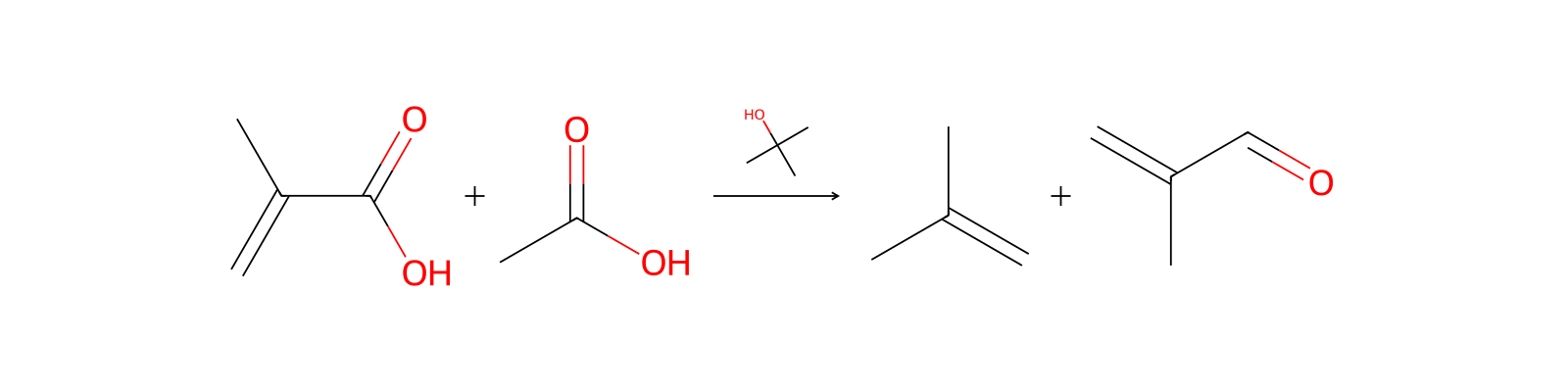
Cross-condensation of propionaldehyde and formaldehyde or the dehydrogenation of isobutyraldehyde.
2-Propenal, 2-methyl-: ACTIVE
Development of more productive catalysts for propylene oxidation, which were not advantages for isobutylene oxidation, and failure of growth in the commercial use of methacrolein contributed to the discontinuance of the manufacture of methacrolein.
Wird geladen…
-81 °C
-81 °C
-81 °C
2.4 (AIR= 1)
Relative vapor density (air = 1): 2.42
155.0 [mmHg]
155 mm Hg @ 25 °C
Vapor pressure, kPa at 20 °C: 16
120 [mm Hg] @20 °C
· TOXIC; may be fatal if inhaled, ingested or absorbed through skin.
Like acrolein (VP= 274; LC50 (mouse) = 66 ppm; LCLo (human) = 5.5 ppm), methacrolein (VP = 154; LCLo (mouse) = 125 ppm) is a skin and respiratory tract irritant with the potential to cause acute lung injury; [HSDB] Methacrylaldehyde, stabilized (UN2396) has warning of explosive polymerization; [ERG 2016]
Section 8(a) of TSCA requires manufacturers of this chemical substance to report preliminary assessment information concerned with production, use, and exposure to EPA as cited in the preamble in 51 FR 41329.
Pursuant to section 8(d) of TSCA, EPA promulgated a model Health and Safety Data Reporting Rule. The section 8(d) model rule requires manufacturers, importers, and processors of listed chemical substances and mixtures to submit to EPA copies and lists of unpublished health and safety studies. 2-methyl-2-propenal is included on this list.
Excerpt from ERG Guide 131 [Flammable Liquids - Toxic; polymerization hazard]:
Use water spray, powder, alcohol-resistant foam, carbon dioxide. In case of fire: keep drums, etc., cool by spraying with water.
Fresh air, rest.
Remove contaminated clothes. Rinse skin with plenty of water or shower. Refer for medical attention .
First rinse with plenty of water for several minutes (remove contact lenses if easily possible), then refer for medical attention.
Rinse mouth. Refer for medical attention .
· CALL 911. Then call emergency response telephone number on shipping paper. If shipping paper not available or no answer, refer to appropriate telephone number listed on the inside back cover.
· ELIMINATE all ignition sources (no smoking, flares, sparks or flames) from immediate area.
Excerpt from ERG Guide 131 [Flammable Liquids - Toxic; polymerization hazard]:
General First Aid:
SRP: At the time of review, criteria for land treatment or burial (sanitary landfill) disposal practices are subject to significant revision. Prior to implementing land disposal of waste residue (including waste sludge), consult with environmental regulatory agencies for guidance on acceptable disposal practices.
Consult an expert! Remove all ignition sources. Ventilation. Personal protection: complete protective clothing including self-contained breathing apparatus. Do NOT let this chemical enter the environment. Do NOT wash away into sewer. Collect leaking and spilled liquid in sealable containers as far as possible. Absorb remaining liquid in sand or inert absorbent. Wash away remainder with plenty of water. Then store and dispose of according to local regulations.
Excerpt from ERG Guide 131 [Flammable Liquids - Toxic; polymerization hazard]:
Immediate precautionary measure
TERRESTRIAL FATE: Based on a recommended classification scheme(1), an estimated Koc value of 11.3(SRC), determined from an experimental water solubility(2) and a recommended regression-derived equation(3), indicates that methacrolein will have very high mobility in soil(SRC). Volatilization of methacrolein may be important from moist soil surfaces(SRC) given an estimated Henry's Law constant of 2.86X10⁻⁴ atm-cu m/mole, calculated from experimental values of vapor pressure(4) and water solubility(2), and from dry soil surfaces(SRC) based on an experimental vapor pressure of 155 mm Hg(4). Insufficient data are available to determine the rate or importance of biodegradation of methacrolein in soil(SRC).
AQUATIC FATE: Based on a recommended classification scheme(1), an estimated Koc value of 11.3(SRC), determined from an experimental water solubility(2) and a recommended regression-derived equation(3), indicates that methacrolein may not adsorb to suspended solids and sediment(SRC) in the water. Methacrolein may volatilize from water surfaces based on an estimated Henry's Law constant of 2.86X10⁻⁴ atm-cu m/mole(SRC), calculated from experimental values of vapor pressure(4) and water solubility(2). Estimated half-lives for a model river and model lake are 5 hours and 4 days, respectively(3,SRC). An estimated BCF value of 1.4(3,SRC), from an experimental water solubility(2), suggests that methacrolein will not bioconcentrate in aquatic organisms(SRC) according to a recommended classification scheme(5). Insufficient data are available to determine the rate or importance of biodegradation of methacrolein in water(SRC).
ATMOSPHERIC FATE: According to a suggested classification scheme(1), an experimental vapor pressure of 155 mm Hg at 25 °C(2) indicates that methacrolein will exist in the vapor phase in the ambient atmosphere. Vapor-phase methacrolein is degraded in the atmosphere by reaction with photochemically produced hydroxyl radicals(SRC); the half-life for this reaction in air is estimated to be about 11.5 hours(3,SRC). Vapor-phase methacrolein is also degraded in the atmosphere by reaction with ozone(SRC); the half-life for this reaction in air is estimated to be about 10.5 days(4,SRC). Methacrolein reacts very quickly in air with oxygen forming peroxides and acids(5). Methacrolein is formed from the gas-phase reaction of ozone with isoprene with a formation yield of 0.387(6).
Cough. Sore throat. Burning sensation.
Redness. Pain.
Redness. Pain. Burns. Watering of the eyes.
Methacrolein has been reported to be released from gasoline exhaust(1). Methacrolein is formed from burning polyethylene which may occur in fire situations(2). Methacrolein emissions from a single-cylinder, production-type engine using isooctane fuel were 21 and less than 1 mole fraction with a 0.9 and 1.15 fuel-air equivalence ratio, respectively(3). Methacrolein has been detected as an emission from liquid floor wax(4). Methacrolein made up 1.6% of the total hydrocarbons released from a pulse flame combustor using methyl-t-butyl ether as fuel(5).
The Koc of methacrolein is estimated as approximately 11.3(SRC), using an experimental water solubility of 50,000 mg/L(1) and a regression-derived equation(2,SRC). According to a recommended classification scheme(3), this estimated Koc value suggests that methacrolein has very high mobility in soil(SRC).
URBAN/SUBURBAN: Air samples from four urban sites in Stockholm contained methacrolein at the following average concentrations: 0.71, 0.19, 0.11, and 0.13 ppb(1).
RURAL/REMOTE: In a rural site, 12 km outside of Stockholm, the average methacrolein concentration was 0.06 ppb(1).
METHACROLEIN WAS LESS CILIOSTATIC (IRRITATING TO TRACHEAL MUCOSA) THAN ACROLEIN.
The low molecular weight aldehydes, the halogenated aliphatic aldehydes, and the unsaturated aldehydes are particularly irritating. The mucus membranes of the nasal and oral passages and the upper respiratory tract are affected, producing a burning sensation, an increased ventilation rate, bronchial constriction, choking, and coughing. The eyes tear, and a burning sensation is noted on the skin of the face. During low exposures, the initial discomfort may abate after 5 to 10 minutes but will recur if exposure is resumed after an interruption. /Aldehydes/
...STRONG IRRITANT.
Section 8(a) of TSCA requires manufacturers of this chemical substance to report preliminary assessment information concerned with production, use, and exposure to EPA as cited in the preamble in 51 FR 41329.
Pursuant to section 8(d) of TSCA, EPA promulgated a model Health and Safety Data Reporting Rule. The section 8(d) model rule requires manufacturers, importers, and processors of listed chemical substances and mixtures to submit to EPA copies and lists of unpublished health and safety studies. 2-methyl-2-propenal is included on this list.