StartseiteMCPWorkbenchSkills
StartseiteWorkbenchBenachrichtigungenMein Bereich
llms.txt · MCP-AnleitungDatenschutz · Nutzungsbedingungen · Supportv1.8.3
  1. Startseite
  2. /Verbindung

Imidothiocarbaminsäure-methylester-sulfat (2:1)

S-methyl isothiourea hemisulfate

HCID 6604939
Neue Reaktion
Drucken
GrundinformationenÜberblickNamen und BezeichnerEigenschaftenSicherheit und RegulatorischesChemie und IndustrieZugehörige ReaktionenNotizen zur Verbindung
TeilstruktursucheÄhnliche Strukturen suchen

Grundinformationen

CAS
867-44-7
Standard-SMILES
CSC(N)=[NH2+].CSC(N)=[NH2+].O=S(=O)([O-])[O-]
InChIKey
BZZXQZOBAUXLHZ-UHFFFAOYSA-N
Summenformel
C4H14N4O4S3
Durchschnittliche Molmasse
278,4 g/mol
Monoisotopische Masse
278,01771793

Überblick

See also: Bis(S-methylisothiouronium) sulfate (preferred).

Namen und Bezeichner

Bevorzugter Name
S-methyl isothiourea hemisulfate
IUPAC
[amino(methylsulfanyl)methylidene]azanium;sulfate
Lokaler Name
Imidothiocarbaminsäure-methylester-sulfat (2:1)
Englischer Name
2-Methyl-2-thiopseudourea sulfate
Summenformel
C2H8N2O4S2
Molmasse
188.23

Namen und Synonyme

NCGC00025367-01Tocris-0776S-Methylisothiuroniumsulfat(C-methylsulfanylcarbonimidoyl)azanium;sulfate2-Methylthiouronium sulfateS-Methyl-thiuronium sulfateS-methylthiouronium sulphateS-methyl-thiouronium sulphateSCHEMBL638465bis(S-methylthiuronium) sulfateS-methylisothiourea hemisulphateS-methyl isothiourea hemisulfate
Weitere Namen anzeigen
2-Methyl-2-ThiopseudoureaS-MethyliSothourea SulfateS-Methyl isothiourea sulfateS-EIT hemihydratemethylsulfanylmethanimidamides-methylthiouroniumsulfate(2:1)methylcarbamimidothioate sulfateS-Methyl-ITUS-METHYLTHIOUREAisothiouronium suL
S-methyl-isothiourea hemisulphateS-methylthiopseudourea hemisulfatebis (S-methylisothiourea) sulphatemethyl carbamimidothioate hemisulfate2-Methyl-2-thiopseudoureahemisulfate2-methyl-isothiourea hemisulfate saltAKOS024458643NS00080119

Datenbank-Bezeichner

CAS
867-44-7
PubChem CID
6604939
DTXSID
DTXSID7061223

Eigenschaften

Berechnete Struktureigenschaften

Polarare Oberfläche (TPSA)
242 Ų
H-Brücken-Donoren
4
H-Brücken-Akzeptoren
6
Frei drehbare Bindungen
2
Schwere Atome
15
Formalladung
0
Komplexität
99,6

Physikochemische Eigenschaften

Schmelzpunkt
240 · 240-241 °C (dec.)(lit.)
Dichte
1.28 · 1.28
Flammpunkt
3 ℃ · 3℃
storage temp.
Inert atmosphere,Room Temperature
Löslichkeit
2 O: · H2O: 0.1 g/mL, clear, colorless
Aggregatzustand
Crystals or Crystalline Powder
pka
1 · pK1:9.83(+1) (25°C)
Farbe
White
PH
5.5 · 5.5 (260g/l, H2O, 20℃)
Wasserlöslichkeit
260 g/L · 260 g/L (20 ºC)
BRN
3917217 · 3917217
Stabilität
Stable. Incompatible with strong oxidizing agents.
InChI
1S/2C2H6N2S.H2O4S/c2*1-5-2(3)4;1-5(2,3)4/h2*1H3,(H3,3,4);(H2,1,2,3,4)
InChIKey
BZZXQZOBAUXLHZ-UHFFFAOYSA-N
SMILES
CSC(N)=N.CSC(N)=N.OS(O)(=O)=O
CAS Datenbank
867 · 867-44-7(CAS DataBase Reference)
EPA chemische Informationen
Carbamimidothioic acid, methyl ester, sulfate (2:1) (867-44-7)

Sicherheit und Regulatorisches

Sicherheitsangaben dienen nur zur Orientierung und ersetzen weder das Sicherheitsdatenblatt (SDB) des Lieferanten noch geltende Vorschriften oder eine fachliche Bewertung.

Sicherheitsdaten

wgk
3
tsca
TSCA listed
hs_code
29309070
RTECS-Nr.
UM9200000
risk_code
22
hazard_code
Xn
safety_code
22-24/25
Speicherklasse
11 - Combustible Solids
Hazard Classifications
Acute Tox. 4 Oral

Chemie und Industrie

Anwendungen

BeschreibungSMIT is a potent non-selective inhibitor of NOS isoforms in vitro but may lack good in vivo efficacy due to poor cellular penetration. The Ki values are 120, 200, and 160 nM using purified human iNOS, eNOS, and nNOS, respectively.

VerwendenIntermediate of 4-Hydroxydebrisoquine. S-Methyl-isothiouronium Hemisulfate is also a reagent used in the synthesis of strobilurin-pyrimidine derivatives for their anti-proliferative activity.

Vor- und nachgelagerte Produkte

Nachgelagerte Produkte

5-[2-(Methylthio)pyrimidin-4-yl]thiophene-2-sulfonyl chloride5-Chloro-2-(methylsulfonyl)pyrimidine-4-carboxylic acid4-Methoxy-6-methyl-2-(methylthio)pyrimidine4-Methyl-2-methylsulfanyl-pyrimidine-5-carboxylic acid ethyl ester1-Methyl-3-nitro-1-nitroso-guanidinethyl 2-(methylsulfanyl)-4-(trifluoromethyl)pyrimidine-5-carboxylate2-(Methylthio)ethanol5-Methyl-2-methylsulfanyl-pyrimidineBis(S-methylthiouronium)sulfatEthyl-4-chlor-2-methylthio-5-pyrimidincarboxylat5-Bromo-2-(methylsulfonyl)pyrimidine-4-carboxylic acid4-Morpholinecarboxamidine5-Bromo-2-(methylthio)pyrimidine-4-carboxylic acid5-Bromo-4-chloro-2-(methylthio)-7H-pyrrolo[2,3-D]pyrimidine ,97%5-Chloro-2-methoxypyrimidine-4-carboxylic acidAminoguanidiniumhydrogencarbonatGabexate mesylateMethyl 5-bromo-2-(methylsulfanyl)-4-pyrimidinecarboxylate, 97Ethyl 2-(ethylthio)-4-hydroxypyrimidine-5-carboxylate5-Chloro-2-(methylsulfonyl)pyrimidine2-(Methylthio)-4-(trifluoromethyl)pyrimidine5-methoxy-2-(methylthio)pyrimidin-4-ol ,97%4-Methoxy-6-methyl-2-(methylsulfonyl)pyrimidine ,97%1,1-Dimethylguanidinium-sulfat-(2:1)3-Oxo-3-thiophen-2-yl-propionic acid ethyl ester4-Amino-2-methylsulfanyl-pyrimidine-5-carboxylic acid4-(Trifluoromethyl)-2-(methylthio)pyrimidine-5-carboxylic acid ,97%4-Chloro-2-(methylthio)pyrimidine-5-carbonitrile ,97%1-(4-Methyl-2-(methylthio)pyrimidin-5-yl)ethanone4-Chloro-6-methyl-2-(methylthio)pyrimidine2-(Methylsulfanyl)-5-phenylpyrimidine5-Methyl-2-(methylsulfonyl)pyrimidine ,97%4-Hydroxy-2-(methylthio)pyrimidine-5-carbonitrile1,4-Dihydro-2-(methylthio)-4-oxo-5-pyrimidine-carboxylate acid ethyl esterN,N''-(Iminodi-8,1-octandiyl)bis-guanidiniumacetat6-Methyl-2-(methylthio)pyrimidin-4-olEthyl 4-amino-2-(methylthio)pyrimidine-5-carboxylate5-Aminopyrimidine5-Chloro-2-(methylthio)pyrimidine-4-carboxylic acidAminoguanidiniumsulfat

Zugehörige Reaktionen

30
Reaktionsaufzeichnung erstellen
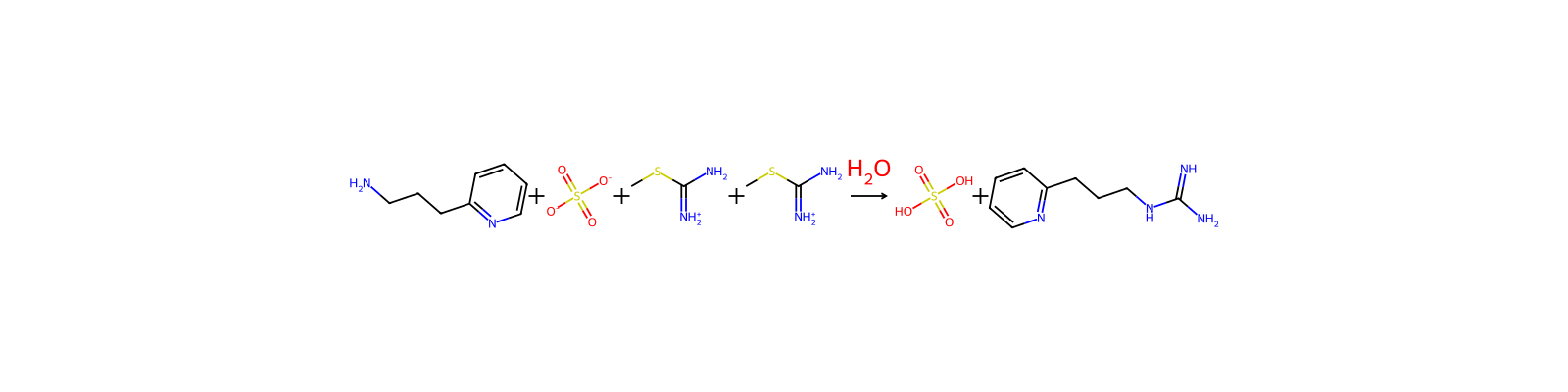
Reaktionsgleichung von HRID 26027
HRID 26027als Edukt
Reaktionsgleichung von HRID 325526
HRID 325526als Edukt
Reaktionsgleichung von HRID 372007
HRID 372007als Edukt
Reaktionsgleichung von HRID 372010
HRID 372010als Edukt
Reaktionsgleichung von HRID 372012
HRID 372012als Edukt
Reaktionsgleichung von HRID 372013
HRID 372013als Edukt
Reaktionsgleichung von HRID 372014
HRID 372014als Edukt
Reaktionsgleichung von HRID 372015
HRID 372015als Edukt
ZurückSeite 1 von 4

Notizen zur Verbindung

Auf dieser SeiteGrundinformationenÜberblickNamen und BezeichnerEigenschaftenSicherheit und RegulatorischesChemie und IndustrieZugehörige ReaktionenNotizen zur Verbindung