StartseiteMCPWorkbenchSkills
StartseiteWorkbenchBenachrichtigungenMein Bereich
llms.txt · MCP-AnleitungDatenschutz · Nutzungsbedingungen · Supportv1.8.0
  1. Startseite
  2. /Verbindung

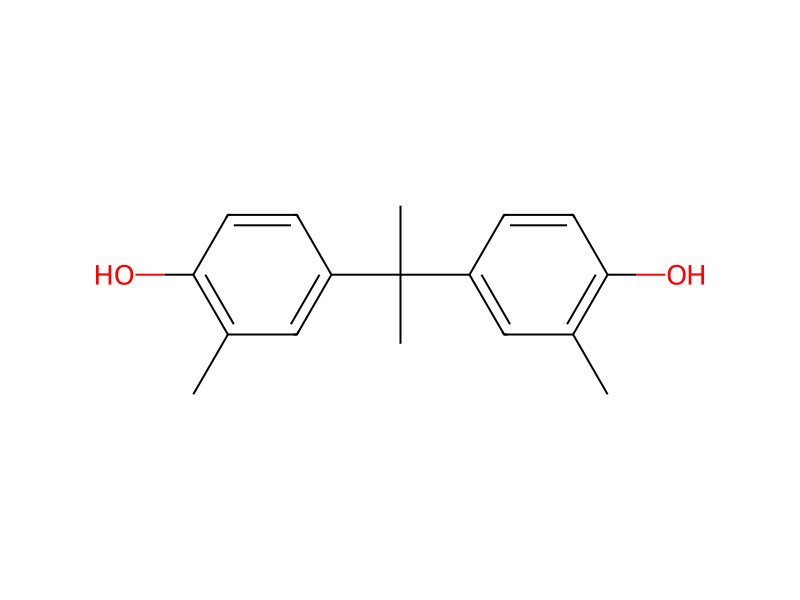
4,4'-Isopropylidendi-o-kresol

Bisphenol C

HCID 6620
Neue NotizNeue ReaktionAnfrage stellen
Druckvorschau

Daten werden ergänzt – lade die Seite später neu, um den aktuellen Stand zu sehen
GrundinformationenÜberblickNamen und BezeichnerEigenschaftenSicherheit und RegulatorischesChemie und IndustrieZugehörige ReaktionenNotizen zur Verbindung
TeilstruktursucheÄhnliche Strukturen suchen

Grundinformationen

CAS
79-97-0
Standard-SMILES
Cc1cc(C(C)(C)c2ccc(O)c(C)c2)ccc1O
InChIKey
YMTYZTXUZLQUSF-UHFFFAOYSA-N
Summenformel
C17H20O2
Durchschnittliche Molmasse
256,34 g/mol
Monoisotopische Masse
256,14632988

Überblick

3,3'-Dimethylbisphenol A is a bisphenol.

Namen und Bezeichner

Bevorzugter Name
Bisphenol C
IUPAC
4-[2-(4-hydroxy-3-methylphenyl)propan-2-yl]-2-methylphenol
Lokaler Name
4,4'-Isopropylidendi-o-kresol
Englischer Name
2,2-Bis(4-hydroxy-3-methylphenyl)propane
Summenformel
C17H20O2
Molmasse
256.34

Namen und Synonyme

79-97-0Bisphenol C3,3'-Dimethylbisphenol ANonox DCPDicresylolpropaneDTXSID804789098817I7XJ2NSC-408489DTXCID4027866RefChem:484991201-240-04-(2,2-dichloro-1-(4-hydroxyphenyl)ethenyl)phenol
Weitere Namen anzeigen
nonoxdcpBisphenlo c3,3’-dimethyldianBisphenol C Solution3,3’-dimethylbisphenola
2,2-Bis(4-hydroxy-3-methylphenyl)propane4,4'-(Propane-2,2-diyl)bis(2-methylphenol)4-[2-(4-hydroxy-3-methylphenyl)propan-2-yl]-2-methylphenol3,3'-Dimethyldian4,4'-Isopropylidenedi-o-cresolBis-o-cresol A2,2-Bis(3-methyl-4-hydroxyphenyl)propanePhenol, 4,4'-(1-methylethylidene)bis[2-methyl-

Datenbank-Bezeichner

CAS
79-97-0
PubChem CID
6620
DTXSID
DTXSID8047890
ChEMBL
CHEMBL2392777
ChEBI
CHEBI:34321
UNII
98817I7XJ2

Eigenschaften

Berechnete StruktureigenschaftenWird ergänzt

XLogP
4,7
Polarare Oberfläche (TPSA)
40,5 Ų
H-Brücken-Donoren
2
H-Brücken-Akzeptoren
2
Frei drehbare Bindungen
2
Schwere Atome
19
Formalladung
0
Komplexität
272

Experimentelle und physikochemische Eigenschaften

Color/FormNeedles from xylene
Endocrine DisruptorsPotential endocrine disrupting compound
Boiling Point238-240 °C at 12 mm Hg
DecompositionWhen heated to decomposition it emits acrid smoke and fumes.
Melting Point140 °C
Refractive IndexIndex of refraction = 1.569
Collision Cross Section172.9 Ų [M-H]- [CCS Type: DT; Buffer gas: N2; Ionization: ESI-; Dataset: TOXCAST; Source Identifier: DTXSID8047890]

Physikochemische Eigenschaften

Schmelzpunkt
138 · 138-140 °C(lit.)
Siedepunkt
238 · 238-240 °C12 mm Hg(lit.)

Sicherheit und Regulatorisches

Sicherheitsangaben dienen nur zur Orientierung und ersetzen weder das Sicherheitsdatenblatt (SDB) des Lieferanten noch geltende Vorschriften oder eine fachliche Bewertung.

GHS-Klassifizierung

GHS Classification · 5 Einträge

This chemical does not meet GHS hazard criteria for 2% (1 of 51) of reports.

Warning

H315 (88.2%): Causes skin irritation [Warning Skin corrosion/irritation]

P261, P264, P264+P265, P271, P280, P302+P352, P304+P340, P305+P351+P338, P319, P321, P332+P317, P337+P317, P362+P364, P403+P233, P405, and P501 (click each P-code to see the statement)

Aggregated GHS information provided per 51 reports by companies from 8 notifications to the ECHA C&L Inventory. Each notification may be associated with multiple companies.

Gefahrenhinweise

Regulatory InformationStatus: Active Update: 19-01-2022 https://echa.europa.eu/registration-dossier/-/registered-dossier/24781
Hazard Classes and CategoriesSkin Irrit. 2 (88.2%)

Sicherheit und Schutzausrüstung

Disposal Methods · 1 Eintrag

SRP: The most favorable course of action is to use an alternative chemical product with less inherent propensity for occupational harm/injury/toxicity or environmental contamination. Recycle any unused portion of the material for its approved use or return it to the manufacturer or supplier. Ultimate disposal of the chemical must consider: the material's impact on air quality; potential migration in soil or water; effects on animal and plant life; and conformance with environmental and public health regulations.

Toxikologische Informationen

Environmental Fate

Chemie und Industrie

Pharmakologische Informationen

Mechanism of Action · 1 Eintrag

/The researchers/ report that the mechanisms by which biphenol A (BPA) and two congeners, bisphenol AF and bisphenol C (BPC), bind to and activate estrogen receptors (ER) alpha and beta differ from that used by 17beta-estradiol. /The researchers/ show that bisphenols act as partial agonists of ERs by activating the N-terminal activation function 1 regardless of their effect on the C-terminal activation function 2, which ranges from weak agonism (with BPA) to antagonism (with BPC). Crystallographic analysis of the interaction between bisphenols and ERs reveals two discrete binding modes, reflecting the different activities of compounds on ERs. BPA and 17beta-estradiol bind to ERs in a similar fashion, whereas, with a phenol ring pointing toward the activation helix H12, the orientation of BPC accounts for the marked antagonist character of this compound. Based on structural data, /the investigators/ developed a protocol for in silico evaluation of the interaction between bisphenols and ERs or other members of the nuclear hormone receptor family, such as estrogen-related receptor gamma and androgen receptor, which are two known main targets of bisphenols. ...

Verwendung und Herstellung

Uses · 2 Einträge

Manufacture of plastics and resins

Used as a color-developer in thermosensitive recording materials

General Manufacturing InformationPhenol, 4,4'-(1-methylethylidene)bis[2-methyl-: ACTIVE
Anwendungen · 2 Einträge

Beschreibung2,2-Bis(4-hydroxy-3-methylphenyl)propane is a monomer of polycarbonate and bisphenol A. It has been used as a reaction solution for sodium salt and calcium stearate. The product contains hydrogen chloride and hydrochloric acid as byproducts. This product also reacts with fatty acids to produce aromatic hydrocarbons.

VerwendenUsed as a color-developer in thermosensitive recording materials.

Zugehörige Reaktionen

3
Reaktionsaufzeichnung erstellen
Reaktionsgleichung von HRID 222485
HRID 222485als Eduktuspto-grants-2012_06
Reaktionsgleichung von HRID 318022
HRID 318022als ProduktTraining data from https://doi.org/10.1039/C8SC04228D (8/10)
Reaktionsgleichung von HRID 1758587
HRID 1758587als Produktuspto-grants-1983_02

Notizen zur Verbindung

Wird geladen…

Auf dieser SeiteGrundinformationenÜberblickNamen und BezeichnerEigenschaftenSicherheit und RegulatorischesChemie und IndustrieZugehörige ReaktionenNotizen zur Verbindung
Weitere Aktionen
Neue NotizNeue ReaktionAnfrage stellen
EC Number
201-240-0
Nikkaji
J10.979G
Dichte
1.0421 · 1.0421 (rough estimate)
Dampfdruck
0 Pa · 0Pa at 25℃
Brechungsindex
1.5 · 1.5000 (estimate)
Löslichkeit
almost transparency in Methanol
Aggregatzustand
solid
pka
10.45 · 10.45±0.10(Predicted)
Farbe
White to Almost white
Wasserlöslichkeit
22 mg/L · 22mg/L at 20℃
Henry's Law Constant
9 · 9.0×105 mol/(m3Pa) at 25℃, HSDB (2015)
Stabilität
Hygroscopic
InChI
1S/C17H20O2/c1-11-9-13(5-7-15(11)18)17(3,4)14-6-8-16(19)12(2)10-14/h5-10,18-19H,1-4H3
InChIKey
YMTYZTXUZLQUSF-UHFFFAOYSA-N
SMILES
Cc1cc(ccc1O)C(C)(C)c2ccc(O)c(C)c2
LogP
4.11 at · 4.11 at 20℃
CAS Datenbank
79 · 79-97-0(CAS DataBase Reference)
NIST chemische Informationen
4 · Phenol, 4,4'-(1-methylethylidene)bis[2-methyl-(79-97-0)
EPA chemische Informationen
4 · Phenol, 4,4'-(1-methylethylidene)bis[2-methyl- (79-97-0)
· 3 Einträge

TERRESTRIAL FATE: Based on a classification scheme(1), an estimated Koc value of 1.0X10+5(SRC), determined from a structure estimation method(2), indicates that bisphenol C is expected to be immobile in soil(SRC). The estimated pKa of bisphenol C is 9.9(3), indicating that this compound will exist partially in the anion form in the environment and anions generally do not adsorb more strongly to soils containing organic carbon and clay than their neutral counterparts(4). Volatilization of bisphenol C from moist soil surfaces is not expected to be an important fate process(SRC) given an estimated Henry's Law constant of 1.1X10⁻¹¹ atm-cu m/mole(SRC), using a fragment constant estimation method(2). Bisphenol C is not expected to volatilize from dry soil surfaces(SRC) based upon an estimated vapor pressure of 7.4X10⁻⁸ mm Hg at 25 °C(SRC), determined from a fragment constant method(2). Biodegradation is expected to be an important fate process in soil(SRC) based on results of river die-away tests in which bisphenol C showed complete degradation in 18 of 24 microcosms within 22 days(5).

AQUATIC FATE: Based on a classification scheme(1), an estimated Koc value of 1.0X10+5(SRC), determined from a structure estimation method(2), indicates that bisphenol C is expected to adsorb to suspended solids and sediment(SRC). Volatilization from water surfaces is not expected(3) based upon an estimated Henry's Law constant of 1.1X10⁻¹¹ atm-cu m/mole(SRC), developed using a fragment constant estimation method(2). According to a classification scheme(4), an estimated BCF of 620(SRC), from an estimated log Kow of 4.74(2) and a regression-derived equation(2), suggests the potential for bioconcentration in aquatic organisms is high(SRC). Phenols can undergo sensitized photo-oxidation in surface waters exposed to sunlight via reaction with hydroxyl and peroxy radicals with half-lives on the order of days to weeks at the water surface(5); therefore, photo-oxidation may have some importance as a fate process for bisphenol C in natural water(SRC). Bisphenol C is not expected to undergo hydrolysis in the environment due to the lack of functional groups that hydrolyze under environmental conditions(3). Biodegradation is expected to be an important fate process in water(SRC) based on results of river die-away tests in which bisphenol C showed complete degradation in 18 of 24 microcosms within 22 days(6).

ATMOSPHERIC FATE: According to a model of gas/particle partitioning of semivolatile organic compounds in the atmosphere(1), bisphenol C, which has an estimated vapor pressure of 7.4X10⁻⁸ mm Hg at 25 °C(SRC), determined from a fragment constant method(2), will exist in both the vapor and particulate phases in the ambient atmosphere. Vapor-phase bisphenol C is degraded in the atmosphere by reaction with photochemically-produced hydroxyl radicals(SRC); the half-life for this reaction in air is estimated to be 1.3 hours(SRC), calculated from its rate constant of 9.9X10⁻¹¹ cu cm/molecule-sec at 25 °C(SRC) that was derived using a structure estimation method(2). Particulate-phase bisphenol C may be removed from the air by wet and dry deposition(SRC).

Soil Adsorption/Mobility · 1 Eintrag

Using a structure estimation method based on molecular connectivity indices(1), the Koc of bisphenol C can be estimated to be 1.0X10+5(SRC). According to a classification scheme(2), this estimated Koc value suggests that bisphenol C is expected to be immobile mobility in soil. The estimated pKa of bisphenol C is 9.9(3), indicating that this compound will exist partially in anion form in the environment and anions generally do not adsorb more strongly to soils containing organic carbon and clay than their neutral counterparts(4).

Artificial Pollution SourcesBisphenol C's production and use in the manufacture of plastics and resins(1) and as a color-developer in thermosensitive recording materials(2) may result in its release to the environment through various waste streams(SRC).
Environmental Biodegradation · 1 Eintrag

AEROBIC: In 22-day aerobic river die-away tests using several river water samples in 24 microcosms, bisphenol C showed no degradation in 6 microcosms, complete primary degradation in 4 microcosms and complete mineralization in 14 microcosms(1).

Environmental Bioconcentration · 1 Eintrag

An estimated BCF of 620 was calculated in fish for bisphenol C(SRC), using an estimated log Kow of 4.74(1) and a regression-derived equation(1). According to a classification scheme(2), this BCF suggests the potential for bioconcentration in aquatic organisms is high(SRC), provided the compound is not metabolized by the organism(SRC).

Volatilization from Water/Soil · 1 Eintrag

The Henry's Law constant for bisphenol C is estimated as 1.1X10⁻¹¹ atm-cu m/mole(SRC) using a fragment constant estimation method(1). This Henry's Law constant indicates that bisphenol C is expected to be essentially nonvolatile from water surfaces(2). Bisphenol C's Henry's Law constant indicates that volatilization from moist soil surfaces is not expected to occur(SRC). Bisphenol C is not expected to volatilize from dry soil surfaces(SRC) based upon an estimated vapor pressure of 7.4X10⁻⁸ mm Hg(SRC), determined from a fragment constant method(1).

Environmental Abiotic Degradation · 1 Eintrag

The rate constant for the vapor-phase reaction of Bisphenol C with photochemically-produced hydroxyl radicals has been estimated as 9.9X10⁻¹¹ cu cm/molecule-sec at 25 °C(SRC) using a structure estimation method(1). This corresponds to an atmospheric half-life of about 1.3 hours at an atmospheric concentration of 5X10+5 hydroxyl radicals per cu cm(1). Bisphenol C is not expected to undergo hydrolysis in the environment due to the lack of functional groups that hydrolyze under environmental conditions(2). Phenols can undergo sensitized photo-oxidation in surface waters exposed to sunlight via reaction with hydroxyl and peroxy (RO2) radicals with half-lives on the order of days to weeks at the water surface(3); therefore, photo-oxidation may have some importance as a fate process for bisphenol C in natural water(SRC).

Probable Routes of Human Exposure · 1 Eintrag

Occupational exposure to bisphenol C may occur through inhalation of dust and dermal contact with this compound at workplaces where bisphenol C is produced or used. Use data suggest the general population may be exposed to bisphenol C via dermal contact with this compound from consumer products containing polymers made from bisphenol C. (SRC)

Environmental Fate/Exposure Summary · 1 Eintrag

Bisphenol C's production and use in the manufacture of plastics and resins and as a color-developer in thermosensitive recording materials may result in its release to the environment through various waste streams. If released to air, an estimated vapor pressure of 7.4X10⁻⁸ mm Hg at 25 °C indicates bisphenol C will exist in both the vapor and particulate phases in the atmosphere. Vapor-phase bisphenol C will be degraded in the atmosphere by reaction with photochemically-produced hydroxyl radicals; the half-life for this reaction in air is estimated to be 1.3 hours. Particulate-phase bisphenol C will be removed from the atmosphere by wet and dry deposition. If released to soil, bisphenol C is expected to have no mobility based upon an estimated Koc of 1.0X10+5. The estimated pKa of bisphenol C is 9.9, indicating that this compound will exist partially in anion form in the environment and anions generally do not adsorb more strongly to soils containing organic carbon and clay than their neutral counterparts. Volatilization from moist soil surfaces is not expected to be an important fate process based upon an estimated Henry's Law constant of 1.1X10⁻¹¹ atm-cu m/mole. Bisphenol C is not expected to volatilize from dry soil surfaces based upon its vapor pressure. Biodegradation is expected to be an important fate process in soil and water based on results of river die-away tests in which bisphenol C showed complete degradation in 18 of 24 microcosms within 22 days. If released into water, bisphenol C is expected to adsorb to suspended solids and sediment based upon the estimated Koc. Volatilization from water surfaces is not expected to be an important fate process based upon this compound's estimated Henry's Law constant. An estimated BCF of 620 suggests the potential for bioconcentration in aquatic organisms is high. Hydrolysis is not expected to be an important environmental fate process since this compound lacks functional groups that hydrolyze under environmental conditions. Sensitized photo-oxidation may have some importance as a fate process for bisphenol C in sunlit natural water. Occupational exposure to bisphenol C may occur through inhalation of dust and dermal contact with this compound at workplaces where bisphenol C is produced or used. Use data suggest the general population may be exposed to bisphenol C via dermal contact with this compound from consumer products containing polymers made from bisphenol C. (SRC)

Antidote and Emergency Treatment · 3 Einträge

/SRP:/ Immediate first aid: Ensure that adequate decontamination has been carried out. If patient is not breathing, start artificial respiration, preferably with a demand valve resuscitator, bag-valve-mask device, or pocket mask, as trained. Perform CPR if necessary. Immediately flush contaminated eyes with gently flowing water. Do not induce vomiting. If vomiting occurs, lean patient forward or place on the left side (head-down position, if possible) to maintain an open airway and prevent aspiration. Keep patient quiet and maintain normal body temperature. Obtain medical attention. /Poisons A and B/

/SRP:/ Basic treatment: Establish a patent airway (oropharyngeal or nasopharyngeal airway, if needed). Suction if necessary. Watch for signs of respiratory insufficiency and assist ventilations if needed. Administer oxygen by nonrebreather mask at 10 to 15 L/min. Monitor for pulmonary edema and treat if necessary ... . Monitor for shock and treat if necessary ... . Anticipate seizures and treat if necessary ... . For eye contamination, flush eyes immediately with water. Irrigate each eye continuously with 0.9% saline (NS) during transport ... . Do not use emetics. For ingestion, rinse mouth and administer 5 mL/kg up to 200 mL of water for dilution if the patient can swallow, has a strong gag reflex, and does not drool ... . Cover skin burns with dry sterile dressings after decontamination ... . /Poisons A and B/

/SRP:/ Advanced treatment: Consider orotracheal or nasotracheal intubation for airway control in the patient who is unconscious, has severe pulmonary edema, or is in severe respiratory distress. Positive-pressure ventilation techniques with a bag valve mask device may be beneficial. Consider drug therapy for pulmonary edema ... . Consider administering a beta agonist such as albuterol for severe bronchospasm ... . Monitor cardiac rhythm and treat arrhythmias as necessary ... . Start IV administration of D5W /SRP: "To keep open", minimal flow rate/. Use 0.9% saline (NS) or lactated Ringer's if signs of hypovolemia are present. For hypotension with signs of hypovolemia, administer fluid cautiously. Watch for signs of fluid overload ... . Treat seizures with diazepam or lorazepam ... . Use proparacaine hydrochloride to assist eye irrigation ... . /Poisons A and B/

Non-Human Toxicity ValuesLD50 Mouse Intravenous 25 mg/kg

Sicherheitsdaten

wgk
3
tsca
TSCA listed
hs_code
29072990
RTECS-Nr.
GP1750000
risk_code
36/37/38
hazard_code
Xi
safety_code
26-36
Speicherklasse
11 - Combustible Solids
Giftige Stoffe Daten
79-97-0(Hazardous Substances Data)
Hazard Classifications
Eye Irrit. 2Skin Irrit. 2STOT SE 3
Darstellung · 1 Eintrag

synthetischeThe preparation of 2,2-Bis(4-hydroxy-3-methylphenyl)propane is as follows:In a full-jacket type 1 L separable flask equipped with a thermometer, a stirrer, and a 100 mL dropping funnel, 26.1 g (0.4 mol) of isopropyl alcohol was added under a nitrogen atmosphere, and then 58.3 g (0.5 mol) of 90% by weight sulfuric acid was slowly added thereto. Thereafter, 54.5 g of toluene, 191.5 g (1.8 mol) of ortho-cresol, and 5.5 g (0.03 mol) of dodecanethiol were added thereto, followed by setting the temperature in the separable flask to 40° C. In the dropping funnel, 42.5 g (0.7 mol) of acetone was placed, and it was slowly fed dropwise to the separable flask for 30 minutes. After completion of the dropwise addition of acetone, the reaction was allowed to proceed at 40° C. for 2 hours. After completion of the reaction, 100.0 g of toluene and 100.0 g of demineralized water were fed, and the temperature was increased to 80° C. After the temperature reached 80° C., the reaction liquid was left to stand to confirm that the precipitates generated during the reaction were dissolved into the organic phase and the aqueous phase. This was followed by extraction of the aqueous phase in the lower layer. Thereafter, saturated sodium hydrogen carbonate solution was added to the obtained organic phase to allow neutralization, followed by confirming that the pH of the aqueous phase in the lower layer, became not less than 9. After extraction of the aqueous phase in the lower layer, demineralized water was added to the obtained organic phase, and the resulting mixture was stirred for 10 minutes. Thereafter, the mixture was left to stand, and the aqueous phase was extracted. Part of the obtained organic phase was removed, and subjected to high-performance liquid chromatography to analyze the amount of bisphenol C produced. As a result, the reaction yield in terms of acetone was found to be 84 mol %.

Vor- und nachgelagerte Produkte

Vorgelagerte Rohstoffe

o-KresolAcetonToluolMethanolSchwefelsure