
N,N-Dimethylglycin
N,N-Dimethylglycine
Daten werden ergänzt – lade die Seite später neu, um den aktuellen Stand zu sehen
Grundinformationen
- CAS
1118-68-9- Standard-SMILES
CN(C)CC(=O)O- InChIKey
FFDGPVCHZBVARC-UHFFFAOYSA-N- Summenformel
- C4H9NO2
- Durchschnittliche Molmasse
- 103,12 g/mol
- Monoisotopische Masse
- 103,06332853
Überblick
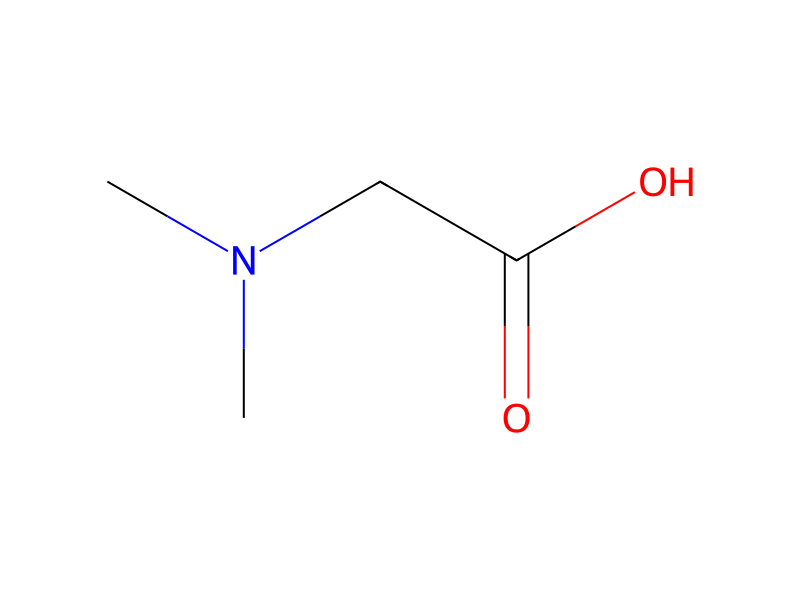
N,N-dimethylglycine is an N-methylglycine that is glycine carrying two N-methyl substituents. It has a role as a mouse metabolite, a human metabolite and a Daphnia magna metabolite. It is a N-methyl-amino acid and a member of N-methylglycines. It is a tautomer of a N,N-dimethylglycine zwitterion.
Namen und Bezeichner
- Bevorzugter Name
- N,N-Dimethylglycine
- IUPAC
- 2-(dimethylamino)acetic acid
- Lokaler Name
- N,N-Dimethylglycin
- Englischer Name
- N,N-Dimethylglycine
- Summenformel
- C4H9NO2
- Molmasse
- 103.12
Namen und Synonyme
N,N-dimethylglycine1118-68-9dimethylglycine2-(dimethylamino)acetic acid(Dimethylamino)acetic acidN-Methylsarcosineglycine, N,N-dimethyl-N,N-Dimethylaminoacetic acid7797M4CPPADTXSID6074336CHEBI:17724RefChem:57349
Weitere Namen anzeigen
DMGN-Me-Sar-OHAKOS BB-5614N-DiMethylglycineN,N-DimthylglycineN. N-methylglycinen,n-dimethyl-glycin
DTXCID1033244214-267-82-(dimethylazaniumyl)acetateN,N-Dimethyl GlycineMFCD00004283dimethyl glycineBRN 1700261EINECS 214-267-8
Datenbank-Bezeichner
- CAS
1118-68-9- PubChem CID
- 673
- DTXSID
DTXSID6074336- ChEMBL
CHEMBL1232274- ChEBI
CHEBI:17724- UNII
- 7797M4CPPA
- EC Number
- 214-267-8
- Nikkaji
- J135.420E
Eigenschaften
Berechnete StruktureigenschaftenWird ergänzt
- XLogP
- -2,9
- Polarare Oberfläche (TPSA)
- 40,5 Ų
- H-Brücken-Donoren
- 1
- H-Brücken-Akzeptoren
- 3
- Frei drehbare Bindungen
- 2
- Schwere Atome
- 7
- Formalladung
- 0
- Komplexität
- 70,1
Experimentelle und physikochemische Eigenschaften
DrugsPharmaceuticals -> Listed in ZINC15
LogP-2.91
Melting Point185.5 °C
Physical DescriptionSolid
Dissociation Constants2.04
Collision Cross Section
119.7 Ų [M+H]+ [CCS Type: DT; Method: single field calibrated with Agilent tune mix (Agilent)]
116 Ų [M+H]+ [CCS Type: TW; Method: calibrated with polyalanine]
123.1 Ų [M+H]+
Physikochemische Eigenschaften
- Schmelzpunkt
- 178 · 178-182 °C(lit.)
- Siedepunkt
- 193.35 °C · 193.35°C (rough estimate)
- Dichte
- 1 g/cm3 · 1 g/cm3
- Brechungsindex
- 1.4674 · 1.4674 (estimate)
- storage temp.
- Keep in dark place,Sealed in dry,Room Temperature
- Löslichkeit
- Methanol (Slightly), Water (Slightly)
- pka
- 9.89 · 9.89(at 25℃)
- Aggregatzustand
- Crystalline Powder
- Farbe
- White to slightly yellow
- Wasserlöslichkeit
- soluble
- Merck
- 14 · 14,3244
- BRN
- 1700261 · 1700261
- InChI
- 1S/C4H9NO2/c1-5(2)3-4(6)7/h3H2,1-2H3,(H,6,7)
- InChIKey
- FFDGPVCHZBVARC-UHFFFAOYSA-N
- SMILES
- CN(C)CC(O)=O
- CAS Datenbank
- 1118 · 1118-68-9(CAS DataBase Reference)
- EPA chemische Informationen
- Glycine, N,N-dimethyl- (1118-68-9)
Sicherheit und Regulatorisches
Sicherheitsangaben dienen nur zur Orientierung und ersetzen weder das Sicherheitsdatenblatt (SDB) des Lieferanten noch geltende Vorschriften oder eine fachliche Bewertung.
GHS-Klassifizierung
GHS Classification
This chemical does not meet GHS hazard criteria for 53.2% (58 of 109) of all reports.
Warning
H302 (46.8%): Harmful if swallowed [Warning Acute toxicity, oral]
P264, P270, P301+P317, P330, and P501 (click each P-code to see the statement)
Aggregated GHS information provided per 109 reports by companies from 4 notifications to the ECHA C&L Inventory.
Gefahrenhinweise
Regulatory Information
PMN - indicates a commenced PMN (Pre-Manufacture Notices) substance.
REACH registered substance: N,N-dimethylglycine (EC: 214-267-8)
Dimethylglycine: Non hazardous
Hazard Classes and CategoriesAcute Tox. 4 (46.8%)
Sicherheitsdaten
- F
- 3
- wgk
- 3
- tsca
- TSCA listed
- hs_code
- 29224999
- RTECS-Nr.
- MB9865000
- risk_code
- 22-36/37/38
- Toxizität
- rat,LD50,oral,> 650mg/kg (650mg/kg),BEHAVIORAL: ATAXIABLOOD: CHANGES IN SPLEENGASTROINTESTINAL: "HYPERMOTILITY, DIARRHEA",Acute Toxicity Data. Journal of the American College of Toxicology, Part B. Vol. 1, Pg. 199, 1992.
- hazard_code
- Xn,Xi
- safety_code
- 24/25-36/37-26
- hazard_class
- IRRITANT
- Speicherklasse
- 11 - Combustible Solids
Chemie und Industrie
Pharmakologische Informationen
Tissue LocationsKidney
Cellular LocationsCytoplasm
Metabolite Pathways3-Phosphoglycerate dehydrogenase deficiency
Verwendung und Herstellung
General Manufacturing InformationGlycine, N,N-dimethyl-: ACTIVE
Anwendungen
BeschreibungN,N-Dimethylglycine (DMG) is a N-methylated product of the amino acid glycine. It is found in beans and liver. It can be formed from trimethylglycine upon the loss of one of its methyl groups. It is also a byproduct of the metabolism of choline. When DMG was first discovered, it was referred to as vitamin B16, but, unlike true B vitamins, deficiency of DMG in the diet does not lead to any ill-effects meaning it does not meet the definition of a vitamin. It is used in comparative analysis with other N-methylated glycines. N,N-Dimethylglycine is used in the development of glycine-based ionic liquids and emulsifiers, and as a substrate to identify, differentiate and characterize amino acid methyltransferase(s). It is potentially useful as a biomarker of protein degradation in COPD patients.
HistoryN,N-Dimethylglycine was discovered in 1943. It is found in some but not all formulations of pangamic acid (vitamin B15). Pangamic acid has been sold as a dietary supplement in the United States at least since the late 1970s, when the lay press celebrated its benefits. Although pangamic acid is also known as vitamin B16, it is not actually a vitamin because no deficiency state has been identified, and it has no known nutritional value.
VerwendenN,N-Dimethylglycine is used as an athletic performance enhancer and immunostimulant. It is also used in the treatment of autism, epilepsy and mitochondrial disease. It is also employed as a biomarker of protein degradation in chronic obstructive lung disease (COPD) patients. Further, it is used as a substrate to identify, differentiate and characterize amino acid methyltransferase. It plays an important role for the development of glycine-based ionic liquids and emulsifiers.
Darstellung
synthetischeN,N-Dimethylglycine is commercially available as the free form amino acid, and as the hydrochloride salt [2491-06-7 ]. DMG may be prepared by the alkylation of glycine via the Eschweiler–Clarke reaction. In this reaction, glycine is treated with aqueous formaldehyde in formic acid that serves as both solvent and reductant. Hydrochloric acid is added thereafter to give the hydrochloride salt. The free amino acid may been obtained by neutralization of the acid salt, which has been performed with silver oxide. H2NCH2COOH + 2 CH2O + 2 HCOOH →(CH3)2NCH2COOH + 2 CO2 + 2 H2O.
Vor- und nachgelagerte Produkte
Vorgelagerte Rohstoffe
Nachgelagerte Produkte
Ergänzende Hinweise
DefinitionChEBI: N,N-dimethylglycine is an N-methylglycine that is glycine carrying two N-methyl substituents. It has a role as a human metabolite, a Daphnia magna metabolite and a mouse metabolite. It is a N-methyl-amino acid and a member of N-methylglycines. It is a tautomer of a N,N-dimethylglycine zwitterion.
Zugehörige Reaktionen
1.037


Notizen zur Verbindung
Wird geladen…