
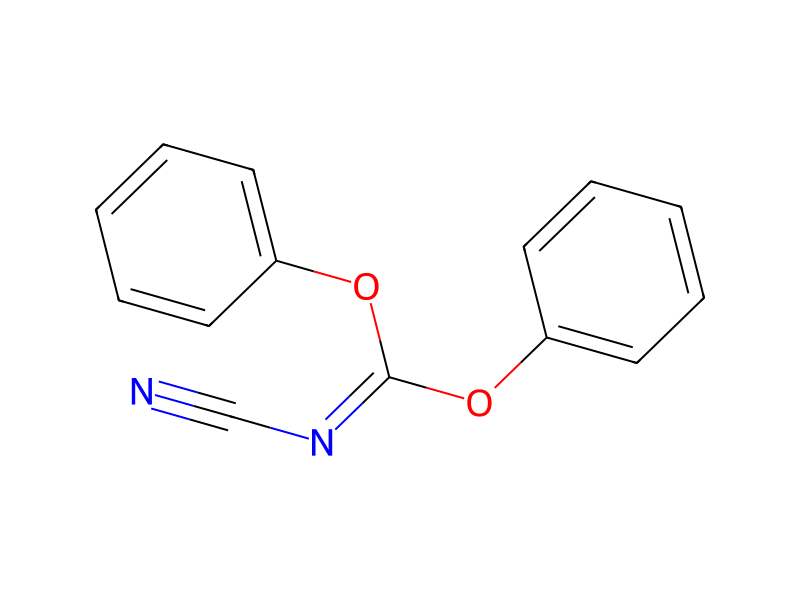
Grundinformationen
- Standard-SMILES
N#CN=C(Oc1ccccc1)Oc1ccccc1- InChIKey
SLIKWVTWIGHFJE-UHFFFAOYSA-N- Summenformel
- C14H10N2O2
- Durchschnittliche Molmasse
- 238,24 g/mol
- Monoisotopische Masse
- 238,07422756
Namen und Bezeichner
- Bevorzugter Name
- Diphenyl N-Cyanocarbonimidate
- IUPAC
- diphenoxymethylidenecyanamide
- Englischer Name
- Diphenyl N-cyanocarbonimidate
- Summenformel
- C14H10N2O2
- Molmasse
- 238.24
Namen und Synonyme
Diphenyl N-cyanocarbonimidateDiphenyl cyanocarbonimidatediphenoxymethylenecyanamideDTXSID70350786EC 427-300-8RefChem:588833DTXCID10301853427-300-8628-090-279463-77-7diphenoxymethylidenecyanamideMFCD00010380
Weitere Namen anzeigen
SKL316AURORA KA-4382N-cyanocarbonimidateDiphenylN-CyanocarbonimideN-CYANODIPHENYLIMIDOCARBONATEDiphenylcyanocarbonimidate,97%
Cyanocarbonimidia acid diphenyl aestercyano(diphenoxymethylidene)aminediphenylcyanocarbonimidatediphenyl cyancarbonimidateMaybridge1_007626diphenyl-N-cyanoimidocarbonateN-Cyano-diphenyl imidocarbonateHMS563C14
Datenbank-Bezeichner
- CAS
79463-77-7- PubChem CID
- 688090
- DTXSID
DTXSID70350786- EC Number
- 427-300-8、628-090-2
- Nikkaji
- J995.321C
Eigenschaften
Berechnete Struktureigenschaften
- XLogP
- 3,6
- Polarare Oberfläche (TPSA)
- 54,6 Ų
- H-Brücken-Donoren
- 0
- H-Brücken-Akzeptoren
- 4
- Frei drehbare Bindungen
- 4
- Schwere Atome
- 18
- Formalladung
- 0
- Komplexität
- 298
Physikochemische Eigenschaften
- Schmelzpunkt
- 155 · 155-158 °C (lit.)
- Siedepunkt
- 380.84 °C · 380.84°C (rough estimate)
- Dichte
- 1.1907 · 1.1907 (rough estimate)
- Brechungsindex
- 1.65 · 1.6500 (estimate)
- storage temp.
- 2 · under inert gas (nitrogen or Argon) at 2-8°C
- Löslichkeit
- -2 · sol THF, propan-2-ol.
- Aggregatzustand
- Fluffy Powder
- pka
- -6.7 · -6.70±0.50(Predicted)
- Farbe
- White
- Wasserlöslichkeit
- Insoluble in water.
- BRN
- 4254248 · 4254248
- InChI
- InChI=1S/C14H10N2O2/c15-11-16-14(17-12-7-3-1-4-8-12)18-13-9-5-2-6-10-13/h1-10H
- InChIKey
- SLIKWVTWIGHFJE-UHFFFAOYSA-N
- SMILES
- C(=N/C#N)(/OC1=CC=CC=C1)\OC1=CC=CC=C1
- CAS Datenbank
- 79463 · 79463-77-7(CAS DataBase Reference)
Sicherheit und Regulatorisches
GHS-Klassifizierung
GHS Classification
Danger
H318: Causes serious eye damage [Danger Serious eye damage/eye irritation]
P264+P265, P273, P280, P305+P354+P338, P317, and P501 (click each P-code to see the statement)
Danger
H302 (86.7%): Harmful if swallowed [Warning Acute toxicity, oral]
P261, P264, P264+P265, P270, P271, P273, P280, P301+P317, P302+P352, P304+P340, P305+P351+P338, P305+P354+P338, P317, P319, P321, P330, P332+P317, P337+P317, P362+P364, P403+P233, P405, and P501 (click each P-code to see the statement)
Gefahrenhinweise
Regulatory InformationStatus: Cease Manufacture Update: 10-11-2008 https://echa.europa.eu/registration-dossier/-/registered-dossier/4452
Hazard Classes and Categories
Acute Tox. 4 (86.7%)
Eye Dam. 1 (100%)
Eye damage - category 1
Eye Dam. 1
Sicherheitsdaten
- F
- 10-21
- wgk
- 3
- ridadr
- 3439
- hs_code
- 29269090
- risk_code
- 20/21/22-36/37/38
- hazard_code
- Xn
- safety_code
- 26-36/37
- hazard_class
- 6.1
- packing_group
- III
- Speicherklasse
- 11 - Combustible Solids
- Hazard Classifications
- Aquatic Chronic 3Eye Dam. 1
Chemie und Industrie
Anwendungen
VerwendenDiphenyl N-cyanocarbonimidate has been used in the preparation of N-substituted 2-amino-4H-3,1-benzoxazines, cyanoguanidine derivatives, oxadiazoles.
VerwendenDiphenyl Cyanocarbonimidate (DPCC) is used for preparation of heterocycles, 1,2,4-triazoles, 4-oxa-1,3-diazoles, benzimidazoles, hexahydropyrimidines, and hydroquinazolines; synthesis of O-phenylisoureas, N-cyanoguanidines, and guanidines; modification of peptides; reverse electron demand Diels-Alder heterodieneophile.
Darstellung
synthetischeDiphenyl Cyanocarbonimidate is prepared from diphenyl carbonate by treatment with PCl5 followed by cyanamide.[1]
Vor- und nachgelagerte Produkte
Vorgelagerte Rohstoffe
Nachgelagerte Produkte
Anbieter50 Anbieter
梯希爱(上海)化成工业发展有限公司021-67121386 · [email protected]
陕西缔都新材料有限公司81124267 17392282731 · [email protected]
Hebei Chuanghai Biotechnology Co., Ltd+86-17732866630 · [email protected]
毕佳索(上海毕得医药科技股份有限公司)400-6005915 · [email protected]
杭州品高化工有限公司0571-87658025 · [email protected]
普善实业(陕西)有限公司029-81310890 18165209495 · [email protected]
Baoji Guokang Healthchem co.,ltd+8615604608665 15604608665 · [email protected]
Dayang Chem (Hangzhou) Co.,Ltd.+86-0571-88938639 17705817739 · [email protected]
郑州鸿晟医药科技有限公司0371-55695890 15637198702 · [email protected]
韶远科技(上海)有限公司021-50795510 4000665055 · [email protected]
Syntechem Co.,Ltd[email protected]
Ark Pharm, Inc.847-367-3680 · [email protected]
上海迈瑞尔生化科技有限公司4006356688 18621169109 · [email protected]
北京索莱宝科技有限公司010-50973130 17801761073 · [email protected]
阿法埃莎(中国)化学有限公司400-6106006 · [email protected]
安耐吉化学&3A(安徽泽升科技股份有限公司)400-0056266 · [email protected]
常州科化生物科技有限公司0519-68985668 13685222090 · [email protected]
上海瀚鸿科技股份有限公司021-54306202 13764082696 · [email protected]
苏州新瑞生物科技有限公司13401437572 · [email protected]
嘉兴市艾森化工有限公司0573-85285100 18627885956 · [email protected]
ZHEJIANG JIUZHOU CHEM CO., LTD+86-0576225566889 +86-13454675544 · [email protected];[email protected];[email protected]
河南多贝化工有限公司0370-2785118 17550508557 · [email protected]
北京伊诺凯科技有限公司15652467323 · [email protected]
斯百全化学(上海)有限公司021-021-021-67601398-809-809-809 15221380277 · [email protected]
上海昊锐医药生物科技有限公司021-58388037;21-58388037 13472507714 · [email protected]
赛默飞世尔科技(中国)有限公司800-810-5118 · [email protected]
TCI AMERICA800-4238616 · [email protected]
TOKYO CHEMICAL INDUSTRY CO., LTD.03-36680489 · [email protected]
TCI Europe320-37350700 · [email protected]
上海伯韵医药科技有限公司13817873692 · [email protected]
上海丽康新材料有限公司+86-16631818819 +86-17736933208 · [email protected]
PT CHEM GROUP LIMITED+86-85511178; +86-85511178 · [email protected]
HBCChem, Inc.+1-510-219-6317 · [email protected]
上海毕得医药科技股份有限公司400-164-7117 18317119277 · [email protected]
成都零六生物科技有限公司400-1166-196 13458535857 · [email protected]
上海御略医药科技有限公司021-60345187 13671753212 · [email protected]
杭州杰恒化工有限公司0571-87396432 · [email protected]
池州凯隆进出口贸易有限公司[email protected]
上海谱科生物技术有限公司021-64705760 18027310741 · [email protected]
Sigma-Aldrich西格玛奥德里奇(上海)贸易有限公司021-61415566 800-8193336 · [email protected]
Accela ChemBio Inc.+1(858) 699-3322 · [email protected]
郑州科豫隆化工产品有限公司17319789407 17319789407 · [email protected]
郑州九亿时光新材料有限公司+86-15225627621 +86-13213167925 · [email protected]
常州优凯美医药科技有限公司0519-86058959 13775231161 · [email protected]
厦门志信化学有限公司+86-5922680277 +86-13806087780 · [email protected]
安耐吉化学&3A(安徽泽升科技股份有限公司)400-0056266 · [email protected]
上海阿拉丁生化科技股份有限公司6206333 13167063860 · [email protected]
上海天习化工有限公司021-20960837,QQ1332204249 · [email protected]
上海思言生物科技有限公司021-50908862,442785678,326799392 18721037013 · [email protected]
上海源叶生物科技有限公司13636370518 · [email protected]
Zugehörige Reaktionen
91


Verknüpfte Notizen
Wird geladen…