
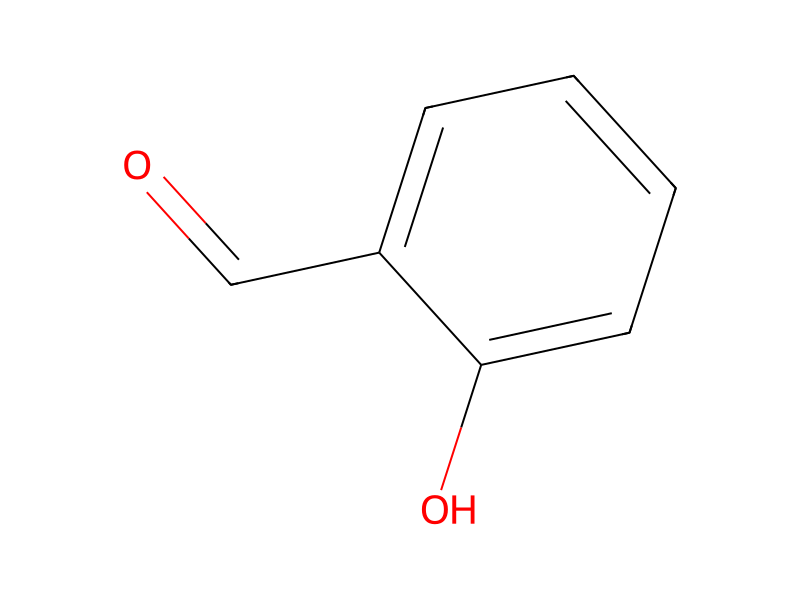
Grundinformationen
- Standard-SMILES
O=Cc1ccccc1O- InChIKey
SMQUZDBALVYZAC-UHFFFAOYSA-N- Summenformel
- C7H6O2
- Durchschnittliche Molmasse
- 122,12 g/mol
- Monoisotopische Masse
- 122,03677943
Überblick
Liquid; colorless or pale yellow; bitter almond odor. Sinks and mixes slowly in water. (USCG, 1999)
Namen und Bezeichner
- Bevorzugter Name
- Salicylaldehyde
- IUPAC
- 2-hydroxybenzaldehyde
- Lokaler Name
- Salicylaldehyd
- Englischer Name
- Salicylaldehyde
- Summenformel
- C7H6O2
- Molmasse
- 122.12
Namen und Synonyme
SALICYLALDEHYDE2-Hydroxybenzaldehyde90-02-8o-Hydroxybenzaldehydeo-Formylphenol2-FormylphenolSalicylalSalicylic aldehydeBenzaldehyde, 2-hydroxy-SalicyladehydeFEMA No. 3004DTXSID1021792
Weitere Namen anzeigen
salicyaldehydeFEMA 30042-hydroxy-benzaldehydSALICYLALDEHYDalicylaldehydeBenzaldehyde,2-hydroxy-
17K64GZH20NSC-49178DTXCID001792CHEBI:16008NSC-83559NSC-83560NSC-83561NSC-83562
Datenbank-Bezeichner
- CAS
27761-48-4、28777-87-9、90-02-8- PubChem CID
- 6998
- DTXSID
DTXSID1021792- ChEMBL
CHEMBL108925- ChEBI
CHEBI:16008- UNII
- 17K64GZH20
- EC Number
- 201-961-0
- Nikkaji
- J10.607K、J3.808.468B
Eigenschaften
Berechnete Struktureigenschaften
- XLogP
- 1,8
- Polarare Oberfläche (TPSA)
- 37,3 Ų
- H-Brücken-Donoren
- 1
- H-Brücken-Akzeptoren
- 2
- Frei drehbare Bindungen
- 1
- Schwere Atome
- 9
- Formalladung
- 0
- Komplexität
- 101
Experimentelle und physikochemische Eigenschaften
Chemical ClassesOther Classes -> Benzaldehydes
CosmeticsCosmetics ingredient -> Fragrance
SpringerMaterials Properties13C nuclear magnetic resonance spectrum
Fragrances
Fragrance Ingredient (Salicylaldehyde) -> IFRA transparency List
Fragrance
LogP
log Kow = 1.81
1.81
1.62
Odor
Bitter, almond-like odor
Pungent, irritating odor similar to benzenaldehyde, acetophenone, and nitrobenzene, but with phenolic notes
Taste
Nut-like, coumarin flavor at low levels
Burning taste
Food AdditivesFLAVORING AGENT OR ADJUVANT -> FDA Substance added to food
Density
1.1674 at 68 °F (USCG, 1999) - Denser than water; will sink
1.167 g/cu cm at 20 °C/4 °C
1.159-1.170
1.167 @25 °C
Flavoring AgentsEU Flavoring substances
ViscosityDynamic viscosity = 2.50X10⁻³ Pa.s at 25 °C
Color/Form
Liquid
Colorless, oily liquid or dark-red oil
Colorless to straw, oily liquid
Physikochemische Eigenschaften
- Schmelzpunkt
- 1 · 1-2 °C (lit.)
- Siedepunkt
- 197 °C · 197 °C (lit.)
- Dichte
- 1.146 g/mL · 1.146 g/mL at 25 °C (lit.)
- Dampfdichte
- 4.2 · 4.2 (vs air)
- Dampfdruck
- 1 mm · 1 mm Hg ( 33 °C)
- Brechungsindex
- 20 · n20/D 1.573(lit.)
- FEMA
- 3004 · 3004 | SALICYLALDEHYDE
- Flammpunkt
- 170 °F · 170 °F
- storage temp.
- -20 °C · -20°C
- Löslichkeit
- 4.9 g/l · 4.9g/l
- Aggregatzustand
- Liquid
- pka
- 8.37 · 8.37(at 25℃)
- Farbe
- Clear yellow
- PH
- 6 · 6-8 (H2O, 20℃)Not applicable
- Geruch (Odor)
- Bitter almonds
- Geruchsart
- medicinal
- Biologische Quelle
- synthetic
- Wasserlöslichkeit
- slightly soluble
- Spezifische Wärmekapazität
- 1.82 J/ · Cp(liquid): 1.82 J/(g·K), at 25℃
- JECFA Number
- 897 · 897
- Merck
- 14 · 14,8326
- BRN
- 471388 · 471388
- Henry's Law Constant
- 1.1 · 1.1×100 mol/(m3Pa) at 25℃, Ji et al. (2008)
- Dielectric constant
- 13.9 · 13.9(20℃)
- Stabilität
- Stable. Combustible. Incompatible with strong bases, strong reducing agents, strong acids, strong oxidizing agents.
- Kosmetik-Inhaltsstoffe Funktionen
- FRAGRANCE
- InChI
- 1S/C7H6O2/c8-5-6-3-1-2-4-7(6)9/h1-5,9H
- InChIKey
- SMQUZDBALVYZAC-UHFFFAOYSA-N
- SMILES
- Oc1ccccc1C=O
- LogP
- 1.66 at · 1.66 at 25℃ and pH6.2-6.3
- CAS Datenbank
- 90 · 90-02-8(CAS DataBase Reference)
- NIST chemische Informationen
- 2 · Benzaldehyde, 2-hydroxy-(90-02-8)
- EPA chemische Informationen
- Salicylaldehyde (90-02-8)
Sicherheit und Regulatorisches
GHS-Klassifizierung
GHS Classification
Warning
H302 (100%): Harmful if swallowed [Warning Acute toxicity, oral]
P203, P264, P264+P265, P270, P280, P301+P317, P302+P352, P305+P351+P338, P317, P318, P321, P330, P332+P317, P337+P317, P362+P364, P405, and P501 (click each P-code to see the statement)
Aggregated GHS information provided per 3872 reports by companies from 19 notifications to the ECHA C&L Inventory. Each notification may be associated with multiple companies.
Danger
H227: Combustible liquid [Warning Flammable liquids]
Gefahrenhinweise
Regulatory Information
Chemical: Benzaldehyde, 2-hydroxy-
Hazard Traits - Fragrance Allergen
Commission Regulation (EC) No 1565/2000 (Repealed by Com. Implementing Reg. (EU) No 872/2012)
Benzaldehyde, 2-hydroxy- is listed on the EPA's Chemical Data Reporting (CDR) system. Manufacturers and importers of Benzaldehyde, 2-hydroxy- are required to report information about their production and use of this chemical to the EPA under the Toxic Substances Control Act (TSCA). (40 eCFR Part 711)
Status: Active Update: 28-04-2022 https://echa.europa.eu/registration-dossier/-/registered-dossier/5715
2-Hydroxybenzaldehyde: Does not have an individual approval but may be used under an appropriate group standard
Fire HazardsCombustible. Can react with oxidizing materials. (USCG, 1999)
Fire PotentialFlamable when exposed to heat or flame.
Health HazardsLIQUID: Irritating to skin and eyes. Harmful if swallowed. (USCG, 1999)
Hazards Summary
A skin and eye irritant; [CAMEO] A skin irritant; [eChemPortal: ERMA] Included in list of established contact allergens in humans; [EC: Scientific Committee on Consumer Safety: Fragrance allergens in cosmetic products (2011)] An irritant; Can be absorbed through skin; [MSDSonline]
FDA Requirements
Synthetic flavoring substances and adjuvants may be safely used in food in accordance with the following conditions. (a) They are used in the minimum quantity required to produce their intended effect, and otherwise in accordance with all the principles of good manufacturing practice. (b) They consist of one or more of the following, used alone or in combination with flavoring substances and adjuvants generally recognized as safe in food, prior-sanctioned for such use, or regulated by an appropriate section in this part. Salicylaldehyde is included on this list.
Reactive GroupAldehydes
TSCA Requirements
Section 8(a) of TSCA requires manufacturers of this chemical substance to report preliminary assessment information concerned with production, exposure, and use to EPA as cited in the preamble in 51 FR 41329. Effective date: 9/30/91; Reporting date: 11/27/91.
Pursuant to section 8(d) of TSCA, EPA promulgated a model Health and Safety Data Reporting Rule. The section 8(d) model rule requires manufacturers, importers, and processors of listed chemical substances and mixtures to submit to EPA copies and lists of unpublished health and safety studies. Benzaldehyde, 2-hydroxy- is included on this list. Effective date: 9/30/91; Sunset date: 6/30/98.
FIFRA Requirements
Residues of salicylaldehyde are exempted from the requirement of a tolerance when used in accordance with good agricultural practice as inert (or occasionally active) ingredients in pesticide formulations applied to growing crops or to raw agricultural commodities after harvest. Use: Penetration aid. Limit: Not to exceed 14% by weight of pesticide formulation.
Reactivity Profile
SALICYLALDEHYDE is an aldehyde. Aldehydes are frequently involved in self-condensation or polymerization reactions. These reactions are exothermic; they are often catalyzed by acid. Aldehydes are readily oxidized to give carboxylic acids. Flammable and/or toxic gases are generated by the combination of aldehydes with azo, diazo compounds, dithiocarbamates, nitrides, and strong reducing agents. Aldehydes can react with air to give first peroxo acids, and ultimately carboxylic acids. These autoxidation reactions are activated by light, catalyzed by salts of transition metals, and are autocatalytic (catalyzed by the products of the reaction). The addition of stabilizers (antioxidants) to shipments of aldehydes retards autoxidation.
Air and Water ReactionsNo rapid reaction with air. No rapid reaction with water.
NFPA Hazard Classification
0 - Materials that, under emergency conditions, would offer no hazard beyond that of ordinary combustible materials.
2 - Materials that must be moderately heated or exposed to relatively high ambient temperatures before ignition can occur. Materials would not under normal conditions form hazardous atmospheres with air, but under high ambient temperatures or under moderate heating could release vapor in sufficient quantities to produce hazardous atmospheres with air.
0 - Materials that in themselves are normally stable, even under fire conditions.
Sicherheit und Schutzausrüstung
Fire FightingExtinguish with water fog, alcohol foam, CO2 or dry chemical. (USCG, 1999)
First AidCall a doctor.
Fire Fighting Procedures
Suitable extinguishing media: Use water spray, alcohol-resistant foam, dry chemical or carbon dioxide.
Advice for firefighters: Wear self-contained breathing apparatus for firefighting if necessary.
Use water spray to cool unopened containers.
To fight fire, use alcohol foam, spray, mist, dry chemical.
Storage ConditionsKeep container tightly closed in a dry and well-ventilated place. Containers which are opened must be carefully resealed and kept upright to prevent leakage.
Cleanup Methods
ACCIDENTAL RELEASE MEASURES: Personal precautions, protective equipment and emergency procedures: Use personal protective equipment. Avoid breathing vapors, mist or gas. Ensure adequate ventilation. Remove all sources of ignition. Evacuate personnel to safe areas. Beware of vapors accumulating to form explosive concentrations. Vapors can accumulate in low areas. Environmental precautions: Prevent further leakage or spillage if safe to do so. Do not let product enter drains. Discharge into the environment must be avoided. Methods and materials for containment and cleaning up: Contain spillage, and then collect with an electrically protected vacuum cleaner or by wet-brushing and place in container for disposal according to local regulations. Keep in suitable, closed containers for disposal.
Nonfire Spill ResponseAvoid contact with liquid or vapor. Keep people away. Wear goggles and self-contained breathing apparatus. Stop discharge if possible. Isolate and remove discharged material. Notify local health and pollution control agencies. (USCG, 1999)
Disposal Methods
SRP: Recycle any unused portion of the material for its approved use or return it to the manufacturer or supplier. Ultimate disposal of the chemical must consider: the material's impact on air quality; potential migration in air, soil or water; effects on animal, aquatic and plant life; and conformance with environmental and public health regulations. If it is possible or reasonable use an alternative chemical product with less inherent propensity for occupational harm/injury/toxicity or environmental contamination.
Product: This combustible material may be burned in a chemical incinerator equipped with an afterburner and scrubber. Offer surplus and non-recyclable solutions to a licensed disposal company. Contact a licensed professional waste disposal service to dispose of this material. Contaminated packaging: Dispose of as unused product.
Preventive Measures
ACCIDENTAL RELEASE MEASURES: Personal precautions, protective equipment and emergency procedures: Use personal protective equipment. Avoid breathing vapors, mist or gas. Ensure adequate ventilation. Remove all sources of ignition. Evacuate personnel to safe areas. Beware of vapors accumulating to form explosive concentrations. Vapors can accumulate in low areas. Environmental precautions: Prevent further leakage or spillage if safe to do so. Do not let product enter drains. Discharge into the environment must be avoided.
Precautions for safe handling: Avoid contact with skin and eyes. Avoid inhalation of vapor or mist. Keep away from sources of ignition. No smoking. Take measures to prevent the build up of electrostatic charge.
Appropriate engineering controls: Handle in accordance with good industrial hygiene and safety practice. Wash hands before breaks and at the end of workday.
Gloves must be inspected prior to use. Use proper glove removal technique (without touching glove's outer surface) to avoid skin contact with this product. Dispose of contaminated gloves after use in accordance with applicable laws and good laboratory practices. Wash and dry hands.
SRP: The scientific literature for the use of contact lenses by industrial workers is inconsistent. The benefits or detrimental effects of wearing contact lenses depend not only upon the substance, but also on factors including the form of the substance, characteristics and duration of the exposure, the uses of other eye protection equipment, and the hygiene of the lenses. However, there may be individual substances whose irritating or corrosive properties are such that the wearing of contact lenses would be harmful to the eye. In those specific cases, contact lenses should not be worn. In any event, the usual eye protection equipment should be worn even when contact lenses are in place.
Allowable Tolerances
Residues of salicylaldehyde are exempted from the requirement of a tolerance when used in accordance with good agricultural practice as inert (or occasionally active) ingredients in pesticide formulations applied to growing crops or to raw agricultural commodities after harvest. Use: Penetration aid. Limit: Not to exceed 14% by weight of pesticide formulation.
Protective Action Criteria (PAC)
1.6 [mg/m3]
17 [mg/m3]
100 [mg/m3]
Personal Protective Equipment (PPE)
Wear goggles and self-contained breathing apparatus. (USCG, 1999)
Eye/face protection: Face shield and safety glasses. Use equipment for eye protection tested and approved under appropriate government standards such as NIOSH (US) or EN 166 (EU).
Skin protection: Handle with gloves.
Body Protection: Complete suit protecting against chemicals. The type of protective equipment must be selected according to the concentration and amount of the dangerous substance at the specific workplace.
Respiratory protection: Where risk assessment shows air-purifying respirators are appropriate use a full-face respirator with multipurpose combination (US) or type ABEK (EN 14387) respirator cartridges as a backup to engineering controls. If the respirator is the sole means of protection, use a full-face supplied air respirator. Use respirators and components tested and approved under appropriate government standards such as NIOSH (US) or CEN (EU).
Toxikologische Informationen
Ecotoxicity Values
EC50; Species: Scenedesmus subspicatus (Green Algae) exponential growth phase; Conditions: freshwater, static, 24 °C, pH 8.0-9.3; Concentration: 12000 ug/L for 48 hr; Effect: population, decreased biomass /formulation/
EC50; Species: Scenedesmus subspicatus (Green Algae) exponential growth phase; Conditions: freshwater, static, 24 °C, pH 8.0-9.3; Concentration: 11000 ug/L for 72 hr; Effect: population, decreased biomass /formulation/
EC50; Species: Scenedesmus subspicatus (Green Algae) exponential growth phase; Conditions: freshwater, static, 24 °C, pH 8.0-9.3; Concentration: 12000 ug/L for 96 hr; Effect: population, decreased biomass /formulation/
EC50; Species: Scenedesmus subspicatus (Green Algae) exponential growth phase; Conditions: freshwater, static, 24 °C, pH 8.0-9.3; Concentration: 22000 ug/L for 72 hr; Effect: decreased population /formulation/
For more Ecotoxicity Values (Complete) data for 2-Hydroxybenzaldehyde (18 total), please visit the HSDB record page.
Environmental Fate
TERRESTRIAL FATE: Based on a classification scheme(1), an estimated Koc value of 73(SRC), determined from a log Kow of 1.81(2) and a regression-derived equation(3), indicates that 2-hydroxybenzaldehyde is expected to have high mobility in soil(SRC). Volatilization of 2-hydroxybenzaldehyde from moist soil surfaces is expected to be an important fate process(SRC) given an estimated Henry's Law constant of 5.6X10⁻⁶ atm-cu m/mole(SRC) derived from its vapor pressure, 5.93X10⁻¹ mm Hg(4), and water solubility, 1.7X10+4 mg/L(5). 2-Hydroxybenzaldehyde has a vapor pressure close to one and exists as a liquid under environmental conditions; therefore, 2-hydroxybenzaldehyde may volatilize from dry soil(SRC). Utilizing an inherent biodegradation test complete degradation was observed indicating that biodegradation is an important environmental fate process in soil(6).
AQUATIC FATE: Based on a classification scheme(1), an estimated Koc value of 73(SRC), determined from a log Kow of 1.81(2) and a regression-derived equation(3), indicates that 2-hydroxybenzaldehydeis not expected to adsorb to suspended solids and sediment(SRC). Volatilization from water surfaces is expected(4) based upon an estimated Henry's Law constant of 5.6X10⁻⁶ atm-cu m/mole(SRC) derived from its vapor pressure, 5.93X10⁻¹ mm Hg(5), and water solubility, 1.7X10+4 mg/L(6). Using this Henry's Law constant and an estimation method(7), volatilization half-lives for a model river and model lake are 5 and 57 days, respectively(SRC). According to a classification scheme(8), an estimated BCF of 7(SRC), from its log Kow(2) and a regression-derived equation(3), suggests the potential for bioconcentration in aquatic organisms is low(SRC). Utilizing an inherent biodegradation test complete degradation was observed indicating that biodegradation is likely an important environmental fate process in water(9).
ATMOSPHERIC FATE: According to a model of gas/particle partitioning of semivolatile organic compounds in the atmosphere(1), 2-hydroxybenzaldehyde, which has a vapor pressure of 5.93X10⁻¹ mm Hg at 25 °C(2), is expected to exist solely as a vapor in the ambient atmosphere. Vapor-phase 2-hydroxybenzaldehyde is degraded in the atmosphere by reaction with photochemically-produced hydroxyl radicals(SRC); the half-life for this reaction in air is estimated to be 14 hours(SRC), calculated from its rate constant of 2.8X10⁻¹¹ cu cm/molecule-sec at 25 °C(SRC) that was derived using a structure estimation method(3). 2-Hydroxybenzaldehyde contains chromophores that absorb at wavelengths >290 nm(4) and, therefore, may be susceptible to direct photolysis by sunlight(SRC).
Food Survey Values
2-Hydroxybenzaldehyde has been reported in grapes, tomato, baked potato, parmesan cheese, butter, milk powder, roasted chicken, beer, rum, Japanese whiskey, sherry, coffee, tea, soybean, mushroom, buckwheat, Bourbon vanilla, Chinese quince, Muscat grape, and vanilla(1). 2-Hydroxybenzaldehyde has been identified, but not quantified, as a volatile constituent of baked potatoes(2).
Adverse EffectsSkin Sensitizer - An agent that can induce an allergic reaction in the skin.
Toxicity Summary
IDENTIFICATION AND USE: Salicylaldehyde is a liquid. It is used in analytical chemistry, perfumery (violet), synthesis of coumarin, as an auxiliary fumigant, and flavoring. HUMAN STUDIES: An elk researcher who had handled leaves from various trees presented with eczema of the hands, face, flexures, trunk and extremities. Patch testing showed sensitivity to salicyl alcohol, salicylaldehyde, balsam of Peru (Myroxylon pereirae resin), aspen wood dust and an extract prepared from the bark of aspen (Populus tremula). Besides salicyl alcohol, salicylaldehyde is also recommended to be used to screen for contact allergy to aspen. Both of these chemicals should be tested in forest workers in areas where aspen is growing. ANIMAL STUDIES: Salicylaldehyde fed to male rats for 10 days or more caused an increase in the number and size of hepatic and renal microbodies and caused fibrillar material to appear. The drug did not cause fibrillar material to appear in hepatic microbodies of mice or microbodies of transplantable rat hepatomas. Salicylaldehyde evoked a hypocalcemia in rats and mice. Salicylaldehyde and its acetyl derivatives are all less potent analgesics and antinflammatory agents in rodents than salicylic acid and aspirin.
Plant Concentrations2-Hydroxybenzaldehyde detections in plants(1).[Table#2034]
Ongoing Test Status
EPA has released the Interactive Chemical Safety for Sustainability (iCSS) Dashboard. The iCSS Dashboard provides an interactive tool to explore rapid, automated (or in vitro high-throughput) chemical screening data generated by the Toxicity Forecaster (ToxCast) project and the federal Toxicity Testing in the 21st century (Tox21) collaboration. /The title compound was tested by ToxCast and/or Tox21 assays/[USEPA; ICSS Dashboard Application; Available from, as of November 16, 2017: http://actor.epa.gov/dashboard/]
Effluent Concentrations2-Hydroxybenzaldehyde was detected, but not quantified, in exhaust samples from 9 test fuels employed in an automobile under simulated city driving conditions(1).
Soil Adsorption/Mobility
The Koc of 2-hydroxybenzaldehyde is estimated as 73(SRC), using a log Kow of 1.81(1) and a regression-derived equation(2). According to a classification scheme(3), this estimated Koc value suggests that 2-hydroxybenzaldehyde is expected to have high mobility in soil.
Natural Pollution Sources
2-Hydroxybenzaldehyde has been identified as a constituent in various tissues and essential oils of several plant species(1). 2-Hydroxybenzaldehyde occurs in the flowers of Spirea ulmaria and in the essential oils of several plants of the genus Spirea, in the roots of Crepis foetida, in the fruits of Pinus avium, in the rind of Rauqolfia caffra, in the leaves of Ceanothus velutinus and in the essential oil of Cinnamonum cassia and tobacco leaves. 2-Hydroxybenzaldehyde has also been reported in pennyroyal, cinnamon bark, cassia leaf, cassia oil, pepperment oil, and mastic gum oil(2,3).
Atmospheric ConcentrationsURBAN/SUBURBAN: 2-Hydroxybenzaldehyde was detected in atmospheric samples collected from Niteroi City, RJ, Brazil, between January 9th and 14th, 2010, with a reported mean and maximum of 3.73 and 7.64 ug/m cu, respectively(1).
Human Toxicity Excerpts
/CASE REPORTS/ Salicyl alcohol or 2-methylolphenol is a well-known allergen in phenol-formaldehyde resins and a strong sensitizer in guinea pigs. There is 1 previous report of allergic contact dermatitis from salicyl alcohol in aspen bark. We describe a second case with concomitant allergy to salicylaldehyde. An elk researcher who had handled leaves from various trees presented with eczema of the hands, face, flexures, trunk and extremities. Patch testing showed sensitivity to salicyl alcohol, salicylaldehyde, balsam of Peru (Myroxylon pereirae resin), aspen wood dust and an extract prepared from the bark of aspen (Populus tremula). Weaker reactions were observed to bark extracts of rowan (Sorbus aucuparia), tea-leaved willow (Salix phylicifolia) and goat willow (Salix caprea). We analyzed salicyl alcohol and salicylaldehyde in the bark extracts and found the 2 chemicals in equal amounts, about 0.9 ug/mg in aspen bark and in lower concentrations in rowan and the willows. We did not find either of the chemicals in the test substance of balsam of Peru (Myroxylon pereirae). Besides salicyl alcohol, salicylaldehyde is also recommended to be used to screen for contact allergy to aspen. Both of these chemicals should be tested in forest workers in areas where aspen is growing.
Regulatorische Informationen
FDA Requirements
Synthetic flavoring substances and adjuvants may be safely used in food in accordance with the following conditions. (a) They are used in the minimum quantity required to produce their intended effect, and otherwise in accordance with all the principles of good manufacturing practice. (b) They consist of one or more of the following, used alone or in combination with flavoring substances and adjuvants generally recognized as safe in food, prior-sanctioned for such use, or regulated by an appropriate section in this part. Salicylaldehyde is included on this list.
TSCA Requirements
Section 8(a) of TSCA requires manufacturers of this chemical substance to report preliminary assessment information concerned with production, exposure, and use to EPA as cited in the preamble in 51 FR 41329. Effective date: 9/30/91; Reporting date: 11/27/91.
Pursuant to section 8(d) of TSCA, EPA promulgated a model Health and Safety Data Reporting Rule. The section 8(d) model rule requires manufacturers, importers, and processors of listed chemical substances and mixtures to submit to EPA copies and lists of unpublished health and safety studies. Benzaldehyde, 2-hydroxy- is included on this list. Effective date: 9/30/91; Sunset date: 6/30/98.
FIFRA Requirements
Residues of salicylaldehyde are exempted from the requirement of a tolerance when used in accordance with good agricultural practice as inert (or occasionally active) ingredients in pesticide formulations applied to growing crops or to raw agricultural commodities after harvest. Use: Penetration aid. Limit: Not to exceed 14% by weight of pesticide formulation.
Sicherheitsdaten
- F
- 8-10-23
- wgk
- 2
- tsca
- TSCA listed
- ridadr
- 3082
- hs_code
- 29122990
- RTECS-Nr.
- VN5250000
- risk_code
- 21/22-36/38-68-36/37/38-20/21/22-51-36-51/53-22
- Toxizität
- MLD in rats (mg/kg): 900-1000 s.c. (Binet)
- hazard_code
- Xn,N
- safety_code
- 26-36/37-36/37/39-36-61-64-29/35
- hazard_class
- 6.1(b)
- packing_group
- II
- Speicherklasse
- 11 - Combustible Solids
- Giftige Stoffe Daten
- 90-02-8(Hazardous Substances Data)
- Hazard Classifications
- Acute Tox. 4 OralAquatic Chronic 2Eye Irrit. 2Muta. 2Skin Irrit. 2
Chemie und Industrie
Pharmakologische Informationen
Absorption, Distribution and ExcretionAt fixed cosubstrate levels of salicylaldehyde, enzyme kinetics showed substrate inhibition effects.
Cellular LocationsCytoplasm
Verwendung und Herstellung
Uses
Used in perfumes, flavoring agents, auxiliary fumigants, reagents, and gasoline additives; Used to make coumarin and chelates; [HSDB] Important derivative of benzaldehyde; Occurs naturally in cassia oil; [Ullmann]
In perfumery
Reported uses (ppm):
Analytical chemistry, perfumery (violet), synthesis of coumarin, auxiliary fumigant, flavoring.
U.S. Exports
(1972) No Data
(1975) No Data
U.S. Imports
(1972) No Data
(1975) No Data
U.S. Production
2023: 1,764 lb
(1972) 2.03X10+9 GRAMS
(1975) 2.10X10+9 GRAMS
Non-confidential 2016 Chemical Data Reporting (CDR) information on the production and use of chemicals manufactured or imported into the United States. Chemical: o-Hydroxybenzaldehyde:
Industry UsesCorrosion inhibitor
Methods of Manufacturing
One industrial process starts with phenol and forms 2-hydroxybenzyl alcohol (saligenin) by reacting triphenyl metaborate with formaldehyde. The alcohol is catalytically oxidized in air to give 2-hydroxybenzaldehyde. It is more economical to react phenol with formaldehyde in the presence of alkaline catalysts and in the absence of boric acid. The yield is approximately 85%. The ratio of 2-hydroxybenzyl alcohol to 4-hydroxybenzyl alcohol can be altered by varying the catalyst. The oxidation of the hydroxybenzyl alcohols is carried out in an aqueous solution with a platinum-lead-carbon catalyst and gives the corresponding hydroxybenzaldehydes in yields of more than 98%.
The best known process /for the manufacture of 2-hydroxybenzaldehyde/ is based on the Reimer-Tiemann reaction, in which phenol is reacted with chloroform in the presence of an aqueous alkali. Moderate yields of 2-hydroxy- and 4-hydroxybenzaldehyde are obtained in a ratio of about 85:15. The use of aqueous methanol as a reaction medium improves the yield, especially that of 4-hydroxybenzaldehyde. According to a modern variation of the Reimer-Tiemann reaction, the process is carried out in the absence of water. An alkali-metal phenolate reacts with chloroform and a suspension of an alkali-metal hydroxide in an inert organic solvent.
2-Hydroxybenzaldehyde can also be produced by electrolytic reduction of salicylic acid on a rotating amalgam cathode and by catalytic reduction of a salicylic acid halide.
Made by heating sodium phenolate and chloroform with NaOH.
Synthesis: From phenol, chloroform, and alkali according to Reimer-Tiemman method (1876); starting material for mfr of coumarin.
Household Products
Cosmetics product ingredient: o-Hydroxy-benzaldehyde (Salicylaldehyde)
Information on 1 consumer products that contain Salicylaldehyde in the following categories is provided:
Use Classification
Fragrance Ingredients
Flavouring Agent -> FLAVOURING_AGENT -> JECFA Functional Classes
Flavoring Agents -> JECFA Flavorings Index
Flavouring Agent -> FLAVOURING_AGENT -> JECFA Functional Classes
Flavouring Agent -> FLAVOURING_AGENT -> JECFA Functional Classes
General Manufacturing Information
Fabricated Metal Product Manufacturing
Benzaldehyde, 2-hydroxy-: ACTIVE
Anwendungen
BeschreibungFlüssigkeit von charakteristischem Geruch. Mit Wasserdämpfen flüchtig. Schwer löslich in Wasser, mischbar mit Alkohol, Ether und Chloroform. Sdp.: 197� C. NULL
BeschreibungSalicylaldehyde (2-hydroxybenzaldehyde) is an organic compound with the formula C6H4CHO-2-OH. Along with 3-hydroxybenzaldehyde and 4-hydroxybenzaldehyde, it is one of the three isomers of hydroxybenzaldehyde. It is a colorless or pale yellow liquid with a bitter almond odor and a burning taste. It is soluble in alcohol, benzene, and ether, and very slightly soluble in water. Salicylaldehyde is found in shrubs of the genus Spiraea and is usually produced from phenol by the action of chloroform in the presence of an alkali base. It is used in the production of coumarin, saligenin, and salicylaldoxime (an important analytical reagent), and also in analytical chemistry—for example, to detect hydrazine. Besides, salicylaldehyde is a key precursor to various chelating agents and a flavouring ingredient.
OccurrenceOccurs frequently in nature; in the flowers of Spirea ulmaria and other Spireae, in the roots of Crepis foetida L., in the fruits of Pinus avium, in the rind of Rauqolfia caffra, in the leaves of Ceanothus velutinus and in the essential oil of Cinnamomum cassia and of tobacco leaves. Also reported found in grapes, tomato, baked potato, cinnamon bark, cassia leaf, peppermint oil, pennyroyal oil, parmesan cheese, butter, milk powder, roasted chicken, beer, rum, Japanese whiskey, sherry, coffee, tea, soybean, mushroom, buckwheat, Bourbon vanilla, Chinese quince, Muscat grape, vanilla and mastic gum oil.
Darstellung
synthetischeSalicylaldehyde is synthesized from phenol, chloroform, and alkali according to the Reimer–Tiemman method, which was developed in 1876. starting material for the manufacture of coumarin.
Vor- und nachgelagerte Produkte
Vorgelagerte Rohstoffe
Nachgelagerte Produkte
Anbieter50 Anbieter
国药集团化学试剂有限公司86-21-63210123 · [email protected]
梯希爱(上海)化成工业发展有限公司021-67121386 · [email protected]
上海阿拉丁生化科技股份有限公司400-6206333 13167063860 · [email protected]
T&W GROUP021-61551611 13296011611 · [email protected]
科瑞迪化学400-821-5857 021-64326257 · [email protected]
Syntechem Co.,Ltd[email protected]
Ark Pharm, Inc.847-367-3680 · [email protected]
上海迈瑞尔生化科技有限公司4006356688 18621169109 · [email protected]
宁波亿诺化学品有限公司86-574-27787657 · [email protected]
阿法埃莎(中国)化学有限公司400-6106006 · [email protected]
安耐吉化学&3A(安徽泽升科技股份有限公司)400-0056266 · [email protected]
上海瀚鸿科技股份有限公司021-54306202 13764082696 · [email protected]
上海柯维化学技术有限公司021-64609169 18901607656 · [email protected]
上海景颜化工科技有限公司13817811078 · [email protected]
嘉兴市艾森化工有限公司0573-85285100 18627885956 · [email protected]
山东信恒化工有限公司152-15269160605-0605 15269160605 · [email protected]
山东西亚化学有限公司13355009207 13355009207 · [email protected]
玛雅试剂+86 (573) 82222445 (0)18006601000 452520369 · [email protected]
四川库利南科技有限公司400-1166-196 18981987031 · [email protected]
天津希恩思生化科技有限公司400 638 7771 · [email protected]
南京维奥化工有限公司Please Send Email 18652950785 · [email protected]
上海乔木化学科技有限公司021-60451683 15021268886 · [email protected]
斯百全化学(上海)有限公司021-021-021-67601398-809-809-809 15221380277 · [email protected]
艾科试剂4008-755-333 18080918076 · [email protected]
上海思域化工科技有限公司86-21-34053660 · [email protected]
赛默飞世尔科技(中国)有限公司800-810-5118 · [email protected]
北京伊诺凯科技有限公司400-810-7969 010-59572699 · [email protected]
张家港保税区凯利特化工有限公司18606289633 15862625988 · [email protected]
TOKYO CHEMICAL INDUSTRY CO., LTD.03-36680489 · [email protected]
上海贤鼎生物科技有限公司4009209199 · [email protected]
越林试剂021-62960152 · [email protected]
深圳市石金谷科技有限公司(0086)755-61930359 (0086)18038192047 · [email protected]
北京环宇世纪化学科技有限公司hysj_bj.com
上海湄水化工科技有限公司021-60549325 18616193163
上海将来实业股份有限公司021-61552785 · [email protected]
日照力德士化工有限公司010-51268198 · [email protected]
美岚实业(上海)有限公司021-58958189 · [email protected]
上海石洋化工有限公司021-56795766 · [email protected]
大连瑞闻科技有限公司86-0411-62789512 · [email protected]
上海爱蝶实业有限公司021-58957966 18930537195 · [email protected]
广拓化学(上海)有限公司021-60899189-8001 18918189673 · [email protected]
上海御略医药科技有限公司021-60345187 13671753212 · [email protected]
上海麦克林生化科技股份有限公司15221275939 15221275939 · [email protected]
杭州杰恒化工有限公司0571-87396432 · [email protected]
上海寰川实业有限公司021-61478794 · [email protected]
上海嵩爰化工科技有限公司010-1234567 18521000990 · [email protected]
上海有朋化工有限公司021-69005955 13701776567 · [email protected]
上海凯赛化工有限公司021-33516722 13701817765 · [email protected]
上海彤源化工有限公司021-021-69182866 13701855675 · [email protected]
成都润泽本土化工有限公司13096311329 028-88469284 616445927 · [email protected]
Ergänzende Hinweise
DefinitionChEBI: Salicylaldehyde is a hydroxybenzaldehyde carrying a hydroxy substituent at position 2. It has a role as a nematicide and a plant metabolite.
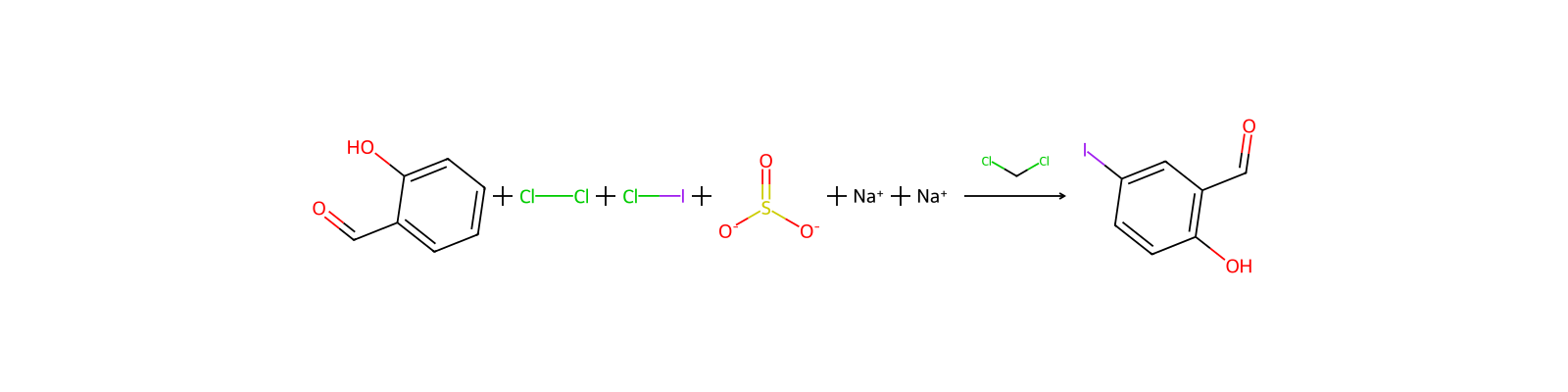
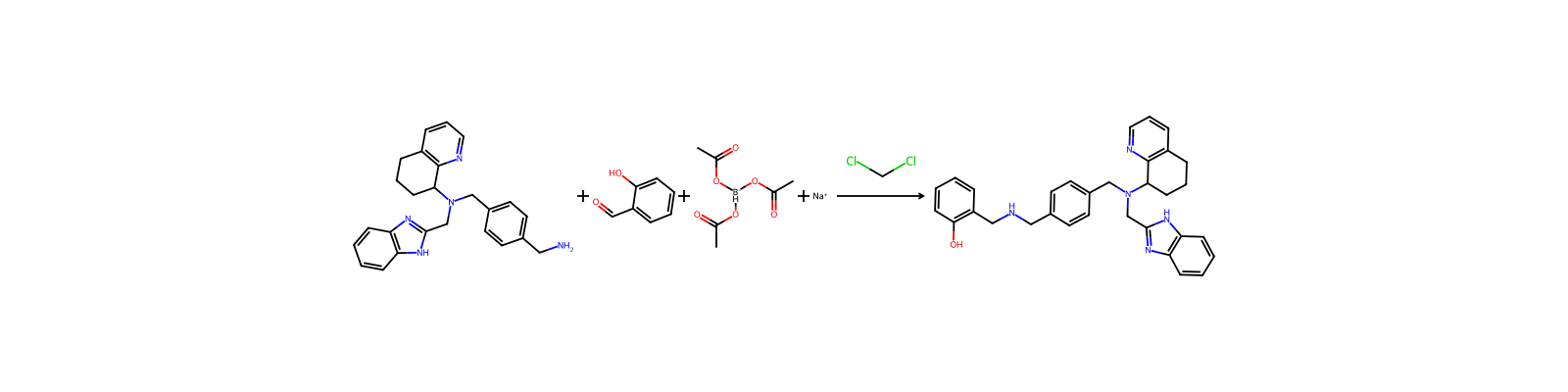
Zugehörige Reaktionen
634





Verknüpfte Notizen
Wird geladen…