
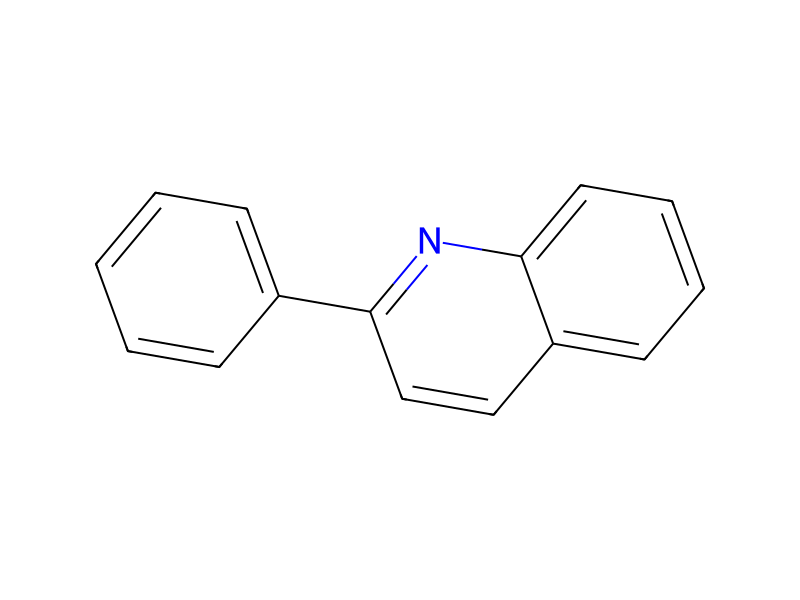
Grundinformationen
- Standard-SMILES
c1ccc(-c2ccc3ccccc3n2)cc1- InChIKey
FSEXLNMNADBYJU-UHFFFAOYSA-N- Summenformel
- C15H11N
- Durchschnittliche Molmasse
- 205,25 g/mol
- Monoisotopische Masse
- 205,08914936
Namen und Bezeichner
- Bevorzugter Name
- 2-Phenylquinoline
- IUPAC
- 2-phenylquinoline
- Lokaler Name
- 2-Phenylchinolin
- Englischer Name
- 2-Phenylquinoline
- Summenformel
- C15H11N
- Molmasse
- 205.25
Namen und Synonyme
2-Phenylquinoline612-96-4DTXSID30210115RefChem:89109DTXCID30132606210-326-7Quinoline, 2-phenyl-Quinoline, phenyl-MFCD000115682-Phenyl-quinoline.alpha.-Phenylquinoline612-73-7
Weitere Namen anzeigen
830ga-PhenylquinolinePhenylquinoline,99%2-Phenylquinoline>Phenylquinoline, 99%2-Phenylquinoline 99%alpha-Phenylquinoline2-Phenylquinoline, 99+%
2-Phenyl-chinolin2-Phenylquinoline, 99%Bionet2_001089CHEMBL89786P20572-phenyl quinolineAE-562/4346014611T-0830
Datenbank-Bezeichner
- CAS
612-96-4- PubChem CID
- 71545
- DTXSID
DTXSID30210115- ChEMBL
CHEMBL89786- EC Number
- 210-326-7
- Nikkaji
- J101.652K
Eigenschaften
Berechnete Struktureigenschaften
- XLogP
- 3,9
- Polarare Oberfläche (TPSA)
- 12,9 Ų
- H-Brücken-Donoren
- 0
- H-Brücken-Akzeptoren
- 1
- Frei drehbare Bindungen
- 1
- Schwere Atome
- 16
- Formalladung
- 0
- Komplexität
- 219
Experimentelle und physikochemische Eigenschaften
Kovats Retention Index335.06;339.21;339.64
Physikochemische Eigenschaften
- Schmelzpunkt
- 84 · 84-85 °C (lit.)
- Siedepunkt
- 363 °C · 363 °C
- Dichte
- 1.1155 · 1.1155 (rough estimate)
- Brechungsindex
- 1.655 · 1.6550 (estimate)
- storage temp.
- Sealed in dry,Room Temperature
- pka
- 4.52 · 4.52±0.10(Predicted)
- Aggregatzustand
- Crystalline Powder
- Farbe
- White to light yellow
- Wasserlöslichkeit
- SLIGHTLY SOLUBLE
- InChI
- 1S/C15H11N/c1-2-6-12(7-3-1)15-11-10-13-8-4-5-9-14(13)16-15/h1-11H
- InChIKey
- FSEXLNMNADBYJU-UHFFFAOYSA-N
- SMILES
- c1ccc(cc1)-c2ccc3ccccc3n2
- CAS Datenbank
- 612 · 612-96-4(CAS DataBase Reference)
- NIST chemische Informationen
- 2 · Quinoline, 2-phenyl-(612-96-4)
Sicherheit und Regulatorisches
GHS-Klassifizierung
GHS Classification
Warning
H315 (100%): Causes skin irritation [Warning Skin corrosion/irritation];H319 (100%): Causes serious eye irritation [Warning Serious eye damage/eye irritation];H335 (97.6%): May cause respiratory irritation [Warning Specific target organ toxicity, single exposure; Respiratory tract irritation]
P261, P264, P264+P265, P271, P280, P302+P352, P304+P340, P305+P351+P338, P319, P321, P332+P317, P337+P317, P362+P364, P403+P233, P405, and P501 (click each P-code to see the statement)
Aggregated GHS information provided per 41 reports by companies from 4 notifications to the ECHA C&L Inventory. Each notification may be associated with multiple companies.;Information may vary between notifications depending on impurities, additives, and other factors. The percentage value in parenthesis indicates the notified classification ratio from companies that provide hazard codes. Only hazard codes with percentage values above 10% are shown. For more detailed information, please visit ECHA C&L website.
Gefahrenhinweise
Hazard Classes and CategoriesSkin Irrit. 2 (100%);Eye Irrit. 2 (100%);STOT SE 3 (97.6%)
Sicherheitsdaten
- wgk
- 3
- hs_code
- 29334900
- risk_code
- 36/37/38
- hazard_code
- Xi
- safety_code
- 26-37/39
- Speicherklasse
- 11 - Combustible Solids
- Hazard Classifications
- Eye Irrit. 2Skin Irrit. 2STOT SE 3
Chemie und Industrie
Anwendungen
Beschreibung2-Phenylquinoline is the major quinoline alkaloid of Galipea iongiflora, a Bolivian plant used as treatment for cutaneous leishmaniasis. Antinociceptive properties of 2-phenylquinoline isolated from the bark of Galipea iongiflora against different models of pain in mice were evaluated.
Darstellung
synthetischeSynthesis of 2-phenylquinoline: Quinoline (1.0 g, 7.742 mmol) and phenyl lithium (2.30 mL, 2 M, 23.22 mmol) were reacted according to general procedure. Purification of the residue by silica gel column chromatography (EtOAc:MeOH:Et3N; 10-30:1:1 or PhMe:MeOH:Et3N; 10:1:1) gave 2-phenylquinoline (0.66 g, 42%) as an orange solid.Aniline (0.140 g, 1.50 mmol) and cinnamaldehyde (0.132 g, 1.00 mmol) were dissolved in toluene in a reaction vial equipped with a magnetic stirrer bar, followed by the addition of K10 (0.50 g). The reaction mixture was heated at a temperature of 110 C for 3 hours. After completion of the reaction, the crude product was purified by column chromatography over silica gel eluting with a mixture of Hexane : Ethyl acetate (20:1) to produce 2-Phenylquinoline as a yellow solid (0.044 g, 21%); (m.p. 82-84 C) (lit. 84-85 °C); Rf 0.67 (20:1 hexane:ethyl acetate);1H NMR (400 MHz, CDCl3) δH 7.46-7.51 (1H, m, H-4’), 7.53-7.56 (3H, m, H-6, 3’, 5’), 7.73- 7.77 (1H, m, H-7), 7.85 (1H, d, J = 8.31 Hz, H-5), 7.88-7.91 (1H, d, J = 8.31 Hz, H-3), 8.18- 8.27 (4H, m, H-4, 8, 2’, 6’)13C NMR(400 MHz, CDCl3) δC 119.2 (C-3), 126.7 (C-6), 127.2 (C-4a), 127.5 (C-2’, 6’), 127.9 (C-5), 128.4 (C-3’, 5’), 128.7 (C-4’), 128.9 (C-7, 8), 129.8 (C-4), 130.3 (C-1’), 137.9 (C-8a), 157.2 (C-2)
Vor- und nachgelagerte Produkte
Vorgelagerte Rohstoffe
Anbieter50 Anbieter
梯希爱(上海)化成工业发展有限公司021-67121386 · [email protected]
湖北永阔科技有限公司027-59223108 15972152991 · [email protected]
上海阿拉丁生化科技股份有限公司400-6206333 13167063860 · [email protected]
湖北万得化工有限公司15377098680 15377098680 · [email protected]
毕佳索(上海毕得医药科技股份有限公司)400-6005915 · [email protected]
上海毕得医药科技股份有限公司400-1647117 13681763483 · [email protected]
INTATRADE GmbH+49 3493/605464 · [email protected]
宁波季诺化学品有限公司0574-87314919 057487319282 · [email protected]
Dayang Chem (Hangzhou) Co.,Ltd.+86-0571-88938639 17705817739 · [email protected]
Syntechem Co.,Ltd[email protected]
上海迈瑞尔生化科技有限公司4006356688 18621169109 · [email protected]
北京华威锐科化工有限公司0757-86329057 18934348241 · [email protected]
安耐吉化学&3A(安徽泽升科技有限公司)021-58432009 400-005-6266 · [email protected]
阿法埃莎(中国)化学有限公司400-6106006 · [email protected]
安耐吉化学&3A(安徽泽升科技股份有限公司)400-0056266 · [email protected]
成都添福瑞生物科技有限公司18030648795 18030648795 · [email protected]
上海瀚鸿科技股份有限公司021-54306202 13764082696 · [email protected]
上海景颜化工科技有限公司13817811078 · [email protected]
郑州研德生物科技有限公司0371-63682289 15538176268 · [email protected]
湖北广奥生物科技有限公司027-02702759223056 18162699093 · [email protected]
济南精合医药科技有限公司0531-88811783 · [email protected]
苏州启航生物科技有限公司18662190603;18151111370 · [email protected]
天津希恩思生化科技有限公司400 638 7771 · [email protected]
南京维奥化工有限公司Please Send Email 18652950785 · [email protected]
常州创视电子科技有限公司+86 (519) 8829-2061 · [email protected]
北京泰亚杰科技有限公司021-33690831-8001 13552411790;18616022633 · [email protected]
赛默飞世尔科技(中国)有限公司800-810-5118 · [email protected]
北京伊诺凯科技有限公司400-810-7969 010-59572699 · [email protected]
TOKYO CHEMICAL INDUSTRY CO., LTD.03-36680489 · [email protected]
南通雅思化学科技有限公司+86-513-86760116 · [email protected]
越林试剂021-62960152 · [email protected]
上海敏寒医药科技有限公司17612188245 · [email protected]
上海裕兰生物科技有限公司021-57171705 13817537615 · [email protected]
上海昶衍化工科技有限公司021-20242659 18930833303 · [email protected]
上海将来实业股份有限公司021-61552785 · [email protected]
上海毕得医药科技股份有限公司400-164-7117 18317119277 · [email protected]
北京奥秘佳得医药科技有限公司+86-13522808617 · [email protected]
上海石洋化工有限公司021-56795766 · [email protected]
上海寰川实业有限公司021-61478794 · [email protected]
上海嵩爰化工科技有限公司010-1234567 18521000990 · [email protected]
上海孚一生物科技有限公司+86 (21) 61124340
Sigma-Aldrich西格玛奥德里奇(上海)贸易有限公司021-61415566 800-8193336 · [email protected]
郑州科豫隆化工产品有限公司17319789407 17319789407 · [email protected]
九鼎化学(上海)科技有限公司4009209199 · [email protected]
厦门志信化学有限公司+86-5922680277 +86-13806087780 · [email protected]
成都润泽本土化工有限公司028-88469284 18000562381 · [email protected]
上海思言生物科技有限公司021-50908862,442785678,326799392 18721037013 · [email protected]
江西冠能光电材料有限公司0799-3607521 17379923216
上海西陇生化科技有限公司021-52907766-8042
上海源叶生物科技有限公司13636370518 · [email protected]
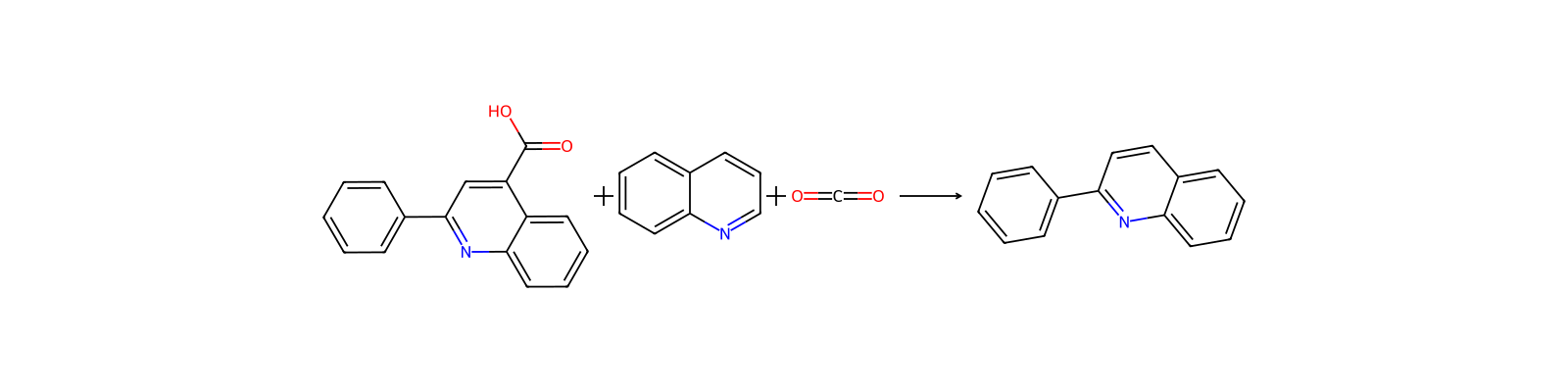
Zugehörige Reaktionen
14



Verknüpfte Notizen
Wird geladen…