Reaktionsgleichung

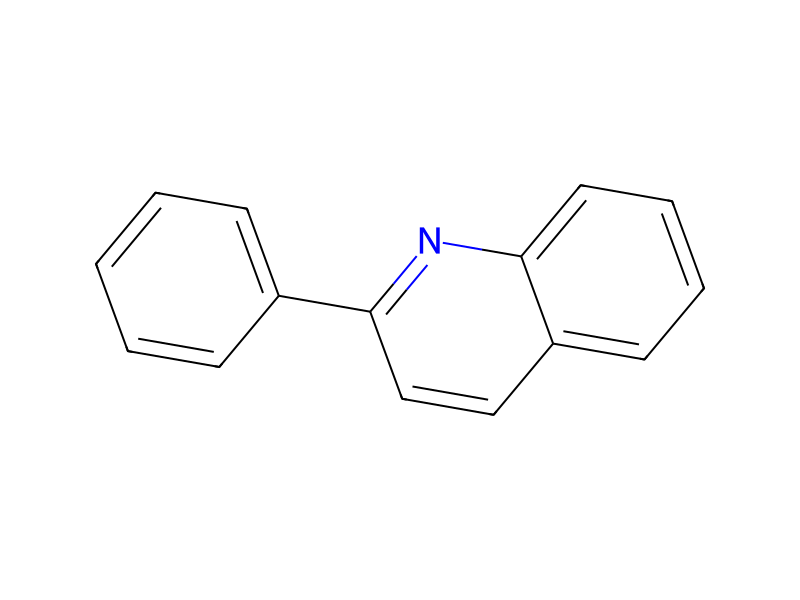
[C:1]1([C:7]2[CH:16]=[CH:15][C:14]3[C:9](=[CH:10][CH:11]=[CH:12][CH:13]=3)[N:8]=2)[CH:6]=[CH:5][CH:4]=[CH:3][CH:2]=1>C(O)(C(F)(F)F)=O.O=[Pt]=O>[C:1]1([C:7]2[CH:16]=[CH:15][C:14]3[CH2:13][CH2:12][CH2:11][CH2:10][C:9]=3[N:8]=2)[CH:2]=[CH:3][CH:4]=[CH:5][CH:6]=1Komponenten
Edukt 1
Produkt 1

Reagenzien, Katalysatoren, Lösungsmittel 2


Reaktionsbedingungen
- Temperatur
- 60 °C
Versuchsvorschrift
To a vigorously stirred solution of 2-phenylquinoline (6.0 g, 29 mmol) in TFA (30 mL) in a 250 mL round-bottomed flask under nitrogen was added PtO2 (332 mg, 1.5 mmol) in one portion. The resulting mixture was then placed under a hydrogen atmosphere (H2 flush for 5 min, then H2 balloon with a wide-bore needle) and heated to 60° C. Stirring was continued for 5 h, at which time GLC analysis indicated all of the starting material was consumed. The reaction was cooled to room temperature and the TFA was evaporated in vacuo. The residue was rendered basic with a minimum amount of 4 N NaOH and extracted with CHCl3 (3×50 mL), dried (MgSO4) and concentrated in vacuo. Purification of the residue by flash chromatography (silica gel, hexane/EtOAc 10:1) afforded 4.85 g of 2-phenyl-5,6,7,8-tetrahydroquinoline (80% yield).
Aufarbeitung
- customflush for 5 min
- customwas consumed
- temperatureThe reaction was cooled to room temperature
- customthe TFA was evaporated in vacuo
- extractionextracted with CHCl3 (3×50 mL)
- dry with materialdried (MgSO4)
- concentrationconcentrated in vacuo
- customPurification of the residue by flash chromatography (silica gel, hexane/EtOAc 10:1)
Quellen und Nachweise
- ORD-Eintrag
- ord-c9161476414241ccbbedf7c9f85dc7f2
- Quelldatensatz
- uspto-grants-2004_06
- Patentnummer
- US06750348B1
Verknüpfte Notizen
Wird geladen…