StartseiteMCPWorkbenchSkills
StartseiteWorkbenchBenachrichtigungenMein Bereich
llms.txt · MCP-AnleitungDatenschutz · Nutzungsbedingungen · Supportv1.8.0
  1. Startseite
  2. /Verbindung

Inden

Indene

HCID 7219
Neue NotizNeue ReaktionAnfrage stellen
Druckvorschau

Daten werden ergänzt – lade die Seite später neu, um den aktuellen Stand zu sehen

GrundinformationenÜberblickNamen und BezeichnerEigenschaftenSicherheit und RegulatorischesChemie und IndustrieZugehörige ReaktionenNotizen zur Verbindung
TeilstruktursucheÄhnliche Strukturen suchen

Grundinformationen

CAS
71551-80-9
Standard-SMILES
C1=Cc2ccccc2C1
InChIKey
YBYIRNPNPLQARY-UHFFFAOYSA-N
Summenformel
C9H8
Durchschnittliche Molmasse
116,16 g/mol
Monoisotopische Masse
116,06260026

Überblick

Indene appears as a colorless liquid derived from coal tar. Fp: -2 °C; bp:182 °C. Density 0.997 g cm-3. Insoluble in water but soluble in organic solvents.

Namen und Bezeichner

Bevorzugter Name
Indene
IUPAC
1H-indene
Lokaler Name
Inden
Englischer Name
Indene
Summenformel
C9H8
Molmasse
116.16

Namen und Synonyme

INDENE1H-Indene95-13-6IndonaphtheneIndenDTXSID8042052NSC 927067H8Y6LB8ANSC-9270DTXCID6022052CHEBI:41921RefChem:790898
Weitere Namen anzeigen
Technicalindenendene1-indeneIndene >Indene,90+%Indene techIndene Odor
CHEBI:37910202-393-6Indenyl radicalMFCD00003777indene, (1H-indene)INDENE, REAGWLN: L56 BHJCHEMBL192812

Datenbank-Bezeichner

CAS
71551-80-9、9003-64-9、95-13-6
PubChem CID
7219
DTXSID
DTXSID8042052
ChEMBL
CHEMBL192812、CHEMBL506735
ChEBI
CHEBI:41921
UNII
67H8Y6LB8A
EC Number
202-393-6
Nikkaji
J4.708B

Eigenschaften

Berechnete StruktureigenschaftenWird ergänzt

XLogP
2,9
Polarare Oberfläche (TPSA)
0 Ų
H-Brücken-Donoren
0
H-Brücken-Akzeptoren
0
Frei drehbare Bindungen
0
Schwere Atome
9
Formalladung
0
Komplexität
124

Experimentelle und physikochemische Eigenschaften

Chemical Classes · 2 Einträge

Other Classes -> Aromatic Hydrocarbons

Flammable agents - 2nd degree

SpringerMaterials Properties13C nuclear magnetic resonance spectrum
FragrancesFragrance Ingredient (1H-Indene) -> IFRA transparency List
LogP · 2 Einträge

Log Kow = 2.92

2.92

Density · 5 Einträge

0.997 (NIOSH, 2024) - Less dense than water; will float

0.9968 @ 20 °C/4 °C

0.997

0.996 @25 °C

0.997

Color/Form · 3 Einträge

LIQUID

Colorless liquid

Colorless liquid [Note: A solid below 29 degrees F].

Solubility · 5 Einträge

Insoluble (NIOSH, 2024)

INSOL IN WATER, MISCIBLE WITH MOST ORGANIC SOLVENTS

SOL IN ALL PROPORTIONS IN ALC, ETHER, N BENZENE, PYRIMIDENE, CARBON DISULFIDE

Soluble in ethanol; it is miscible with diethyl ether, naphtha, pyridine, carbon tetrachloride, chloroform, and carbon disulfide

Sicherheit und Regulatorisches

Sicherheitsangaben dienen nur zur Orientierung und ersetzen weder das Sicherheitsdatenblatt (SDB) des Lieferanten noch geltende Vorschriften oder eine fachliche Bewertung.

GHS-Klassifizierung

GHS Classification · 6 Einträge

This chemical does not meet GHS hazard criteria for 0.5% (2 of 400) of reports.

Danger

H226 (99.2%): Flammable liquid and vapor [Warning Flammable liquids]

P210, P233, P240, P241, P242, P243, P264, P264+P265, P273, P280, P301+P316, P302+P352, P303+P361+P353, P305+P351+P338, P321, P331, P332+P317, P337+P317, P362+P364, P370+P378, P391, P403+P235, P405, and P501 (click each P-code to see the statement)

Aggregated GHS information provided per 400 reports by companies from 16 notifications to the ECHA C&L Inventory. Each notification may be associated with multiple companies.

Danger

Gefahrenhinweise

Regulatory Information · 5 Einträge

Chemical: 1H-Indene

1H-Indene is listed on the EPA's Chemical Data Reporting (CDR) system. Manufacturers and importers of 1H-Indene are required to report information about their production and use of this chemical to the EPA under the Toxic Substances Control Act (TSCA). (40 eCFR Part 711)

REACH registered substance: Indene (EC: 202-393-6)

Indene: Does not have an individual approval but may be used under an appropriate group standard

The New Jersey Worker and Community Right to Know Act requires public and private employers to provide information about hazardous substances at their workplaces. (N.J.S.A. 34:5A-1 et. seq.)

DOT LabelCombustible Liquid
Fire HazardsExcerpt from ERG Guide 128 [Flammable Liquids (Water-Immiscible)]:
Fire PotentialDEFLAGRATES ON HEATING. /INDENE PICRATE/
Health HazardsExcerpt from NIOSH Pocket Guide for Indene:

Chemie und Industrie

Pharmakologische Informationen

Metabolism/Metabolites · 3 Einträge

YIELDS CIS-1,2-DIHYDROXYINDANE & TRANS-1,2-DIHYDROXYINDANE IN RABBITS. /FROM TABLE/

RAT-LIVER MICROSOMES SUPPLEMENTED WITH NADPH CONVERTED INDENE INTO TRANS-INDANE-1,2-DIOL ...

THE OXIDATION OF INDENE TO TRANS-1,2-DIHYDROXYINDANE IN LIVER PREPN IN VITRO WAS DEMONSTRATED. THE REACTION WAS MEDIATED BY LIVER MICROSOMES OF RATS & RABBITS IN THE PRESENCE OF NADPH-GENERATING SYSTEMS.

Verwendung und Herstellung

Uses · 4 Einträge

Used to prepare coumarone-indene resins; [ACGIH]

Plastic Composites Manufacturing [Category: Industry]

Used as a comonomer in coumarone and petroleum-derived aromatic hydrocarbon resins. Technical pure indene is used for the production of indan and its derivatives. Esters of indene-1-carboxylic acid, which are effective as acaricides, can be synthesized from indene for use in, eg, collars

It is composed of a benzene ring fused with a cyclopentene ring.

U.S. Production2023: 500,000 - <1,000,000 lb
Industry UsesMonomers
Methods of Manufacturing · 2 Einträge

... FROM ACETYLENE OVER ACTIVATED CHARCOAL @ 625 °C ... MFR FROM TETRAHYDRONAPHTHALENE BY PASSING OVER SIO2-AL2O3 CATALYST @ 670 °C

Pyrolysis residual oils from olefin production contain varying amounts of indene, which can be separated by extractive distillation with N-methyl-2- pyrrolidone or by crystallization. Indene is recovered industrially from dephenolated and debased tar light oil by rectifying distillation followed by crystallization. When the phenol extraction is omitted a highly concentrated indene fraction can also be obtained by azeotropic distillation of an indene- phenol fraction with water, whereby the phenol is separated as a bottom product.

Use ClassificationFragrance Ingredients

Zugehörige Reaktionen

215
Reaktionsaufzeichnung erstellen
Reaktionsgleichung von HRID 1306
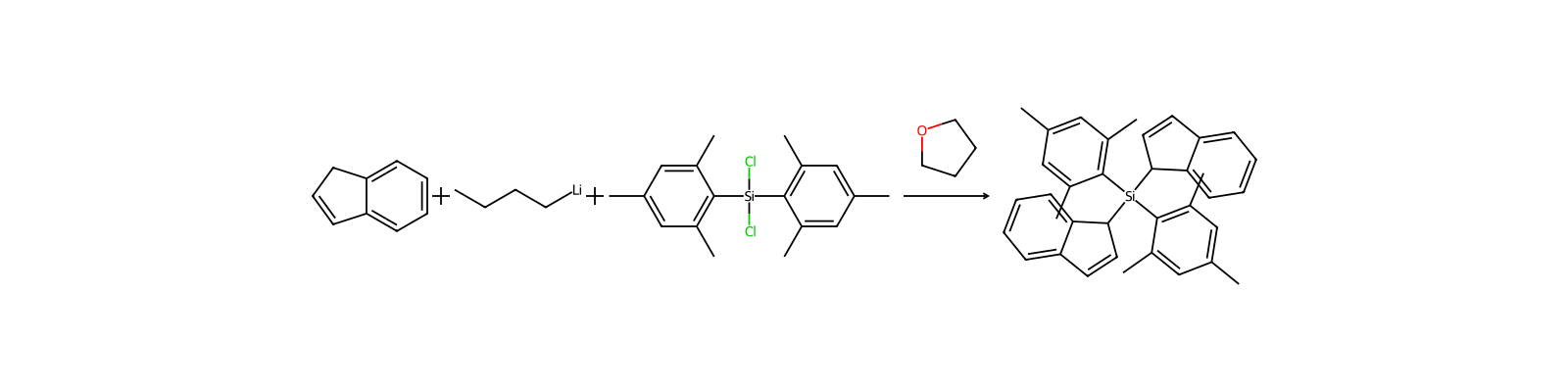
HRID 1306als Eduktuspto-grants-1998_03
Reaktionsgleichung von HRID 22443
HRID 22443als Eduktuspto-grants-1995_06
Reaktionsgleichung von HRID 22444
HRID 22444als Eduktuspto-grants-1995_06
Reaktionsgleichung von HRID 36480
HRID 36480als Produktuspto-grants-1995_05
Reaktionsgleichung von HRID 39114
HRID 39114als Eduktuspto-grants-2013_09
Reaktionsgleichung von HRID 47413
HRID 47413als Eduktuspto-grants-2004_03
Reaktionsgleichung von HRID 52676
HRID 52676als Eduktuspto-grants-1997_04
Reaktionsgleichung von HRID 52819
HRID 52819als Produktuspto-grants-1997_04
Seite 1 von 27

Notizen zur Verbindung

Wird geladen…

Auf dieser SeiteGrundinformationenÜberblickNamen und BezeichnerEigenschaftenSicherheit und RegulatorischesChemie und IndustrieZugehörige ReaktionenNotizen zur Verbindung
Weitere Aktionen
Neue NotizNeue ReaktionAnfrage stellen

Insoluble

Flash Point · 5 Einträge

173 °F (NIOSH, 2024)

173 °F

173 °F

173 °F

173 °F

Boiling Point · 5 Einträge

359 °F at 760 mmHg (NIOSH, 2024)

181.6 °C 760 MM HG

359 °F

182 °C @760 [mm Hg]

359 °F

Melting Point · 5 Einträge

29 °F (NIOSH, 2024)

-1.8 °C

29 °F

-1.5 °C

29 °F

Odor ThresholdOdor Threshold Low: 0.0042 [ppm]
Vapor Pressure · 3 Einträge

1.1 [mmHg]

1.1 mm Hg at 25 °C

0.75 [mm Hg] @12 °C

Physikochemische Eigenschaften

Schmelzpunkt
-5 · -5--3 °C (lit.)
Siedepunkt
181 · 181-182 °C (lit.)
Dichte
0.996 g/mL · 0.996 g/mL at 25 °C (lit.)
Dampfdruck
1.7 hPa · 1.7 hPa (20 °C)
Brechungsindex
20 · n20/D 1.595(lit.)
Flammpunkt
138 °F · 138 °F
storage temp.
2 · 2-8°C
Löslichkeit
organic solvents: miscible
pka
20 · 20(at 25℃)
Aggregatzustand
Crystalline Powder
Farbe
White to pale yellow
Odor Threshold
0.0038 ppm · 0.0038ppm
Wasserlöslichkeit
INSOLUBLE
Spezifische Wärmekapazität
1.61 J/ · Cp(liquid): 1.61 J/(g·K), at 25℃
Merck
14 · 14,4939
BRN
635873 · 635873
Henry's Law Constant
6.2 · 6.2×10-3 mol/(m3Pa) at 25℃, HSDB (2015)
Stabilität
80 · Stable, but air and light sensitive; may polymerize upon exposure to light. Typically contains aroung 80 - 100 ppm of p-tert-butylcatechol as inhibitor. Refrigerate. Flammable. Incompatible with strong oxidizing agents.
Kosmetik-Inhaltsstoffe Funktionen
PERFUMING
InChI
1S/C9H8/c1-2-5-9-7-3-6-8(9)4-1/h1-6H,7H2
InChIKey
YBYIRNPNPLQARY-UHFFFAOYSA-N
SMILES
C1C=Cc2ccccc12
LogP
3.02 at · 3.02 at 25℃ and pH6.4
CAS Datenbank
95 · 95-13-6(CAS DataBase Reference)
NIST chemische Informationen
Indene(95-13-6)
EPA chemische Informationen
Indene (95-13-6)
Hazards Summary
Animals exposed to 800-900 ppm for six 7-hour periods show evidence of liver and kidney injury. [ACGIH]
Reactive GroupHydrocarbons, Aromatic
Reactivity AlertsPolymerizable
Reactivity Profile · 1 Eintrag

INDENE is combustible (flash point between 140 °F and 200 °F). Polymerizes and oxidizes on standing in the air. This reaction is accelerated by heating, acids, and catalysts, including peroxides. Has exploded during nitration with a mixture of H2SO4 and HNO3.

Flammable LimitsClass IIIA Combustible Liquid: Fl.P. at or above 140 °F and below 200 °F.
Air and Water ReactionsPeroxide formation with air with initiation of polymerization
NIOSH RecommendationsRecommended Exposure Limit: 10 Hr Time-Weighted Avg: 10 ppm (45 mg/cu m).

Sicherheit und Schutzausrüstung

Fire FightingExcerpt from ERG Guide 128 [Flammable Liquids (Water-Immiscible)]:
First Aid · 2 Einträge

Excerpt from NIOSH Pocket Guide for Indene:

(General first aid procedures)

Nonfire Spill ResponseExcerpt from ERG Guide 128 [Flammable Liquids (Water-Immiscible)]:
Disposal Methods · 1 Eintrag

SRP: At the time of review, criteria for land treatment or burial (sanitary landfill) disposal practices are subject to significant revision. Prior to implementing land disposal of waste residue (including waste sludge), consult with environmental regulatory agencies for guidance on acceptable disposal practices.

Preventive Measures · 2 Einträge

The worker should wash daily at the end of each work shift.

Work clothing that becomes wet or significantly contaminated should be removed and replaced.

Isolation and EvacuationExcerpt from ERG Guide 128 [Flammable Liquids (Water-Immiscible)]:
Respirator RecommendationsImportant additional information about respirator selection
Threshold Limit Values (TLV) · 4 Einträge

5.0 [ppm]

8 hr Time Weighted Avg (TWA): 5 ppm.

Excursion Limit Recommendation: Excursions in worker exposure levels may exceed 3 times the TLV-TWA for no more than a total of 30 minutes during a work day, and under no circumstances should they exceed 5 times the TLV-TWA, provided that the TLV-TWA is not exceeded.

5 ppm [2007]

Permissible Exposure Limit (PEL) · 2 Einträge

10 ppm (45 mg/m³) OSHA Construction and Maritime industries only.

none See Appendix G

Protective Action Criteria (PAC) · 3 Einträge

70 [mg/m3]

100 [mg/m3]

620 [mg/m3]

Recommended Exposure Limit (REL) · 2 Einträge

10 ppm (45 mg/m³)

TWA 10 ppm (45 mg/m3)

Personal Protective Equipment (PPE) · 3 Einträge

Excerpt from NIOSH Pocket Guide for Indene:

Wear appropriate personal protective clothing to prevent skin contact.

Wear appropriate eye protection to prevent eye contact.

Toxikologische Informationen

Toxicological InformationRanking: 303 (total points: 714.72)
Body Burden · 1 Eintrag

Indene was detected in respiratory gas from 7 of 8 male volunteers (3 smokers) at a concn range of 0.14-83 ug/hr-expired air; according to this study, indene may result from or be related to normal human metabolism(1). Indene was found at an average concn of 0.138 ng/L in 59 of 387 expired air samples obtained from 54 nonsmoking-volunteers(2).

Target OrgansEyes, skin, respiratory system, liver, kidneys, spleen
Environmental Fate · 3 Einträge

TERRESTRIAL FATE: The estimated Koc value of 540(1-2,SRC) suggests that indene will have low mobility in soil(3). If spilled on soil surfaces, some indene may photolyze(4,SRC) or volatilize into the air (estimated Henry's Law constant of 1.59X10⁻³ atm-cu m/mol at 25 °C(5)). However, adsorption may limit these processes(SRC). Limited data suggest indene is biodegradable in soil(6-7).

AQUATIC FATE: Based on the estimated Koc value of 540(1-2,SRC), indene may adsorb to sediment; indene was found in a river sediment(3). Oxidation via reaction with sunlight produced alkyl peroxy radicals is very slow (estimated half-life of 1,100 days(4)). Limited data suggest indene is biodegradable. Indene may be susceptible to some direct photolysis in sunlight(5); however, this is not expected to be an important removal process(SRC). Indene is not expected to hydrolyze in the aquatic environments(SRC). Volatilization from water is fast with estimated half-lives of 3.7 hrs and 4.4 days from a model river and model lake, respectively(1,SRC).

ATMOSPHERIC FATE: Based upon a measured vapor pressure of 1.1 mm Hg at 25 °C(1), indene is expected to exist almost entirely in the vapor phase in the ambient atmosphere(2,SRC). Vapor-phase indene will degrade rapidly in the ambient atmosphere by reaction with photochemically produced hydroxyl radicals with an estimated half-life of about 6.2 hours(3,SRC).

Food Survey ValuesIndene was qualitatively identified as a volatile component of roasted filberts(1).
Adverse EffectsOccupational hepatotoxin - Secondary hepatotoxins: the potential for toxic effect in the occupational setting is based on cases of poisoning by human ingestion or animal experimentation.
Exposure Routesinhalation, ingestion, skin and/or eye contact
Signs and SymptomsIn Animals: irritation eyes, skin, mucous membrane; dermatitis, skin sensitization; chemical pneumonitis (aspiration liquid); liver, kidney, spleen injury
Effluent Concentrations · 2 Einträge

Indene was qualitatively identified in effluents from a POTW facility in Sauget, Illinois(1). On October 24, 1974, indene was qualitatively found in advanced waste treatment concentrates from Lake Tahoe, CA(2). During August and September of 1979, indene was found at a concn range of 0.08-0.4 ug/cu-m in the Allegheny Mountain Tunnel in Pennsylvania(3). Indene was identified at a concn range of 10.3-137.6 ng/L in paper-mill effluents being discharged into the Rainy River(4). Indene was identified in a plume of contaminated water moving through sand away from creosote waste disposal lagoons(5). Indene was found at a concn of 1.28 in an air sample taken near an oil fire(6).

Indene was found in a groundwater sample prior to coal gasification (0.03 ppm), process water during gasification (272 and 72 ppm), and aqueous condensate from low-BTU coal gasification (363 ppm)(1). Indene was found at a concn of 15 ng/L in a canal to a harbor of a freshwater lake before any boat traffic was observed; after 1,293 boats passed through the canal, the concn of indene was 74 ng/L(2). Indene has been detected in wastewater effluents from the timber products industry at a concn of 8,252 ng/ul extract(3).

Soil Adsorption/MobilityBased on a measured log Kow of 2.92(2) and a regression derived equation(1), the Koc for indene can be estimated to be about 540(SRC). According to a suggested classification scheme(3), this Koc value suggests low mobility in soil.
Natural Pollution SourcesIndene is found in high-temperature coal tar at an average concn of 1 percent(1). It can be released to the environment in emissions from biomass combustion(2).
Atmospheric Concentrations · 1 Eintrag

In 1977, indene was qualitatively identified in the air of six industrial cities of the former USSR(1). Indene was qualitatively found in the air of three South African cities during the summer of 1975-winter of 1976(2). Indene was qualitatively identified in air taken at Homebush Bay, Australia on June 3, 1975(3). Indene was qualitatively identified in Paris air on October 24, 1972(4).

Sicherheitsdaten

F
8
OEB
A
OEL
TWA: 10 ppm (45 mg/m3)
wgk
1
tsca
TSCA listed
ridadr
UN 3295 3/PG 3
hs_code
2902 90 00
RTECS-Nr.
NK8225000
risk_code
10-65-36/37/38-20
hazard_code
Xn
safety_code
23-24/25-62-37/39-26
hazard_class
3
packing_group
III
Speicherklasse
3 - Flammable liquids
Giftige Stoffe Daten
95-13-6(Hazardous Substances Data)
Hazard Classifications
Asp. Tox. 1Flam. Liq. 3
General Manufacturing Information · 2 Einträge

Petrochemical Manufacturing

1H-Indene: ACTIVE

Anwendungen

VerwendenPreparation of coumarone-indene resins, intermediate.

Vor- und nachgelagerte Produkte

Vorgelagerte Rohstoffe

Motor benzolheavy benzolColumn plateDestillate (Kohlenteer)Heavy benzeneBenzofuran

Nachgelagerte Produkte

Indan-1-onIndanIndan-1-ylaminNaphthalinAprindineINDANYL-1-CARBOXYLIC ACID(2-Carboxyphenyl)essigsureSulindac1-Methyl-naphthalinIndeloxazine hydrochlorideBenzofuranTriphenylphosphinhydrobromidIndan-2-aminDibenzo[def,mno]chrysen2-Bromoindene
Ergänzende Hinweise · 1 Eintrag

Definitionindene: A colourless flammable hydrocarbon,C9H8; r.d. 0.996; m.p.–1.8°C; b.p. 182.6°C. Indene is anaromatic hydrocarbon with a five-memberedring fused to a benzenering. It is present in coal tar and isused as a solvent and raw materialfor making other organic compounds.