StartseiteMCPWorkbenchSkills
StartseiteWorkbenchBenachrichtigungenMein Bereich
llms.txt · MCP-AnleitungDatenschutz · Nutzungsbedingungen · Supportv1.8.0
  1. Startseite
  2. /Verbindung

Pentan-3-on

Ethyl ketone

HCID 7288
Neue NotizNeue ReaktionAnfrage stellen
Druckvorschau

Daten werden ergänzt – lade die Seite später neu, um den aktuellen Stand zu sehen

GrundinformationenÜberblickNamen und BezeichnerEigenschaftenSicherheit und RegulatorischesChemie und IndustrieZugehörige ReaktionenNotizen zur Verbindung
TeilstruktursucheÄhnliche Strukturen suchen

Grundinformationen

CAS
96-22-0
Standard-SMILES
CCC(=O)CC
InChIKey
FDPIMTJIUBPUKL-UHFFFAOYSA-N
Summenformel
C5H10O
Durchschnittliche Molmasse
86,13 g/mol
Monoisotopische Masse
86,07316494

Überblick

Diethyl ketone appears as a clear colorless liquid with an acetone-like odor. Flash point 55 °F. Less dense than water. Vapors heavier than air.

Namen und Bezeichner

Bevorzugter Name
Ethyl ketone
IUPAC
pentan-3-one
Lokaler Name
Pentan-3-on
Englischer Name
3-Pentanone
Summenformel
C5H10O
Molmasse
86.13

Namen und Synonyme

3-PENTANONEPentan-3-oneDiethyl ketone96-22-0DimethylacetoneMethacetonePropioneMetacetoneEthyl ketoneDiethylcetoneDIETHYLKETONEPentanone-3
Weitere Namen anzeigen
DEK3-PentanonPentan-3-onketone,3-Pentanone
Ethyl propionylDTXSID60218209SLZ98M9NKNSC-8653DTXCID301820CHEBI:87755RefChem:95267202-490-3

Datenbank-Bezeichner

CAS
96-22-0
PubChem CID
7288
DTXSID
DTXSID6021820
ChEMBL
CHEMBL45315
ChEBI
CHEBI:87755
UNII
9SLZ98M9NK
EC Number
202-490-3
Nikkaji
J1.260.154I、J4.718J

Eigenschaften

Berechnete StruktureigenschaftenWird ergänzt

XLogP
0,9
Polarare Oberfläche (TPSA)
17,1 Ų
H-Brücken-Donoren
0
H-Brücken-Akzeptoren
1
Frei drehbare Bindungen
2
Schwere Atome
6
Formalladung
0
Komplexität
41,9

Experimentelle und physikochemische Eigenschaften

Chemical ClassesFlammable agents - 3rd degree
LipidsFatty Acyls [FA] -> Oxygenated hydrocarbons [FA12]
SolventsSolvents -> Ketones (<C12)
SpringerMaterials PropertiesSchoenflies notation
LogP · 2 Einträge

log Kow = 0.99

0.99

OdorAcetone odor
Density · 6 Einträge

0.8159 at 66.2 °F (USCG, 1999) - Less dense than water; will float

0.8098 g/cu cm at 25 °C

Relative density (water = 1): 0.81 (25 °C)

0.81

0.8159 @ 19°C

0.81

Flavoring AgentsEU Flavoring substances
Viscosity · 2 Einträge

0.444 mPa s at 25 °C

0.6 mm²/s

Sicherheit und Regulatorisches

Sicherheitsangaben dienen nur zur Orientierung und ersetzen weder das Sicherheitsdatenblatt (SDB) des Lieferanten noch geltende Vorschriften oder eine fachliche Bewertung.

GHS-Klassifizierung

GHS Classification · 6 Einträge

Danger

H225: Highly Flammable liquid and vapor [Danger Flammable liquids]

P210, P233, P240, P241, P242, P243, P261, P271, P280, P303+P361+P353, P304+P340, P319, P370+P378, P403+P233, P403+P235, P405, and P501 (click each P-code to see the statement)

Danger

H225 (100%): Highly Flammable liquid and vapor [Danger Flammable liquids]

P210, P233, P240, P241, P242, P243, P261, P271, P280, P303+P361+P353, P304+P340, P319, P370+P378, P403+P233, P403+P235, P405, and P501 (click each P-code to see the statement)

Gefahrenhinweise

Regulatory Information · 6 Einträge

Chemical: 3-Pentanone

Commission Regulation (EC) No 1565/2000 (Repealed by Com. Implementing Reg. (EU) No 872/2012)

3-Pentanone is listed on the EPA's Chemical Data Reporting (CDR) system. Manufacturers and importers of 3-Pentanone are required to report information about their production and use of this chemical to the EPA under the Toxic Substances Control Act (TSCA). (40 eCFR Part 711)

Status: Active Update: 04-03-2019 https://echa.europa.eu/registration-dossier/-/registered-dossier/2213

3-Pentanone: HSNO Approval: HSR001125 Approved with controls

The New Jersey Worker and Community Right to Know Act requires public and private employers to provide information about hazardous substances at their workplaces. (N.J.S.A. 34:5A-1 et. seq.)

DOT LabelFlammable Liquid
Fire Hazards · 3 Einträge

Excerpt from ERG Guide 127 [Flammable Liquids (Water-Miscible)]:

· HIGHLY FLAMMABLE: Will be easily ignited by heat, sparks or flames.

Highly flammable. Vapour/air mixtures are explosive.

Fire PotentialDangerous fire hazard when exposed to heat or flame ...

Chemie und Industrie

Verwendung und Herstellung

Uses · 4 Einträge

Used as a paint solvent and in organic synthesis; [HSDB]

Painting (Solvents) [Category: Paint]

Medicine, organic synthesis.

... Solvent for paints and as a starting material for organic synthesis

U.S. Production · 3 Einträge

2023: 1,000,000 - <8,500,000 lb

Production volumes for non-confidential chemicals reported under the Inventory Update Rule. [Table#5349]

3-Pentanone is listed as a High Production Volume (HPV) chemical (65FR81686). Chemicals listed as HPV were produced in or imported into the U.S. in >1 million pounds in 1990 and/or 1994. The HPV list is based on the 1990 Inventory Update Rule. (IUR) (40 CFR part 710 subpart B; 51FR21438).

Industry UsesIntermediate
Methods of Manufacturing · 4 Einträge

By distilling sugar with an excess of lime.

When the hydroformylation reaction of ethylene takes place in an aq medium, diethyl ketone is obtained as the principal product ... .

3-Pentanone can be produced by catalytic ketonization of propionic acid over a thorium oxide or zirconium oxide catalyst at 350-380 °C.

Hydroformylation of ethylene in the presence of cobalt carbonyl complexes at 100 °C.

Formulations/PreparationsGrade: Technical
General Manufacturing Information · 3 Einträge

Computer and Electronic Product Manufacturing

3-Pentanone: ACTIVE

METHOD OF PURIFICATION: RECTIFICATION

Anwendungen · 1 Eintrag

Verwenden3-Pentanone is mainly used as a solvent in paint and a precursor to vitamin E. It is used as a reagent to synthesize ethyl 2-cyano-3,3-diethylacrylate by Knoevenagel condensation. It also shows anticonvulsant effect in several types of mouse seizure models. It serves as an intermediate in the manufacture of pharmaceuticals.

Zugehörige Reaktionen

356
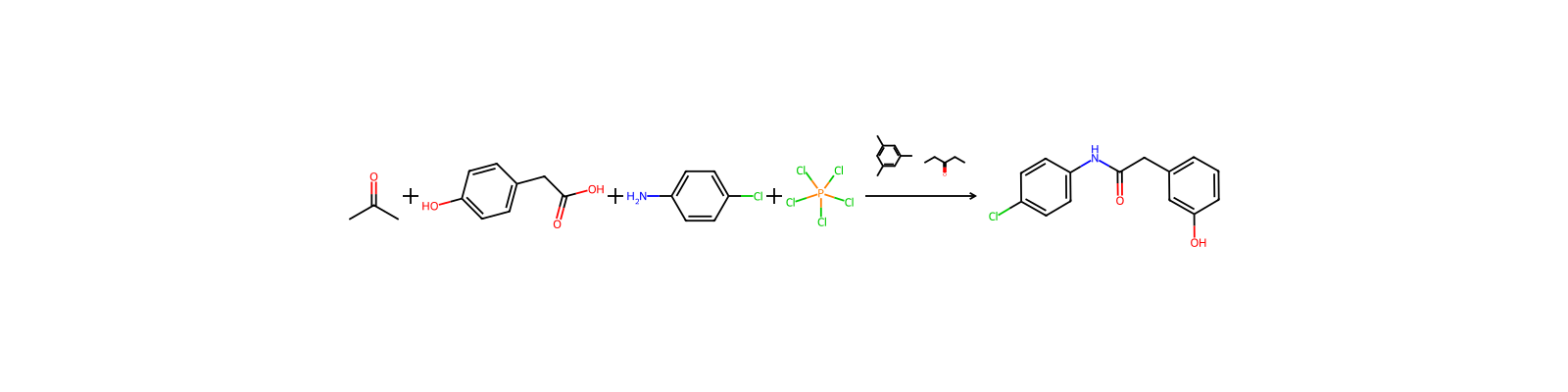
Reaktionsaufzeichnung erstellen
Reaktionsgleichung von HRID 2990
HRID 2990als Lösungsmitteluspto-grants-1998_03
Reaktionsgleichung von HRID 6442
HRID 6442als Lösungsmitteluspto-grants-1993_09
Reaktionsgleichung von HRID 9205
HRID 9205als Eduktuspto-grants-2006_08
Reaktionsgleichung von HRID 10965
HRID 10965als Eduktuspto-grants-2006_08
Reaktionsgleichung von HRID 20798
HRID 20798als Eduktuspto-grants-2010_06
Reaktionsgleichung von HRID 20800
HRID 20800als Eduktuspto-grants-2010_06
Reaktionsgleichung von HRID 22060
HRID 22060als Eduktuspto-grants-1995_06
Reaktionsgleichung von HRID 31629
HRID 31629als Eduktuspto-grants-2008_09
Seite 1 von 45

Notizen zur Verbindung

Wird geladen…

Auf dieser SeiteGrundinformationenÜberblickNamen und BezeichnerEigenschaftenSicherheit und RegulatorischesChemie und IndustrieZugehörige ReaktionenNotizen zur Verbindung
Weitere Aktionen
Neue NotizNeue ReaktionAnfrage stellen
Color/Form
Colorless, mobile liquid
Solubility · 6 Einträge

5 % (NIOSH, 2024)

Solubility at 20 °C: 2.6 wt% water in 3-pentanone

Miscible with ethanol, ether; soluble in carbon tetrachloride

In water, 47,000 mg/L at 20 °C; 38,000 mg/L at 100 °C

In water, 4.589X10+4 mg/L at 25 °C

Solubility in water, g/100ml at 25 °C: 3,9 (soluble)

Flash Point · 6 Einträge

55 °F (USCG, 1999)

13 °C

13 °C (open cup)

13 °C o.c.

55 °F (open cup)

(oc) 55 °F

Physikochemische Eigenschaften

Schmelzpunkt
-42 °C · -42 °C (lit.)
Siedepunkt
101.5 °C · 101.5 °C (lit.)
Dichte
0.813 g/mL · 0.813 g/mL at 25 °C (lit.)
Dampfdichte
3 · 3 (vs air)
Dampfdruck
20 mm · 20 mm Hg ( 28 °C)
Brechungsindex
20 · n20/D 1.392(lit.)
Flammpunkt
55 °F · 55 °F
storage temp.
30 °C · Store below +30°C.
Löslichkeit
water: slightly soluble
Aggregatzustand
Liquid
Farbe
Clear colorless
PH
6.2 · 6.2 (50g/l, H2O, 20℃)
Geruch (Odor)
0.1 % · at 0.10 % in propylene glycol. ethereal acetone
Geruchsart
ethereal
Biologische Quelle
synthetic
Explosionsgrenze
1.6 · 1.6-7.7%(V)
Wasserlöslichkeit
50 g/L · 50 g/L (20 ºC)
Spezifische Wärmekapazität
2.22 J/ · Cp(liquid): 2.22 J/(g·K), at 25℃
Merck
14 · 14,3121
BRN
635749 · 635749
Henry's Law Constant
8.9 · 8.9×10-2 mol/(m3Pa) at 25℃, Brockbank (2013)
Dielectric constant
17.3 · 17.3(14℃)
Stabilität
Stable. Highly flammable. Readily forms explosive mixtures with air. Incompatible with strong bases, reducing agents, strong oxidizing agents.
Major Application
flavors and fragrances
Kosmetik-Inhaltsstoffe Funktionen
PERFUMING
InChI
1S/C5H10O/c1-3-5(6)4-2/h3-4H2,1-2H3
InChIKey
FDPIMTJIUBPUKL-UHFFFAOYSA-N
SMILES
CCC(=O)CC
LogP
0.85 at · 0.85 at 25℃
CAS Datenbank
96 · 96-22-0(CAS DataBase Reference)
NIST chemische Informationen
3 · 3-Pentanone(96-22-0)
EPA chemische Informationen
3 · 3-Pentanone (96-22-0)
Health Hazards · 2 Einträge

Liquid causes eye burn. Vapor irritates eyes, nose and throat; can cause headache, dizziness, nausea, weakness, and loss of consciousness. (USCG, 1999)

· Inhalation or contact with material may irritate or burn skin and eyes.

Hazards Summary · 2 Einträge

A skin, eye, and respiratory tract irritant; [ICSC]; Can cause headache, dizziness, weakness, and loss of consciousness; [CAMEO]

The major hazards encountered in the use and handling of 3-pentanone stem from its toxicologic properties and flammability. Toxic by all routes (ie, inhalation, ingestion, and dermal contact), exposure to this colorless acetone-smelling liquid may occur from its use in organic syntheses. Effects from exposure may include contact burns to the skin and eyes, tachycardia, nausea, shortness of breath, headache, dizziness, fainting, coma and death. Both the OSHA PEL and the ACGIH TLV have been set at a TWA of 200 ppm. In activities or situations where over-exposure may occur, wear a self-contained breathing apparatus and chemical protective clothing. If contact should occur, immediately flush affected skin or eyes with running water for at least 15 minutes. Remove contaminated clothing and shoes at the site. 3-Pentanone may be easily ignited by heat, sparks, or flame (Flash point: 13 °C, open cup). Its heavier than air vapor and may travel to a source of ignition and flash back, or result in a build-up of explosive concentrations in enclosed spaces such as sewers. Also, containers may explode in the heat of a fire. 3-Pentanone fires may produce poisonous gases. Therefore, if a tank car or truck is involved in the fire, isolate the area for 1/2 mile in all directions. 3-Pentanone fires may be extinguished with dry chemical, CO2, Halon, standard or alcohol foam, and water spray or fog (solid streams of water may spread the fire). Fight the fire from as far a distance as possible and dike the fire control water. 3-Pentanone should be stored away from sources of ignition and oxidizing materials. 3-Pentanone may be shipped via air, rail, road, and water. Small spills of 3-pentanone may be taken up with sand or other noncombustible absorbent and placed into containers for later disposal. Before implementing land disposal of waste 3-pentanone, consult with environmental regulatory agencies for guidance.

DOT ID and Guide · 2 Einträge

1156 127

1156 127

Reactive GroupKetones
UN ClassificationUN Hazard Class: 3; UN Pack Group: II
Special ReportsEuropean Chemicals Bureau; IUCLID Dataset, 3-Pentanone (CAS # 99-22-0) Available from the Database Query page at: http://ecb.jrc.it/esis/esis.php as of November 16, 2007
TSCA Requirements · 2 Einträge

Section 8(a) of TSCA requires manufacturers of this chemical substance to report preliminary assessment information concerned with production, exposure, and use to EPA as cited in the preamble in 51 FR 41329. Effective date 9/29/2006, Reporting date 11/28/2006.

Pursuant to section 8(d) of TSCA, EPA promulgated a model Health and Safety Data Reporting Rule. The section 8(d) model rule requires manufacturers, importers, and processors of listed chemical substances and mixtures to submit to EPA copies and lists of unpublished health and safety studies. 3-Pentanone is included on this list. Effective date 9/29/2006, Sunset date 11/28/2006.

Reactivity AlertsHighly Flammable

Sicherheit und Schutzausrüstung

Fire Fighting · 2 Einträge

Excerpt from ERG Guide 127 [Flammable Liquids (Water-Miscible)]:

Use alcohol-resistant foam, powder, carbon dioxide. In case of fire: keep drums, etc., cool by spraying with water.

First Aid Measures · 4 Einträge

Fresh air, rest. Refer for medical attention.

Remove contaminated clothes. Rinse skin with plenty of water or shower.

First rinse with plenty of water for several minutes (remove contact lenses if easily possible), then refer for medical attention.

Rinse mouth.

Accidental Release Measures · 2 Einträge

· CALL 911. Then call emergency response telephone number on shipping paper. If shipping paper not available or no answer, refer to appropriate telephone number listed on the inside back cover.

· ELIMINATE all ignition sources (no smoking, flares, sparks or flames) from immediate area.

First Aid · 3 Einträge

Excerpt from NIOSH Pocket Guide for Diethyl ketone:

General First Aid:

(General first aid procedures)

Safe StorageFireproof. Well closed. Separated from oxidants. Ventilation along the floor. Store in an area without drain or sewer access.
Exposure Control and Personal Protection· Wear positive pressure self-contained breathing apparatus (SCBA).
Fire Fighting Procedures · 3 Einträge

In case of fire: keep drums, etc., cool by spraying with water. AFFF, alcohol-resistant foam, powder, carbon dioxide.

WATER MAY BE INEFFECTIVE FIGHTING FIRES WITH LOW FLASH POINT. ALCOHOL FOAM.

If material on fire or involved in fire: Do not extinquish fire unless flow can be stopped. Use water in flooding quantities as fog. Solid streams of water may spread fire. Cool all affected containers with flooding quantities of water. Apply water from as far a distance as possible. Use "alcohol" foam, dry chemical or carbon dioxide.

Storage Conditions · 1 Eintrag

Diethyl ketone must be stored to avoid contact with oxidizing materials (such as peroxides, perchlorates, chlorates, permanganates, and nitrates) Since violent reactions may occur. Store in tightly closed containers in a cool, well ventilated area away from sources of heat. Sources of ignition such as smoking and open flames are prohibited where diethyl ketone is handled, used or stored in a manner that could create a potential fire or explosion hazard. Metal containers involving the transfer of 5 gallons or more of diethyl ketone should be grounded and bonded. Drums must be equipped with self-closing valves, pressure vacuum bungs, and flame arresters. Use only non-sparking tools and equipment, especially when opening and closing containers of diethyl ketone. Wherever this diethyl ketone is used, handled, manufactured, or stored, use explosion-proof electrical equipment and fittings.

Cleanup Methods · 1 Eintrag

Evacuate and restrict persons not wearing protective equipment from area of spill or leak until cleanup is complete. Remove all ignition sources. Establish forced ventilation to keep levels below explosive limit. Absorb liquids in vermiculite, dry sand, earth, peat, carbon, or similar material and deposit in sealed containers. Keep this chemical out of a comfined space ... because of the possibility of an explosion ... It may be necessary to contain and dispose of this chemical as a hazardous waste. If material or contaminated runoff enters waterways, notify downstream users of potentially contaminated waters. Contact your Department of Environmental Protection or your regional office of the federal EPA for specific recommendations. If employees are required to clean up spills, they must be properly trained and equipped. OSHA 1910.120(q) may be applicable.

Nonfire Spill ResponseExcerpt from ERG Guide 127 [Flammable Liquids (Water-Miscible)]:
Disposal Methods · 2 Einträge

SRP: The most favorable course of action is to use an alternative chemical product with less inherent propensity for occupational exposure or environmental contamination. Recycle any unused portion of the material for its approved use or return it to the manufacturer or supplier. Ultimate disposal of the chemical must consider: the material's impact on air quality; potential migration in soil or water; effects on animal, aquatic, and plant life; and conformance with environmental and public health regulations.

Incineration /SRP: with effective emission controls/

Spillage Disposal · 1 Eintrag

Evacuate danger area! Remove all ignition sources. Consult an expert! Personal protection: filter respirator for organic gases and vapours adapted to the airborne concentration of the substance. Ventilation. Collect leaking and spilled liquid in sealable metal (mild steel) containers as far as possible. Absorb remaining liquid in sand or inert absorbent. Then store and dispose of according to local regulations. Do NOT wash away into sewer.

Toxikologische Informationen

Target OrgansEyes, skin, respiratory system
Ecotoxicity Values · 5 Einträge

LC50 Pimephales promelas (fathead minnow) 27-28 days old 1540 mg/L/96 hr (confidence limit: 1470-1600 mg/L) at 24.2 °C (hardness 46.2 mg/L calcium carbonate, pH 7.88) /Purity 98%; Conditions of bioassay not specified/

LC50 Scenedesmus subspicatus (algae) = >500 mg/L/72 hours /Conditions of bioassay not specified/

LC50 Carassius auratus (goldfish) 1200 mg/L for 24 hr /Conditions of bioassay not specified/

EC50; Species: Spirostomum ambiguum (Protozoa); Conditions: freshwater, static, 25 °C, pH > or =7.4, hardness 2.8 mg/L CaCO3; Concentration: 21.4 mmol/L for 24 hr; Effect: development, deformation

For more Ecotoxicity Values (Complete) data for 3-PENTANONE (7 total), please visit the HSDB record page.

Environmental Fate · 3 Einträge

TERRESTRIAL FATE: Based on a classification scheme(1), an estimated Koc value of 82(SRC), determined from a log Kow of 0.99(2) and a regression-derived equation(3), indicates that diethyl ketone is expected to have high mobility in soil(SRC). Volatilization of diethyl ketone from moist soil surfaces is expected to be an important fate process(SRC) given a Henry's Law constant of 5.0X10⁻⁵ atm-cu m/mole(4). Diethyl ketone is expected to volatilize from dry soil surfaces(SRC) based upon a vapor pressure of 37.7 mm Hg(5). Using an acclimated sewage inocula diethyl ketone reached 50.8%(6) and 38%(7) of the theoretical BOD over a 10 day incubation period, suggesting that biodegradation may be an important environmental fate process in soil(SRC).

AQUATIC FATE: Based on a classification scheme(1), an estimated Koc value of 82(SRC), determined from a log Kow of 0.99(2) and a regression-derived equation(3), indicates that diethyl ketone is not expected to adsorb to suspended solids and sediment(SRC). Volatilization from water surfaces is expected(3) based upon a Henry's Law constant of 5.0X10⁻⁵ atm-cu m/mole(4). Using this Henry's Law constant and an estimation method(3), volatilization half-lives for a model river and model lake are 19 hours and 8.6 days, respectively(SRC). According to a classification scheme(5), an estimated BCF of 3(SRC), from its log Kow(2) and a regression-derived equation(6), suggests the potential for bioconcentration in aquatic organisms is low(SRC). Using an acclimated sewage inocula diethyl ketone reached 50.8%(7) and 38%(8) of the theoretical BOD over a 10 day incubation period, suggesting that biodegradation may be an important environmental fate process in water(SRC).

ATMOSPHERIC FATE: According to a model of gas/particle partitioning of semivolatile organic compounds in the atmosphere(1), diethyl ketone, which has a vapor pressure of 37.7 mm Hg at 25 °C(2), is expected to exist solely as a vapor in the ambient atmosphere. Vapor-phase diethyl ketone is degraded in the atmosphere by reaction with photochemically-produced hydroxyl radicals(SRC); the half-life for this reaction in air is estimated to be 8 days(SRC), calculated from its rate constant of 2.0X10⁻¹² cu cm/molecule-sec at 25 °C(3). Diethyl ketone contains chromophores that absorb at wavelengths >290 nm and therefore may be susceptible to direct photolysis by sunlight(4).

Food Survey ValuesDiethyl ketone was identified, not quantified, in the volatiles of raw chicken breast(1), mutton, chicken and pork(2), kiwi(3,4), roasted earth almonds (Cyperus esculentus L.)(5) and nectarines(6).
Adverse EffectsNeurotoxin - Acute solvent syndrome
Exposure Routes · 2 Einträge

The substance can be absorbed into the body by inhalation of its vapour.

inhalation, ingestion, skin and/or eye contact

Ecotoxicity Excerpts · 2 Einträge

/AQUATIC SPECIES/ Affected fish (fathead minnow) /exposed to mean concentrations of 259-2300 mg/L/96 hr/ stopped schooling, came to water surface with pronounced operculation, then lost equilibrium prior to death.

/OTHER TERRESTRIAL SPECIES/ Ketones, incl 3-pentanone, were tested for their ability to release alarm pheromones in ants. The most active cmpd were of a size & geometry similar to 4-methyl-3-heptanone.

Plant Concentrations · 1 Eintrag

Diethyl ketone is a volatile emitted from many plants including European birch, European larch, European fir, Scots pine, Siberian pine, evergreen Cyprus and northern white cedar(1). Diethyl ketone was emitted from rape during the blooming period at a rate of 0.65 and 1.09 ppbv during May 8 and 9, 1998(2). Diethyl ketone is also found in kiwi(3,4) and nectarines(5).

Signs and Symptoms · 4 Einträge

Cough. Shortness of breath.

Redness. Dry skin.

Redness. Pain.

irritation eyes, skin, mucous membrane, respiratory system; cough, sneezing

Effluent Concentrations · 1 Eintrag

In a comprehensive survey of wastewater from 4000 industrial and publicly owned treatment works (POTWs) sponsored by the Effluent Guidelines Division of the USEPA, diethyl ketone was identified in discharges of the following industrial category (positive occurrences; median concn in ppb): nonferrous metals (1;26.7), ore mining (3;2.1), organics and plastics (1;47.3), plastics and synthetics (1; 2491.1), pulp and paper (1; 27.5)(1). The highest effluent concn was 2491.1 ppb in the plastics and synthetics industry(1). Diethyl ketone was identified, not quantified, in effluent from an advanced wastewater treatment plant in Lake Tahoe, CA(2). Diethyl ketone has been identified in automobile exhaust(3).

Soil Adsorption/Mobility · 1 Eintrag

The Koc of diethyl ketone is estimated as 82(SRC), using a log Kow of 0.99(1) and a regression-derived equation(2). According to a classification scheme(3), this estimated Koc value suggests that diethyl ketone is expected to have high mobility in soil.

Natural Pollution Sources · 1 Eintrag

Diethyl ketone is a volatile emitted from many plants and fruits including European birch, European larch, European fir, Scots pine, Siberian pine, evergreen cyprus and northern white cedar(1). Diethyl ketone is emitted from blooming rape(2) and is also found in kiwi(3,4) and nectarines(5).

Regulatorische Informationen

TSCA Requirements · 2 Einträge

Section 8(a) of TSCA requires manufacturers of this chemical substance to report preliminary assessment information concerned with production, exposure, and use to EPA as cited in the preamble in 51 FR 41329. Effective date 9/29/2006, Reporting date 11/28/2006.

Pursuant to section 8(d) of TSCA, EPA promulgated a model Health and Safety Data Reporting Rule. The section 8(d) model rule requires manufacturers, importers, and processors of listed chemical substances and mixtures to submit to EPA copies and lists of unpublished health and safety studies. 3-Pentanone is included on this list. Effective date 9/29/2006, Sunset date 11/28/2006.

Sicherheitsdaten

OEB
A
OEL
TWA: 200 ppm (705 mg/m3)
wgk
1
tsca
TSCA listed
ridadr
UN 1156
hs_code
2914 19 90
RTECS-Nr.
SA8050000
risk_code
11-37-66-67
Toxizität
LD50 orally in rats: 2.1 g/kg, Smyth et al., Arch. Ind. Hyg. Occup. Med. 10, 61 (1954)
hazard_code
F,Xi
safety_code
9-16-25-33
hazard_class
3
packing_group
II
Speicherklasse
3 - Flammable liquids
Giftige Stoffe Daten
96-22-0(Hazardous Substances Data)
Hazard Classifications
Eye Irrit. 2Flam. Liq. 2STOT SE 3
Selbstentzündungstemperatur
845 °F

Vor- und nachgelagerte Produkte

Vorgelagerte Rohstoffe

Natriumdichromat Dihydrat101Pentan-3-ol

Nachgelagerte Produkte

2-(3-Bromo-propyl)-1H-benzoimidazoleDiphenylketene2,3,6-Trimethylphenol2-Amino-4-ethyl-5-methyl-thiophene-3-carboxylic acid methyl ester5-Ethyl-6-methylthieno[2,3-d]pyrimidin-4(3H)-one ,97%3-Aminopentane-3-carboxylic acid2-Chloropentan-3-one2-Amino-4-ethyl-5-methyl-thiophene-3-carboxylic acid ethyl ester2,4-Dimethyl-2,4-heptadienal3-Ethylpentan-3-olBicyclo[2.2.2]octane1-Methylbutylacetat3-Ethylpent-2-en2-6-Dimethyl-4-nitroaniline4-Nitro-2,6-xylenol3,5-Dimethylheptan-4-on1-Dimethylamino-2-methylpentan-3-one

Ergänzende Hinweise

DefinitionChEBI: Pentan-3-one is a pentanone that is pentane carrying an oxo group at position 3. It has been isolated from Triatoma brasiliensis and Triatoma infestans. It has a role as an animal metabolite.