
2,2'-(2,5-Cyclohexadien-1,4-diyli-den)bismalononitril
Tetracyanoquinodimethane
Daten werden ergänzt – lade die Seite später neu, um den aktuellen Stand zu sehen

Grundinformationen
- CAS
1518-16-7- Standard-SMILES
N#CC(C#N)=c1ccc(=C(C#N)C#N)cc1- InChIKey
PCCVSPMFGIFTHU-UHFFFAOYSA-N- Summenformel
- C12H4N4
- Durchschnittliche Molmasse
- 204,19 g/mol
- Monoisotopische Masse
- 204,04359613
Überblick
Tetracyanoquinodimethane is a quinodimethane that is p-quinodimethane in which the methylidene hydrogens are replaced by cyano groups. It is a nitrile, an alicyclic compound and a quinodimethane. It is functionally related to a p-quinodimethane.
Namen und Bezeichner
- Bevorzugter Name
- Tetracyanoquinodimethane
- IUPAC
- 2-[4-(dicyanomethylidene)cyclohexa-2,5-dien-1-ylidene]propanedinitrile
- Lokaler Name
- 2,2'-(2,5-Cyclohexadien-1,4-diyli-den)bismalononitril
- Englischer Name
- 7,7,8,8-Tetracyanoquinodimethane
- Summenformel
- C12H4N4
- Molmasse
- 204.19
Namen und Synonyme
1518-16-77,7,8,8-TetracyanoquinodimethaneTCNQTetracyanoquinodimethaneTetracyanoquinodimethanTetracyano-p-quinodimethanePropanedinitrile, 2,2'-(2,5-cyclohexadiene-1,4-diylidene)bis-Tetracyanoquinodimethan(e)7,7,8,8-Tetracyano-p-quinodimethane7,7,8,8-Tetracyano-1,4-quinodimethan7,7',8,8'-Tetracyanoquinodimethane2-[4-(dicyanomethylidene)cyclohexa-2,5-dien-1-ylidene]propanedinitrile
Weitere Namen anzeigen
Tetracyano p-Quinone Dimethane2,2'-(Cyclohexa-2,5-diene-1,4-diylidene)dimalononitrileTIMTEC-BB SBB0004357,7,8,8-Tetracyanoqutetracyano-quinodimethaetracyanoquinodimethane7,7,8,8-Tetracyanodimethan
2,5-Cyclohexadiene-1,4-diylidenedimalononitrileHC6FB4H2KW2,5-Cyclohexadiene-delta(sup1alpha:4alpha)dimalononitrileNSC-1052372,5-Cyclohexadiene-delta1,alpha:4,alpha'-dimalononitrileDTXSID5061748CHEBI:524452,5-Cyclohexadiene-1,4-diylidene-alpha,alpha'-dimalononitrile
Eigenschaften
Berechnete StruktureigenschaftenWird ergänzt
- XLogP
- 1
- Polarare Oberfläche (TPSA)
- 95,2 Ų
- H-Brücken-Donoren
- 0
- H-Brücken-Akzeptoren
- 4
- Frei drehbare Bindungen
- 0
- Schwere Atome
- 16
- Formalladung
- 0
- Komplexität
- 535
Experimentelle und physikochemische Eigenschaften
Chemical ClassesNitrogen Compounds -> Nitriles
SpringerMaterials PropertiesBand gap energy
Physical DescriptionGreen crystalline solid; [Alfa Aesar MSDS]
Physikochemische Eigenschaften
- Schmelzpunkt
- 287 · 287-289 °C (dec.) (lit.)
- Siedepunkt
- 332.67 °C · 332.67°C (rough estimate)
- Dichte
- 1.3596 · 1.3596 (rough estimate)
- Brechungsindex
- 1.5 · 1.5000 (estimate)
- storage temp.
- Sealed in dry,Room Temperature
- Aggregatzustand
- Crystalline Powder
- Farbe
- Orange-brown to green
- Wasserlöslichkeit
- insoluble
- BRN
- 611604 · 611604
Sicherheit und Regulatorisches
Sicherheitsangaben dienen nur zur Orientierung und ersetzen weder das Sicherheitsdatenblatt (SDB) des Lieferanten noch geltende Vorschriften oder eine fachliche Bewertung.
GHS-Klassifizierung
GHS Classification
Danger
H301+H311+H331 (87%): Toxic if swallowed, in contact with skin or if inhaled [Danger Acute toxicity, oral; acute toxicity, dermal; acute toxicity, inhalation]
P261, P262, P264, P270, P271, P280, P301+P316, P301+P317, P302+P352, P304+P340, P316, P317, P321, P330, P361+P364, P403+P233, P405, and P501 (click each P-code to see the statement)
Aggregated GHS information provided per 46 reports by companies from 4 notifications to the ECHA C&L Inventory. Each notification may be associated with multiple companies.
Gefahrenhinweise
Regulatory Information7,7,8,8-Tetracyanoquinonedimethane: Does not have an individual approval but may be used under an appropriate group standard
Hazards SummaryIntravenous LD50 (mouse) = 56 mg/kg; [RTECS] May cause irritation; Harmful by ingestion and skin absorption; Toxic by inhalation; [Alfa Aesar MSDS] See NITRILES.
Hazard Classes and CategoriesAcute Tox. 3 (89.1%)
Sicherheit und Schutzausrüstung
Protective Action Criteria (PAC)
0.18 [mg/m3]
2.0 [mg/m3]
12 [mg/m3]
Toxikologische Informationen
Treatment
Antidotes to cyanide poisoning include hydroxocobalamin and sodium nitrite, which release the cyanide from the cytochrome system, and rhodanase, which is an enzyme occurring naturally in mammals that combines serum cyanide with thiosulfate, producing comparatively harmless thiocyanate. Oxygen therapy can also be administered. (L97)
Chemie und Industrie
Pharmakologische Informationen
Metabolism/Metabolites
Organic nitriles are converted into cyanide ions through the action of cytochrome P450 enzymes in the liver. Cyanide is rapidly absorbed and distributed throughout the body. Cyanide is mainly metabolized into thiocyanate by either rhodanese or 3-mercaptopyruvate sulfur transferase. Cyanide metabolites are excreted in the urine. (L96)
Verwendung und Herstellung
Uses
Synthetic Polymer MALDI Matrix Compounds
Tetracyanoquinodimethane is an electron-acceptor that is used to prepare charge transfer salts, which are of interest in the area of molecular electronics. (L614)
General Manufacturing InformationPropanedinitrile, 2,2'-(2,5-cyclohexadiene-1,4-diylidene)bis-: ACTIVE
Anwendungen
Beschreibung7,7,8,8-tetracyanoquinodimethane (TCNQ), with a LUMO at 4.5 eV, is known for the charge-transfer salts formed by its radical anion TCNQ inphotovoltaic, light-emitting diodes, and organic field-effect transistordevices. TCNQ and its derivativeshave been used as dopants, leading to an increase in hole mobility or to the lowering of injectionbarriers. One classic example of such is the treatment of tetrathiafulvene (TTF), an electron donor with TCNQ. TFF and TCNQ form an ion pair, the TTF-TCNQ complex. This process of doping leads to the crystallisation of the ion pair into a one-dimensionally stacked polymer. This polymer consists of segregated stacks of cations and anions of the donors and the acceptors, respectively. The complex crystal is an organic semiconductor that exhibits metallic electric conductivity [1, 2].
HistoryThe first report on the electrical conductivity in an organic solid appeared in 1954, namely, a perylene—bromine complex with a room-temperature conductivity of 0.1 S cm1. In 1960, the organic acceptor Tetracyanoquinodimethane (TCNQ; 7,7,8,8-Tetracyanoquinodimethane) was synthesized, as well as a great number of its conducting charge-transfer complexes and radical ion salts. In the 1970s, the organic donor TTF led to the first organic metal TTF-TCNQ. Its room-temperature conductivity (500 S cm1) increases with a decrease in the temperature to the value of 6000 S cm1 at 60 K, where a metal-insulator transition occurs[1].
Zugehörige Reaktionen
13
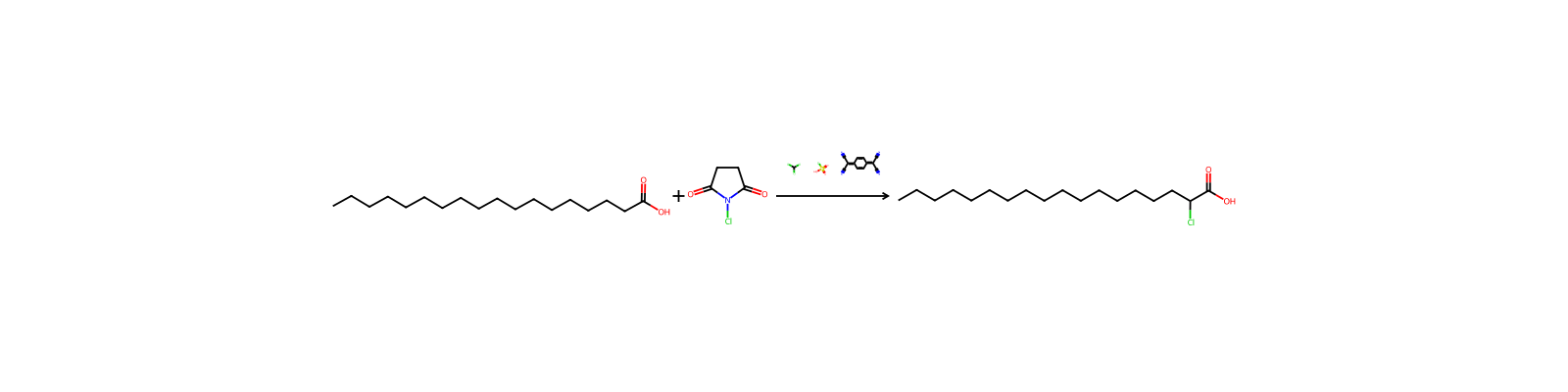


Notizen zur Verbindung
Wird geladen…