
Grundinformationen
- Standard-SMILES
Nc1cccc(C(F)(F)F)c1- InChIKey
VIUDTWATMPPKEL-UHFFFAOYSA-N- Summenformel
- C7H6F3N
- Durchschnittliche Molmasse
- 161,12 g/mol
- Monoisotopische Masse
- 161,04523385
Überblick
3-trifluoromethylaniline appears as a colorless liquid with a fishlike odor. Insoluble in water and denser than water. Toxic by ingestion and inhalation. Used to make dyes and pharmaceuticals.
Namen und Bezeichner
- Bevorzugter Name
- 3-(Trifluoromethyl)aniline
- IUPAC
- 3-(trifluoromethyl)aniline
- Lokaler Name
- 3-Aminobenzotrifluorid
- Englischer Name
- 3-Aminobenzotrifluoride
- Summenformel
- C7H6F3N
- Molmasse
- 161.12
Namen und Synonyme
3-(Trifluoromethyl)aniline98-16-83-Aminobenzotrifluoridem-Aminobenzotrifluoride3-Trifluoromethylaniline3-(Trifluoromethyl)benzenamineBenzenamine, 3-(trifluoromethyl)-m-Aminobenzal fluorideM-(TRIFLUOROMETHYL)ANILINEUSAF MA-41-Amino-3-(trifluoromethyl)benzeneDTXSID9024512
Weitere Namen anzeigen
META-AMINOBENZOTRIFLUORIDE3-trifluoromethyl3-(trifluoromethyl)3-aminotrifluorotoluene3-Aminobenzotrifluoride 98%DK9593-ABTFusafma-4
m-Amino-alpha,alpha,alpha-trifluorotolueneZ1RWM538YNm-Toluidine, alpha,alpha,alpha-trifluoro-NSC-4540Toluene, 3-amino-alpha,alpha,alpha-trifluoro-DTXCID504512RefChem:92749202-643-4
Datenbank-Bezeichner
- CAS
98-16-8- PubChem CID
- 7375
- DTXSID
DTXSID9024512- ChEMBL
CHEMBL1162293- UNII
- Z1RWM538YN
- EC Number
- 202-643-4
- Nikkaji
- J54.405A
Eigenschaften
Berechnete Struktureigenschaften
- XLogP
- 2,3
- Polarare Oberfläche (TPSA)
- 26 Ų
- H-Brücken-Donoren
- 1
- H-Brücken-Akzeptoren
- 4
- Frei drehbare Bindungen
- 0
- Schwere Atome
- 11
- Formalladung
- 0
- Komplexität
- 132
Experimentelle und physikochemische Eigenschaften
Chemical Classes
Nitrogen Compounds -> Amines, Aromatic
Flammable agents - 2nd degree
SpringerMaterials Properties13C nuclear magnetic resonance spectrum
PesticidesPesticide degradation product
LogP2.29
OdorFish-like
Density
1.303 at 59.9 °F (EPA, 1998) - Denser than water; will sink
1.303 @25 °C
Color/FormCOLORLESS TO YELLOW OILY LIQ
Solubility
Slightly soluble (NTP, 1992)
SLIGHTLY SOL IN WATER; SOL IN ALC, ETHER
Flash Point185 °F (NTP, 1992)
Boiling Point
369.5 °F at 764 mmHg (EPA, 1998)
187.5 °C @ 764 MM HG
189 °C @760 [mm Hg]
Melting Point
37 °F (EPA, 1998)
3 °C
Vapor Density5.56 (EPA, 1998) - Heavier than air; will sink (Relative to Air)
Physikochemische Eigenschaften
- Schmelzpunkt
- 5 °C · 5 °C
- Siedepunkt
- 187 °C · 187 °C(lit.)
- Dichte
- 1.29 g/mL · 1.29 g/mL at 25 °C(lit.)
- Dampfdruck
- 0.3 mm · 0.3 mm Hg ( 20 °C)
- Brechungsindex
- 20 · n20/D 1.480(lit.)
- Flammpunkt
- 185 °F · 185 °F
- storage temp.
- 30 °C · Store below +30°C.
- Löslichkeit
- 5 g/L · 5 g/L (20°C)
- Aggregatzustand
- Liquid
- pka
- 3.49 · 3.49(at 25℃)
- Wichte
- 1.29 · 1.290
- Farbe
- Clear light yellow
- Wasserlöslichkeit
- 5 g/L · 5 g/L (20 ºC)
- BRN
- 387672 · 387672
- Henry's Law Constant
- 3.9 · 3.9×10-1 mol/(m3Pa) at 25℃, Ebert et al. (2023)
- InChI
- 1S/C7H6F3N/c8-7(9,10)5-2-1-3-6(11)4-5/h1-4H,11H2
- InChIKey
- VIUDTWATMPPKEL-UHFFFAOYSA-N
- SMILES
- Nc1cccc(c1)C(F)(F)F
- LogP
- 2.09 · 2.09-2.16 at 25-30℃ and pH5.9
- Oberflächenspannung
- 64.5 mN/m · 64.5mN/m at 1g/L and 22.2℃
- CAS Datenbank
- 98 · 98-16-8(CAS DataBase Reference)
- NIST chemische Informationen
- 3 · Benzenamine, 3-(trifluoromethyl)-(98-16-8)
- EPA chemische Informationen
- m-(Trifluoromethyl)aniline (98-16-8)
Sicherheit und Regulatorisches
GHS-Klassifizierung
GHS Classification
Danger
H302 (95.7%): Harmful if swallowed [Warning Acute toxicity, oral]
P260, P261, P264, P264+P265, P270, P271, P273, P280, P284, P301+P317, P302+P352, P304+P340, P305+P351+P338, P305+P354+P338, P316, P317, P319, P320, P321, P330, P332+P317, P337+P317, P362+P364, P391, P403+P233, P405, and P501 (click each P-code to see the statement)
Aggregated GHS information provided per 70 reports by companies from 18 notifications to the ECHA C&L Inventory. Each notification may be associated with multiple companies.
Gefahrenhinweise
Regulatory Information
Chemical: Benzenamine, 3-(trifluoromethyl)-
Commission Regulation (EC) No 33/2008
SP - indicates a substance that is identified in a proposed Significant New Use Rule.
Status: Active Update: 18-12-2020 https://echa.europa.eu/registration-dossier/-/registered-dossier/13933
3-Aminobenzotrifluoride: Does not have an individual approval but may be used under an appropriate group standard
The New Jersey Worker and Community Right to Know Act requires public and private employers to provide information about hazardous substances at their workplaces. (N.J.S.A. 34:5A-1 et. seq.)
DOT LabelPoison
Fire Hazards
This material may burn but does not ignite readily. Cylinder may explode in heat of fire. When heated to decomposition, it emits very toxic fumes of fluorides and nitrogen oxides. (EPA, 1998)
· Combustible material: may burn but does not ignite readily.
Health Hazards
Contact may cause burns to skin and eyes. May be poisonous if inhaled, swallowed or absorbed through the skin. (EPA, 1998)
· TOXIC and/or CORROSIVE; inhalation, ingestion or skin contact with material may cause severe injury or death.
Hazards Summary
A moderate eye irritant; In lethal-dose feeding studies, causes methemoglobinemia, somnolence, and fatty liver degeneration; [RTECS] A corrosive chemical that could cause chemical pneumonitis after inhalation; Methemoglobinemia reported in animal experiments; Monitor liver and kidney function after significant exposure; [HSDB] May burn skin and eyes; [CAMEO] An irritant; Can be absorbed through skin; [MSDSonline]
DOT ID and Guide2948 153
Reactive GroupFluorinated Organic Compounds
Reactivity Profile
3-TRIFLUOROMETHYLANILINE is a trifluoromethyl- and amine-substituted aromatic compound. Amines are chemical bases. They neutralize acids to form salts plus water. These acid-base reactions are exothermic. The amount of heat that is evolved per mole of amine in a neutralization is largely independent of the strength of the amine as a base. Amines may be incompatible with isocyanates, halogenated organics, peroxides, phenols (acidic), epoxides, anhydrides, and acid halides. Flammable gaseous hydrogen is generated by amines in combination with strong reducing agents, such as hydrides.
DOT Emergency Guidelines
/GUIDE 153: SUBSTANCES - TOXIC and/or CORROSIVE (Combustible)/ Fire or Explosion: Combustible material: may burn but does not ignite readily. When heated, vapors may form explosive mixtures with air: indoors, outdoors and sewers explosion hazards. Those substances designated with a (P) may polymerize explosively when heated or involved in a fire. Contact with metals may evolve flammable hydrogen gas. Containers may explode when heated. Runoff may pollute waterways. Substance may be transported in a molten form.
/GUIDE 153: SUBSTANCES - TOXIC and/or CORROSIVE (Combustible)/ Health: TOXIC; inhalation, ingestion or skin contact with material may cause severe injury or death. Contact with molten substance may cause severe burns to skin and eyes. Avoid any skin contact. Effects of contact or inhalation may be delayed. Fire may produce irritating, corrosive and/or toxic gases. Runoff from fire control or dilution water may be corrosive and/or toxic and cause pollution.
/GUIDE 153: SUBSTANCES - TOXIC and/or CORROSIVE (Combustible)/ Public Safety: CALL Emergency Response Telephone Number on Shipping Paper first. If Shipping Paper not available or no answer, refer to appropriate telephone number listed on the inside back cover. As an immediate precautionary measure, isolate spill or leak area in all directions for at least 50 meters (150 feet) for liquids and at least 25 meters (75 feet) for solids. Keep unauthorized personnel away. Stay upwind. Keep out of low areas. Ventilate enclosed areas.
/GUIDE 153: SUBSTANCES - TOXIC and/or CORROSIVE (Combustible)/ Protective Clothing: Wear positive pressure self-contained breathing apparatus (SCBA). Wear chemical protective clothing that is specifically recommended by the manufacturer. It may provide little or no thermal protection. Structural firefighters' protective clothing provides limited protection in fire situations ONLY; it is not effective in spill situations where direct contact with the substance is possible.
For more DOT Emergency Guidelines (Complete) data for M-(TRIFLUOROMETHYL)ANILINE (8 total), please visit the HSDB record page.
DOT Hazard Classification
3-Trifluoromethylaniline
UN2948
Div 6.1 Poisonous materials (49 eCFR § 173.132)
PG II: the degree of danger presented by the material is medium
Air and Water ReactionsInsoluble in water.
CERCLA Reportable Quantities
Releases of CERCLA hazardous substances are subject to the release reporting requirement of CERCLA section 103, codified at 40 CFR part 302, in addition to the requirements of 40 CFR part 355. Benzenamine, 3-(trifluoromethyl)- is an extremely hazardous substance (EHS) subject to reporting requirements when stored in amounts in excess of its threshold planning quantity (TPQ) of 500 lbs.
Sicherheit und Schutzausrüstung
Fire Fighting
Wear positive pressure breathing apparatus and special protective clothing. Move container from fire area if you can do so without risk. Fight fire from maximum distance. Dike fire control water for later disposal; do not scatter the material.
Accidental Release Measures
· CALL 911. Then call emergency response telephone number on shipping paper. If shipping paper not available or no answer, refer to appropriate telephone number listed on the inside back cover.
· ELIMINATE all ignition sources (no smoking, flares, sparks or flames) from immediate area.
First Aid
Note: No information on specific clinical effects of exposure was available.
General First Aid:
Exposure Control and Personal Protection· Wear positive pressure self-contained breathing apparatus (SCBA).
Fire Fighting Procedures
If material on fire or involved in fire: Do not extinguish fire unless flow can be stopped. Extinguish fire using agent suitable for type of surrounding fire. (Material itself does not burn or burns with difficulty.) Use water in flooding quantities as fog. Cool all affected containers with flooding quantities of water. Apply water from as far a distance as possible. Use foam, dry chemical, or carbon dioxide. Keep run off water out of sewers and water sources.
Nonfire Spill ResponseExcerpt from ERG Guide 153 [Substances - Toxic and/or Corrosive (Combustible)]:
Preventive Measures
If material not on fire and not involved in fire: Keep sparks, flames, and other sources of ignition away. Keep material out of water sources and sewers. Build dikes to contain flow as necessary. Do not use water.
Personnel protection: Avoid breathing vapors. Keep upwind. Avoid bodily contact with the material. Do not handle broken packages unless wearing appropriate personnal protective equipment.
Isolation and Evacuation
Excerpt from ERG Guide 153 [Substances - Toxic and/or Corrosive (Combustible)]:
Immediate precautionary measure
Protective Action Criteria (PAC)
0.40 [mg/m3]
4.4 [mg/m3]
19 [mg/m3]
Personal Protective Equipment (PPE)
For emergency situations, wear a positive pressure, pressure-demand, full facepiece self-contained breathing apparatus (SCBA) or pressure- demand supplied air respirator with escape SCBA and a fully-encapsulating, chemical resistant suit. (EPA, 1998)
Wear positive pressure self contained breathing apparatus. ... Wear appropriate chemical protective clothing.
Emergency Response Planning GuidelinesSmall Fire
Toxikologische Informationen
Adverse EffectsOccupational hepatotoxin - Secondary hepatotoxins: the potential for toxic effect in the occupational setting is based on cases of poisoning by human ingestion or animal experimentation.
Non-Human Toxicity ExcerptsWHEN ADDED TO FOOD OF LARVAL & IMAGO DROSOPHILA, M-TRIFLUOROMETHYLANILINE INCR INCIDENCE OF DOMINANT LETHAL MUTATIONS AMONG OFFSPRING & INCR PERCENTAGE OF UNFERTILIZED EGGS.
Toxicity DataLC50 (rat) = 440 mg/m3/4h
USGS Health-Based Screening Levels for Evaluating Water-Quality
3-Trifluoromethylaniline
Pesticide degradation product
Also see CASRN 2164172
Smith, C.D. and Nowell, L.H., 2024. Health-Based Screening Levels for evaluating water-quality data (3rd ed.). DOI:10.5066/F71C1TWP
Regulatorische Informationen
CERCLA Reportable Quantities
Releases of CERCLA hazardous substances are subject to the release reporting requirement of CERCLA section 103, codified at 40 CFR part 302, in addition to the requirements of 40 CFR part 355. Benzenamine, 3-(trifluoromethyl)- is an extremely hazardous substance (EHS) subject to reporting requirements when stored in amounts in excess of its threshold planning quantity (TPQ) of 500 lbs.
Sicherheitsdaten
- wgk
- 2
- tsca
- TSCA listed
- ridadr
- UN 2948
- hs_code
- 29214300
- RTECS-Nr.
- XU9180000
- risk_code
- 36/37/38-33-23-21/22-26-24-22-20/21/22
- hazard_code
- Xi,T,T+,Xn
- hazard_note
- Toxic/Irritant
- safety_code
- 26-36-45-36/37/39-28A
- hazard_class
- 6.1
- packing_group
- II
- Speicherklasse
- 6.1A - Combustible acute toxic Cat. 1 and 2very toxic hazardous materials
- Giftige Stoffe Daten
- 98-16-8(Hazardous Substances Data)
- Hazard Classifications
- Acute Tox. 4 DermalAcute Tox. 4 OralAquatic Chronic 2Eye Dam. 1Skin Irrit. 2
Chemie und Industrie
Verwendung und Herstellung
Uses
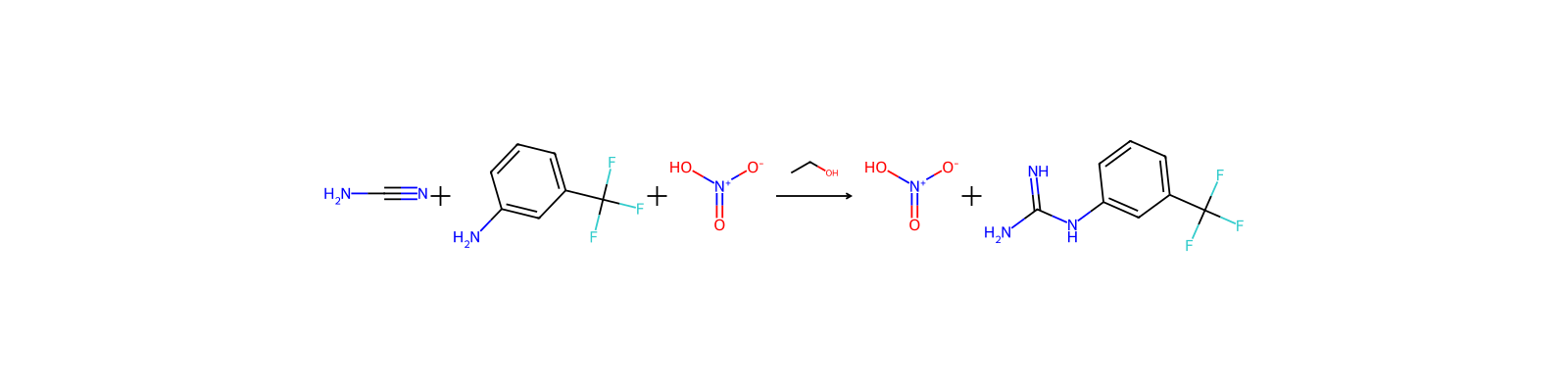
Used as intermediate for phenothiazine derivatives, herbicides, antihypertensives, and diuretics; [HSDB] Used to make dyes; [CAMEO]
INT IN MFR OF PHENOTHIAZINE DERIV.
CHEM INT FOR HERBICIDES (EG, FLUOMETRON & NORFLURAZON), ANTIHYPERTENSIVES & DIURETICS.
U.S. Imports
(1977) 1.01X10+7 G (PRINCPL CUSTMS DISTS)
(1979) 2.94X10+8 G (PRINCPL CUSTMS DISTS)
U.S. Production
(1978) PROBABLY GREATER THAN 2.27X10+6 G
(1979) PROBABLY GREATER THAN 2.27X10+6 G
Consumption PatternsESSENTIALLY 100% AS A CHEM INT
Methods of ManufacturingNITRATION OF BENZOTRIFLUORIDE TO 3-NITROBENZOTRIFLUORIDE FOLLOWED BY HYDROGENATION
Formulations/PreparationsGRADE: TECHNICAL (88% MIN); PURIFIED (98% MIN).
General Manufacturing InformationBenzenamine, 3-(trifluoromethyl)-: ACTIVE
Vor- und nachgelagerte Produkte
Vorgelagerte Rohstoffe
Nachgelagerte Produkte
Anbieter50 Anbieter
国药集团化学试剂有限公司86-21-63210123 · [email protected]
梯希爱(上海)化成工业发展有限公司021-67121386 · [email protected]
上海阿拉丁生化科技股份有限公司400-6206333 13167063860 · [email protected]
济南宏嘉化工有限公司15253128188; 15253128188
河北创海生物科技有限公司+86-86-13131129325 · [email protected]
T&W GROUP021-61551611 13296011611 · [email protected]
爱斯特(成都)生物制药股份有限公司+86-28-85122536 85324413 · [email protected]
科瑞迪化学400-821-5857 021-64326257 · [email protected]
Syntechem Co.,Ltd[email protected]
上海迈瑞尔生化科技有限公司4006356688 18621169109 · [email protected]
阿法埃莎(中国)化学有限公司400-6106006 · [email protected]
安耐吉化学&3A(安徽泽升科技股份有限公司)400-0056266 · [email protected]
武汉凯威斯科技有限公司86-027-67849912 · [email protected]
Allfluoro Pharmaceutical Company Limited+86-400-0216110 +86-15958047586 · [email protected]
上海瀚鸿科技股份有限公司021-54306202 13764082696 · [email protected]
上海景颜化工科技有限公司13817811078 · [email protected]
嘉兴市艾森化工有限公司0573-85285100 18627885956 · [email protected]
Pure Chemistry Scientific Inc.001-857-928-2050 or 1-888-588-9418 · [email protected]
山东西亚化学有限公司13355009207 13355009207 · [email protected]
玛雅试剂+86 (573) 82222445 (0)18006601000 452520369 · [email protected]
四川库利南科技有限公司400-1166-196 18981987031 · [email protected]
天津希恩思生化科技有限公司400 638 7771 · [email protected]
南京维奥化工有限公司Please Send Email 18652950785 · [email protected]
艾科试剂4008-755-333 18080918076 · [email protected]
上海思域化工科技有限公司86-21-34053660 · [email protected]
赛默飞世尔科技(中国)有限公司800-810-5118 · [email protected]
北京伊诺凯科技有限公司400-810-7969 010-59572699 · [email protected]
江苏艾康生物医药研发有限公司025-66113011 13913916777 · [email protected]
TCI AMERICA800-4238616 · [email protected]
TOKYO CHEMICAL INDUSTRY CO., LTD.03-36680489 · [email protected]
TCI Europe320-37350700 · [email protected]
卡迪亚医药科技有限公司0371-86615086 18203638366 0371-86159066 13526786601
上海贤鼎生物科技有限公司4009209199 · [email protected]
深圳康特腾科技有限公司86-0755-86635001 · [email protected]
越林试剂021-62960152 · [email protected]
上海睿升化工科技有限公司+86-021-50935922
Clearsynth Labs Limited+91-22-26355700 · [email protected]
北京环宇世纪化学科技有限公司hysj_bj.com
上海湄水化工科技有限公司021-60549325 18616193163
安徽科迪达化工有限公司0554-2106669 · [email protected]
HBCChem, Inc.+1-510-219-6317 · [email protected]
日照力德士化工有限公司010-51268198 · [email protected]
上海石洋化工有限公司021-56795766 · [email protected]
上海爱蝶实业有限公司021-58957966 18930537195 · [email protected]
成都零六生物科技有限公司400-1166-196 13458535857 · [email protected]
广拓化学(上海)有限公司021-60899189-8001 18918189673 · [email protected]
天津安浩生物科技有限公司[email protected]
上海麦克林生化科技股份有限公司15221275939 15221275939 · [email protected]
杭州杰恒化工有限公司0571-87396432 · [email protected]
上海纳谦化学科技有限公司13598610367 13598610367 · [email protected]
Zugehörige Reaktionen
588




Verknüpfte Notizen
Wird geladen…