
Isophthaloyl chloride
Daten werden ergänzt – lade die Seite später neu, um den aktuellen Stand zu sehen
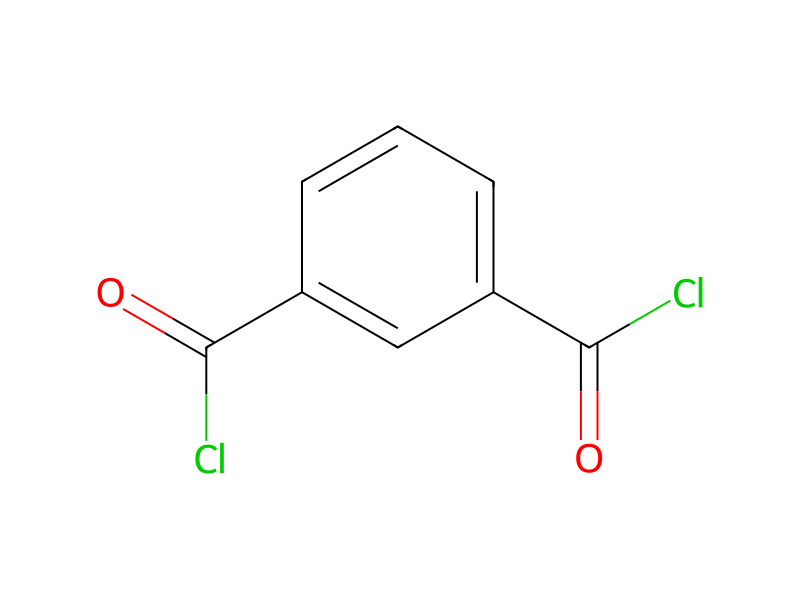
Grundinformationen
- CAS
99-63-8- Standard-SMILES
O=C(Cl)c1cccc(C(=O)Cl)c1- InChIKey
FDQSRULYDNDXQB-UHFFFAOYSA-N- Summenformel
- C8H4Cl2O2
- Durchschnittliche Molmasse
- 203,02 g/mol
- Monoisotopische Masse
- 201,95883473
Namen und Bezeichner
- Bevorzugter Name
- Isophthaloyl chloride
- IUPAC
- benzene-1,3-dicarbonyl chloride
- Englischer Name
- 1,3-Benzenedicarbonyl chloride
- Summenformel
- C8H4Cl2O2
- Molmasse
- 0
Namen und Synonyme
Isophthaloyl chlorideIsophthaloyl dichloride99-63-81,3-Benzenedicarbonyl dichloridem-Phthaloyl chlorideIsophthalic acid chloridem-Phthalic dichlorideIsophthalic acid dichlorideIsophthalic chloride1,3-BENZENEDICARBONYL CHLORIDEIsophthalyl dichlorideIsothaloyl chloride
Weitere Namen anzeigen
Isophthalyl chloridem-Benzenedicarbonyl chlorideDichlorid kyseliny isoftalovemeta-Phthalyl dichloridem-Phthaloyl dichlorideDTXSID30266416A3LDJ6CL31,3-Benzenedicarboxylic acid, dichloride
Datenbank-Bezeichner
- CAS
99-63-8- PubChem CID
- 7451
- DTXSID
DTXSID3026641- ChEMBL
CHEMBL1885739- UNII
- 6A3LDJ6CL3
- EC Number
- 202-774-7
- Nikkaji
- J4.971I
Eigenschaften
Berechnete StruktureigenschaftenWird ergänzt
- XLogP
- 3,6
- Polarare Oberfläche (TPSA)
- 34,1 Ų
- H-Brücken-Donoren
- 0
- H-Brücken-Akzeptoren
- 2
- Frei drehbare Bindungen
- 2
- Schwere Atome
- 12
- Formalladung
- 0
- Komplexität
- 183
Experimentelle und physikochemische Eigenschaften
Chemical ClassesToxic Gases & Vapors -> Other Toxic Gases & Vapors
SpringerMaterials PropertiesBoiling point
Density1.3880 @ 17 °C/4 °C
Color/Form
CRYSTALLINE SOLID
PRISMS FROM ETHER
Solubility
SOL IN ETHER & OTHER ORG SOLVENTS
SLIGHTLY SOL IN WATER & ALCOHOL
Flash Point356 °F OC
Boiling Point276 °C
Melting Point43-44 °C
Food Contact SubstancesFCS -> FDA Inventory of Food Contact Substances Listed in 21 CFR
Refractive IndexINDEX OF REFRACTION: 1.570 @ 47 °C/D
Sicherheit und Regulatorisches
Sicherheitsangaben dienen nur zur Orientierung und ersetzen weder das Sicherheitsdatenblatt (SDB) des Lieferanten noch geltende Vorschriften oder eine fachliche Bewertung.
GHS-Klassifizierung
GHS Classification
This chemical does not meet GHS hazard criteria for 0.4% (1 of 269) of reports.
Danger
H312 (99.6%): Harmful in contact with skin [Warning Acute toxicity, dermal]
P260, P261, P264, P264+P265, P271, P280, P301+P330+P331, P302+P352, P302+P361+P354, P304+P340, P305+P354+P338, P316, P317, P321, P362+P364, P363, P403+P233, P405, and P501 (click each P-code to see the statement)
Aggregated GHS information provided per 269 reports by companies from 11 notifications to the ECHA C&L Inventory. Each notification may be associated with multiple companies.
Warning
Gefahrenhinweise
Regulatory Information
Chemical: 1,3-Benzenedicarbonyl dichloride
Regulation (EC) No 1935/2004 (amended)
1,3-Benzenedicarbonyl dichloride is listed on the EPA's Chemical Data Reporting (CDR) system. Manufacturers and importers of 1,3-Benzenedicarbonyl dichloride are required to report information about their production and use of this chemical to the EPA under the Toxic Substances Control Act (TSCA). (40 eCFR Part 711)
Status: Active Update: 07-05-2021 https://echa.europa.eu/registration-dossier/-/registered-dossier/13191
Isophthaloyl dichloride: Does not have an individual approval but may be used under an appropriate group standard
Hazards Summary
Reacts with water; [Hawley] A skin and eye irritant; [HSDB] Evolves HCl upon reaction with water; A moderate to severe skin irritant; [CHEMINFO] A corrosive substance that can cause injury to the skin, eyes, and respiratory tract; Inhalation may cause edema and chemical pneumonitis; [MSDSonline]
Hazard Classes and Categories
Acute Tox. 4 (99.6%)
Acute toxicity (Dermal) - Category 4
Chemie und Industrie
Verwendung und Herstellung
Uses
Used in dyes, synthetic fibers, resins, films, and glass coatings; [HSDB]
Textiles (Fiber & Fabric Manufacturing) [Category: Industry]
INTERMEDIATE; DYES; SYNTHETIC FIBERS; RESINS; FILMS; PROTECTIVE COATINGS; LABORATORY REAGENT
NONTHROMBOGENIC GLASS COATING
U.S. Production2023: 100,000 - <250,000 lb
Industry UsesIntermediate
General Manufacturing Information
Plastics Material and Resin Manufacturing
1,3-Benzenedicarbonyl dichloride: ACTIVE
Zugehörige Reaktionen
66


Notizen zur Verbindung
Wird geladen…