
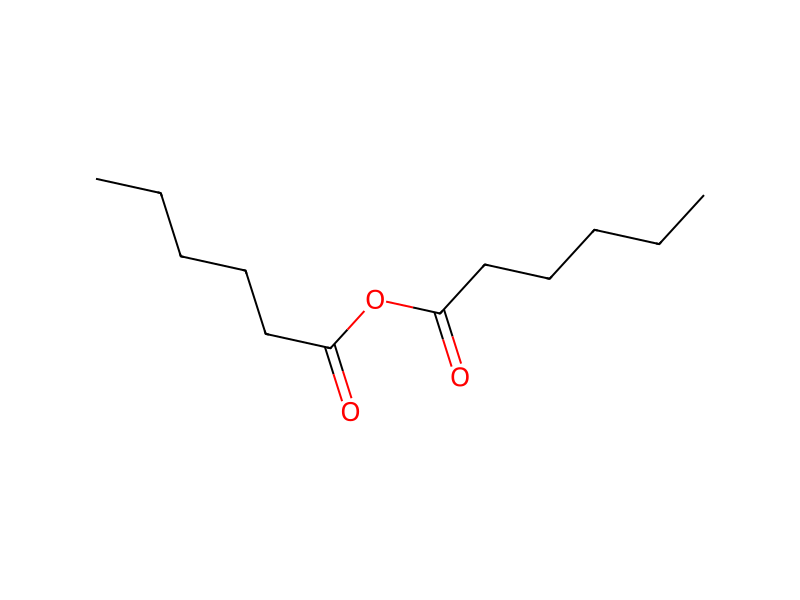
Grundinformationen
- Standard-SMILES
CCCCCC(=O)OC(=O)CCCCC- InChIKey
PKHMTIRCAFTBDS-UHFFFAOYSA-N- Summenformel
- C12H22O3
- Durchschnittliche Molmasse
- 214,3 g/mol
- Monoisotopische Masse
- 214,15689456
Überblick
hexanoic anhydride has been reported in Nicotiana tabacum with data available.
Namen und Bezeichner
- Bevorzugter Name
- Hexanoic anhydride
- IUPAC
- hexanoyl hexanoate
- Lokaler Name
- Hexansureanhydrid
- Englischer Name
- HEXANOIC ANHYDRIDE
- Summenformel
- C12H22O3
- Molmasse
- 214.3
Namen und Synonyme
Hexanoic anhydride2051-49-2hexanoyl hexanoateCaproic anhydrideHexanoic acid, anhydrideHexanoic acid, 1,1'-anhydriden-Hexanoic anhydrideCaproic acid anhydrideCapronic acid anhydrideCapronic anhydrideHexanoyl anhydriden-Hexanoic acid anhydride
Weitere Namen anzeigen
hexanoylhexanoateN-HEXOIC ANHYDRIDEn-CapriocanhydrideN-CAPROIC ANHYDRIDEN-CAPRONIC ANHYDRIDE
GG70Y8LTBYEINECS 218-121-4AI3-06132DTXSID20870929EC 218-121-4RefChem:787419Hexanoic acid, 1,1'anhydrideDTXCID30818610
Datenbank-Bezeichner
- CAS
2051-49-2- PubChem CID
- 74918
- DTXSID
DTXSID20870929- UNII
- GG70Y8LTBY
- EC Number
- 218-121-4
- Nikkaji
- J95.911A
Eigenschaften
Berechnete Struktureigenschaften
- XLogP
- 3,7
- Polarare Oberfläche (TPSA)
- 43,4 Ų
- H-Brücken-Donoren
- 0
- H-Brücken-Akzeptoren
- 3
- Frei drehbare Bindungen
- 10
- Schwere Atome
- 15
- Formalladung
- 0
- Komplexität
- 167
Experimentelle und physikochemische Eigenschaften
Chemical Classes
Other Classes -> Acid Anhydrides, Other
Industrial compound
SpringerMaterials PropertiesOptical coefficient
Physical DescriptionClear slightly yellow liquid; [Acros Organics MSDS]
Physikochemische Eigenschaften
- Schmelzpunkt
- -40 °C · -40 °C
- Siedepunkt
- 246 · 246-248 °C (lit.)
- Dichte
- 0.928 g/mL · 0.928 g/mL at 20 °C (lit.)
- Dampfdruck
- 2.9 Pa · 2.9Pa at 25℃
- Brechungsindex
- 20 · n20/D 1.428(lit.)
- Flammpunkt
- 230 °F · >230 °F
- storage temp.
- 30 °C · Store below +30°C.
- Löslichkeit
- 1 g/10 · ethanol: soluble1g/10 mL, clear, colorless
- Aggregatzustand
- Liquid
- Farbe
- Clear colorless to light yellow
- Explosionsgrenze
- 0.7 % · 0.7%(V)
- Wasserlöslichkeit
- Hydrolyzes in water.
- BRN
- 1776561 · 1776561
- InChI
- 1S/C12H22O3/c1-3-5-7-9-11(13)15-12(14)10-8-6-4-2/h3-10H2,1-2H3
- InChIKey
- PKHMTIRCAFTBDS-UHFFFAOYSA-N
- SMILES
- CCCCCC(=O)OC(=O)CCCCC
- LogP
- 4.45 at · 4.45 at 25℃
- CAS Datenbank
- 2051 · 2051-49-2(CAS DataBase Reference)
- EPA chemische Informationen
- Hexanoic acid, anhydride (2051-49-2)
Sicherheit und Regulatorisches
GHS-Klassifizierung
GHS Classification
Danger
H314 (96.7%): Causes severe skin burns and eye damage [Danger Skin corrosion/irritation]
P260, P264, P280, P301+P330+P331, P302+P361+P354, P304+P340, P305+P354+P338, P316, P321, P363, P405, and P501 (click each P-code to see the statement)
Aggregated GHS information provided per 61 reports by companies from 5 notifications to the ECHA C&L Inventory.
Gefahrenhinweise
Regulatory Information
Chemical: Hexanoic acid, anhydride
Status: Active Update: 02-05-2018 https://echa.europa.eu/registration-dossier/-/registered-dossier/23159
Hexanoic anhydride: Does not have an individual approval but may be used under an appropriate group standard
Other Safety InformationIMAP assessments - Hexanoic acid, anhydride: Environment tier I assessment
Hazards SummaryCauses burns; Inhalation may cause corrosive injuries to upper respiratory tract and lungs; [Acros Organics MSDS] See Butyric anhydride.
Hazard Classes and CategoriesSkin Corr. 1B (96.7%)
Toxikologische Informationen
Adverse EffectsDermatotoxin - Skin burns.
Sicherheitsdaten
- wgk
- 3
- tsca
- TSCA listed
- ridadr
- UN 3265 8/PG 2
- hs_code
- 29159000
- risk_code
- 34
- hazard_code
- C
- safety_code
- 26-36/37/39-45
- hazard_class
- 8
- packing_group
- III
- Speicherklasse
- 8A - Combustible corrosive hazardous materials
- Hazard Classifications
- Skin Corr. 1B
Chemie und Industrie
Verwendung und Herstellung
General Manufacturing InformationHexanoic acid, 1,1'-anhydride: ACTIVE
Anwendungen
VerwendenHexanoic anhydride has been used in:green synthesis of esters of acyclovir (acyclovir prodrugs)preparation of hexanoyl-modified chitosan nanoparticles and chitosan-based polymeric surfactants via N-acylation of chitosans
Darstellung
synthetischeTo an ice-cooled flask containing 116 gm (1.0 mole) of n-caproic acid is added 21.0-23.10 gm (0.5-0.55 mole) of ketene at a rate of 0.45 mole/hr. The reaction mixture is fractionally distilled at atmospheric pressure to afford a forecut of acetone, acetic acid, and acetic anhydride. The oil bath is raised to 220°C over a 1-hr period, kept there for 3 hr to ensure complete removal of acetic acid, and then cooled. The distillation is continued under reduced pressure to afford 86-95 gm (80-87%), b.p. 109- 112°C (3 mm Hg) and b.p. 118-121°C (6 mm Hg).
Vor- und nachgelagerte Produkte
Vorgelagerte Rohstoffe
Nachgelagerte Produkte
Anbieter50 Anbieter
国药集团化学试剂有限公司86-21-63210123 · [email protected]
梯希爱(上海)化成工业发展有限公司021-67121386 · [email protected]
阿诺西(上海)生物技术有限公司400-1107768 15058188853 · [email protected]
上海阿拉丁生化科技股份有限公司400-6206333 13167063860 · [email protected]
宁波君龙新材料有限公司0574 88552216 19032109277 · [email protected]
南通润丰石油化工有限公司66017690 19952660367 · [email protected]
湖北成丰化工有限公司13125175253 · [email protected]
武汉欣扬瑞和化学科技有限公司13720274133 · [email protected]
普善实业(陕西)有限公司029-81310890 18165209495 · [email protected]
武汉灵灵九生物科技有限公司15623309010
河北创海生物科技有限公司+86-86-13131129325 · [email protected]
常州科益化工有限公司519-81882581 18602584369 · [email protected]
爱斯特(成都)生物制药股份有限公司+86-28-85122536 85324413 · [email protected]
Dayang Chem (Hangzhou) Co.,Ltd.+86-0571-88938639 17705817739 · [email protected]
科瑞迪化学400-821-5857 021-64326257 · [email protected]
Syntechem Co.,Ltd[email protected]
江苏普乐司生物科技有限公司0513-66017706 18551496367 · [email protected]
武汉市聚舜化工有限公司027-02783261126 18971318572 · [email protected]
北京东华力拓科技发展有限公司010-88425576 · [email protected]
阿法埃莎(中国)化学有限公司400-6106006 · [email protected]
安耐吉化学&3A(安徽泽升科技股份有限公司)400-0056266 · [email protected]
上海钰康生物科技有限公司+86-18930848214 +86-021-56762820 · [email protected]
上海泰坦科技股份有限公司400-6009262 15618770481 · [email protected]
广东谦进化学试剂有限公司0751-2818792 13435114148 · [email protected]
山东西亚化学有限公司13355009207 13355009207 · [email protected]
玛雅试剂+86 (573) 82222445 (0)18006601000 452520369 · [email protected]
四川库利南科技有限公司400-1166-196 18981987031 · [email protected]
天津希恩思生化科技有限公司400 638 7771 · [email protected]
艾科试剂4008-755-333 18080918076 · [email protected]
上海思域化工科技有限公司86-21-34053660 · [email protected]
赛默飞世尔科技(中国)有限公司800-810-5118 · [email protected]
北京伊诺凯科技有限公司400-810-7969 010-59572699 · [email protected]
江苏艾康生物医药研发有限公司025-66113011 13913916777 · [email protected]
TCI AMERICA800-4238616 · [email protected]
TOKYO CHEMICAL INDUSTRY CO., LTD.03-36680489 · [email protected]
TCI Europe320-37350700 · [email protected]
成都麦卡希化工有限公司028-85632863 18108198598 · [email protected]
上海将来实业股份有限公司400-0066400 13621662912 · [email protected]
上海将来实业股份有限公司021-61552785 · [email protected]
安徽科迪达化工有限公司0554-2106669 · [email protected]
上海石洋化工有限公司021-56795766 · [email protected]
成都零六生物科技有限公司400-1166-196 13458535857 · [email protected]
北京福源坊科技有限公司010-57903446 15869909019 · [email protected]
上海麦克林生化科技股份有限公司15221275939 15221275939 · [email protected]
康迪斯化工(湖北)有限公司13125172151 · [email protected]
成都润泽本土化工有限公司13096311329 028-88469284 616445927 · [email protected]
池州凯隆进出口贸易有限公司[email protected]
Sigma-Aldrich西格玛奥德里奇(上海)贸易有限公司021-61415566 800-8193336 · [email protected]
九鼎化学(上海)科技有限公司4009209199 · [email protected]
广东翁江化学试剂有限公司0751-2815987 13927875076 · [email protected]
Zugehörige Reaktionen
13


Verknüpfte Notizen
Wird geladen…