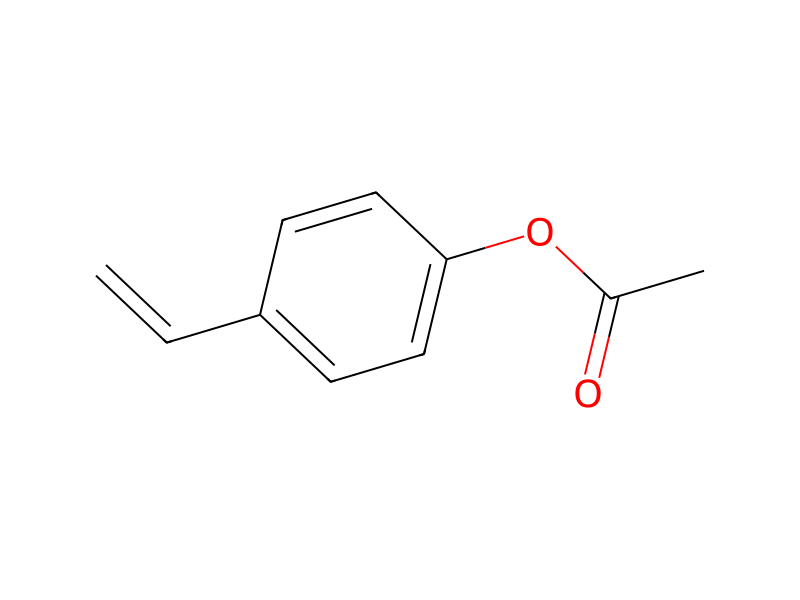
4-Ethenylphenyl acetate
Daten werden ergänzt – lade die Seite später neu, um den aktuellen Stand zu sehen
Grundinformationen
- CAS
2628-16-2- Standard-SMILES
C=Cc1ccc(OC(C)=O)cc1- InChIKey
JAMNSIXSLVPNLC-UHFFFAOYSA-N- Summenformel
- C10H10O2
- Durchschnittliche Molmasse
- 162,18 g/mol
- Monoisotopische Masse
- 162,06807956
Namen und Bezeichner
- Bevorzugter Name
- 4-Ethenylphenyl acetate
- IUPAC
- (4-ethenylphenyl) acetate
- Englischer Name
- 4-Acetoxystyrene
- Summenformel
- C10H10O2
- Molmasse
- 162.19
Namen und Synonyme
4-Acetoxystyrene2628-16-24-Ethenylphenol acetate4-Vinylphenyl acetate4-Ethenylphenyl acetatep-AcetoxystyrenePhenol, 4-ethenyl-, acetatePhenol, 4-ethenyl-, 1-acetatep-Vinylphenol acetateDTXSID2044898Phenol, p-vinyl-, acetateC-908
Weitere Namen anzeigen
ACETOXYSTYRENEVPAC(4-Ethenylphenyl) acetatePhenol, 4-ethenyl-,1-acetateACS/ASM
BRN 1862793DTXCID00248987S21904AYNACETIC ACID P-VINYLPHENYL ESTERJ71.623E4-06-00-03777 (Beilstein Handbook Reference)RefChem:522572434-600-2
Datenbank-Bezeichner
- CAS
2628-16-2- PubChem CID
- 75821
- DTXSID
DTXSID2044898- ChEMBL
CHEMBL3186305- UNII
- 7S21904AYN
- EC Number
- 434-600-2、607-905-5
- Nikkaji
- J71.623E
Eigenschaften
Berechnete StruktureigenschaftenWird ergänzt
- XLogP
- 2,5
- Polarare Oberfläche (TPSA)
- 26,3 Ų
- H-Brücken-Donoren
- 0
- H-Brücken-Akzeptoren
- 2
- Frei drehbare Bindungen
- 3
- Schwere Atome
- 12
- Formalladung
- 0
- Komplexität
- 167
Experimentelle und physikochemische Eigenschaften
Physical DescriptionLiquid
Physikochemische Eigenschaften
- Schmelzpunkt
- 7 · 7-8 °C (lit.)
- Siedepunkt
- 260 °C · 260 °C (lit.)
- Dichte
- 1.07 · 1.07
- Brechungsindex
- 1.54 · 1.54
- Flammpunkt
- 87 °C · 87 °C
- storage temp.
- 2 · 2-8°C
- Aggregatzustand
- clear liquid
- Farbe
- Colorless to Light yellow to Light orange
- BRN
- 1862793 · 1862793
- InChI
- InChI=1S/C10H10O2/c1-3-9-4-6-10(7-5-9)12-8(2)11/h3-7H,1H2,2H3
- InChIKey
- JAMNSIXSLVPNLC-UHFFFAOYSA-N
- SMILES
- C1(OC(=O)C)=CC=C(C=C)C=C1
- CAS Datenbank
Sicherheit und Regulatorisches
Sicherheitsangaben dienen nur zur Orientierung und ersetzen weder das Sicherheitsdatenblatt (SDB) des Lieferanten noch geltende Vorschriften oder eine fachliche Bewertung.
GHS-Klassifizierung
GHS Classification
Danger
H302 (100%): Harmful if swallowed [Warning Acute toxicity, oral]
P260, P261, P262, P264, P264+P265, P270, P271, P272, P273, P280, P284, P301+P317, P302+P352, P304+P340, P305+P351+P338, P316, P319, P320, P321, P330, P332+P317, P333+P317, P337+P317, P361+P364, P362+P364, P391, P403+P233, P405, and P501 (click each P-code to see the statement)
Aggregated GHS information provided per 171 reports by companies from 5 notifications to the ECHA C&L Inventory. Each notification may be associated with multiple companies.
Warning
H302 (100%): Harmful if swallowed [Warning Acute toxicity, oral]
Gefahrenhinweise
Regulatory Information
Phenol, 4-ethenyl-, 1-acetate is listed on the EPA's Chemical Data Reporting (CDR) system. Manufacturers and importers of Phenol, 4-ethenyl-, 1-acetate are required to report information about their production and use of this chemical to the EPA under the Toxic Substances Control Act (TSCA). (40 eCFR Part 711)
PMN - indicates a commenced PMN (Pre-Manufacture Notices) substance.
Status: Active Update: 16-02-2021 https://echa.europa.eu/registration-dossier/-/registered-dossier/24914
Phenol, 4-ethenyl-, acetate: Does not have an individual approval but may be used under an appropriate group standard
Hazard Classes and Categories
Acute Tox. 4 (100%)
Acute Tox. 4 (100%)
Sicherheitsdaten
- wgk
- 3
- tsca
- TSCA listed
- ridadr
- 2810
- hs_code
- 2915390090
Chemie und Industrie
Verwendung und Herstellung
U.S. Production2023: 621,129 lb
Industry UsesIntermediate
General Manufacturing Information
Plastics Material and Resin Manufacturing
Phenol, 4-ethenyl-, 1-acetate: ACTIVE
Anwendungen
Beschreibung4-Acetoxystyrene can be used to synthesize Poly(p-hydroxystyrene) as the main component of photoresist. The chemically amplified photoresist of the poly(p-hydroxystyrene) series is currently the mainstream photoresist product in the world, and it is one of the key technologies for processing photo-etched integrated circuits and manufacturing chips.
Verwenden4-Acetoxystyrene is a stable Styrene monomer which can be readily polymerized and copolymerized to low, medium and high molecular weight polymers. Undergoes free radical polymerization, similar to styrene.
Darstellung
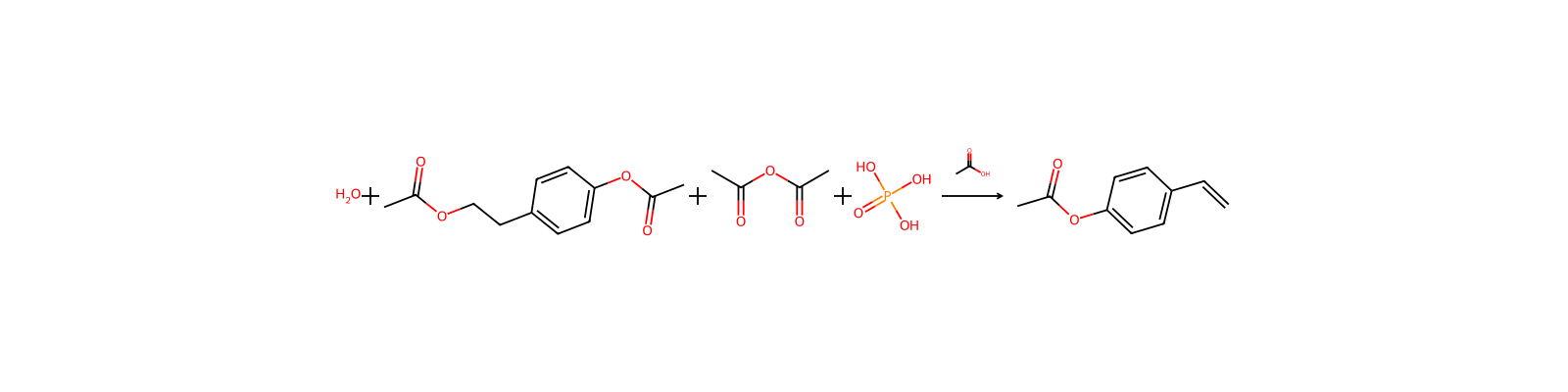
synthetischeThe preparation of 4-Acetoxystyrene is as follows:Add p-hydroxystyrene (120g) to a 2L four-neck bottle. triethylamine(106g), phenothiazine (1.2g), Methyl tert-butyl ether (480 g), Dry ice-ethanol bath to -5 to 0 °C, acetyl chloride (86g) was added dropwise with stirring. The internal temperature is controlled at -5 to 0 °C. After the completion of the dropwise addition, the temperature was raised at 10 to 20 °C to continue the reaction for 1 hour. Sampling analysis (central control 1, raw material After completion of the reaction, the mixture was filtered, and the cake was washed with methyl t-butyl ether (50 g × 3). The filtrate was quenched by the addition of 4 g of methanol, and the reaction was stirred for 10 minutes. After completion, phenothiazine (1.2 g) was added and the reaction mixture was concentrated.Methyl tert-butyl ether (580 g) was recovered to give a crude product (160 g).The crude product was distilled under reduced pressure to give the product, p-acetoxy styrene (142 g), yield 87.7%, and sampled for analysis (main content >99%).
Zugehörige Reaktionen
125


Notizen zur Verbindung
Wird geladen…