
Grundinformationen
- Standard-SMILES
O=[N+]([O-])C=Cc1ccccc1- InChIKey
PIAOLBVUVDXHHL-UHFFFAOYSA-N- Summenformel
- C8H7NO2
- Durchschnittliche Molmasse
- 149,15 g/mol
- Monoisotopische Masse
- 149,04767847
Namen und Bezeichner
- Bevorzugter Name
- Beta-Nitrostyrene
- IUPAC
- 2-nitroethenylbenzene
Namen und Synonyme
DTXSID0025789nitrostyrolStyrene, beta-nitro-DTXCID3028130RefChem:567930203-066-01-nitro-2-phenylethylene1-Phenyl-2-nitroethene102-96-5Benzene, (2-nitroethenyl)-Beta-NitrostyreneNCI-C02211
Weitere Namen anzeigen
(2-nitro-vinyl)-benzene1-(2-nitrovinyl)benzenePIAOLBVUVDXHHL-UHFFFAOYSA-N2-nitrovinylbenzene2-phenylnitroetheneSCHEMBL30591(2-Nitroethen-1-yl)benzeneSCHEMBL4230868
Datenbank-Bezeichner
- CAS
102-96-5- PubChem CID
- 7626
- DTXSID
DTXSID0025789- ChEMBL
CHEMBL3187573- EC Number
- 203-066-0
Eigenschaften
Berechnete Struktureigenschaften
- XLogP
- 2,1
- Polarare Oberfläche (TPSA)
- 45,8 Ų
- H-Brücken-Donoren
- 0
- H-Brücken-Akzeptoren
- 2
- Frei drehbare Bindungen
- 1
- Schwere Atome
- 11
- Formalladung
- 0
- Komplexität
- 154
Experimentelle und physikochemische Eigenschaften
LogPlog Kow = 2.11
Density
1.1552 at 90 °F (NTP, 1992) - Denser than water; will sink
Density: 1.1552 at 90 °F
Color/Form
Yellow prisms (from ethanol or petr ether) /trans-isomer/
Yellow crystalline solid
Solubility
less than 1 mg/mL at 73 °F (NTP, 1992)
In water, <1 mg/mL at 73 °C
Soluble in ethanol, acetone; very soluble in ether, chloroform, carbon disufide /trans-isomer/
Boiling Point
482 to 500 °F at 760 mmHg (NTP, 1992)
255 °C /trans-isomer/
DecompositionWhen heated to decomposition it emits toxic vapors of /oxides of nitrogen/.
Melting Point
136 °F (NTP, 1992)
58 °C
Vapor Pressure0.01 [mmHg]
Physical Description
Beta-nitrostyrene appears as yellow prisms (from ethanol) or yellow crystalline solid. (NTP, 1992)
Yellow crystals; [CAMEO]
Other Experimental PropertiesModerate fire and explosion risk
Sicherheit und Regulatorisches
GHS-Klassifizierung
GHS Classification
Danger
H301 (95%): Toxic if swallowed [Danger Acute toxicity, oral];H315 (100%): Causes skin irritation [Warning Skin corrosion/irritation];H319 (100%): Causes serious eye irritation [Warning Serious eye damage/eye irritation];H335 (100%): May cause respiratory irritation [Warning Specific target organ toxicity, single exposure; Respiratory tract irritation]
P261, P264, P264+P265, P270, P271, P280, P301+P316, P302+P352, P304+P340, P305+P351+P338, P319, P321, P330, P332+P317, P337+P317, P362+P364, P403+P233, P405, and P501 (click each P-code to see the statement)
Aggregated GHS information provided per 40 reports by companies from 3 notifications to the ECHA C&L Inventory. Each notification may be associated with multiple companies.;Information may vary between notifications depending on impurities, additives, and other factors. The percentage value in parenthesis indicates the notified classification ratio from companies that provide hazard codes. Only hazard codes with percentage values above 10% are shown. For more detailed information, please visit ECHA C&L website.
Gefahrenhinweise
Regulatory Information
Chemical: Benzene, (2-nitroethenyl)-
Benzene, (2-nitroethenyl)-: Does not have an individual approval but may be used under an appropriate group standard
Fire HazardsFlash point data for this chemical are not available. It is probably combustible. (NTP, 1992)
Health Hazards
SYMPTOMS: Symptoms of exposure to this compound may include irritation of the skin, eyes, mucous membranes and upper respiratory tract. It can cause lachrymation. Other symptoms may include burning sensation, coughing, wheezing, laryngitis, shortness of breath, headache, nausea and vomiting.;ACUTE/CHRONIC HAZARDS: This compound is harmful if swallowed, inhaled or absorbed through the skin. It is a primary irritant of the skin, eyes, mucous membranes and upper respiratory tract. It is a lachrymator. When heated to decomposition it emits toxic fumes of carbon monoxide, carbon dioxide and nitrogen oxides. (NTP, 1992)
Hazards SummaryA skin, eye, mucous membrane, and respiratory tract irritant; A lachrymator; [CAMEO] An irritant; Harmful if swallowed; [MSDSonline] See NITRATES and NITRITES.
Reactive GroupNitro, Nitroso, Nitrate, and Nitrite Compounds, Organic;Hydrocarbons, Aliphatic Unsaturated
Reactivity ProfileBETA-NITROSTYRENE is incompatible with strong oxidizing agents and strong bases. (NTP, 1992).
Air and Water ReactionsThis chemical may be sensitive to prolonged exposure to air. Insoluble in water.
Hazard Classes and CategoriesAcute Tox. 3 (95%);Skin Irrit. 2 (100%);Eye Irrit. 2A (100%);STOT SE 3 (100%)
Sicherheit und Schutzausrüstung
Fire FightingFires involving this material can be controlled with a dry chemical, carbon dioxide or Halon extinguisher. A water spray may also be used. (NTP, 1992)
First Aid
EYES: First check the victim for contact lenses and remove if present. Flush victim's eyes with water or normal saline solution for 20 to 30 minutes while simultaneously calling a hospital or poison control center. Do not put any ointments, oils, or medication in the victim's eyes without specific instructions from a physician. IMMEDIATELY transport the victim after flushing eyes to a hospital even if no symptoms (such as redness or irritation) develop.;SKIN: IMMEDIATELY flood affected skin with water while removing and isolating all contaminated clothing. Gently wash all affected skin areas thoroughly with soap and water. If symptoms such as redness or irritation develop, IMMEDIATELY call a physician and be prepared to transport the victim to a hospital for treatment.;INHALATION: IMMEDIATELY leave the contaminated area; take deep breaths of fresh air. If symptoms (such as wheezing, coughing, shortness of breath, or burning in the mouth, throat, or chest) develop, call a physician and be prepared to transport the victim to a hospital. Provide proper respiratory protection to rescuers entering an unknown atmosphere. Whenever possible, Self-Contained Breathing Apparatus (SCBA) should be used; if not available, use a level of protection greater than or equal to that advised under Protective Clothing.;INGESTION: DO NOT INDUCE VOMITING. If the victim is conscious and not convulsing, give 1 or 2 glasses of water to dilute the chemical and IMMEDIATELY call a hospital or poison control center. Be prepared to transport the victim to a hospital if advised by a physician. If the victim is convulsing or unconscious, do not give anything by mouth, ensure that the victim's airway is open and lay the victim on his/her side with the head lower than the body. DO NOT INDUCE VOMITING. IMMEDIATELY transport the victim to a hospital. (NTP, 1992)
Nonfire Spill Response
SMALL SPILLS AND LEAKAGE: Should a spill occur while you are handling this chemical, FIRST REMOVE ALL SOURCES OF IGNITION, then you should dampen the solid spill material with 60-70% ethanol and transfer the dampened material to a suitable container. Use absorbent paper dampened with 60-70% ethanol to pick up any remaining material. Seal the absorbent paper, and any of your clothes, which may be contaminated, in a vapor-tight plastic bag for eventual disposal. Solvent wash all contaminated surfaces with 60-70% ethanol followed by washing with a soap and water solution. Do not reenter the contaminated area until the Safety Officer (or other responsible person) has verified that the area has been properly cleaned.;STORAGE PRECAUTIONS: You should keep this material in a tightly closed container under an inert atmosphere, and store it at refrigerated temperatures. Keep it away from oxidizing materials and bases. (NTP, 1992)
Disposal Methods
SRP: The most favorable course of action is to use an alternative chemical product with less inherent propensity for occupational harm/injury/toxicity or environmental contamination. Recycle any unused portion of the material for its approved use or return it to the manufacturer or supplier. Ultimate disposal of the chemical must consider: the material's impact on air quality; potential migration in soil or water; effects on animal and plant life; and conformance with environmental and public health regulations.
Personal Protective Equipment (PPE)
RECOMMENDED RESPIRATOR: When working with this chemical, wear a NIOSH-approved full face chemical cartridge respirator equipped with the appropriate organic vapor and high efficiency particulate filter cartridges. If that is not available, a half face respirator similarly equipped plus airtight goggles can be substituted. However, please note that half face respirators provide a substantially lower level of protection than do full face respirators. (NTP, 1992)
Toxikologische Informationen
Environmental Fate
TERRESTRIAL FATE: Based on a classification scheme(1), an estimated Koc value of 737(SRC), determined from a structure estimation method(2), indicates that beta-nitrostyrene is expected to have low mobility in soil(SRC). Volatilization of beta-nitrostyrene from moist soil surfaces is expected to occur(SRC) given a an estimated Henry's Law constant of 3.48X10⁻⁶ atm-cu m/mole(SRC), using a fragment constant estimation method(2). beta-Nitrostyrene is not expected to volatilize from dry soil surfaces(SRC) based upon an estimated vapor pressure of 0.01 mm Hg at 25 °C(SRC), determined from a fragment constant method(2). Biodegradation data in soil were not available(SRC, 2012).
AQUATIC FATE: Based on a classification scheme(1), an estimated Koc value of 737(SRC), determined from a structure estimation method(2), indicates that beta-nitrostyrene is expected to adsorb to suspended solids and sediment(SRC). Volatilization from water surfaces is expected to occur(3) based upon an estimated Henry's Law constant of 3.48X10⁻⁶ atm-cu m/mole(SRC), developed using a fragment constant estimation method(2). Using this Henry's Law constant and an estimation method(3), volatilization half-lives for a model river and model lake are 13 and 98 days, respectively(SRC). According to a classification scheme(4), an estimated BCF of 11(SRC), from its log Kow of 2.11(5) and regression-derived equation(2), suggests the potential for bioconcentration in aquatic organisms is low. beta-Nitrostyrene is not expected to undergo hydrolysis in the environment due to the lack of functional groups that hydrolyze under environmental conditions(3). Biodegradation data in water were not available(SRC, 2012).
ATMOSPHERIC FATE: According to a model of gas/particle partitioning of semivolatile organic compounds in the atmosphere(1), beta-nitrostyrene, which has an estimated vapor pressure of 0.01 mm Hg at 25 °C(SRC), determined from a fragment constant method(2), is expected to exist solely as a vapor in the ambient atmosphere. Vapor-phase beta-nitrostyrene is degraded in the atmosphere by reaction with photochemically-produced hydroxyl radicals(SRC); the half-life for this reaction in air is estimated to be 26 hours(SRC), calculated from its rate constant of 1.39X10⁻¹¹ cu cm/molecule-sec at 25 °C(SRC) that was derived using a structure estimation method(2). Vapor-phase beta-nitrostyrene is also degraded in the atmosphere by reaction with ozone(SRC); the half-life for this reaction in air is estimated to be 8 days(SRC), calculated from its rate constant of 1.6X10⁻¹⁸ cu cm/molecule-sec at 25 °C(SRC) that was derived using a structure estimation method(2).
Adverse EffectsLacrimator (Lachrymator) - A substance that irritates the eyes and induces the flow of tears.
Ongoing Test Status
The following link will take the user to the National Toxicology Program (NTP) Test Agent Search Results page, which tabulates all of the "Standard Toxicology & Carcinogenesis Studies", "Developmental Studies", and "Genetic Toxicity Studies" performed with this chemical. Clicking on the "Testing Status" link will take the user to the status (i.e., in review, in progress, in preparation, on test, completed, etc.) and results of all the studies that the NTP has done on this chemical.[Available from, as of June 21, 2012: http://ntp-apps.niehs.nih.gov/ntp_tox/index.cfm?fuseaction=ntpsearch.searchresults&searchterm=102-96-5]
Soil Adsorption/Mobility
Using a structure estimation method based on molecular connectivity indices(1), the Koc of beta-nitrostyrene can be estimated to be 737(SRC). According to a classification scheme(2), this estimated Koc value suggests that beta-nitrostyrene is expected to have low mobility in soil.
Human Toxicity Excerpts
/ALTERNATIVE and IN VITRO TESTS/ A series of twenty-three beta-E-nitrostyrenes was synthesized in order to evaluate potential antineoplastic, antitubulin, and antimicrobial activities. The beta-E-nitrostyrenes evaluated ranged from monosubstituted phenols to trimethoxy and 3-methoxy-4,5-methylenedioxy derivatives. Two of the beta-nitrostyrenes were synthesized as water-soluble sodium phosphate derivatives (4t, 4v). All except four (4r, 4s, 4t, 4u) of the series significantly inhibited a minipanel of human cancer cell lines. All but eight led to an IC(50) of <10 microM for inhibition of tubulin polymerization, and all except three (4l, 4t, 4v) displayed antimicrobial activity. /beta-Nitrostyrene derivatives/
/ALTERNATIVE and IN VITRO TESTS/ In this study, a series of beta-nitrostyrenes were synthesized and subjected to anti-platelet aggregation assay and cytotoxicity assay. The mono- and di-substitutions on the B ring of BMNS tended to increase the anti-platelet activity and decrease the cytotoxic activity. Of these, compounds 19 and 24 exhibited the most potent inhibitory effects on thrombin- and collagen-induced platelet aggregation (IC(50) < 0.7 uM) without significant cytotoxicity on a human cancer cell line (up to 20 uM). Further studies indicated that compounds 19 and 24 inhibited platelet aggregation via prevention of glycoprotein IIb/IIIa activation. The potent and novel effects of BMNS derivatives make them attractive candidates for the development of new anti-platelet agents. /beta-Nitrostyrene derivatives/
Artificial Pollution Sources
beta-Nitrostyrene's production and use as an intermediate in production of bromonitrostyrene (which is employed as a slimicide) and its use as a chain transfer agent to lower the molecular weights of polymers in their free radical initiated synthesis(1) may result in its release to the environment through various waste streams(SRC).
Carcinogen Classification
Beta-nitrostyrene
TR-170: Bioassay of a Solution of Ã-Nitrostyrene and Styrene for Possible Carcinogenicity (CASRNs 102-96-5 and 100-42-5) (1979 )
08/31/78
No Evidence
No Evidence
No Evidence
Environmental Bioconcentration
An estimated BCF of 11 was calculated in fish for beta-nitrostyrene(SRC), using a log Kow of 2.11(1) and a regression-derived equation(2). According to a classification scheme(3), this BCF suggests the potential for bioconcentration in aquatic organisms is low(SRC).
Volatilization from Water/Soil
The Henry's Law constant for beta-nitrostyrene is estimated as 3.48X10⁻⁶ atm-cu m/mole(SRC) using a fragment constant estimation method(1). This Henry's Law constant indicates that beta-nitrostyrene is expected to volatilize from water surfaces(2). Based on this Henry's Law constant, the volatilization half-life from a model river (1 m deep, flowing 1 m/sec, wind velocity of 3 m/sec)(2) is estimated as 13 days(SRC). The volatilization half-life from a model lake (1 m deep, flowing 0.05 m/sec, wind velocity of 0.5 m/sec)(2) is estimated as 98 days(SRC). beta-Nitrostyrene's Henry's Law constant indicates that volatilization from moist soil surfaces may occur(SRC). beta-Nitrostyrene is not expected to volatilize from dry soil surfaces(SRC) based upon an estimated vapor pressure of 0.01 mm Hg at 25 °C(SRC), determined from a fragment constant method(1).
Environmental Abiotic Degradation
The rate constant for the vapor-phase reaction of beta-nitrostyrene with photochemically-produced hydroxyl radicals has been estimated as 1.39X10⁻¹¹ cu cm/molecule-sec at 25 °C(SRC) using a structure estimation method(1). This corresponds to an atmospheric half-life of about 26 hours at an atmospheric concentration of 5X10+5 hydroxyl radicals per cu cm(1). The rate constant for the vapor-phase reaction of beta-nitrostyrene with ozone has been estimated as 1.6X10⁻¹⁸ cu cm/molecule-sec at 25 °C(SRC) that was derived using a structure estimation method(1). This corresponds to an atmospheric half-life of about 8 days at an atmospheric concentration of 7X10+11 ozone molecules per cu cm(1). beta-Nitrostyrene is not expected to undergo hydrolysis in the environment due to the lack of functional groups that hydrolyze under environmental conditions(2).
Probable Routes of Human Exposure
Occupational exposure to beta-nitrostyrene may occur through dermal contact with this compound at workplaces where beta-nitrostyrene is produced or used. Monitoring data were not available to indicate how the general population might be exposed to beta-nitrostyrene. (SRC)
Environmental Fate/Exposure Summary
beta-Nitrostyrene's production and use as an intermediate in the production of bromonitrostyrene (which is employed as a slimicide) and its use as a chain transfer agent to lower the molecular weights of polymers in their free radical initiated synthesis may result in its release to the environment through various waste streams. If released to air, an estimated vapor pressure of 0.01 mm Hg at 25 °C indicates beta-nitrostyrene will exist solely as a vapor in the atmosphere. Vapor-phase beta-nitrostyrene will be degraded in the atmosphere by reaction with photochemically-produced hydroxyl radicals; the half-life for this reaction in air is estimated to be 26 hours. Vapor-phase beta-nitrostyrene will also be degraded in the atmosphere by reaction with ozone; the half-life for this reaction in air is estimated to be 8 days. If released to soil, beta-nitrostyrene is expected to have low mobility based upon an estimated Koc value of 737. Volatilization from moist soil surfaces is expected to occur given an estimated Henry's Law constant of 3.48X10⁻⁶ atm-cu m/mole. beta-Nitrostyrene is not expected to volatilize from dry soil surfaces based upon its vapor pressure. No biodegradation data were available. If released into water, beta-nitrostyrene is expected to adsorb to suspended solids and sediment based upon the estimated Koc value. Volatilization from water surfaces is expected to occur slowly based upon this compound's estimated Henry's Law constant. Estimated volatilization half-lives for a model river and model lake are 13 and 98 days, respectively. An estimated BCF of 11 suggests the potential for bioconcentration in aquatic organisms is low. Hydrolysis is not expected to be an important environmental fate process since this compound lacks functional groups that hydrolyze under environmental conditions. Occupational exposure to beta-nitrostyrene may occur through dermal contact with this compound at workplaces where beta-nitrostyrene is produced or used. Monitoring
Regulatorische Informationen
Regulatory Information
Chemical: Benzene, (2-nitroethenyl)-
Benzene, (2-nitroethenyl)-: Does not have an individual approval but may be used under an appropriate group standard
Chemie und Industrie
Pharmakologische Informationen
Metabolism/Metabolites
Enzymatic reduction of aliphatic nitro compounds, beta-nitrostyrene (I), 1-nitro-4-phenylbutadiene (II), 1-nitro-4-phenyl-1-butene (III), 1-nitro-2-phenylethane (IV), and nitrophenylethane (V) was investigated in a xanthine oxidase-hypoxanthine system. I and II were easily reduced by the enzyme system under anaerobic conditions, but III, IV, and V resisted to the enzymatic reduction. The reduction products of I and II were isolated from the reaction mixtures and were identified as dimolecular compounds, 1,4-dinitro-2, 3-diphenylbutane and 1,4-dinitro-2,3-distyrylbutane, respectively, by mass, nuclear magnetic resonance, and infrared spectrometries, and by elementary analyses.
Verwendung und Herstellung
Uses
Used to stop chain in styrene polymerization; [Hawley]
beta-Nitrostyrene is used as a chain stopper in styrene type polymerization reactions for the production of polystyrene plastics, synthetic rubber, and resins. beta-Nitrostyrene also possesses antibacterial, antifungal, and insecticidal activities and has been suggested for use as a repellent for bats and other rodents; however, this compound does not appear to be currently registered for pesticide use with the U.S. Environmental Protection Agency.
/beta-Nitrostyrene/ ... has been used as a chain transfer agent, i.e., to lower the molecular weights of polymers in their free radical initiated synthesis.
Chemical intermedicate in the production of bromonitrostyrene which is employed as a slimicide.
U.S. ProductionProduction volumes for non-confidential chemicals reported under the Inventory Update Rule.[Table#8036]
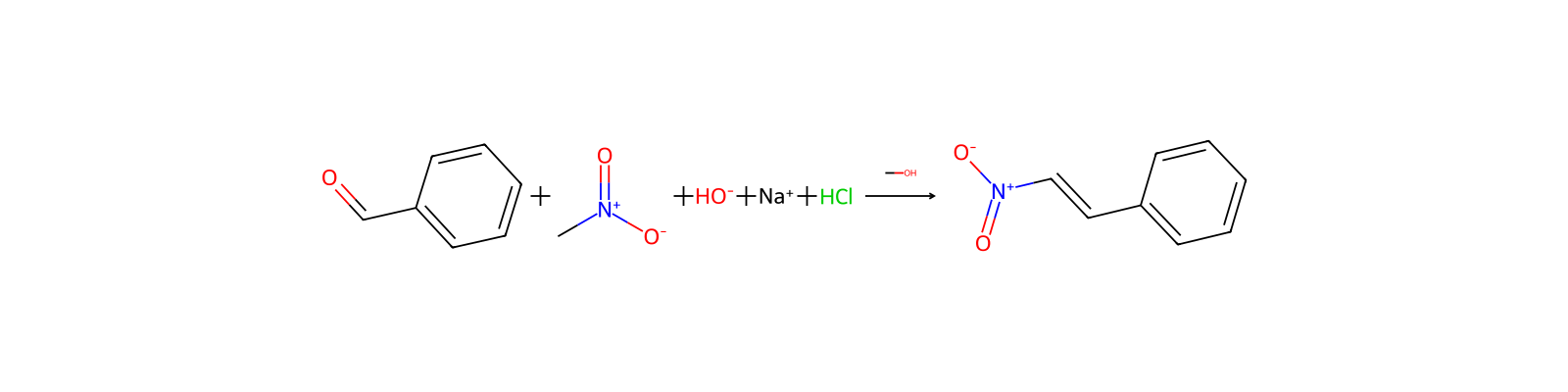
Methods of ManufacturingThe reaction between benzaldehyde and nitromethane does not stop at the corresponding nitroalcohol; instead, dehydration to beta-nitrostyrene ... occurs.
General Manufacturing InformationBenzene, (2-nitroethenyl)-: ACTIVE
Zugehörige Reaktionen
88


Verknüpfte Notizen
Wird geladen…