StartseiteMCPWorkbenchSkills
StartseiteWorkbenchBenachrichtigungenMein Bereich
llms.txt · MCP-AnleitungDatenschutz · Nutzungsbedingungen · Supportv1.8.0
  1. Startseite
  2. /Verbindung

Formanilid

Formanilide
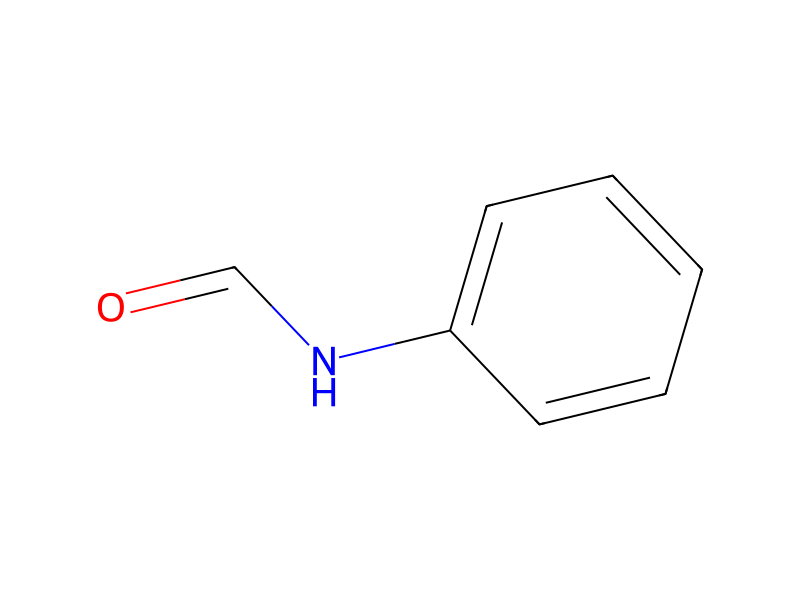
HCID 7671
Neue NotizNeue ReaktionAnfrage stellen
Druckvorschau
GrundinformationenÜberblickNamen und BezeichnerEigenschaftenSicherheit und RegulatorischesChemie und IndustrieZugehörige ReaktionenNotizen zur Verbindung
TeilstruktursucheÄhnliche Strukturen suchen

Grundinformationen

CAS
103-70-8
Standard-SMILES
O=CNc1ccccc1
InChIKey
DYDNPESBYVVLBO-UHFFFAOYSA-N
Summenformel
C7H7NO
Durchschnittliche Molmasse
121,14 g/mol
Monoisotopische Masse
121,05276384

Überblick

Formanilide is a white crystalline solid. (NTP, 1992)

Namen und Bezeichner

Bevorzugter Name
Formanilide
IUPAC
N-phenylformamide
Lokaler Name
Formanilid
Englischer Name
FORMANILIDE
Summenformel
C7H7NO
Molmasse
121.14

Namen und Synonyme

FormanilideN-PHENYLFORMAMIDE103-70-8N-FormylanilinePhenyl formamideFormylanilineCarbanilaldehydeFormamidobenzeneAniline, N-formyl-DTXSID30253382805XEA9CLNSC-8862
Weitere Namen anzeigen
AnilinoformaldehydeNSC 8862NSC 203239FormamilideFORMANILINE
DTXCID205338CHEBI:42416RefChem:830993203-136-0Formamide, N-phenyl-N-phenyl-formamidephenylformamideMFCD00003276

Datenbank-Bezeichner

CAS
103-70-8
PubChem CID
7671
DTXSID
DTXSID3025338
ChEMBL
CHEMBL1232659
ChEBI
CHEBI:42416
UNII
2805XEA9CL
EC Number
203-136-0
Nikkaji
J28.435A

Eigenschaften

Berechnete Struktureigenschaften

XLogP
1,2
Polarare Oberfläche (TPSA)
29,1 Ų
H-Brücken-Donoren
1
H-Brücken-Akzeptoren
1
Frei drehbare Bindungen
1
Schwere Atome
9
Formalladung
0
Komplexität
86,9

Experimentelle und physikochemische Eigenschaften

Chemical ClassesNitrogen Compounds -> Other Aromatics (Nitrogen)
SpringerMaterials Properties15N nuclear magnetic resonance spectrum
LogP · 2 Einträge

log Kow= 1.15

1.2

Density · 2 Einträge

1.144 at 68 °F (NTP, 1992) - Denser than water; will sink

1.186 @ 50 °C

Viscosity1.65 mN/s/m @ 20 °C
Color/FormWhite crystals
Solubility · 3 Einträge

10 to 50 mg/mL at 77 °F (NTP, 1992)

> 10% in benzene; > 10% in ether; > 10% ethanol

In water, 28.6 g/l @ 25 °C; 25.4 g/l @ 20 °C

Flash Pointgreater than 235 °F (NTP, 1992)
Boiling Point · 2 Einträge

520 °F at 760 mmHg (NTP, 1992)

271 °C

Sicherheit und Regulatorisches

Sicherheitsangaben dienen nur zur Orientierung und ersetzen weder das Sicherheitsdatenblatt (SDB) des Lieferanten noch geltende Vorschriften oder eine fachliche Bewertung.

GHS-Klassifizierung

GHS Classification · 5 Einträge

This chemical does not meet GHS hazard criteria for 37.5% (3 of 8) of reports.

Warning

H302 (62.5%): Harmful if swallowed [Warning Acute toxicity, oral]

P264, P270, P301+P317, P330, and P501 (click each P-code to see the statement)

Aggregated GHS information provided per 8 reports by companies from 3 notifications to the ECHA C&L Inventory.

Gefahrenhinweise

Fire HazardsThis chemical is probably combustible. (NTP, 1992)
Health HazardsSYMPTOMS: Exposure to this chemical may cause cyanosis, headache, dizziness, confusion, decreased blood pressure, convulsions and coma. (NTP, 1992)
Hazards SummaryEmergency treatment: Symptomatic drug ingestion; [HSDB] Causes somnolence, muscle weakness, and respiratory stimulation in intravenous lethal-dose studies of dogs; [RTECS] May cause irritation; [Alfa Aesar MSDS] See N-Methylformamide.
Reactive GroupAmides and Imides
Reactivity Profile · 1 Eintrag

FORMANILIDE is an amide. Amides/imides react with azo and diazo compounds to generate toxic gases. Flammable gases are formed by the reaction of organic amides/imides with strong reducing agents. Amides are very weak bases (weaker than water). Imides are less basic yet and in fact react with strong bases to form salts. That is, they can react as acids. Mixing amides with dehydrating agents such as P2O5 or SOCl2 generates the corresponding nitrile. The combustion of these compounds generates mixed oxides of nitrogen (NOx).

Air and Water ReactionsThis chemical may be sensitive to prolonged exposure to air. (NTP, 1992). Soluble in water.

Chemie und Industrie

Pharmakologische Informationen

Metabolism/Metabolites · 2 Einträge

AGMENELLUM QUADRUPLICATUM STRAIN PR-6 & OSCILLATORIA SPECIES STRAIN JCM GROWN PHOTOAUTOTROPHICALLY IN PRESENCE OF ANILINE METABOLIZED ANILINE TO FORMANILIDE.

JERINA, DM, DALY, JW & WITKOP, B; BIOCHEMISTRY 10, (l971) YIELDS N-(P-HYDROXYPHENYL)FORMAMIDE IN LIVER: /FROM TABLE/

Verwendung und Herstellung

Uses · 4 Einträge

Used for chemical synthesis and formerly as a local anesthetic, analgesic, and antipyretic; [HSDB]

Feedstock for chemical synthesis

Analgesic and antipyretic

MEDICATION

Methods of ManufacturingReview on methods of preparation: de Jonge et al, Rec Trav Chim 75, 5 (1956).
General Manufacturing InformationFormamide, N-phenyl-: ACTIVE
Anwendungen · 1 Eintrag

VerwendenFormanilide was used to study the zero electron kinetic energy(ZEKE) spectra of cis- and trans-formanilide. It was used to investigate the gas-phase structures of the two isomers of the trans-formanilide-water complex by two-colour (1+1′) resonance enhanced multiphoton ionisation (REMPI) and ZEKE spectroscopy.

Vor- und nachgelagerte Produkte

Nachgelagerte Produkte

α,α,α-Trifluor-p-toluidinphthalogen auxiliary agent BSMphthalogen auxiliary BSK

Zugehörige Reaktionen

75
Reaktionsaufzeichnung erstellen
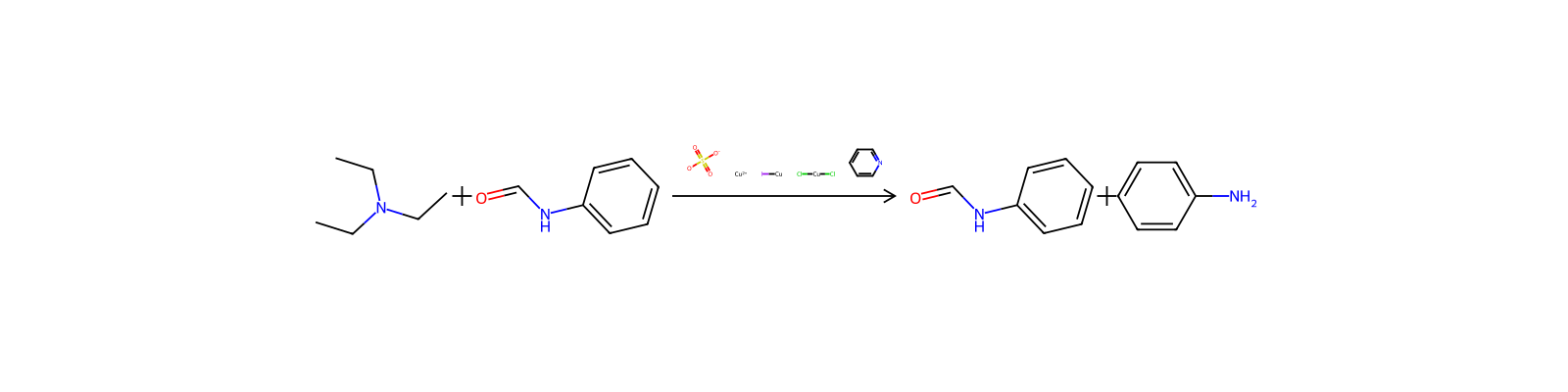
Reaktionsgleichung von HRID 7263
HRID 7263als Eduktuspto-grants-2006_08
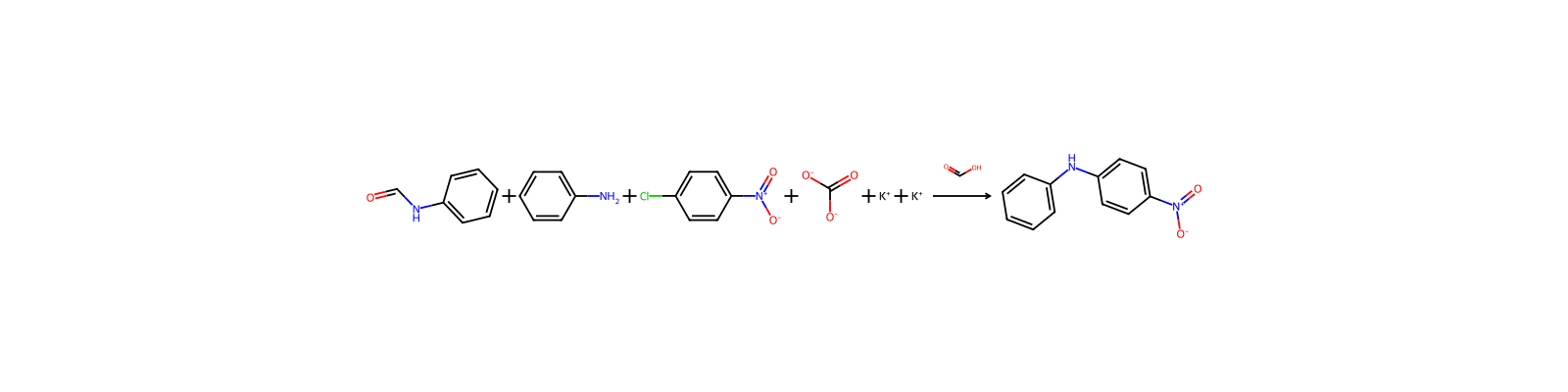
Reaktionsgleichung von HRID 27670
HRID 27670als Produktals Eduktuspto-grants-1980_09
Reaktionsgleichung von HRID 65489
HRID 65489als Eduktuspto-grants-1986_09
Reaktionsgleichung von HRID 127815
HRID 127815als Eduktuspto-grants-1981_03
Reaktionsgleichung von HRID 170542
HRID 170542als Produktals EduktTraining data from https://doi.org/10.1039/C8SC04228D (9/10)
Reaktionsgleichung von HRID 176853
HRID 176853als EduktTraining data from https://doi.org/10.1039/C8SC04228D (6/10)
Reaktionsgleichung von HRID 189308
HRID 189308als EduktTraining data from https://doi.org/10.1039/C8SC04228D (6/10)
Reaktionsgleichung von HRID 224914
HRID 224914als Eduktuspto-grants-1980_11
Seite 1 von 10

Notizen zur Verbindung

Wird geladen…

Auf dieser SeiteGrundinformationenÜberblickNamen und BezeichnerEigenschaftenSicherheit und RegulatorischesChemie und IndustrieZugehörige ReaktionenNotizen zur Verbindung
Weitere Aktionen
Neue NotizNeue ReaktionAnfrage stellen
Decomposition
When heated to decomposition it emits toxic fumes of /nitrogen oxides/.
Melting Point · 2 Einträge

115.9 to 117.5 °F (NTP, 1992)

46.6-47.5 °C

Vapor Pressure · 2 Einträge

0.00357 [mmHg]

3.57X10⁻³ mm Hg @ 25 °C

Physikochemische Eigenschaften

Schmelzpunkt
46 · 46-48 °C(lit.)
Siedepunkt
166 °C14 · 166 °C14 mm Hg(lit.)
Dichte
1.144 g/mL · 1.144 g/mL at 25 °C(lit.)
Brechungsindex
1.5908 · 1.5908 (estimate)
Flammpunkt
230 °F · >230 °F
storage temp.
2 · Sealed in dry,2-8°C
Löslichkeit
25.4 g/L · water: soluble25.4g/L at 20°C
Aggregatzustand
Crystals
pka
15 · 15.00±0.70(Predicted)
Wichte
1.144 · 1.144
Farbe
White to pale grayish-beige
Wasserlöslichkeit
25.4 g/L · water: soluble 25.4g/L at20°Cwater: soluble 28.6g/L at25°C
Merck
14 · 14,4238
BRN
906934 · 906934
Henry's Law Constant
1.2 · 1.2×103 mol/(m3Pa) at 25℃, HSDB (2015)
Stabilität
Stable. Combustible. Incompatible with strong oxidizing agents.
InChI
1S/C7H7NO/c9-6-8-7-4-2-1-3-5-7/h1-6H,(H,8,9)
InChIKey
DYDNPESBYVVLBO-UHFFFAOYSA-N
SMILES
O=CNc1ccccc1
CAS Datenbank
103 · 103-70-8(CAS DataBase Reference)
EPA chemische Informationen
Formanilide (103-70-8)
Toxic Combustion ProductsWhen heated to decomposition it emits toxic fumes of /nitrogen oxides/.
Hazard Classes and CategoriesAcute Tox. 4 (62.5%)

Sicherheit und Schutzausrüstung

Fire FightingFires involving this chemical can be controlled with a dry chemical, carbon dioxide, foam or Halon extinguisher. (NTP, 1992)
First Aid · 1 Eintrag

EYES: First check the victim for contact lenses and remove if present. Flush victim's eyes with water or normal saline solution for 20 to 30 minutes while simultaneously calling a hospital or poison control center. Do not put any ointments, oils, or medication in the victim's eyes without specific instructions from a physician. IMMEDIATELY transport the victim after flushing eyes to a hospital even if no symptoms (such as redness or irritation) develop.

Nonfire Spill Response · 1 Eintrag

SMALL SPILLS AND LEAKAGE: If you should spill this chemical, use absorbent paper to pick up all liquid spill material. Seal the absorbent paper, as well as any of your clothing which may be contaminated, in a vapor-tight plastic bag for eventual disposal. Wash any surfaces you may have contaminated with a strong soap and water solution. Do not reenter the contaminated area until the Safety Officer (or other responsible person) has verified that the area has been properly cleaned.

Disposal Methods · 1 Eintrag

SRP: At the time of review, criteria for land treatment or burial (sanitary landfill) disposal practices are subject to significant revision. Prior to implementing land disposal of waste residue (including waste sludge), consult with environmental regulatory agencies for guidance on acceptable disposal practices.

Personal Protective Equipment (PPE) · 1 Eintrag

RECOMMENDED RESPIRATOR: Where the neat test chemical is weighed and diluted, wear a NIOSH-approved half face respirator equipped with an organic vapor/acid gas cartridge (specific for organic vapors, HCl, acid gas and SO2) with a dust/mist filter. (NTP, 1992)

Toxikologische Informationen

Environmental Fate · 3 Einträge

TERRESTRIAL FATE: Based on a classification scheme(1), an estimated Koc value of 100(SRC), determined from an measured log Kow of 1.15(2) and a regression-derived equation(3), indicates that N- phenylformamide is expected to have high mobility in soil(SRC). Volatilization of N-phenylformamide from moist soil surfaces is not expected to be an important fate process(SRC) given an estimated Henry's Law constant of 8.45X10⁻⁹ atm-cu m/mole(SRC), using a fragment constant estimation method(4). N-Phenylformamide is not expected to volatilize from dry soil surfaces(SRC) based upon a vapor pressure of 3.57X10⁻³ mm Hg(5). N-Phenylformamide, present at 20 mg/l in water, eliminated 100% of dissolved organic carbon in 4 weeks using the modified OECD screening test(6). Therefore, this compound may biodegrade in soil(SRC).

AQUATIC FATE: Based on a classification scheme(1), an estimated Koc value of 100(SRC), determined from a log Kow of 1.15(2) and a regression-derived equation(3), indicates that N-phenylformamide is not expected to adsorb to suspended solids and sediment(SRC). Volatilization from water surfaces is not expected(3) based upon an estimated Henry's Law constant of 8.45X10⁻⁹ atm-cu m/mole(SRC), developed using a fragment constant estimation method(4). According to a classification scheme(5), an estimated BCF of 2(SRC), from its log Kow(2) and a regression-derived equation(6), suggests the potential for bioconcentration in aquatic organisms is low(SRC). N-Phenylformamide is expected to undergo slow chemical hydrolysis(7). The hydrolysis half-life in water at 55 °C and pH 5-9 has been estimated to be on the order of 29-146 days(7). N-Phenylformamide, present at 20 mg/l, eliminated 100% of dissolved organic carbon in 4 weeks using the modified OECD screening test(8). Therefore, this compound is expected to biodegrade in the environment(SRC).

ATMOSPHERIC FATE: According to a model of gas/particle partitioning of semivolatile organic compounds in the atmosphere(1), N-phenylformamide, which has a vapor pressure of 3.57X10⁻³ mm Hg at 25 °C(2), is expected to exist solely as a vapor in the ambient atmosphere(SRC). Vapor-phase N-phenylformamide is degraded in the atmosphere by reaction with photochemically-produced hydroxyl radicals(SRC); the half-life for this reaction in air is estimated to be 9 hours(SRC), calculated from its rate constant of 43X10-12 cu cm/molecule-sec at 25 °C(SRC) determined using a structure estimation method(3).

Effluent ConcentrationsN-Phenylformamide has been detected, but not quantified, in US wastewater treatment effluent(1).
Soil Adsorption/Mobility · 1 Eintrag

The Koc of N-phenylformamide is estimated as 100(SRC), using a log Kow of 1.15(1) and a regression-derived equation(2). According to a classification scheme(3), this estimated Koc value suggests that N-phenylformamide is expected to have high mobility in soil(SRC).

Artificial Pollution Sources · 1 Eintrag

N-Phenylformamide's production and use as a feedstock for chemical synthesis(1) may result in its release to the environment through various waste streams(SRC). N-Phenylformamide's production and former use as an analgesic and antipyretic(2) may have resulted in its release to the environment through various waste streams(SRC). N-Phenylformamide has been detected, but not quantified, in US wastewater treatment effluent(3).

Environmental BiodegradationAEROBIC: In a modified OECD screening test with N-phenylformamide, present at 20 mg/l, 100% of dissolved organic carbon was removed in 4 weeks(1). Therefore, this compound is expected to biodegrade in the environment(SRC).
Environmental Bioconcentration · 1 Eintrag

An estimated BCF of 2 was calculated for N-phenylformamide(SRC), using a log Kow of 1.15(1) and a regression-derived equation(2). According to a classification scheme(3), this BCF suggests the potential for bioconcentration in aquatic organisms is low(SRC).

Volatilization from Water/Soil · 1 Eintrag

The Henry's Law constant for N-phenylformamide is estimated as 8.45X10⁻⁹ atm-cu m/mole(SRC) using a fragment constant estimation method(1). This Henry's Law constant indicates that N-phenylformamide is expected to be essentially nonvolatile from water surfaces(2). N-Phenylformamide is not expected to volatilize from dry soil surfaces(SRC) based upon a vapor pressure of 3.57X10⁻³ mm Hg(3).

Non-Human Toxicity ExcerptsPoison by ingestion & intravenous routes.
Environmental Abiotic Degradation · 1 Eintrag

The rate constant for the vapor-phase reaction of N- phenylformamide with photochemically-produced hydroxyl radicals has been estimated as 43X10-12 cu cm/molecule-sec at 25 °C(SRC) using a structure estimation method(1). This corresponds to an atmospheric half-life of about 9 hours at an atmospheric concentration of 5X10+5 hydroxyl radicals per cu cm(1). N-Phenylformamide is expected to undergo slow chemical hydrolysis(2). The hydrolysis half-life in water at 55 °C and pH 5-9 has been estimated to be on the order of 29-146 days(2).

Probable Routes of Human ExposureOccupational exposure to N-phenylformamide may have occurred through inhalation and dermal contact with this compound at workplaces where N- phenylformamide was produced or used. (SRC)
Environmental Fate/Exposure Summary · 1 Eintrag

N-Phenylformamide's production and use as a feedstock for chemical synthesis may result in its release to the environment through various waste streams. N-Phenylformamide's production and former use as an analgesic and antipyretic may have resulted in its release to the environment through various waste streams. If released to air, a vapor pressure of 3.57X10⁻³ mm Hg at 25 °C indicates N-phenylformamide will exist solely as a vapor in the ambient atmosphere. Vapor-phase N-phenylformamide will be degraded in the atmosphere by reaction with photochemically-produced hydroxyl radicals; the half-life for this reaction in air is estimated to be 9 hours. If released to soil, N-phenylformamide is expected to have high mobility based upon an estimated Koc of 100. Volatilization from moist soil surfaces is not expected to be an important fate process based upon an estimated Henry's Law constant of 8.45X10⁻⁹ atm-cu m/mole. If released into water, N-phenylformamide is not expected to adsorb to suspended solids and sediment based upon the estimated Koc. N-Phenylformamide, present at 20 mg/l in water, eliminated 100% of dissolved organic carbon in 4 weeks using the modified OECD screening test. Therefore, this compound may be expected to biodegrade in the environment. Volatilization from water surfaces is not expected to be an important fate process based upon this compound's estimated Henry's Law constant. An estimated BCF of 2 suggests the potential for bioconcentration in aquatic organisms is low. N-Phenylformamide is expected to undergo slow chemical hydrolysis; its hydrolysis half-life in water ranges from 29-146 days. Occupational exposure to N-phenylformamide may have occurred through inhalation and dermal contact with this compound at workplaces where N-phenylformamide was produced or used. (SRC)

Sicherheitsdaten

F
8
wgk
2
tsca
TSCA listed
hs_code
29242990
RTECS-Nr.
BY1780000
risk_code
22
safety_code
22-24/25
Speicherklasse
11 - Combustible Solids
Giftige Stoffe Daten
103-70-8(Hazardous Substances Data)
4-Amino-diphenylamin
N-Methylformanilid
(2,4-Dichlorphenyl)imidocarbonyldichlorid
4-Methoxy-N-phenyl-o-toluidin
N-(Dichlormethylen)anilin
N-Boc aniline
Ethyl-N-phenylformimidat
N-Phenyl-m-anisidin
4-Hydroxy-2,6-dimethoxybenzaldehyde
Chinazolin
Benzenesulfonyl chloride, 4-(formylamino)-

Ergänzende Hinweise

DefinitionChEBI: A member of the class of formamides that is formamide in which one of the amino hydrogens is replaced by a phenyl group.