
2-Amino-5-chlorbenzonitril
2-Amino-5-chlorobenzonitrile
Daten werden ergänzt – lade die Seite später neu, um den aktuellen Stand zu sehen
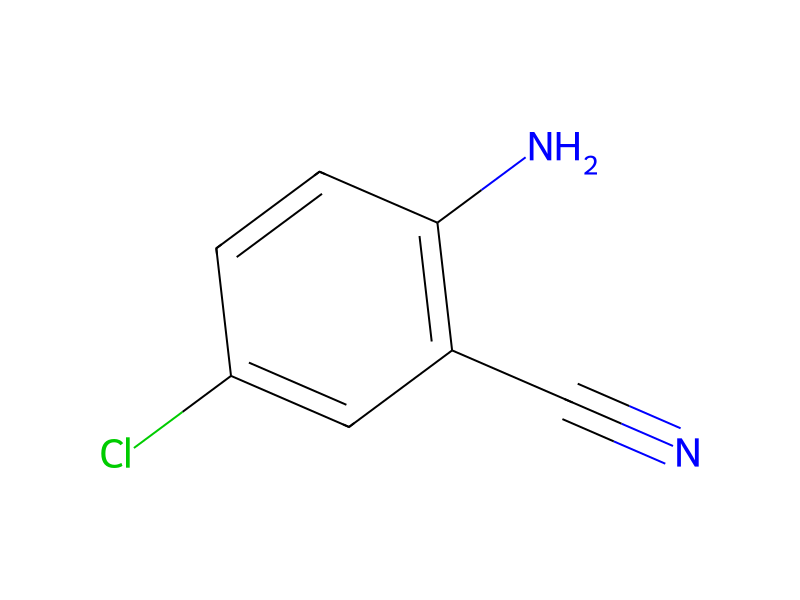
Grundinformationen
- CAS
5922-60-1- Standard-SMILES
N#Cc1cc(Cl)ccc1N- InChIKey
QYRDWARBHMCOAG-UHFFFAOYSA-N- Summenformel
- C7H5ClN2
- Durchschnittliche Molmasse
- 152,58 g/mol
- Monoisotopische Masse
- 152,01412584
Überblick
structure in first source
Namen und Bezeichner
- Bevorzugter Name
- 2-Amino-5-chlorobenzonitrile
- IUPAC
- 2-amino-5-chlorobenzonitrile
- Lokaler Name
- 2-Amino-5-chlorbenzonitril
- Englischer Name
- 2-Amino-5-chlorobenzonitrile
- Summenformel
- C7H5ClN2
- Molmasse
- 152.58
Namen und Synonyme
2-Amino-5-chlorobenzonitrile5922-60-1Benzonitrile, 2-amino-5-chloro-GY0X0082QBDTXSID4022234RefChem:464565DTXCID102234227-651-55-ChloroanthranilonitrileAnthranilonitrile, 5-chloro-2-Amino-5-chloro-benzonitrileMFCD00017106
Weitere Namen anzeigen
ACBNTIMTEC-BB SBB0040505-Chloro-2-aminobenzonitrile2-amino-5-chloro-benzonitrilAMINO(2-) 5-CHLORO-BENZONITRILE1-CYANO-2-AMINO-5-CHLOROBENZENE
4-Chloro-2-cyanoaniline2-Cyano-4-chloroanilineEINECS 227-651-52-amino-5-chlorobenzenecarbonitrile6-Amino-3-chlorobenzonitrile2-Amino-5-chlorobenzonitrile, 98%GEO-00097STK802208
Datenbank-Bezeichner
- CAS
5922-60-1- PubChem CID
- 80019
- DTXSID
DTXSID4022234- UNII
- GY0X0082QB
- EC Number
- 227-651-5
- Nikkaji
- J223.886A
Eigenschaften
Berechnete StruktureigenschaftenWird ergänzt
- XLogP
- 2,6
- Polarare Oberfläche (TPSA)
- 49,8 Ų
- H-Brücken-Donoren
- 1
- H-Brücken-Akzeptoren
- 2
- Frei drehbare Bindungen
- 0
- Schwere Atome
- 10
- Formalladung
- 0
- Komplexität
- 160
Physikochemische Eigenschaften
- Schmelzpunkt
- 96 · 96-99 °C (lit.)
- Siedepunkt
- 132 · 132-135 °C/0.5 mmHg (lit.)
- Dichte
- 1.2763 · 1.2763 (rough estimate)
- Brechungsindex
- 1.55 · 1.5500 (estimate)
- Flammpunkt
- 230 °F · >230 °F
- storage temp.
- Keep in dark place,Inert atmosphere,Room temperature
- Löslichkeit
- Chloroform (Slightly), DMSO (Slightly)
- pka
- 1.18 · 1.18±0.10(Predicted)
- Aggregatzustand
- Crystalline Needles
- Farbe
- White to light beige
- InChI
- 1S/C7H5ClN2/c8-6-1-2-7(10)5(3-6)4-9/h1-3H,10H2
- InChIKey
- QYRDWARBHMCOAG-UHFFFAOYSA-N
- SMILES
- Nc1ccc(Cl)cc1C#N
- CAS Datenbank
- 5922 · 5922-60-1(CAS DataBase Reference)
- EPA chemische Informationen
- 2 · Benzonitrile, 2-amino-5-chloro- (5922-60-1)
Sicherheit und Regulatorisches
Sicherheitsangaben dienen nur zur Orientierung und ersetzen weder das Sicherheitsdatenblatt (SDB) des Lieferanten noch geltende Vorschriften oder eine fachliche Bewertung.
GHS-Klassifizierung
GHS Classification
Danger
H301 (14%): Toxic if swallowed [Danger Acute toxicity, oral]
P261, P262, P264, P264+P265, P270, P271, P280, P301+P316, P301+P317, P302+P352, P304+P340, P305+P351+P338, P316, P317, P319, P321, P330, P332+P317, P337+P317, P361+P364, P362+P364, P403+P233, P405, and P501 (click each P-code to see the statement)
Aggregated GHS information provided per 50 reports by companies from 9 notifications to the ECHA C&L Inventory. Each notification may be associated with multiple companies.
Gefahrenhinweise
Hazard Classes and CategoriesAcute Tox. 3 (14%)
Sicherheitsdaten
- wgk
- 3
- tsca
- TSCA listed
- ridadr
- 3276
- hs_code
- 2926909090
- risk_code
- 20/21/22-36/37/38
- hazard_code
- Xn,Xi
- hazard_note
- Irritant
- safety_code
- 26-36-36/37/39
- hazard_class
- 6.1
- packing_group
- III
- Speicherklasse
- 11 - Combustible Solids
- Hazard Classifications
- Acute Tox. 4 DermalAcute Tox. 4 InhalationAcute Tox. 4 OralAquatic Chronic 3Eye Irrit. 2Skin Irrit. 2STOT SE 3
Chemie und Industrie
Verwendung und Herstellung
General Manufacturing InformationBenzonitrile, 2-amino-5-chloro-: ACTIVE
Anwendungen
Verwenden2-Amino-5-chlorobenzonitrile was used to build up the 2,2-dioxide-1H-2,1,3-benzothiadiazine ring system.
Darstellung
synthetischeSynthesis of 2-amino-5-chlorobenzonitrile is reported in the literature by two methods. The first method involves synthesis from 2-aminobenzonitrile, N-chlorosuccinimide an d acetonitrile. The second method involves synthesis from 5-chloroisatin-β-oxime and bis(2-ethylhexyl)phthalate. Both the methods are not feasible commercially as far as the cost and availability of raw materials are concerned.
Vor- und nachgelagerte Produkte
Vorgelagerte Rohstoffe
Nachgelagerte Produkte
Zugehörige Reaktionen
48


Notizen zur Verbindung
Wird geladen…