
2-Ethylamino-ethanol
2-(Ethylamino)ethanol
Daten werden ergänzt – lade die Seite später neu, um den aktuellen Stand zu sehen
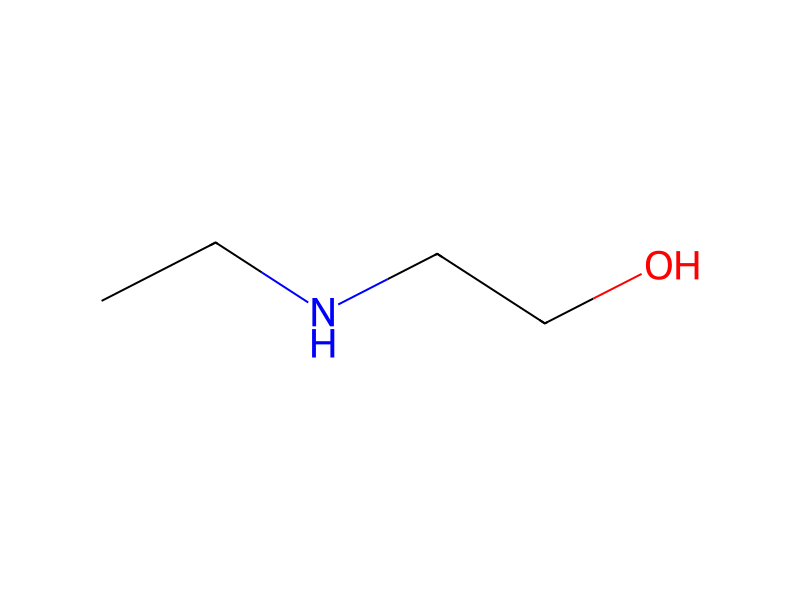
Grundinformationen
- CAS
110-73-6- Standard-SMILES
CCNCCO- InChIKey
MIJDSYMOBYNHOT-UHFFFAOYSA-N- Summenformel
- C4H11NO
- Durchschnittliche Molmasse
- 89,14 g/mol
- Monoisotopische Masse
- 89,08406397
Überblick
Ethylaminoethanol, [combustible liquid label] appears as a colorless liquid with an amine-like odor. Slightly less dense than water. May mildly irritate skin and eyes. At high temperature may decompose to yield toxic oxides of nitrogen.
Namen und Bezeichner
- Bevorzugter Name
- 2-(Ethylamino)ethanol
- IUPAC
- 2-(ethylamino)ethanol
- Lokaler Name
- 2-Ethylamino-ethanol
- Englischer Name
- 2-(Ethylamino)ethanol
- Summenformel
- C4H11NO
- Molmasse
- 89.14
Namen und Synonyme
2-(ETHYLAMINO)ETHANOL110-73-62-EthylaminoethanolEthanol, 2-(ethylamino)-Ethyl ethanolamineN-Ethylmonoethanolamine(2-Hydroxyethyl)ethylamineN-EthylaminoethanolN-Ethyl-2-aminoethanolDTXSID90219221G0G2TK41HEXTENDEX 40
Weitere Namen anzeigen
EMEAEthylaminoethanolMonoethylaminoethanol2-ETHYLETHANOLAMINEMonoethylethanolamin
DTXCID3019222-(MONOETHYLAMINO)ETHANOLRefChem:829983203-797-52-(Ethylamino)Ethan-1-Ol2-(Ethylamino)etanolN-Ethylethanolamine2-N-Monoethylaminoethanol
Datenbank-Bezeichner
- CAS
110-73-6- PubChem CID
- 8072
- DTXSID
DTXSID9021922- ChEMBL
CHEMBL3188262- UNII
- 1G0G2TK41H
- EC Number
- 203-797-5
- Nikkaji
- J2.881I
Eigenschaften
Berechnete StruktureigenschaftenWird ergänzt
- XLogP
- -0,5
- Polarare Oberfläche (TPSA)
- 32,3 Ų
- H-Brücken-Donoren
- 2
- H-Brücken-Akzeptoren
- 2
- Frei drehbare Bindungen
- 3
- Schwere Atome
- 6
- Formalladung
- 0
- Komplexität
- 23,5
Experimentelle und physikochemische Eigenschaften
Chemical Classes
Nitrogen Compounds -> Ethanolamines
Corrosives
SpringerMaterials PropertiesOptical coefficient
Flash Point160 °F (NFPA, 2010)
Physical Description
Ethylaminoethanol, [combustible liquid label] appears as a colorless liquid with an amine-like odor. Slightly less dense than water. May mildly irritate skin and eyes. At high temperature may decompose to yield toxic oxides of nitrogen.
Liquid
Colorless liquid with an odor like amines; [CAMEO]
Physikochemische Eigenschaften
- Schmelzpunkt
- 90 °C · −90 °C(lit.)
- Siedepunkt
- 169 · 169-170 °C(lit.)
- Dichte
- 0.914 g/mL · 0.914 g/mL at 25 °C(lit.)
- Dampfdichte
- 3 · 3 (vs air)
- Dampfdruck
- 1 mm · <1 mm Hg ( 20 °C)
Sicherheit und Regulatorisches
Sicherheitsangaben dienen nur zur Orientierung und ersetzen weder das Sicherheitsdatenblatt (SDB) des Lieferanten noch geltende Vorschriften oder eine fachliche Bewertung.
GHS-Klassifizierung
GHS Classification
Danger
H302 (99.5%): Harmful if swallowed [Warning Acute toxicity, oral]
P260, P262, P264, P264+P265, P270, P280, P301+P317, P301+P330+P331, P302+P352, P302+P361+P354, P304+P340, P305+P354+P338, P316, P317, P321, P330, P361+P364, P363, P405, and P501 (click each P-code to see the statement)
Aggregated GHS information provided per 187 reports by companies from 12 notifications to the ECHA C&L Inventory. Each notification may be associated with multiple companies.
Gefahrenhinweise
Regulatory Information
Chemical: Ethanol, 2-(ethylamino)-
Ethanol, 2-(ethylamino)- is listed on the EPA's Chemical Data Reporting (CDR) system. Manufacturers and importers of Ethanol, 2-(ethylamino)- are required to report information about their production and use of this chemical to the EPA under the Toxic Substances Control Act (TSCA). (40 eCFR Part 711)
Status: Active Update: 11-09-2014 https://echa.europa.eu/registration-dossier/-/registered-dossier/5533
2-(Ethylamino) ethanol: Does not have an individual approval but may be used under an appropriate group standard
The New Jersey Worker and Community Right to Know Act requires public and private employers to provide information about hazardous substances at their workplaces. (N.J.S.A. 34:5A-1 et. seq.)
Other Safety InformationEvaluation - Chemicals that are unlikely to require further regulation to manage risks to environment
DOT LabelCombustible Liquid
Fire HazardsExcerpt from ERG Guide 128 [Flammable Liquids (Water-Immiscible)]:
Health HazardsExcerpt from ERG Guide 128 [Flammable Liquids (Water-Immiscible)]:
Chemie und Industrie
Verwendung und Herstellung
UsesPermitted for use as an inert ingredient in non-food pesticide products; [EPA]
U.S. Production2023: 550,000 - <1,000,000 lb
Industry UsesIntermediate
General Manufacturing Information
All Other Basic Organic Chemical Manufacturing
Ethanol, 2-(ethylamino)-: ACTIVE
Anwendungen
Verwenden2-(Ethylamino)ethanol is an efficient compound used for inhibiting corrosion. This high activity of the inhibitor may be interpreted both by its ability to stabilize the hydroxide surface film and by its adsorption onto bare sites of the metal.
Vor- und nachgelagerte Produkte
Nachgelagerte Produkte
Zugehörige Reaktionen
251


Notizen zur Verbindung
Wird geladen…