
Grundinformationen
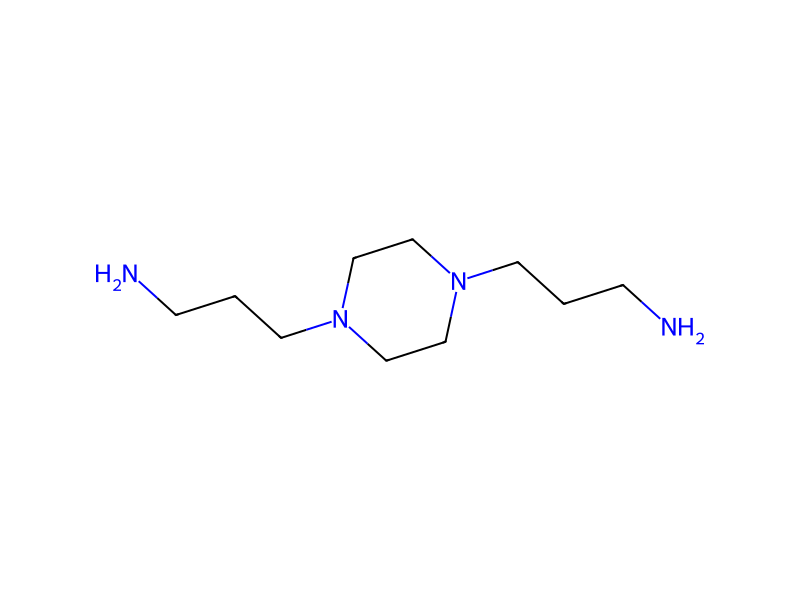
- Standard-SMILES
NCCCN1CCN(CCCN)CC1- InChIKey
XUSNPFGLKGCWGN-UHFFFAOYSA-N- Summenformel
- C10H24N4
- Durchschnittliche Molmasse
- 200,32 g/mol
- Monoisotopische Masse
- 200,20009678
Namen und Bezeichner
- Bevorzugter Name
- 1,4-Bis(3-aminopropyl)piperazine
- IUPAC
- 3-[4-(3-aminopropyl)piperazin-1-yl]propan-1-amine
- Lokaler Name
- N,N'-Bis(3-aminopropyl)piperazin
- Englischer Name
- 1,4-Bis(3-aminopropyl)piperazine
- Summenformel
- C10H24N4
- Molmasse
- 200.32
Namen und Synonyme
1,4-Bis(3-aminopropyl)piperazineRefChem:4170327209-38-31,4-Piperazinedipropanamine3,3'-(Piperazine-1,4-diyl)bis(propan-1-amine)Bis(aminopropyl)piperazineN,N'-Bis(3-aminopropyl)piperazine3-[4-(3-aminopropyl)piperazin-1-yl]propan-1-amineMFCD00006161CCRIS 8915EINECS 230-589-1UNII-7GVX6C734B
Weitere Namen anzeigen
BAPPRZLABOTEST-BB LT00454560BIS AMINOPROPYL PIPIRAZINE1,4-PIPERAZINEBIS(PROPYLAMINE)1,4-(BIS AMINOPROPYL) PIPERAZINE
7GVX6C734BDTXSID8022246Piperazine, 1,4-bis(3-aminopropyl)-N,N'-Bis(p-aminopropyl)piperazine1,4-Bis(3-aminoprop-1-yl)piperazine1 pound not4-Bis(3-aminopropyl)piperazine1,4-Di(3-aminopropyl)piperazineBAPP
Datenbank-Bezeichner
- CAS
7209-38-3- PubChem CID
- 81629
- DTXSID
DTXSID8022246- ChEMBL
CHEMBL41307- UNII
- 7GVX6C734B
- EC Number
- 230-589-1
- Nikkaji
- J2.148.520I、J35.447C
Eigenschaften
Berechnete Struktureigenschaften
- XLogP
- -1,4
- Polarare Oberfläche (TPSA)
- 58,5 Ų
- H-Brücken-Donoren
- 2
- H-Brücken-Akzeptoren
- 4
- Frei drehbare Bindungen
- 6
- Schwere Atome
- 14
- Formalladung
- 0
- Komplexität
- 116
Experimentelle und physikochemische Eigenschaften
Physical DescriptionLiquid
Collision Cross Section150.3 Ų [M+H]+ [CCS Type: DT; Buffer gas: N2; Ionization: APCI+; Dataset: TOXCAST; Source Identifier: DTXSID8022246];150.2 Ų [M+H]+ [CCS Type: DT; Buffer gas: N2; Ionization: ESI+; Dataset: TOXCAST; Source Identifier: DTXSID8022246]
Physikochemische Eigenschaften
- Schmelzpunkt
- 15 °C · 15 °C(lit.)
- Siedepunkt
- 150 · 150-152 °C2 mm Hg(lit.)
- Dichte
- 0.973 g/mL · 0.973 g/mL at 25 °C(lit.)
- Dampfdichte
- 6.9 · 6.9 (vs air)
- Dampfdruck
- 0.133 Pa · 0.133Pa at 25℃
- Brechungsindex
- 20 · n20/D 1.502(lit.)
- Flammpunkt
- 325 °F · 325 °F
- storage temp.
- 2 · 2-8°C, protect from light
- Aggregatzustand
- clear liquid
- pka
- 10.69 · 10.69±0.10(Predicted)
- Farbe
- Colorless to Almost colorless
- PH
- 11.7 at · 11.7 at 20℃ and 1mg/L
- Wasserlöslichkeit
- Fully miscible in water.
- BRN
- 111747 · 111747
- InChI
- 1S/C10H24N4/c11-3-1-5-13-7-9-14(10-8-13)6-2-4-12/h1-12H2
- InChIKey
- XUSNPFGLKGCWGN-UHFFFAOYSA-N
- SMILES
- NCCCN1CCN(CCCN)CC1
- LogP
- -1.43 at · -1.43 at 25℃ and pH12.5
- Oberflächenspannung
- 39.96 mN/m · 39.96mN/m at 1g/L and 20℃
- CAS Datenbank
- 7209 · 7209-38-3(CAS DataBase Reference)
- NIST chemische Informationen
- 1 · 1,4-Bis(3-aminopropyl)piperazine(7209-38-3)
- EPA chemische Informationen
- 1 · 1,4-Piperazinedipropanamine (7209-38-3)
Sicherheit und Regulatorisches
GHS-Klassifizierung
GHS Classification
Danger
H302 (58.3%): Harmful if swallowed [Warning Acute toxicity, oral];H314 (100%): Causes severe skin burns and eye damage [Danger Skin corrosion/irritation];H318 (78.2%): Causes serious eye damage [Danger Serious eye damage/eye irritation];H412 (58.3%): Harmful to aquatic life with long lasting effects [Hazardous to the aquatic environment, long-term hazard]
P260, P264, P264+P265, P270, P273, P280, P301+P317, P301+P330+P331, P302+P361+P354, P304+P340, P305+P354+P338, P316, P317, P321, P330, P363, P405, and P501 (click each P-code to see the statement)
Aggregated GHS information provided per 206 reports by companies from 10 notifications to the ECHA C&L Inventory. Each notification may be associated with multiple companies.;Information may vary between notifications depending on impurities, additives, and other factors. The percentage value in parenthesis indicates the notified classification ratio from companies that provide hazard codes. Only hazard codes with percentage values above 10% are shown. For more detailed information, please visit ECHA C&L website.
Gefahrenhinweise
Regulatory Information
Chemical: 1,4-Piperazinedipropanamine;Specific Information Requirement: Obligations to provide information apply. You must tell us within 28 days if the circumstances of your importation or manufacture (introduction) are different to those in our assessment.
1,4-Piperazinedipropanamine is listed on the EPA's Chemical Data Reporting (CDR) system. Manufacturers and importers of 1,4-Piperazinedipropanamine are required to report information about their production and use of this chemical to the EPA under the Toxic Substances Control Act (TSCA). (40 eCFR Part 711)
Status: Active Update: 19-08-2020 https://echa.europa.eu/registration-dossier/-/registered-dossier/21266
1,4-Bis(3-aminopropyl)piperazine: Does not have an individual approval but may be used as a component in a product covered by a group standard. It is not approved for use as a chemical in its own right.
The New Jersey Worker and Community Right to Know Act requires public and private employers to provide information about hazardous substances at their workplaces. (N.J.S.A. 34:5A-1 et. seq.)
Hazard Classes and Categories
Acute Tox. 4 (58.3%);Skin Corr. 1B (100%);Eye Dam. 1 (78.2%);Aquatic Chronic 3 (58.3%)
Corrosives
Regulatorische Informationen
Regulatory Information
Chemical: 1,4-Piperazinedipropanamine;Specific Information Requirement: Obligations to provide information apply. You must tell us within 28 days if the circumstances of your importation or manufacture (introduction) are different to those in our assessment.
1,4-Piperazinedipropanamine is listed on the EPA's Chemical Data Reporting (CDR) system. Manufacturers and importers of 1,4-Piperazinedipropanamine are required to report information about their production and use of this chemical to the EPA under the Toxic Substances Control Act (TSCA). (40 eCFR Part 711)
Status: Active Update: 19-08-2020 https://echa.europa.eu/registration-dossier/-/registered-dossier/21266
1,4-Bis(3-aminopropyl)piperazine: Does not have an individual approval but may be used as a component in a product covered by a group standard. It is not approved for use as a chemical in its own right.
The New Jersey Worker and Community Right to Know Act requires public and private employers to provide information about hazardous substances at their workplaces. (N.J.S.A. 34:5A-1 et. seq.)
Sicherheitsdaten
- wgk
- 3
- tsca
- TSCA listed
- ridadr
- UN 2735 8/PG 2
- hs_code
- 2933599590
- RTECS-Nr.
- TK8700000
- risk_code
- 34
- Toxizität
- LD50 ivn-mus: 3500 mg/kg CPBTAL 20,2459,72
- hazard_code
- C
- safety_code
- 26-27-28-36/37/39-45
- hazard_class
- 8
- packing_group
- II
- Speicherklasse
- 8A - Combustible corrosive hazardous materials
- Hazard Classifications
- Eye Dam. 1Skin Corr. 1B
Chemie und Industrie
Verwendung und Herstellung
U.S. Production2023: 46,914 lb;2022: 50,684 lb;2021: 51,940 lb
Industry UsesAdhesion/cohesion promoter
General Manufacturing Information
Adhesive Manufacturing
1,4-Piperazinedipropanamine: ACTIVE
Anwendungen
Verwenden1,4-Bis(3-aminopropyl)piperazine was used to functionalize natural montmorillonite (M) and synthetic kanemite (K)1.
Vor- und nachgelagerte Produkte
Vorgelagerte Rohstoffe
Anbieter50 Anbieter
国药集团化学试剂有限公司86-21-63210123 · [email protected]
常州帝通化工有限公司+86-0519-88298848 · [email protected]
梯希爱(上海)化成工业发展有限公司021-67121386 · [email protected]
郑州阿尔法化工有限公司+86-18530059196 · [email protected]
湖北永阔科技有限公司027-59223108 15972152991 · [email protected]
上海阿拉丁生化科技股份有限公司400-6206333 13167063860 · [email protected]
湖北万得化工有限公司15377098680 15377098680 · [email protected]
毕佳索(上海毕得医药科技股份有限公司)400-6005915 · [email protected]
河南科聚恒昌新材料科技有限公司18436626777 18436626777 · [email protected]
Wuhan Chemwonders Technology Inc.027-85778276 · [email protected]
上海毕得医药科技股份有限公司400-1647117 13681763483 · [email protected]
普善实业(陕西)有限公司029-81310890 18165209495 · [email protected]
爱斯特(成都)生物制药股份有限公司+86-28-85122536 85324413 · [email protected]
Baoji Guokang Healthchem co.,ltd+8615604608665 15604608665 · [email protected]
扬州时利和诚科技有限公司15312801805 · [email protected]
上海仲因实业有限公司2537653158 16621191650 · [email protected]
Dayang Chem (Hangzhou) Co.,Ltd.+86-0571-88938639 17705817739 · [email protected]
武汉绿景丰华生物科技有限公司19972070065 · [email protected]
淮安嘉目生物科技有限公司0517-83187139 18205232085 · [email protected]
Syntechem Co.,Ltd[email protected]
上海迈瑞尔生化科技有限公司4006356688 18621169109 · [email protected]
阿法埃莎(中国)化学有限公司400-6106006 · [email protected]
石家庄斯迪亚诺精细化工有限公司0311-89250318 13582355795 · [email protected]
上海瀚鸿科技股份有限公司021-54306202 13764082696 · [email protected]
上海钰康生物科技有限公司18939844854 · [email protected]
上海泰坦科技股份有限公司400-6009262 15618770481 · [email protected]
济南瑞朗化工有限公司0531-80993178 15621249788
湖北广奥生物科技有限公司027-02702759223056 18162699093 · [email protected]
武汉丰泰威远科技有限公司+86-27-8746-5837 +86-18627785180 · [email protected]
武汉丰泰威远科技有限公司027-87465837 19945049750 · [email protected]
玛雅试剂+86 (573) 82222445 (0)18006601000 452520369 · [email protected]
四川库利南科技有限公司400-1166-196 18981987031 · [email protected]
上海耐士化工科技有限公司400-188-0725 +86 21 34310725 13611771617
上海遐瑞医药科技有限公司+86 21 61551611
TCI AMERICA800-4238616 · [email protected]
TOKYO CHEMICAL INDUSTRY CO., LTD.03-36680489 · [email protected]
TCI Europe320-37350700 · [email protected]
深圳康特腾科技有限公司86-0755-86635001 · [email protected]
武汉普洛夫生物科技有限公司17612776928 · [email protected]
湖北隆信化工实业有限公司15271551270 · [email protected]
上海汇凯化学科技有限公司021-61995394 18916691159 · [email protected]
成都零六生物科技有限公司400-1166-196 13458535857 · [email protected]
雷丁试剂0510-85629785 18013409632 · [email protected]
上海麦克林生化科技股份有限公司15221275939 15221275939 · [email protected]
上海永叶生物科技有限公司86-021-61559134 15921386130 · [email protected]
Sigma-Aldrich西格玛奥德里奇(上海)贸易有限公司021-61415566 800-8193336 · [email protected]
山东宸宜环保科技有限公司1856-0179988 13355310698
石家庄斯迪亚诺精细化工有限公司0311-89250318 031166536426 · [email protected]
上海炎泽化工有限公司15345144255 19901447308 · [email protected]
上海源叶生物科技有限公司13636370518 · [email protected]
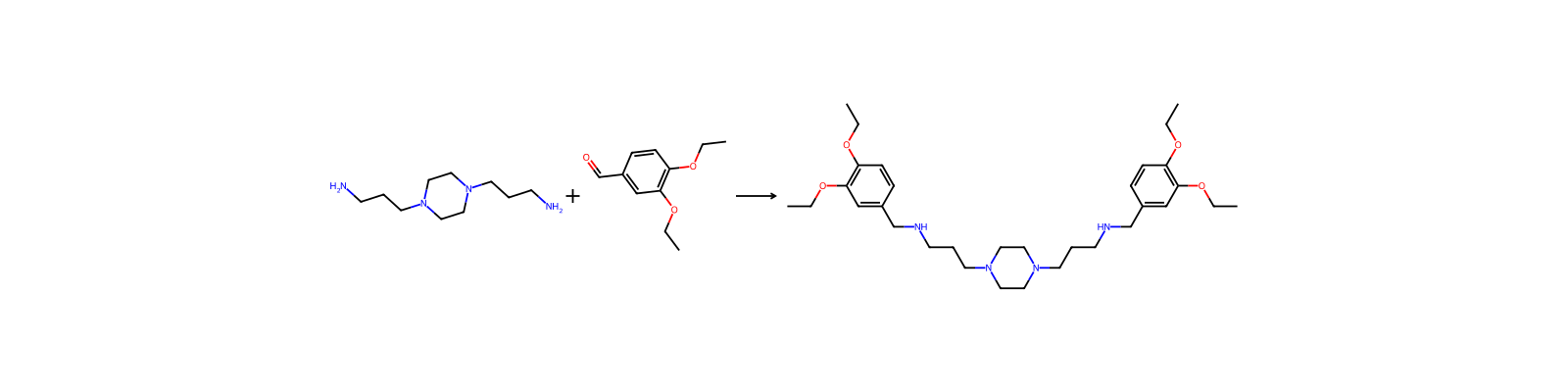
Zugehörige Reaktionen
24


Verknüpfte Notizen
Wird geladen…