
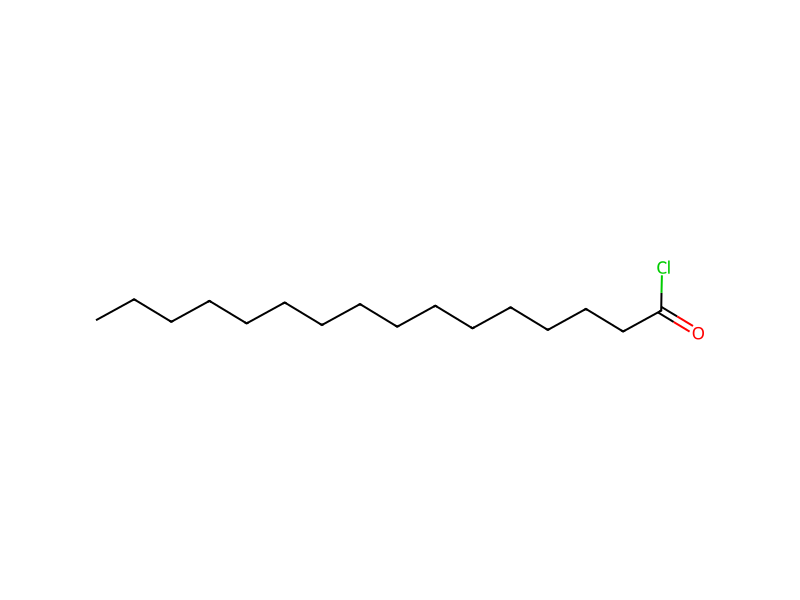
Grundinformationen
- Standard-SMILES
CCCCCCCCCCCCCCCC(=O)Cl- InChIKey
ARBOVOVUTSQWSS-UHFFFAOYSA-N- Summenformel
- C16H31ClO
- Durchschnittliche Molmasse
- 274,9 g/mol
- Monoisotopische Masse
- 274,2063433
Namen und Bezeichner
- Bevorzugter Name
- Palmitoyl chloride
- IUPAC
- hexadecanoyl chloride
- Englischer Name
- Palmitoyl chloride
- Summenformel
- C16H31ClO
- Molmasse
- 274.87
Namen und Synonyme
Palmitoyl chlorideHEXADECANOYL CHLORIDE112-67-4Palmitic acid chlorideHexadecanoic acid, chloride7642R2JOSBNSC-9854DTXSID4051582RefChem:169735DTXCID8030134203-996-7Palmityl chloride
Weitere Namen anzeigen
N-HEXADECANOYL CHLORIDEmitoyLPalmitoylchloridCETYLOYL CHLORIDEPalmitoyl choridePALNITOYL CHLORIDEPalmitoylChloride>
Hexadecanoyl-chloride-MFCD00000742palmitoylchloridehexadecanoic acid chlorideC16H31ClOUNII-7642R2JOSBPalmitic chlorideHSDB 5573
Datenbank-Bezeichner
- CAS
112-67-4- PubChem CID
- 8206
- DTXSID
DTXSID4051582- UNII
- 7642R2JOSB
- EC Number
- 203-996-7
- Nikkaji
- J110.173K
Eigenschaften
Berechnete Struktureigenschaften
- XLogP
- 7,3
- Polarare Oberfläche (TPSA)
- 17,1 Ų
- H-Brücken-Donoren
- 0
- H-Brücken-Akzeptoren
- 1
- Frei drehbare Bindungen
- 14
- Schwere Atome
- 18
- Formalladung
- 0
- Komplexität
- 180
Experimentelle und physikochemische Eigenschaften
Color/FormCOLORLESS LIQUID
SolubilityVERY SOL IN ETHER
Boiling Point
199 °C @ 20 MM HG
BOILING POINT: 194.5 °C AT 17 MM HG
Melting Point11-12 °C
Refractive IndexINDEX OF REFRACTION: 1.4514 @ 20 °C/D
Physical Description
Hexadecanoyl chloride appears as a clear colorless to light yellow liquid with a pungent odor. Freezing point 11-12 °C. Irritates skin, eyes, and mucous membranes. May be toxic by ingestion, inhalation and skin absorption.
Clear colorless to light yellow liquid; mp = 11-12 deg C; [CAMEO] Clear colorless liquid; mp = 11-13 deg C; [MSDSonline]
Other Experimental PropertiesDECOMPOSES IN WATER, ALCOHOL
Physikochemische Eigenschaften
- Schmelzpunkt
- 11 · 11-13 °C (lit.)
- Siedepunkt
- 88 · 88-90 °C/0.2 mmHg (lit.)
- Dichte
- 0.906 g/mL · 0.906 g/mL at 25 °C (lit.)
- Brechungsindex
- 20 · n20/D 1.452(lit.)
- Flammpunkt
- 230 °F · >230 °F
- storage temp.
- 30 °C · Store below +30°C.
- Löslichkeit
- Chloroform (Sparingly), Ethyl Acetate (Slightly)
- Aggregatzustand
- Liquid
- Wichte
- 0.905 · 0.905
- Farbe
- Clear
- Wasserlöslichkeit
- Decomposition
- BRN
- 972409 · 972409
- Stabilität
- Moisture Sensitive
- InChI
- 1S/C16H31ClO/c1-2-3-4-5-6-7-8-9-10-11-12-13-14-15-16(17)18/h2-15H2,1H3
- InChIKey
- ARBOVOVUTSQWSS-UHFFFAOYSA-N
- SMILES
- CCCCCCCCCCCCCCCC(Cl)=O
- CAS Datenbank
- 112 · 112-67-4(CAS DataBase Reference)
- NIST chemische Informationen
- Palmitoyl chloride(112-67-4)
- EPA chemische Informationen
- Hexadecanoyl chloride (112-67-4)
Sicherheit und Regulatorisches
GHS-Klassifizierung
GHS Classification
This chemical does not meet GHS hazard criteria for 0.5% (1 of 201) of reports.
Danger
H290 (21.4%): May be corrosive to metals [Warning Corrosive to Metals];H312 (52.7%): Harmful in contact with skin [Warning Acute toxicity, dermal];H314 (25.4%): Causes severe skin burns and eye damage [Danger Skin corrosion/irritation];H315 (74.1%): Causes skin irritation [Warning Skin corrosion/irritation];H317 (74.1%): May cause an allergic skin reaction [Warning Sensitization, Skin]
P234, P260, P261, P264, P272, P280, P301+P330+P331, P302+P352, P302+P361+P354, P304+P340, P305+P354+P338, P316, P317, P321, P332+P317, P333+P317, P362+P364, P363, P390, P405, P406, and P501 (click each P-code to see the statement)
Aggregated GHS information provided per 201 reports by companies from 17 notifications to the ECHA C&L Inventory. Each notification may be associated with multiple companies.;Reported as not meeting GHS hazard criteria per 1 of 201 reports by companies.;There are 16 notifications provided by 200 of 201 reports by companies with hazard statement code(s).;Information may vary between notifications depending on impurities, additives, and other factors. The percentage value in parenthesis indicates the notified classification ratio from companies that provide hazard codes. Only hazard codes with percentage values above 10% are shown. For more detailed information, please visit ECHA C&L website.
Gefahrenhinweise
Regulatory Information
Chemical: Hexadecanoyl chloride
Status: Active Update: 23-05-2022 https://echa.europa.eu/registration-dossier/-/registered-dossier/32158
Palmitoyl chloride: Does not have an individual approval but may be used under an appropriate group standard
Other Safety InformationIMAP assessments - Hexadecanoyl chloride: Human health tier I assessment;IMAP assessments - Hexadecanoyl chloride: Environment tier I assessment
DOT LabelCorrosive
Fire Hazards
Excerpt from ERG Guide 154 [Substances - Toxic and/or Corrosive (Non-Combustible)]:;Non-combustible, substance itself does not burn but may decompose upon heating to produce corrosive and/or toxic fumes. Some are oxidizers and may ignite combustibles (wood, paper, oil, clothing, etc.). Corrosives in contact with metals may evolve flammable hydrogen gas. Containers may explode when heated. For electric vehicles or equipment, ERG Guide 147 (lithium ion or sodium ion batteries) or ERG Guide 138 (sodium batteries) should also be consulted. (ERG, 2024)
Health Hazards
Excerpt from ERG Guide 154 [Substances - Toxic and/or Corrosive (Non-Combustible)]:;TOXIC and/or CORROSIVE; inhalation, ingestion or skin contact with material may cause severe injury or death. Contact with molten substance may cause severe burns to skin and eyes. Avoid any skin contact. Fire may produce irritating, corrosive and/or toxic gases. Runoff from fire control or dilution water may be corrosive and/or toxic and cause environmental contamination. (ERG, 2024)
Hazards Summary
Slowly decomposed by water forming hydrochloric and palmitic acids; A skin, eye, and mucous membrane irritant; [CAMEO] Corrosive to skin and eyes; [eChemPortal: ERMA] Reacts violently with water; A corrosive substance that can cause injury to the skin, eyes, and respiratory tract; A lachrymator; Inhalation may cause chemical pneumonitis; [MSDSonline]
Reactive GroupAcyl Halides, Sulfonyl Halides, and Chloroformates
Reactivity Profile
HEXADECANOYL CHLORIDE is incompatible with bases (including amines), with strong oxidizing agents, and with alcohols. May react vigorously or explosively if mixed with diisopropyl ether or other ethers in the presence of trace amounts of metal salts [J. Haz. Mat., 1981, 4, 291].
Air and Water ReactionsDecomposes rather slowly in water to form hydrochloric acid and palmitic acid, a fatty acid that is not soluble in water.
Hazard Classes and CategoriesMet. Corr. 1 (21.4%);Acute Tox. 4 (52.7%);Skin Corr. 1 (25.4%);Skin Irrit. 2 (74.1%);Skin Sens. 1 (74.1%)
Sicherheit und Schutzausrüstung
Fire Fighting
Excerpt from ERG Guide 154 [Substances - Toxic and/or Corrosive (Non-Combustible)]:;SMALL FIRE: Dry chemical, CO2 or water spray.;LARGE FIRE: Dry chemical, CO2, alcohol-resistant foam or water spray. If it can be done safely, move undamaged containers away from the area around the fire. Dike runoff from fire control for later disposal.;FIRE INVOLVING TANKS, RAIL TANK CARS OR HIGHWAY TANKS: Fight fire from maximum distance or use unmanned master stream devices or monitor nozzles. Do not get water inside containers. Cool containers with flooding quantities of water until well after fire is out. Withdraw immediately in case of rising sound from venting safety devices or discoloration of tank. ALWAYS stay away from tanks in direct contact with flames. (ERG, 2024)
First Aid
Excerpt from ERG Guide 154 [Substances - Toxic and/or Corrosive (Non-Combustible)]:;Refer to the "General First Aid" section. Specific First Aid: For corrosives, in case of contact, immediately flush skin or eyes with running water for at least 30 minutes. Additional flushing may be required. (ERG, 2024)
Nonfire Spill Response
Excerpt from ERG Guide 154 [Substances - Toxic and/or Corrosive (Non-Combustible)]:;ELIMINATE all ignition sources (no smoking, flares, sparks or flames) from immediate area. Do not touch damaged containers or spilled material unless wearing appropriate protective clothing. Stop leak if you can do it without risk. Prevent entry into waterways, sewers, basements or confined areas. Absorb or cover with dry earth, sand or other non-combustible material and transfer to containers. DO NOT GET WATER INSIDE CONTAINERS. (ERG, 2024)
Isolation and Evacuation
Excerpt from ERG Guide 154 [Substances - Toxic and/or Corrosive (Non-Combustible)]:;IMMEDIATE PRECAUTIONARY MEASURE: Isolate spill or leak area in all directions for at least 50 meters (150 feet) for liquids and at least 25 meters (75 feet) for solids.;SPILL: Increase the immediate precautionary measure distance, in the downwind direction, as necessary.;FIRE: If tank, rail tank car or highway tank is involved in a fire, ISOLATE for 800 meters (1/2 mile) in all directions; also, consider initial evacuation for 800 meters (1/2 mile) in all directions. (ERG, 2024)
Personal Protective Equipment (PPE)
Excerpt from ERG Guide 154 [Substances - Toxic and/or Corrosive (Non-Combustible)]:;Wear positive pressure self-contained breathing apparatus (SCBA). Wear chemical protective clothing that is specifically recommended by the manufacturer when there is NO RISK OF FIRE. Structural firefighters' protective clothing provides thermal protection but only limited chemical protection. (ERG, 2024)
Toxikologische Informationen
Adverse EffectsDermatotoxin - Skin burns.;Lacrimator (Lachrymator) - A substance that irritates the eyes and induces the flow of tears.;Toxic Pneumonitis - Inflammation of the lungs induced by inhalation of metal fumes or toxic gases and vapors.
Regulatorische Informationen
Regulatory Information
Chemical: Hexadecanoyl chloride
Status: Active Update: 23-05-2022 https://echa.europa.eu/registration-dossier/-/registered-dossier/32158
Palmitoyl chloride: Does not have an individual approval but may be used under an appropriate group standard
Sicherheitsdaten
- F
- 9-21
- wgk
- 1
- tsca
- TSCA listed
- ridadr
- UN 3265 8/PG 2
- hs_code
- 2915 90 70
- risk_code
- 14-34-29
- Toxizität
- LD50 orally in Rabbit: > 2000 mg/kg
- hazard_code
- C
- safety_code
- 26-36/37/39-43-45-8
- hazard_class
- 8
- packing_group
- II
- Speicherklasse
- 8A - Combustible corrosive hazardous materials
- Giftige Stoffe Daten
- 112-67-4(Hazardous Substances Data)
- Hazard Classifications
- Skin Corr. 1B
Chemie und Industrie
Verwendung und Herstellung
General Manufacturing InformationHexadecanoyl chloride: ACTIVE
Anwendungen
VerwendenPalmitoyl Chloride was used as a polymeric carriers for plasmid DNA (pDNA) delivery to 293T cells.
Vor- und nachgelagerte Produkte
Vorgelagerte Rohstoffe
Nachgelagerte Produkte
Anbieter50 Anbieter
国药集团化学试剂有限公司86-21-63210123 · [email protected]
梯希爱(上海)化成工业发展有限公司021-67121386 · [email protected]
上海阿拉丁生化科技股份有限公司400-6206333 13167063860 · [email protected]
Shandong chuangyingchemical Co., Ltd.18853181302 · [email protected]
Career Henan Chemica Co+86-0371-86658258 +86-13203830695 · [email protected]
合肥翰刚医药科技有限公司+8618062405514 · [email protected]
Dayang Chem (Hangzhou) Co.,Ltd.+86-0571-88938639 17705817739 · [email protected]
科瑞迪化学400-821-5857 021-64326257 · [email protected]
Syntechem Co.,Ltd[email protected]
阿法埃莎(中国)化学有限公司400-6106006 · [email protected]
安耐吉化学&3A(安徽泽升科技股份有限公司)400-0056266 · [email protected]
武汉卡诺斯科技有限公司027-83238443 15327105076 · [email protected]
上海瀚鸿科技股份有限公司021-54306202 13764082696 · [email protected]
上海隆盛化工有限公司58099637 13585536065 · [email protected]
山东西亚化学有限公司13355009207 13355009207 · [email protected]
玛雅试剂+86 (573) 82222445 (0)18006601000 452520369 · [email protected]
四川库利南科技有限公司400-1166-196 18981987031 · [email protected]
天津希恩思生化科技有限公司400 638 7771 · [email protected]
Xiamen AmoyChem Co., Ltd+86-86-5926051114 · [email protected]
武汉吉业升化工有限公司027-13545242311 13545242311 · [email protected]
斯百全化学(上海)有限公司021-021-021-67601398-809-809-809 15221380277 · [email protected]
艾科试剂4008-755-333 18080918076 · [email protected]
上海思域化工科技有限公司86-21-34053660 · [email protected]
赛默飞世尔科技(中国)有限公司800-810-5118 · [email protected]
北京伊诺凯科技有限公司400-810-7969 010-59572699 · [email protected]
上海遐瑞医药科技有限公司+86 21 61551611
TCI AMERICA800-4238616 · [email protected]
TOKYO CHEMICAL INDUSTRY CO., LTD.03-36680489 · [email protected]
TCI Europe320-37350700 · [email protected]
上海贤鼎生物科技有限公司4009209199 · [email protected]
安徽科迪达化工有限公司0554-2106669 · [email protected]
日照力德士化工有限公司010-51268198 · [email protected]
美岚实业(上海)有限公司021-58958189 · [email protected]
上海爱蝶实业有限公司021-58957966 18930537195 · [email protected]
成都零六生物科技有限公司400-1166-196 13458535857 · [email protected]
雷丁试剂0510-85629785 18013409632 · [email protected]
上海御略医药科技有限公司021-60345187 13671753212 · [email protected]
上海麦克林生化科技股份有限公司15221275939 15221275939 · [email protected]
杭州杰恒化工有限公司0571-87396432 · [email protected]
上海有朋化工有限公司021-69005955 13701776567 · [email protected]
上海彤源化工有限公司021-021-69182866 13701855675 · [email protected]
凯试(上海)科技有限公司021-50135380 · [email protected]
上海容立化学科技有限公司021-69992220 13701886816 · [email protected]
上海康拓化工有限公司021-69185552 13701777608 · [email protected]
Changzhou Fullone Chemical Co., Ltd.+86-13328197671 +86-13861172460 · [email protected]
池州凯隆进出口贸易有限公司[email protected]
Sigma-Aldrich西格玛奥德里奇(上海)贸易有限公司021-61415566 800-8193336 · [email protected]
康迪斯化工(湖北)有限公司13343438265 · [email protected]
上海昕凯医药科技有限公司21-619849051-1 18521059765 · [email protected]
成都瑞欧克科技有限公司028-64353063 · [email protected]
Zugehörige Reaktionen
250


Verknüpfte Notizen
Wird geladen…