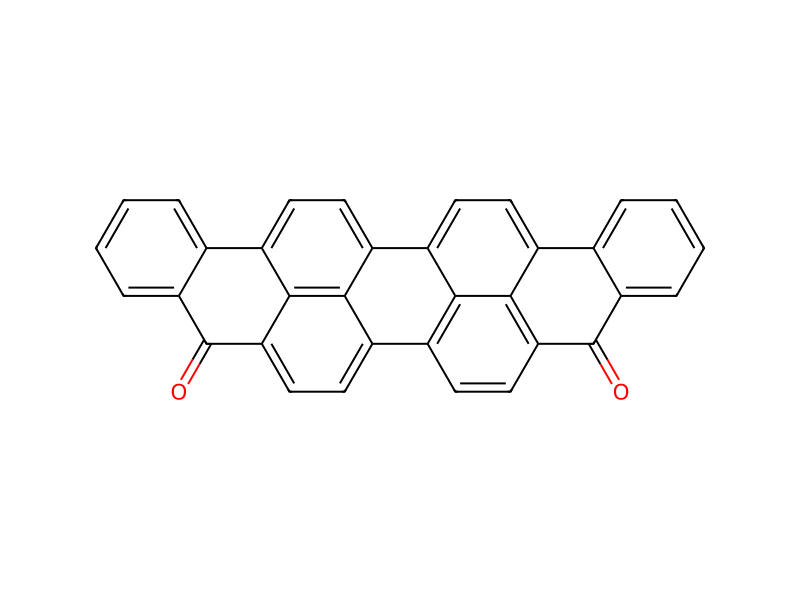
Anthra(9,1,2-cde)benzo(rst)pentaphene-5,10-dione
HCID 8317
Grundinformationen
- CAS
116-71-2- Standard-SMILES
O=C1c2ccccc2-c2ccc3c4ccc5c6c(ccc(c7ccc1c2c73)c64)C(=O)c1ccccc1-5- InChIKey
YKSGNOMLAIJTLT-UHFFFAOYSA-N- Summenformel
- C34H16O2
- Durchschnittliche Molmasse
- 456,5 g/mol
- Monoisotopische Masse
- 456,11502975
Überblick
Vat blue 20 is a bluish-black to black powder. (NTP, 1992)
Namen und Bezeichner
- Bevorzugter Name
- Anthra(9,1,2-cde)benzo(rst)pentaphene-5,10-dione
- IUPAC
- nonacyclo[18.10.2.22,5.03,16.04,13.06,11.017,31.022,27.028,32]tetratriaconta-1(31),2,4,6,8,10,13,15,17,19,22,24,26,28(32),29,33-hexadecaene-12,21-dione
- Englischer Name
- Dibenzanthrone
- Summenformel
- C34H16O2
- Molmasse
- 456.49
Namen und Synonyme
Violanthrone116-71-2Anthra[9,1,2-cde]benzo[rst]pentaphene-5,10-dioneDibenzanthroneVat Blue 20Violanthrone ABianthrone A5,10-ViolanthrenedioneTinon Dark Blue BOAAhcovat Dark Blue BOCaledon Dark Blue BMIrgalite Blue 2R
Weitere Namen anzeigen
Blue BOc.i.59800C.I. 59815C.I. 59800Vat Blue 18bianthroneavat blue BOvatdarkblueo
Paradone Dark BlueSolanthrene Dark Blue BBelanthrene Dark Blue BOIndanthrene Dark Blue BOSolanthrene Dark Blue BAIndanthren Dark Blue BOATinon Dark Blue BOTinon Dark Blue MB
Datenbank-Bezeichner
- CAS
116-71-2、475-50-3、57455-86-4- PubChem CID
- 8317
- DTXSID
DTXSID7026281- ChEMBL
CHEMBL344254
Eigenschaften
Berechnete Struktureigenschaften
- XLogP
- 8
- Polarare Oberfläche (TPSA)
- 34,1 Ų
- H-Brücken-Donoren
- 0
- H-Brücken-Akzeptoren
- 2
- Frei drehbare Bindungen
- 0
- Schwere Atome
- 36
- Formalladung
- 0
- Komplexität
- 877
Experimentelle und physikochemische Eigenschaften
SpringerMaterials PropertiesBoiling point
Solubilityless than 1 mg/mL at 66 °F (NTP, 1992)
Melting Point914 to 923 °F (decomposes) (NTP, 1992)
Physical Description
Vat blue 20 is a bluish-black to black powder. (NTP, 1992)
Dry Powder
Physikochemische Eigenschaften
- Schmelzpunkt
- 338 · 338-339 °C
- Siedepunkt
- 522.64 °C · 522.64°C (rough estimate)
- Dichte
- 1.1055 · 1.1055 (rough estimate)
- Brechungsindex
- 1.4875 · 1.4875 (estimate)
- storage temp.
- Sealed in dry,Room Temperature
- CAS Datenbank
- 116 · 116-71-2(CAS DataBase Reference)
- NIST chemische Informationen
Sicherheit und Regulatorisches
Sicherheitsangaben dienen nur zur Orientierung und ersetzen weder das Sicherheitsdatenblatt (SDB) des Lieferanten noch geltende Vorschriften oder eine fachliche Bewertung.
GHS-Klassifizierung
GHS Classification
This chemical does not meet GHS hazard criteria for 96% (24 of 25) of all reports.
Not Classified
Aggregated GHS information provided per 25 reports by companies from 2 notifications to the ECHA C&L Inventory.
Not Classified
Not Classified
Gefahrenhinweise
Regulatory Information
Chemical: Dinaphtho[1,2,3-cd:3',2',1'-lm]perylene-5,10-dione
Anthra[9,1,2-cde]benzo[rst]pentaphene-5,10-dione is listed on the EPA's Chemical Data Reporting (CDR) system. Manufacturers and importers of Anthra[9,1,2-cde]benzo[rst]pentaphene-5,10-dione are required to report information about their production and use of this chemical to the EPA under the Toxic Substances Control Act (TSCA). (40 eCFR Part 711)
REACH registered substance: Violanthrene-5,10-dione (EC: 204-152-0)
Anthra9,1,2-cdebenzorstpentaphene-5,10-dione: Does not have an individual approval but may be used as a component in a product covered by a group standard. It is not approved for use as a chemical in its own right.
Fire HazardsFlash point data for this chemical are not available. It is probably combustible. (NTP, 1992)
Reactive GroupHydrocarbons, Aromatic
Air and Water ReactionsInsoluble in water.
Hazard Classes and Categories
Not Classified
Not Classified
Not Classified
Sicherheit und Schutzausrüstung
Chemie und Industrie
Verwendung und Herstellung
U.S. Production2023: 49,541 lb
Consumer UsesDye
Industry UsesDye
General Manufacturing Information
Synthetic Dye and Pigment Manufacturing
Anthra[9,1,2-cde]benzo[rst]pentaphene-5,10-dione: ACTIVE
Vor- und nachgelagerte Produkte
Vorgelagerte Rohstoffe
Zugehörige Reaktionen
0
Noch keine zugehörigen Reaktionen