
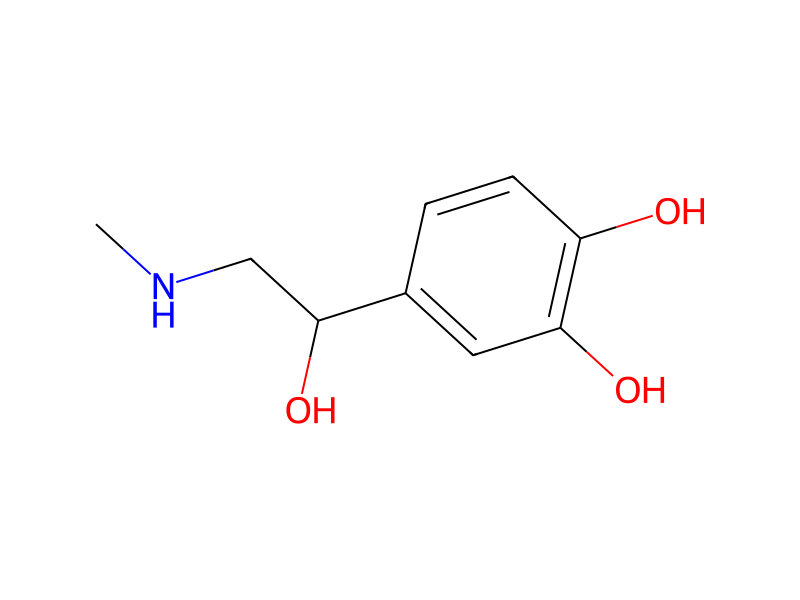
Grundinformationen
- Standard-SMILES
CNCC(O)c1ccc(O)c(O)c1- InChIKey
UCTWMZQNUQWSLP-UHFFFAOYSA-N- Summenformel
- C9H13NO3
- Durchschnittliche Molmasse
- 183,2 g/mol
- Monoisotopische Masse
- 183,08954328
Überblick
3,4-dihydroxyl-alpha-[methylamino]methylbenzyl alcohol appears as odorless light brown or nearly white crystals. (NTP, 1992)
Namen und Bezeichner
- Bevorzugter Name
- (+-)-Adrenaline
- IUPAC
- 4-[1-hydroxy-2-(methylamino)ethyl]benzene-1,2-diol
Namen und Synonyme
329-65-7Racepinephrine(+-)-AdrenalineEpinephrine, dl-Racemic EpinephrineRacemic adrenalineGR0L9S3J0FAdrenaline, racemicEpinephrine, RacemicCHEBI:33568DTXSID808589654-(1-hydroxy-2-methylaminoethyl)benzene-1,2-diol
Weitere Namen anzeigen
RefChem:55959DTXCID20196651DL-Adrenalinedl-EpinephrineRacepinefrineEpirenamineEpinephrine racemicDL-Adrenalin
Datenbank-Bezeichner
- CAS
329-65-7- PubChem CID
- 838
- DTXSID
DTXSID80858965- ChEMBL
CHEMBL1740- ChEBI
CHEBI:33568- UNII
- GR0L9S3J0F
- EC Number
- 206-347-6
- Nikkaji
- J81.291I
Eigenschaften
Berechnete Struktureigenschaften
- XLogP
- -1,4
- Polarare Oberfläche (TPSA)
- 72,7 Ų
- H-Brücken-Donoren
- 4
- H-Brücken-Akzeptoren
- 4
- Frei drehbare Bindungen
- 3
- Schwere Atome
- 13
- Formalladung
- 0
- Komplexität
- 154
Experimentelle und physikochemische Eigenschaften
Solubility
Sparingly soluble (NTP, 1992)
Soluble
Melting Point412 to 414 °F (NTP, 1992)
Physical Description3,4-dihydroxyl-alpha-[methylamino]methylbenzyl alcohol appears as odorless light brown or nearly white crystals. (NTP, 1992)
Sicherheit und Regulatorisches
GHS-Klassifizierung
GHS Classification
Danger
H311 (97.6%): Toxic in contact with skin [Danger Acute toxicity, dermal]
P261, P262, P264, P264+P265, P270, P271, P280, P302+P352, P304+P340, P305+P351+P338, P316, P319, P321, P332+P317, P337+P317, P361+P364, P362+P364, P403+P233, P405, and P501 (click each P-code to see the statement)
Aggregated GHS information provided per 41 reports by companies from 4 notifications to the ECHA C&L Inventory. Each notification may be associated with multiple companies.
Gefahrenhinweise
DOT LabelPoison
Fire HazardsFlash point data for this compound are not available, however, it is probably combustible. (NTP, 1992)
Health HazardsSYMPTOMS: Pallor, tremor, anxiety, nervousness, rapid, forceful pulse, rise in blood pressure and temperature, rapid breathing, dilation of the pupils. (NTP, 1992)
Reactive GroupAmines, Phosphines, and Pyridines
Reactivity Profile
Light sensitive. Incompatible with heat, air, iron salts, and alkalis. (NTP, 1992). An organic compound with both amine and alcohol substituents. Amines are chemical bases. They neutralize acids to form salts plus water. These acid-base reactions are exothermic. The amount of heat that is evolved per mole of amine in a neutralization is largely independent of the strength of the amine as a base. Amines may be incompatible with isocyanates, halogenated organics, peroxides, phenols (acidic), epoxides, anhydrides, and acid halides. Flammable gaseous hydrogen is generated by amines in combination with strong reducing agents, such as hydrides. Incompatible with heat, air, iron salts, and alkalis. (NTP, 1992).
Air and Water ReactionsSlightly water soluble (NTP, 1992).
Hazard Classes and CategoriesAcute Tox. 3 (97.6%)
Sicherheit und Schutzausrüstung
Fire FightingFires involving this material can be controlled with a dry chemical, carbon dioxide, foam, or Halon extiguisher. (NTP, 1992)
First Aid
EYES: First check the victim for contact lenses and remove if present. Flush victim's eyes with water or normal saline solution for 20 to 30 minutes while simultaneously calling a hospital or poison control center. Do not put any ointments, oils, or medication in the victim's eyes without specific instructions from a physician. IMMEDIATELY transport the victim after flushing eyes to a hospital even if no symptoms (such as redness or irritation) develop.
Nonfire Spill Response
SMALL SPILLS AND LEAKAGE: If you spill this chemical, you should dampen the solid spill material with 5% acetic acid, then transfer the dampened material to a suitable container. Use absorbent paper dampened with 5% acetic acid to pick up any remaining material. Your contaminated clothing and the absorbent paper should be sealed in a vapor-tight plastic bag for eventual disposal. Wash all contaminated surfaces with 5% acetic acid followed by washing with a strong soap and water solution. Do not reenter the contaminated area until the Safety Officer (or other responsible person) has verified that the area has been properly cleaned.
Isolation and EvacuationExcerpt from ERG Guide 154 [Substances - Toxic and/or Corrosive (Non-Combustible)]:
Personal Protective Equipment (PPE)
RECOMMENDED RESPIRATOR: Where the neat test chemical is weighed and diluted, wear a NIOSH-approved half face respirator equipped with a combination filter cartridge, i.e. organic vapor/acid gas/HEPA (specific for organic vapors, HCl, acid gas, SO2 and a high efficiency particulate filter). (NTP, 1992)
Chemie und Industrie
Pharmakologische Informationen
Protein BindingTo refer to the pharmacokinetic data of L-epinephrine, refer to the drug entry for [DB00668].
Pharmacodynamics
Epinephrine acts on α- and β-adrenergic receptors. When given subcutaneously or intramuscularly, epinephrine has a rapid onset and short duration of action. Epinephrine induces bronchial smooth muscle relaxation to relieve respiratory distress in asthma. In a clinical trial of paediatric patients with bronchiolitis, administration of aerosolized racemic epinephrine via inhalation resulted in improved clinical symptoms such as wheezing and retractions. The clinical efficacy of racemic epinephrine was comparable to that of salbutamol or albuterol, which are commonly used bronchodilators.
Mechanism of Action
Epinephrine is a non-selective agonist at α- and β-adrenergic receptors, which are all G-protein-coupled receptors. The main therapeutic effect of epinephrine arises from its agonist action on β2-adrenergic receptors, which activate adenylyl cyclase and increase intracellular cyclic AMP production. Epinephrine causes smooth muscle relaxation on various tissues, including bronchial smooth muscles. As a result, epinephrine serves to alleviate bronchospasm, wheezing and tightness of chest that may occur during asthmatic attacks. Via its relaxer effects on the smooth muscle of the stomach, intestine, uterus and urinary bladder, epinephrine may also alleviate pruritus, urticaria, and angioedema and may relieve gastrointestinal and genitourinary symptoms associated with anaphylaxis. Epinephrine also acts on the α-adrenergic receptors on vascular smooth muscles, particularly in the skin and splanchnic vascular beds, to cause constriction. Epinephrine is thought to reduce capillary leakage by constricting precapillary arterioles, reducing hydrostatic pressure and consequently bronchial mucosal edema.
Biological Half-LifeTo refer to the pharmacokinetic data of L-epinephrine, refer to the drug entry for [DB00668].
Metabolism/MetabolitesTo refer to the pharmacokinetic data of L-epinephrine, refer to the drug entry for [DB00668].
MeSH Pharmacological Classification
Drugs that selectively bind to and activate alpha adrenergic receptors.
Drugs that selectively bind to and activate beta-adrenergic receptors.
Agents that cause an increase in the expansion of a bronchus or bronchial tubes.
Agents that dilate the pupil. They may be either sympathomimetics or parasympatholytics.
Drugs that mimic the effects of stimulating postganglionic adrenergic sympathetic nerves. Included here are drugs that directly stimulate adrenergic receptors and drugs that act indirectly by provoking the release of adrenergic transmitters.
Drugs used to cause constriction of the blood vessels.
Absorption, Distribution and Excretion
To refer to the pharmacokinetic data of L-epinephrine, refer to the drug entry for [DB00668].
To refer to the pharmacokinetic data of L-epinephrine, refer to the drug entry for [DB00668].
To refer to the pharmacokinetic data of L-epinephrine, refer to the drug entry for [DB00668].
To refer to the pharmacokinetic data of L-epinephrine, refer to the drug entry for [DB00668].
Zugehörige Reaktionen
2

Verknüpfte Notizen
Wird geladen…