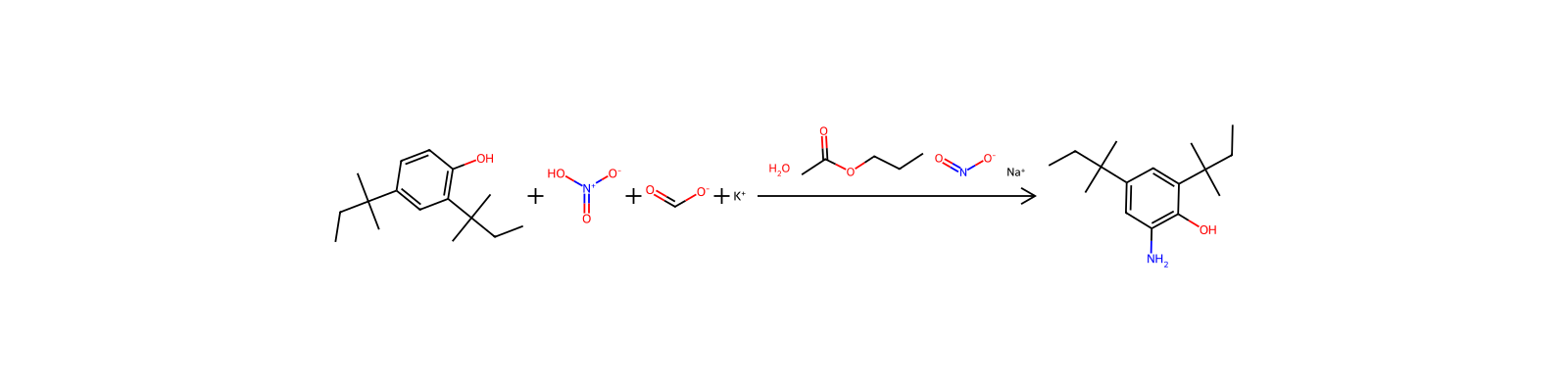
2,4-Di-tert-pentylphenol
HCID 8455
Daten werden ergänzt – lade die Seite später neu, um den aktuellen Stand zu sehen

Grundinformationen
- CAS
120-95-6- Standard-SMILES
CCC(C)(C)c1ccc(O)c(C(C)(C)CC)c1- InChIKey
WMVJWKURWRGJCI-UHFFFAOYSA-N- Summenformel
- C16H26O
- Durchschnittliche Molmasse
- 234,38 g/mol
- Monoisotopische Masse
- 234,19836545
Namen und Bezeichner
- Bevorzugter Name
- 2,4-Di-tert-pentylphenol
- IUPAC
- 2,4-bis(2-methylbutan-2-yl)phenol
- Lokaler Name
- 2,4-Di-tert-pentylphenol
- Englischer Name
- 2,4-Di-tert-amylphenol
- Summenformel
- C16H26O
- Molmasse
- 234.38
Namen und Synonyme
2,4-Di-tert-pentylphenol2,4-Di-tert-amylphenolPhenol, 2,4-bis(1,1-dimethylpropyl)-2,4-Bis(1,1-dimethylpropyl)phenol2,4-DI-T-PENTYLPHENOL2,4-bis(2-methylbutan-2-yl)phenolHSDB 5588UNII-852F1HP88HNSC 158351DTXSID9026974EINECS 204-439-0BRN 2370274
Weitere Namen anzeigen
DTAPDi-tert-amylphenol2,4-Di-t-pentyphenolprodox156Prodox 1562,4-di-t-amylphenol
DTXCID1069742,4-di(1,1-dimethylpropyl)phenol2,4-di-tert-amyl phenol2,4-di-tert-PentylphenylNSC-158351WMVJWKURWRGJCI-UHFFFAOYSA-3-06-00-02085 (Beilstein Handbook Reference)2,4-BIS(TERT-PENTYL)PHENOL
Datenbank-Bezeichner
- CAS
120-95-6- PubChem CID
- 8455
- DTXSID
DTXSID9026974- ChEMBL
CHEMBL1890694- UNII
- 852F1HP88H
- EC Number
- 204-439-0
- Nikkaji
- J297.768K
Eigenschaften
Berechnete StruktureigenschaftenWird ergänzt
- XLogP
- 6
- Polarare Oberfläche (TPSA)
- 20,2 Ų
- H-Brücken-Donoren
- 1
- H-Brücken-Akzeptoren
- 1
- Frei drehbare Bindungen
- 4
- Schwere Atome
- 17
- Formalladung
- 0
- Komplexität
- 242
Experimentelle und physikochemische Eigenschaften
Chemical ClassesOther Classes -> Phenols
Vapor Pressure0.0000841 [mmHg]
Food Contact SubstancesFCS -> FDA Cumulative Estimated Daily Intake (CEDI)
Physical Description
Liquid; Liquid; Other Solid
Semi-solid that melts to colorless liquid; mp = 25 deg C; [MSDSonline]
Physikochemische Eigenschaften
- Schmelzpunkt
- 25 °C · 25 °C (lit.)
- Siedepunkt
- 169 · 169-170 °C/22 mmHg (lit.)
- Dichte
- 0.93 g/mL · 0.930 g/mL at 25 °C (lit.)
- Brechungsindex
- 1.506 · 1.506-1.508
- Flammpunkt
- 230 °F · >230 °F
- storage temp.
- 2 · 2-8°C
- Aggregatzustand
- powder to lump to clear liquid
Sicherheit und Regulatorisches
Sicherheitsangaben dienen nur zur Orientierung und ersetzen weder das Sicherheitsdatenblatt (SDB) des Lieferanten noch geltende Vorschriften oder eine fachliche Bewertung.
GHS-Klassifizierung
GHS Classification
Danger
H302 (100%): Harmful if swallowed [Warning Acute toxicity, oral]
P260, P264, P264+P265, P270, P273, P280, P301+P317, P301+P330+P331, P302+P352, P302+P361+P354, P304+P340, P305+P351+P338, P305+P354+P338, P316, P317, P321, P330, P332+P317, P337+P317, P362+P364, P363, P391, P405, and P501 (click each P-code to see the statement)
Aggregated GHS information provided per 91 reports by companies from 7 notifications to the ECHA C&L Inventory. Each notification may be associated with multiple companies.
Warning
H302: Harmful if swallowed [Warning Acute toxicity, oral]
Gefahrenhinweise
Regulatory Information
Chemical: Phenol, 2,4-bis(1,1-dimethylpropyl)-
Regulation (EC) No 1935/2004 (amended)
Phenol, 2,4-bis(1,1-dimethylpropyl)- is listed on the EPA's Chemical Data Reporting (CDR) system. Manufacturers and importers of Phenol, 2,4-bis(1,1-dimethylpropyl)- are required to report information about their production and use of this chemical to the EPA under the Toxic Substances Control Act (TSCA). (40 eCFR Part 711)
Status: Active Update: 22-12-2017 https://echa.europa.eu/registration-dossier/-/registered-dossier/17246
Phenol, 2,4-bis(1,1-dimethylpropyl)-: Does not have an individual approval but may be used under an appropriate group standard
Hazards SummaryA moderate eye irritant when tested in rabbits; [RTECS] An eye irritant; [MSDSonline]
Hazard Classes and Categories
Acute Tox. 4 (100%)
Acute toxicity (Oral) - Category 4
Toxikologische Informationen
Chemie und Industrie
Verwendung und Herstellung
Uses
Used as a chemical intermediate; [HSDB]
CHEM INT FOR CONDENSATE WITH DIAZOTIZED O-NITROANILINE
CHEM INT FOR DIPENTYLPHENOXYALKYL ACIDS
CHEM INT FOR DIPENTYLPHENOXYALKYL & ARYL ACID CHLORIDES
CHEM INT FOR DIPENTYLPHENOXYALKYL & ARYL AMIDES
CHEM INT FOR DIPENTYLPHENOXYALKYL NITRILES
U.S. Exports
(1979) No Data
(1981) No Data
U.S. Imports
(1979) No Data
(1982) 4.22X10+7 GRAMS (PRINCPL CUSTMS DISTS)
U.S. Production
2023: 1,000,000 - <8,500,000 lb
(1979) PROBABLY GREATER THAN 4.54X10+6 GRAMS
(1981) PROBABLY GREATER THAN 4.54X10+6 GRAMS
Industry UsesMonomers
Methods of ManufacturingPROBABLY PRODUCED AS A COPRODUCT IN THE PRODUCTION OF 4-TERT-PENTYLPHENOL BY THE REACTION OF PHENOL WITH MIXED AMYLENES
General Manufacturing Information
Plastics Material and Resin Manufacturing
Phenol, 2,4-bis(1,1-dimethylpropyl)-: ACTIVE
Anwendungen
VerwendenUV Stabilizer Intermediate, Photographic Developers, Specialty Surfactants, Fuel Additive Intermediate
Vor- und nachgelagerte Produkte
Nachgelagerte Produkte
Zugehörige Reaktionen
11