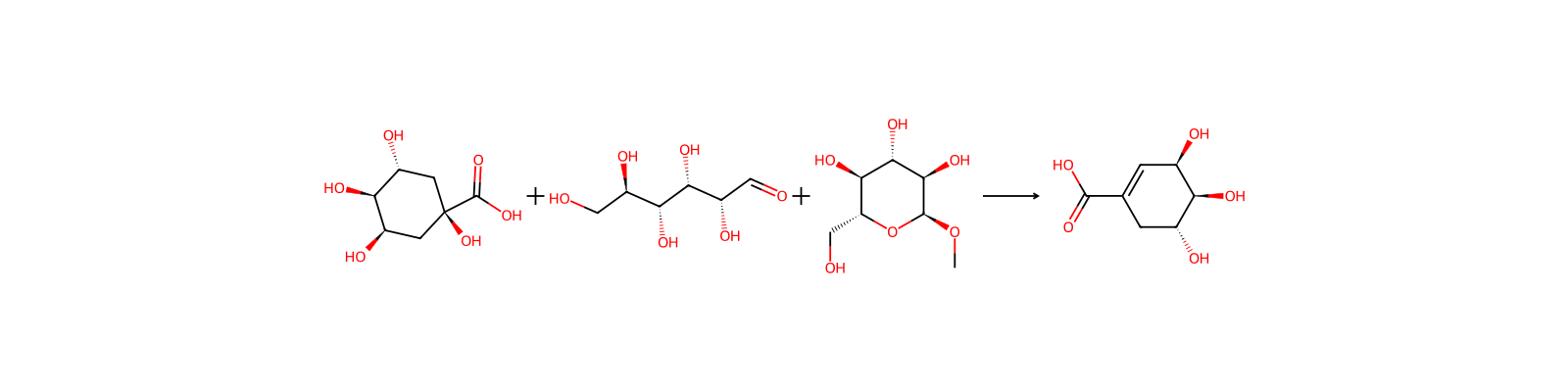
HRID 992829als Produkt
Shikimic Acid

138-59-0O=C(O)C1=C[C@@H](O)[C@@H](O)[C@H](O)C1JXOHGGNKMLTUBP-HSUXUTPPSA-NShikimic acid is a cyclohexenecarboxylic acid that is cyclohex-1-ene-1-carboxylic acid substituted by hydroxy groups at positions 3, 4 and 5 (the 3R,4S,5R stereoisomer). It is an intermediate metabolite in plants and microorganisms. It has a role as a Saccharomyces cerevisiae metabolite, a plant metabolite and an Escherichia coli metabolite. It is a cyclohexenecarboxylic acid, a hydroxy monocarboxylic acid and an alpha,beta-unsaturated monocarboxylic acid. It is a conjugate acid of a shikimate.
Water solubility = 1.5X10+5 mg/l @ 21 °C
Solubility in water about 18 g/100 ml; solubility @ 23 °C (g/100 ml): 2.25 in absolute alcohol, 0.015 in anhydrous ether; practically insoluble in chloroform, benzene, petroleum ether
150 mg/mL at 21 °C
183-184.5 °C
186 °C
Solid; [Merck Index] White powder; [MSDSonline]
Solid
Sicherheitsangaben dienen nur zur Orientierung und ersetzen weder das Sicherheitsdatenblatt (SDB) des Lieferanten noch geltende Vorschriften oder eine fachliche Bewertung.
This chemical does not meet GHS hazard criteria for 8.3% (3 of 36) of reports.
Danger
H318 (86.1%): Causes serious eye damage [Danger Serious eye damage/eye irritation]
P264+P265, P280, P305+P354+P338, and P317 (click each P-code to see the statement)
Aggregated GHS information provided per 36 reports by companies from 4 notifications to the ECHA C&L Inventory.
REACH registered substance: (3R,4S,5R)-3,4,5-trihydroxycyclohex-1-enecarboxylic acid (EC: 205-334-2)
1-Cyclohexene-1-carboxylic acid, 3,4,5-trihydroxy-, (3R,4S,5R)-: Does not have an individual approval but may be used under an appropriate group standard
STAVRIC B, STOLTZ DR; SHIKIMIC ACID; FOOD COSMET TOXICOL 14: 141 (1976). A REVIEW DISCUSSING NATURAL OCCURRENCE, FORMATION AS AN INTERMEDIATE IN THE SYNTHESIS OF SEVERAL AROMATIC COMPOUNDS FROM CARBOHYDRATES, PHYSICAL PROPERTIES, CHEMICAL STRUCTURE, THE TOXIC COMPONENT OF BRAKEN FERN, CARCINOGENICITY, BIOLOGICAL DISTRIBUTION & ANALYTICAL METHODS USED FOR ITS IDENTIFICATION.
SHIKIMIC ACID IS METABOLIZED INTO CYCLOHEXANECARBOXYLIC ACID BY THE INTESTINAL MICROFLORA, BUT THE AROMATIZATION OF CYCLOHEXANECARBOXYLIC ACID OCCURS IN MAMMALIAN TISSUES. IN RATS, THIS ACID IS METABOLIZED AND EXCRETED IN THE URINE MAINLY AS HIPPURIC ACID, TOGETHER WITH 3,4,5,6-TETRAHYDROHIPPURIC ACID & HEXAHYDROHIPPURIC ACID AND SMALL AMT OF BENZOYL & CYCLOHEXYLCARBONYL GLUCURONIDES.
RATS METABOLIZED (14)C-LABELED SHIKIMIC ACID TO HIPPURIC ACID & CATECHOL IN VIVO; RAT CECAL CONTENTS CONVERTED IT TO CYCLOHEXANECARBOXYLIC ACID IN VITRO, THIS CONVERSION BEING ALMOST TOTALLY INHIBITED BY ANTIBIOTICS.
Active component in the flotation reagent Quebracho; [HSDB] Precursor of the aromatic nucleus of tocopherols synthesized by algae and higher plants; Also a precursor in the biosynthesis of the naphthoquinone ring of vitamin K by plants and bacteria; L-tyrosine, L-phenylalanine, and L-tryptophan are synthesized in nature in the shikimic acid pathway; [Ullmann]
Active component in the flotation reagent Quebracho; depressant for carbonates, fluorite, and non-sulfides
CHEMICAL SYNTHESIS: SMISSMAN ET AL; J AM CHEM SOC 84: 1040 (1962).
Isolation from the fruit of the oriental plant Illicium religiosum (Seib et Jucc, Magnoliacea: JF Eykman, Rec Trav Chim 4: 32 (1885), idem Ber 24: 1278 (1891); improved synthesis: JL Pawlak, GA Berchtold, J Org Chem 52: 1765 (1987)
BeschreibungShikimic acid (3,4,5-trihydroxy-1-cyclohexene-1-carboxylic acid) is a natural organic compound. Plant and microbial sources are the only sources of this compound. The isolation of shikimic acid from the fruit of Illicium religiosum was primarily reported by Ekmann in 1885. The name shikimic acid was derived from the oriental plant shikimi-no-ki in Japanese. It is now available in more quantities through the extraction from the fruit Illicium verum (Chinese star anise). This compound is generally utilized as a starting material for the industrial synthesis of the antiviral oseltamivir, a drug against the H1N1 influenza virus. It is also an essential intermediate in the biosynthesis of lignin, aromatic amino acids (phenylalanine, tyrosine, and tryptophan), and most alkaloids of plants and microorganisms[1]. The neuraminidase inhibitors oseltamivir or Tamiflu derived from the shikimic acid pathway are potent influenza viral neuraminidase inhibitors against most influenza strains ( influenza A and B infections). The mode of application is by mouth, either in the form of a pill or liquid.
138-59-0DTXSID4032039CHEMBL290345CHEBI:16119149.5 Ų [M+H]+ [CCS Type: DT; Method: stepped-field]
136.3 Ų [M-H]- [CCS Type: DT; Method: single field calibrated with ESI Low Concentration Tuning Mix (Agilent)]
137.7 Ų [M-H]-
SUBLIMES; SPECIFIC OPTICAL ROTATION: -161 °C/D (C= 0.57 IN METHANOL), -183.8 DEG @ 18 °C/D (C= 4.03 IN WATER)
NEEDLES FROM METHANOL/ETHYL ACETATE; MP: 191-192 °C; MAX ABSORPTION (ETHANOL): 212 NM (E= 8200) /(+ OR -)-FORM/
SRP: At the time of review, criteria for land treatment or burial (sanitary landfill) disposal practices are subject to significant revision. Prior to implementing land disposal of waste residue (including waste sludge), consult with environmental regulatory agencies for guidance on acceptable disposal practices.
TERRESTRIAL FATE: Based on a recommended classification scheme(1), an estimated Koc value of 6(SRC), determined from an experimental water solubility(2,SRC) and a recommended regression-derived equation(3), indicates that shikimic acid is expected to have very high mobility in soil(SRC). Volatilization of shikimic acid from moist soil surfaces is not expected(SRC) given an estimated Henry's Law constant of 2.7X10⁻¹⁴ atm-cu m/mole(SRC), using a fragment constant estimation method(4). Shikimic acid is not expected to volatilize from dry soil surfaces based on an estimated vapor pressure of 5.0X10⁻⁹ mm Hg(SRC), determined from a fragment constant method(5). Aerobic biodegradation of shikimic acid by bacteria of the genera Pseudomonas, Flavobacterium, Achromobacter, and Xanthomonas was relatively rapid; oxygen uptake by the bacteria was approximately 150 ul after 120 minutes(6). Also, it was determined that benthic microorganisms isolated from bottom sediment of a eutrophic lake were able to utilize shikimic acid as a source of carbon(7).
AQUATIC FATE: Based on a recommended classification scheme(1), an estimated Koc value of 6(SRC), determined from an experimental water solubility(2,SRC) and a recommended regression-derived equation(3), indicates that shikimic acid is not expected to adsorb to suspended solids and sediment in water(SRC). Shikimic acid is not expected to volatilize from water surfaces(3,SRC) based on an estimated Henry's Law constant of 2.7X10⁻¹⁴ atm-cu m/mole(SRC), developed using a fragment constant estimation method(4). According to a classification scheme(5), an estimated BCF value of 0.74(3,SRC), from an experimental water solubility(2,SRC), suggests that bioconcentration in aquatic organisms is low(SRC). Aerobic biodegradation of shikimic acid by bacteria of the genera Pseudomonas, Flavobacterium, Achromobacter, and Xanthomonas was relatively rapid; oxygen uptake by the bacteria was approximately 150 ul after 120 minutes(6). Also, it was determined that benthic microorganisms isolated from bottom sediment of a eutrophic lake were able to utilize shikimic acid as a source of carbon(7).
ATMOSPHERIC FATE: According to a model of gas/particle partitioning of semivolatile organic compounds in the atmosphere(1), shikimic acid, which has an estimated vapor pressure of 5.0X10⁻⁹ mm Hg at 25 °C(2,SRC), is expected to exist almost entirely in the particulate phase in the ambient atmosphere. Vapor-phase shikimic acid is degraded in the atmosphere by reaction with photochemically-produced hydroxyl radicals(SRC); the half-life for this reaction in air is estimated to be about 6.3 hours(3,SRC). Particulate-phase shikimic acid may be physically removed from the air by wet and dry deposition(SRC).
The Koc of shikimic acid is estimated as approximately 6(SRC), using a measured water solubility of 1.5X10+5 mg/l(1) and a regression-derived equation(2,SRC). According to a recommended classification scheme(3), this estimated Koc value suggests that shikimic acid is expected to have very high mobility in soil(SRC).
At 100 ppm shikimic acid, the oxygen uptake by selected aerobic bacteria of the genera Pseudomonas, Flavobacterium, Achromobacter, and Xanthomonas (obtained from garden soil, compost, and sediment from a waste lagoon of a petroleum refinery catalytic cracking plant) inoculated in a mineral salt medium was approximately 150 ul after 120 minutes(1). Benthic microorganisms isolated from two types of bottom sediment of eutrophic Lake Jeziorak in Poland were able to utilize shikimic acid as a source of carbon(2).
Shikimic acid
Group 3: Not classifiable as to its carcinogenicity to humans
Volume 40: (1986) Some Naturally Occurring and Synthetic Food Components, Furocoumarins and Ultraviolet Radiation
1987
1987
An estimated BCF value of 0.74 was calculated for shikimic acid(SRC), using an experimental water solubility of 1.5X10+5 mg/l(1,SRC) and a recommended regression-derived equation(2). According to a classification scheme(3), this BCF value suggests that bioconcentration in aquatic organisms is low(SRC).
The Henry's Law constant for shikimic acid is estimated as 2.7X10⁻¹⁴ atm-cu m/mole(SRC) using a fragment constant estimation method(1). This value indicates that shikimic acid will be essentially nonvolatile from water surfaces(2,SRC). Shikimic acid's Henry's Law constant(1,SRC) indicates that volatilization from moist soil surfaces is not expected(SRC). Shikimic acid is not expected to volatilize from dry soil surfaces based on an estimated vapor pressure of 5.0X10⁻⁹ mm Hg(SRC), determined from a fragment constant method(3).
...MICE GIVEN SINGLE ADMIN OF COMMERCIALLY PRODUCED SHIKIMIC ACID OF TESTED PURITY...9 OF THESE 14 ANIMALS...DEVELOPED PRECANCEROUS AND CANCEROUS LESIONS INVOLVING THE GLANDULAR GASTRIC MUCOSA AND ALSO MALIGNANT LEUKEMIAS.
SHIKIMIC ACID WAS NOT MUTAGENIC IN AMES TEST.
INBRED ACL RATS RECEIVED DIET CONTAINING SHIKIMIC ACID AT 0.1% FOR 142 DAYS. DOSE INGESTED PER RAT WAS MORE THAN TWICE THAT CONTAINED IN BRACKEN (PTERIDIUM SP) IN AN AMT SUFFICIENT TO INDUCE TUMORS AT 100% IN FEEDING EXPT. NO TUMORS WERE INDUCED. CARCINOGENICITY OF BRACKEN, AT LEAST IN RATS, IS ATTRIBUTABLE TO (A) SUBSTANCE(S) OTHER THAN SHIKIMIC ACID.
The rate constant for the vapor-phase reaction of shikimic acid with photochemically-produced hydroxyl radicals has been estimated as 6.1X10⁻¹¹ cu cm/molecule-sec at 25 °C(SRC) using a structure estimation method(1,SRC). This corresponds to an atmospheric half-life of about 6.3 hours at an atmospheric concentration of 5X10+5 hydroxyl radicals per cu cm(1,SRC). Shikimic acid is not expected to undergo hydrolysis(SRC) or direct photolysis in the environment due to the lack of functional groups to hydrolyze(3) or absorb in the environmental spectrum, respectively.
The most probable human exposure to shikimic acid would be occupational exposure, which may occur through dermal contact at workplaces where it is produced or used. The general population will be exposed to shikimic acid via ingestion of food and drinking water and other products containing shikimic acid. (SRC)
VerwendenShikimic acid has been used as a standard for the quantification of shikimate in apical parts of roots. It has also been used as a substrate in shikimate kinase assay.
DefinitionChEBI: A cyclohexenecarboxylic acid that is cyclohex-1-ene-1-carboxylic acid substituted by hydroxy groups at positions 3, 4 and 5 (the 3R,4S,5R stereoisomer). It is an intermediate metabolite in plants and micro rganisms.

