Zinnbis(2-ethylhexanoat)
2-ethylhexanoic acid tin(II) salt
Daten werden ergänzt – lade die Seite später neu, um den aktuellen Stand zu sehen

Grundinformationen
- CAS
301-10-0- Standard-SMILES
CCCCC(CC)C(=O)[O-].CCCCC(CC)C(=O)[O-].[Sn+2]- InChIKey
KSBAEPSJVUENNK-UHFFFAOYSA-L- Summenformel
- C16.H30.O4.Sn
- Durchschnittliche Molmasse
- 405,1 g/mol
- Monoisotopische Masse
- 406,11660414
Überblick
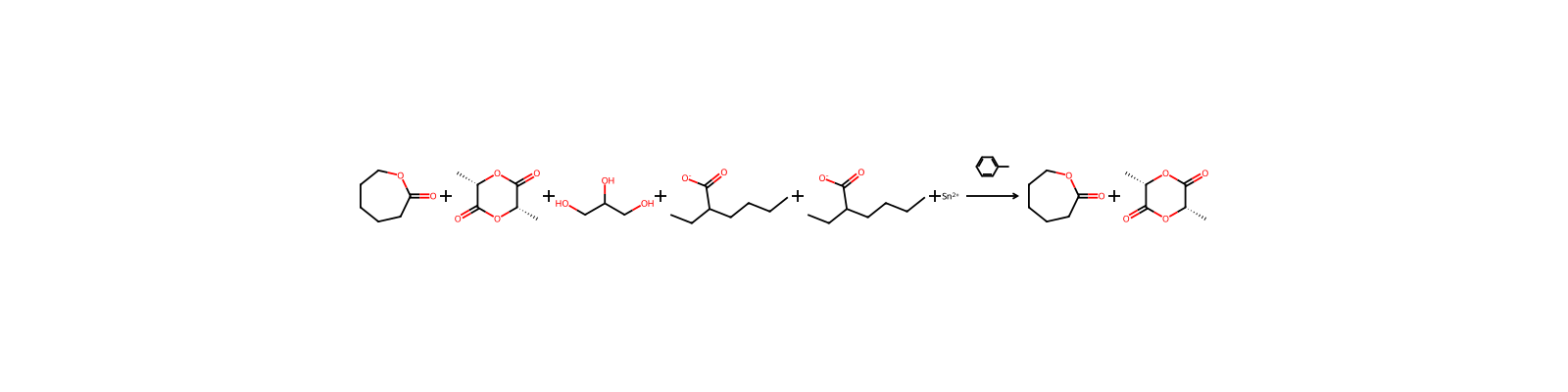
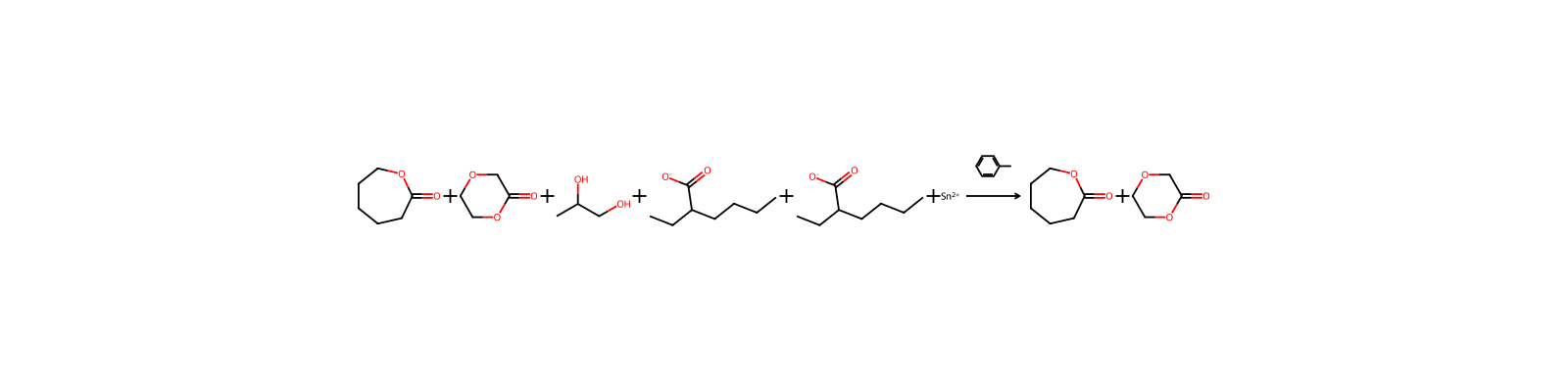
used as a catalyst for ring-opening polymerization to make D,L-lactide and epsilon-caprolactone copolymers
Namen und Bezeichner
- Bevorzugter Name
- 2-ethylhexanoic acid tin(II) salt
- IUPAC
- bis(2-ethylhexanoate);tin(2+)
- Lokaler Name
- Zinnbis(2-ethylhexanoat)
- Englischer Name
- Stannous octoate
- Summenformel
- C16H30O4Sn
- Molmasse
- 405.12
Namen und Synonyme
2-Ethylhexanoic acid tin(II) saltSn(Oct)2RefChem:58487STANNOUS OCTOATE301-10-0Tin(II) 2-ethylhexanoateTin dioctoateStannous 2-ethylhexanoateTin octoateTin bis(2-ethylhexanoate)Tin ethylhexanoateTin(II) bis(2-ethylhexanoate)
Weitere Namen anzeigen
Stannous octanoateTIB KAT 129Stannous Octoate T-9Tin(Ⅱ) 2-ethylhexanoateBIS(2-ETHYLHEXANOATE)TIN
Nuocure 28Tin 2-ethylhexanoateStannous 2-ethylhexoateTin(II) 2-ethylhexylate2-ethylhexanoate;tin(2+)Tin(2+) 2-ethylhexanoateHexanoic acid, 2-ethyl-, tin(2+) saltUNII-519A78R12Y
Datenbank-Bezeichner
- CAS
301-10-0- PubChem CID
- 9318
- DTXSID
DTXSID1027138- UNII
- 519A78R12Y
- EC Number
Eigenschaften
Berechnete StruktureigenschaftenWird ergänzt
- Polarare Oberfläche (TPSA)
- 80,3 Ų
- H-Brücken-Donoren
- 0
- H-Brücken-Akzeptoren
- 4
- Frei drehbare Bindungen
- 8
- Schwere Atome
- 21
- Formalladung
- 0
- Komplexität
- 93,9
Experimentelle und physikochemische Eigenschaften
Chemical ClassesMetals -> Organic Acids, Metal Salts
Density1.251 @25 °C
Vapor Pressure0.00000001 [mmHg]
Food Contact SubstancesFCS -> FDA Inventory of Food Contact Substances Listed in 21 CFR
Physical Description
CBI
Liquid; [Sigma-Aldrich MSDS]
Physikochemische Eigenschaften
- Schmelzpunkt
- -20 °C · <-20°C
- Siedepunkt
- 200 °C · >200°C
- Dichte
- 1.251 g/mL · 1.251 g/mL at 25 °C(lit.)
- Dampfdruck
- 0.3 Pa · 0.3Pa at 20℃
- Brechungsindex
- 20 · n20/D 1.493(lit.)
- Flammpunkt
- 110 °C · >110°C
- pka
- 5.09 · 5.09[at 20 ℃]
Sicherheit und Regulatorisches
Sicherheitsangaben dienen nur zur Orientierung und ersetzen weder das Sicherheitsdatenblatt (SDB) des Lieferanten noch geltende Vorschriften oder eine fachliche Bewertung.
GHS-Klassifizierung
GHS Classification
This chemical does not meet GHS hazard criteria for 0.2% (2 of 972) of reports.
Danger
H315 (26.1%): Causes skin irritation [Warning Skin corrosion/irritation]
P203, P261, P264, P264+P265, P272, P273, P280, P302+P352, P305+P351+P338, P305+P354+P338, P317, P318, P321, P332+P317, P333+P317, P337+P317, P362+P364, P391, P405, and P501 (click each P-code to see the statement)
Aggregated GHS information provided per 972 reports by companies from 30 notifications to the ECHA C&L Inventory. Each notification may be associated with multiple companies.
Danger
Gefahrenhinweise
Regulatory Information
Chemical: Hexanoic acid, 2-ethyl-, tin(2+) salt
Hexanoic acid, 2-ethyl-, tin(2+) salt (2:1) is listed on the EPA's Chemical Data Reporting (CDR) system. Manufacturers and importers of Hexanoic acid, 2-ethyl-, tin(2+) salt (2:1) are required to report information about their production and use of this chemical to the EPA under the Toxic Substances Control Act (TSCA). (40 eCFR Part 711)
Status: Active Update: 19-12-2022 https://echa.europa.eu/registration-dossier/-/registered-dossier/2082
Other Safety InformationIMAP assessments - Hexanoic acid, 2-ethyl-, tin(2+) salt: Human health tier II assessment
Hazards Summary
Oral LD50 (rat) = 3,400-5,870 mg/kg; Causes mild skin and moderate eye irritation in rabbits; [EPA ChAMP: Submissions - Final Summaries] Metal carboxylates readily dissociate in water into the free metal and free acid; [EPA ChAMP: Submission] A skin and strong eye irritant; [Sigma-Aldrich MSDS] See Tin and inorganic compounds. See 2-Ethylhexanoic acid.
Hazard Classes and Categories
Chemie und Industrie
Verwendung und Herstellung
Uses
Used as a crosslinking agent for flexible polyurethane foams and catalyst for polymer production; [EPA ChAMP: Submissions - Final Summaries]
Plastic Composites Manufacturing [Category: Industry]
U.S. Production2023: 5,500,000 - <7,000,000 lb
Consumer UsesCatalyst
Industry UsesCatalyst
General Manufacturing Information
Other (requires additional information)
Hexanoic acid, 2-ethyl-, tin(2+) salt (2:1): ACTIVE
Anwendungen
VerwendenStannous octoate is susceptible to hydrolysis and oxidation and cannot be used in combination polyethers (premixes). Its catalytic activity is higher than that of dibutyltin dilaurate.Stannous octoate can be used as a catalyst for polyurethane, mainly in the production of soft block polyether type polyurethane foam, but also as a catalyst for polyurethane coatings, elastomers, room temperature curing silicone rubber, etc. As it is a divalent tin compound, it may be oxidized to tetravalent tin compound itself after foaming, and it remains in the foam body to play the role of an antioxidant, which stays in the foam after foaming and has no adverse effect on the foam performance.
Darstellung
synthetischeStannous octoate is produced by reacting 2-ethylhexanoic acid with sodium hydroxide to form sodium 2-ethylhexanoate, which then undergoes a complex decomposition reaction with stannous chloride by heating in an inert solvent.
Vor- und nachgelagerte Produkte
Vorgelagerte Rohstoffe
Zugehörige Reaktionen
86





Notizen zur Verbindung
Wird geladen…