
Grundinformationen
- Standard-SMILES
NC(=O)C[S@@](=O)C(c1ccccc1)c1ccccc1- InChIKey
YFGHCGITMMYXAQ-LJQANCHMSA-N- Summenformel
- C15H15NO2S
- Durchschnittliche Molmasse
- 273,4 g/mol
- Monoisotopische Masse
- 273,08234972
Überblick
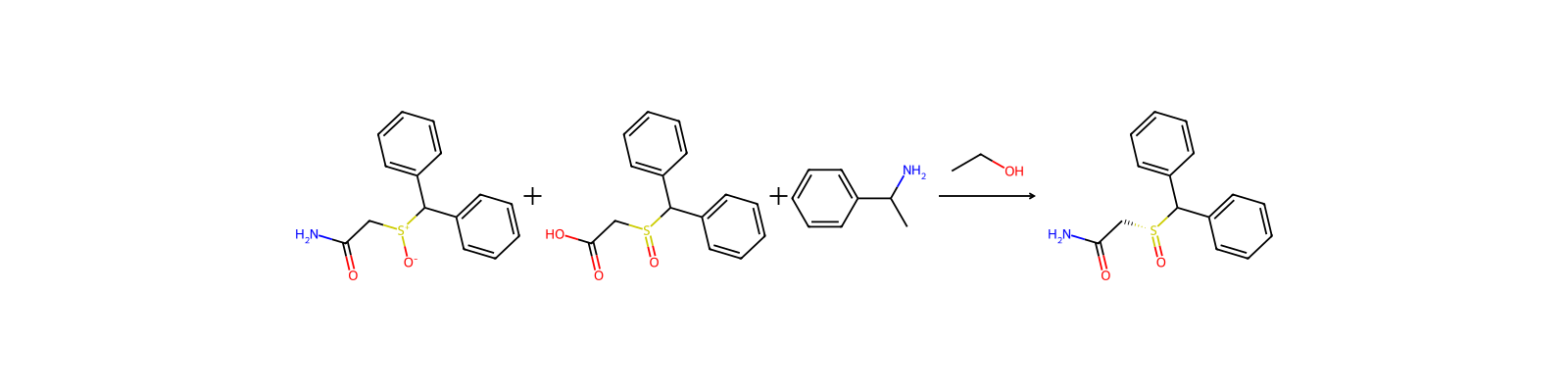
Armodafinil is a 2-[(diphenylmethyl)sulfinyl]acetamide that has R configuration at the sulfur atom. Like its racemate, modafinil, it is used for the treatment of sleeping disorders such as narcolepsy, obstructive sleep apnoea, and shift-work sleep disorder. Peak concentration in the blood later occurs later following administration than with modafinil, so it is thought that armodafinil may be more effective than modafinil in treating people with excessive daytime sleepiness. It has a role as a central nervous system stimulant and a eugeroic. It is an enantiomer of a (S)-modafinil.
Namen und Bezeichner
- Bevorzugter Name
- Armodafinil
- IUPAC
- 2-[(R)-benzhydrylsulfinyl]acetamide
Namen und Synonyme
Armodafinil112111-43-0Nuvigil(R)-Modafinil(-)-Modafinil(R)-(-)-ModafinilarmodafiniloCEP-109532-[(R)-(Diphenylmethyl)sulfinyl]acetamideModafinil, (r)-R-(-)-Modafinilarmodafinilum
Weitere Namen anzeigen
(-)-(R)-modafinilCEP 10953CEP-10952CRL-40982V63XWA605INSC-751850NSC-758711CHEBI:77590
Datenbank-Bezeichner
- CAS
112111-43-0- PubChem CID
- 9690109
- DTXSID
DTXSID90920667- ChEMBL
CHEMBL1201192- ChEBI
CHEBI:77590- UNII
- V63XWA605I
- EC Number
- 682-508-8
Eigenschaften
Berechnete Struktureigenschaften
- XLogP
- 1,7
- Polarare Oberfläche (TPSA)
- 79,4 Ų
- H-Brücken-Donoren
- 1
- H-Brücken-Akzeptoren
- 3
- Frei drehbare Bindungen
- 5
- Schwere Atome
- 19
- Formalladung
- 0
- Komplexität
- 302
Experimentelle und physikochemische Eigenschaften
Drugs
DEA NFLIS-Drug Category -> Stimulants
Pharmaceuticals -> Listed in ZINC15
Human Drugs
Breast Feeding; Lactation; Milk, Human; Central Nervous System Stimulants; Wakefulness-Promoting Agents
FDA approved drugs -> Active ingredient
FDA approved drugs -> Active ingredient
Collision Cross Section157.93 Ų [M+Na]+ [CCS Type: TW; Method: calibrated with polyalanine and drug standards]
Sicherheit und Regulatorisches
GHS-Klassifizierung
GHS Classification
Danger
H318 (90.5%): Causes serious eye damage [Danger Serious eye damage/eye irritation]
P264+P265, P280, P305+P354+P338, and P317 (click each P-code to see the statement)
Aggregated GHS information provided per 42 reports by companies from 5 notifications to the ECHA C&L Inventory.
Gefahrenhinweise
Hazard Classes and CategoriesEye Dam. 1 (90.5%)
Toxikologische Informationen
Drug Induced Liver Injury
Drug Induced Liver Injury Rank (DILIrank 2.0)
Armodafinil
Ambiguous-DILI-concern
3
Warnings & precautions
DOI:10.1016/j.drudis.2016.02.015
Effects During Pregnancy and Lactation◉ Summary of Use during Lactation
Chemie und Industrie
Pharmakologische Informationen
ATC Code
N - Nervous system
QN - Nervous system
Protein BindingSpecific data unavailable. Similar to modafinil: approximately 60%, primarily to albumin.
Mechanism of Action
Nuvigil (armodafinil) is a single-isomer of modafini. The exact mechanism of action is unknown. Armodafinil belongs to a class of drugs known as eugeroics, which are stimulants that provide long-lasting mental arousal. Pharmacologically, armodafinil does not bind to or inhibit several receptors and enzymes potentially relevant for sleep/wake regulation. Armodafinil is not a direct- or indirect-acting dopamine receptor agonist. However, in vitro, both armodafinil and modafinil bind to the dopamine transporter and inhibit dopamine reuptake. [Medilexicon]
Biological Half-LifeTerminal half-life is approximately 15 hours.
Metabolism/Metabolites
In vitro and in vivo data show that armodafinil undergoes hydrolytic deamidation, S-oxidation, and aromatic ring hydroxylation, with subsequent glucuronide conjugation of the hydroxylated products. Amide hydrolysis is the single most prominent metabolic pathway, with sulfone formation by cytochrome P450 (CYP) 3A4/5 being next in importance. The other oxidative products are formed too slowly in vitro to enable identification of the enzyme(s) responsible. Only two metabolites reach appreciable concentrations in plasma (i.e., R-modafinil acid and modafinil sulfone). Data specific to armodafinil disposition are not available.
MeSH Pharmacological Classification
A loosely defined group of drugs that tend to increase behavioral alertness, agitation, or excitation. They work by a variety of mechanisms, but usually not by direct excitation of neurons. The many drugs that have such actions as side effects to their main therapeutic use are not included here.
A specific category of drugs that prevent sleepiness by specifically targeting sleep-mechanisms in the brain. They are used to treat DISORDERS OF EXCESSIVE SOMNOLENCE such as NARCOLEPSY. Note that this drug category does not include broadly-acting central nervous system stimulants such as AMPHETAMINES.
Drugs and compounds that induce the synthesis of CYTOCHROME P-450 CYP3A.
Absorption, Distribution and Excretion
Tmax is 2 hours when fasted and can be delayed approximately 2-4 hours by food, potentially affecting the onset of action.
Apparent volume of distribution: 42L.
The oral clearance of armodafinil is approximately 33 mL/min.
Zugehörige Reaktionen
3


Verknüpfte Notizen
Wird geladen…